

It’s not even 5:30 and it’s already getting dim outside, your toddler’s internal clock still thinks it’s July, and dinner, bath, and bed all feel like they’re being squeezed into a shrinking window. You’re not imagining it — the days really are getting shorter, and a fall routine toddlers actually need doesn’t happen automatically just because the calendar changed.
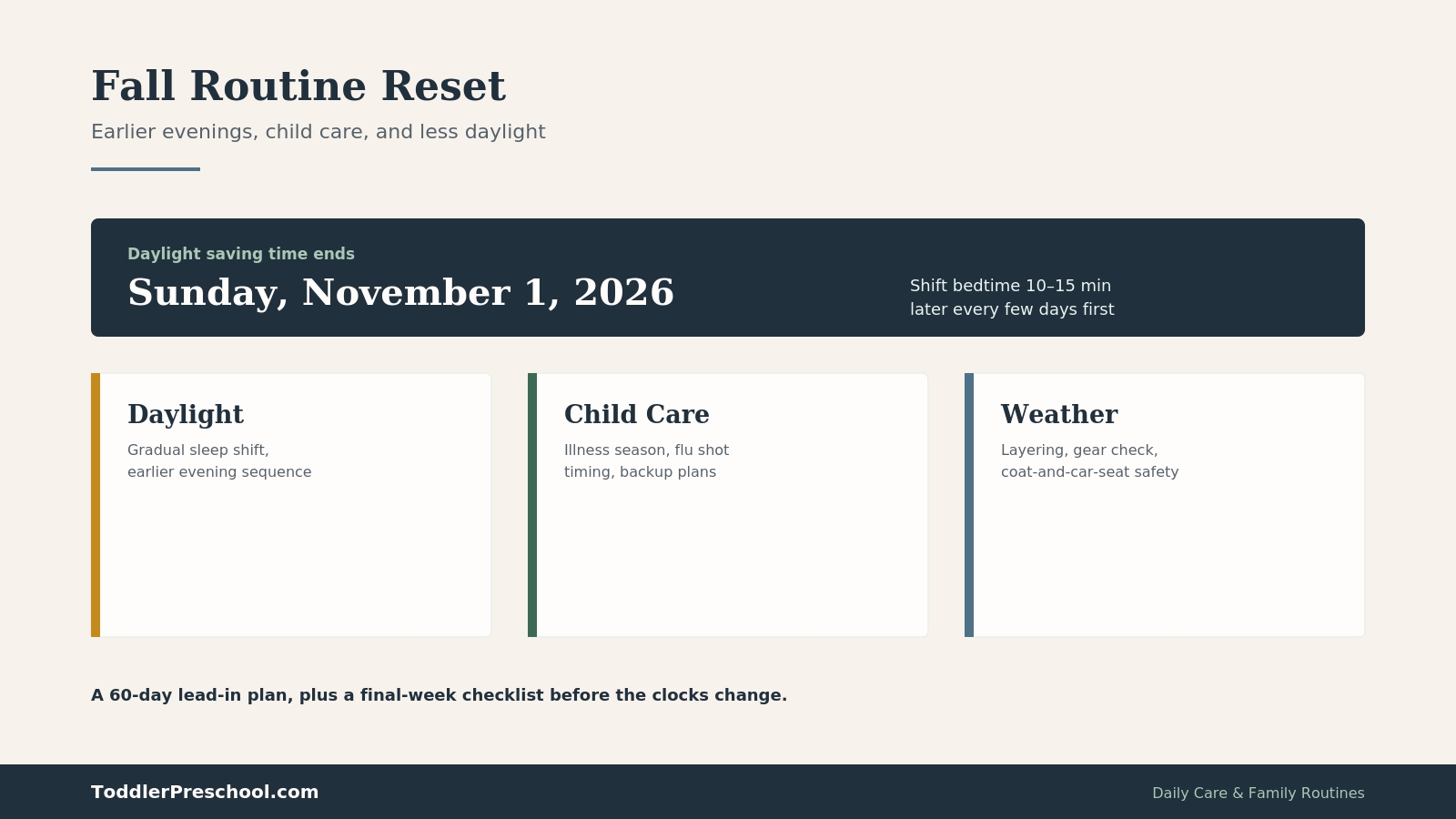
Here’s the direct answer: a fall routine reset for toddlers mainly comes down to three things — adjusting sleep and evening timing gradually as daylight shrinks and the clocks change, planning ahead for child care and illness season, and rethinking outdoor time and clothing for cooler weather — and all three go more smoothly with a little lead time than with a sudden scramble the week everything changes at once. This guide walks through a 60-day plan, the specific daylight saving time shift coming on November 1, 2026, and the everyday adjustments that make the whole season easier instead of one long transition.
This guide is organized so you can use whichever part actually applies to your family right now — the daylight saving time section if the November 1 change is what’s on your mind, the illness-season section if you’re thinking ahead to child care logistics, or the cold-weather section if gear and outdoor time are the immediate question. None of it requires reading start to finish before you can act on any piece of it.
The Direct Answer: What a Fall Routine Reset for Toddlers Actually Involves
Unlike a back-to-school transition, a fall routine toddlers reset isn’t tied to a specific new program starting — it affects every family with a young child, whether your toddler is in child care, home with a parent or grandparent, or somewhere in between. Three separate but related shifts are happening at once each fall:
- Daylight changes, both gradual (sunset creeping earlier through September and October) and sudden (the clocks moving back an hour on November 1, 2026), both of which can throw off a toddler’s sleep and evening timing.
- Child care and illness season, since fall reliably brings more group-setting illness exposure and, for many families, schedule or program changes tied to the new season.
- Weather and outdoor time, as cooler temperatures change what outdoor play looks like and how much preparation it takes to get out the door.
None of this requires an elaborate plan. For most families, a fall routine toddlers can actually follow comes down to a gradual approach to each piece, started with some lead time, rather than trying to adjust everything at once the week the clocks actually change.
The Fall Routine Reset at a Glance
| Weeks Out | Focus | What to Actually Do |
|---|---|---|
| 8–6 weeks | Observe | Notice current sleep rhythm and how earlier sunsets are already affecting mood and timing |
| 5–3 weeks | Plan | Confirm child care fall paperwork and schedule; start sourcing cold-weather gear |
| 2 weeks | Shift begins | Begin nudging bedtime and wake time 10–15 minutes earlier every few days |
| 1 week | Finalize | Confirm gear is complete; refill sick-day supplies; check program illness policy |
| Nov 1 (change day) | Arrive | Clocks change; schedule should already be close to settled if the gradual shift was followed |
| Following 1–2 weeks | Settle | Hold the new routine steady; expect some early waking or mood adjustment to ease gradually |
The 60-Day Lead-In to a Fall Routine Reset for Toddlers
60 to 30 Days Out: Observe and Plan
This window of a fall routine toddlers reset is mostly about noticing your current summer-into-fall rhythm — what time your toddler naturally falls asleep and wakes, how they’ve been handling the gradually earlier sunsets already, and what your child care or program’s fall schedule looks like once you have it. This is also a reasonable time to confirm any paperwork a child care program needs for the fall season and to check that your family’s cold-weather gear (coats, boots) still fits after a summer of growth.
It’s also worth using this window to simply notice, without changing anything yet, how your toddler’s mood and energy shift as afternoon light starts fading earlier through September. Some children show no real difference; others get noticeably more tired or a little more emotionally reactive in the hour or so before what used to be a well-lit dinner time. Neither pattern needs a response yet at this stage — it’s just useful information for the adjustments that follow.
30 to 14 Days Out: Start Shifting Gradually
Begin nudging bedtime and wake time 10 to 15 minutes earlier every few days if the natural sunset shift hasn’t already been doing this work for you, and start planning explicitly for the November 1 time change (more on the specific approach below). This is also a good window to start layering in slightly warmer clothing options for outdoor play as temperatures begin to drop, so it doesn’t feel like a sudden wardrobe overhaul later.
This is also a sensible time to look ahead at your family’s fall calendar as a whole — any known busy weeks, travel, or schedule disruptions coming up — and decide whether it makes sense to complete the bulk of the sleep-timing shift before or around those events, since a packed week with houseguests or travel isn’t the easiest time to also be actively adjusting a sleep schedule.
Final 2 Weeks: Rehearse the Real Routine
In the two weeks before the clocks change, run the actual evening sequence you’re aiming for — same wind-down time, same bath and book routine — consistently, even on nights when the schedule would otherwise be flexible. This is also the point to finalize any cold-weather gear you’re missing and to double-check your child care program’s plan for fall illness policies, described in more detail below.
By this point, the goal is for the new routine to feel boring and automatic rather than like something you’re actively managing — repetition in these final two weeks is what actually builds the habit, more than any single conversation or explanation to your toddler about what’s changing.

Meals and Appetite Changes Through the Season
A fall routine toddlers reset often includes a shift in what a toddler wants to eat and when, alongside everything else changing — cooler weather sometimes increases interest in warm foods (oatmeal, soup) even in a child who resisted them in summer, and a shift in activity level (more time indoors, less spontaneous outdoor snacking) can change appetite patterns too. None of this needs troubleshooting on its own; a toddler’s appetite naturally fluctuates with activity, growth, and season, and there’s no need to treat a fall appetite shift as a feeding problem unless it comes with other real concerns (weight loss, distress around meals) worth raising with your pediatrician separately.
If earlier evenings are compressing your dinner window, a slightly earlier, simpler dinner — leaning on foods your child reliably eats rather than introducing something new during an already-adjusting week — tends to reduce friction during this transition specifically. This is a reasonable, temporary simplification, not a permanent lowering of standards; a return to more variety once the routine has settled is completely fine.
A few other fall-specific meal logistics worth planning for: if your child care program’s snack or lunch routine shifts with a fall schedule change, confirming the new timing helps you calibrate meals at home so your toddler isn’t arriving home either overly hungry or too full to eat dinner at the new, earlier time. And if warm breakfast foods are newly appealing as mornings turn cooler, simple, quick options (oatmeal made in bulk and reheated, a warm breakfast that doesn’t require much active cooking on a rushed morning) can work well without adding meaningful prep time to an already tighter morning routine as darkness lingers later into the start of the day.
Daylight Saving Time: Adjusting Your Toddler’s Sleep Schedule
Daylight saving time ends on Sunday, November 1, 2026, when clocks move back one hour — for most families, this single date is the hardest single piece of a fall routine toddlers reset to manage well. It sounds like a gift — an extra hour of sleep — but many toddlers don’t experience it that way, since a young child’s internal clock doesn’t know about the calendar. A toddler who reliably woke at 6 a.m. before the change often wakes at what the new clock calls 5 a.m. afterward, because their body is still running on the old schedule, just relabeled by an hour.
The Gradual Shift Approach
Rather than letting the change hit all at once, shift your toddler’s schedule gradually in the days leading up to November 1: move bedtime and wake time later by 10 to 15 minutes every two to three days in the week or so before the change, so that by the time the clocks actually move back, your child’s schedule has already eased most of the way to where it needs to be. This is the same gradual-shift principle used for any schedule change at this age — small, repeated adjustments tend to work better than one abrupt jump.
A Sample Shift Schedule
Here’s what a gradual approach looks like for a toddler with a 7 p.m. bedtime and 7 a.m. wake time, in the eight days before the November 1 change:
| Day | Bedtime | Wake Time |
|---|---|---|
| Oct 24 (start) | 7:00 p.m. | 7:00 a.m. |
| Oct 27 | 7:15 p.m. | 7:15 a.m. |
| Oct 30 | 7:30 p.m. | 7:30 a.m. |
| Nov 1 (change day) | 7:30 p.m. (new clock) | 7:30 a.m. (new clock) |
By the day of the change itself, your toddler’s schedule — measured by the new clock — lands close to their original bedtime and wake time, softening what would otherwise be an abrupt hour-long jump.
If You Didn’t Get to Shift Gradually
If the date arrives before you’ve had a chance to adjust gradually, it’s not too late to manage the transition — just expect a few days of an earlier-than-usual wake time and a correspondingly earlier bedtime to compensate, and let the schedule settle back to normal over the following week or two rather than trying to force it back immediately. Keeping the rest of the daily routine (meals, nap timing relative to wake time) consistent, even while the specific clock times shift, tends to help the whole household settle faster.
A few extra tactics if you’re managing this without lead time: keep the room genuinely dark for an early wake-up rather than responding right away, since a toddler who’s put back down calmly for even 20 to 30 more minutes sometimes does drift back to sleep; and resist the urge to start the day’s activities the moment your child wakes early, since an early “reward” of attention and stimulation can reinforce the earlier waking pattern rather than easing it.
Using Morning Light and Evening Dimness as Cues
Light exposure genuinely helps reset a young child’s internal clock, the same way it does for adults. In the days around the time change, keeping the morning bright (opening curtains promptly, some time outside if possible) and keeping the evening dimmer as bedtime approaches (lower household lighting, screens off well before bed) reinforces the schedule you’re aiming for, on top of the gradual timing shift itself. Blackout curtains in your toddler’s room, if you don’t already use them, can also help on the other end — keeping a very early, still-dark morning from prompting an even earlier wake-up than the schedule shift alone would produce.
Naps During the Adjustment
If your toddler still naps, expect nap timing to drift along with everything else for a few days — a nap that comes an hour “early” by the new clock is really right on schedule by your child’s body clock, and forcing it back to the old clock time immediately tends to create more disruption than letting it settle gradually over the same week or two as the rest of the schedule.

Earlier Evenings: Rebuilding the After-Dark Routine
Why This Feels Different From Summer
A fall routine toddlers actually need has to account for this: by late fall, sunset in much of the U.S. happens well before a typical dinner and bath routine even starts, which changes the emotional texture of the evening even if the clock times stay the same — many toddlers (and parents) find a fully dark 5 p.m. genuinely harder than a light 5 p.m., independent of the actual schedule. Naming this directly, rather than assuming something’s “wrong” with your evening routine specifically, tends to reduce the frustration of feeling like nothing is working when the real culprit is just less daylight.
Rebuilding the Evening Sequence for Shorter Days
A consistent, predictable evening sequence — dinner, some connected or free time, bath, pajamas, a book, lights out — does the same calming work in fall and winter that it does any other season, but it’s worth starting the sequence a little earlier than you might in summer, simply because the transition into “nighttime” now happens well before your toddler’s actual bedtime. If dinner used to start at 6 with plenty of daylight left, and now 6 p.m. feels like the middle of the night, moving the whole sequence 20 to 30 minutes earlier often matches your child’s felt sense of the day better than keeping the old clock-time schedule out of habit.
A Sample Fall Evening Sequence
For a family with a 6:30 p.m. bedtime and an earlier fall pickup or arrival home:
| Time | What’s Happening |
|---|---|
| 4:30–5:00 p.m. | Arrival home or pickup, quick outdoor time while there’s still some daylight |
| 5:00–5:30 p.m. | Dinner |
| 5:30–6:00 p.m. | Quiet connected play, low lighting starting to come on |
| 6:00–6:15 p.m. | Bath or wash-up |
| 6:15–6:30 p.m. | Pajamas and a book |
| 6:30 p.m. | Lights out |
Shift the whole sequence earlier or later to match your own family’s actual schedule — the consistency and the earlier overall start matter more than these specific clock times.
Managing the Outdoor-Time Gap
If your family relied on after-dinner outdoor play or a walk in the summer, fall’s early darkness closes that window fast. Shifting outdoor time earlier in the day — right after pickup, or before dinner instead of after — helps preserve the movement and fresh air a toddler still needs, even though the exact time it happens has to move with the season. Weekend mornings, when daylight is more available, are also worth leaning on more heavily for extended outdoor time if weekday evenings have gotten too dark for it.
Fall Routine Changes for Toddlers in Child Care and Illness Season
Illness Season Ramps Up
Illness planning is a core piece of any fall routine toddlers reset, since fall reliably brings an increase in common colds and other viral illnesses circulating through group child care and preschool settings, as children return indoors more, spend more time in closer contact, and encounter a new mix of circulating viruses compared to summer. This is a normal seasonal pattern, not a sign of anything wrong with your specific program, and it’s worth stocking basic sick-day supplies (a working thermometer, an age-appropriate fever reducer confirmed with your pediatrician, tissues) before the season is in full swing rather than scrambling during a 2 a.m. fever.
Vaccination Timing
Fall is also the season many pediatricians recommend the annual flu vaccine, typically available starting in early fall for children 6 months and older. This is worth scheduling proactively rather than waiting, since vaccine supply and appointment availability can tighten as the season progresses — ask your pediatrician’s office directly about their specific recommended timing for your child. Many child care programs and pharmacies also offer flu vaccination clinics in early fall specifically to make this easier to fit into an already busy season, worth asking about if scheduling a separate pediatrician visit feels like one more thing to manage.
Know Your Program’s Illness Policy Going Into Fall
Confirm your child care or preschool’s specific policy on fevers, symptoms, and how long a child needs to stay home — policies vary by program, and knowing the specifics in advance avoids a stressful, confusing phone call mid-morning when your toddler is already not feeling well. It’s also worth confirming your own backup child care plan for an inevitable sick day or two, since fall is a common time for this need to come up with little warning.
Building In Slack for the Season
If your work schedule allows any flexibility, fall is a reasonable season to build in a bit more slack than usual — both for illness and for the general adjustment period as daylight and schedules shift. This isn’t a requirement, but families who go into the season expecting some disruption tend to find it less stressful than those who assume the summer’s smoother rhythm will continue unchanged. If your workplace offers any flexibility around remote work or flexible hours, fall is a reasonable time to have that conversation proactively rather than reactively during a specific sick-day crisis. Lining up a backup caregiver — a relative, a trusted sitter, a friend in a similar situation open to a reciprocal arrangement — before you need one specifically for illness coverage is also worth doing in this same window, rather than scrambling to find coverage the first time your toddler wakes up with a fever on a workday.

Cold Weather and Outdoor Play: What Changes in Fall
Layering, Not Bundling
The clothing side of a fall routine toddlers reset is mostly about layering: as temperatures drop, dressing a toddler in layers that can be added or removed through the day works better than one heavy outfit, since indoor spaces (home, child care, a store) are often warmer than the actual outdoor temperature would suggest, and an overheated toddler in a heavy coat indoors is its own kind of uncomfortable. A base layer, a mid layer, and an outer layer that can each come on or off gives more flexibility than a single seasonal wardrobe swap.
Maintaining Outdoor Time Despite the Weather
Outdoor time remains valuable through the fall, and cooler weather alone isn’t a reason to move all play time indoors — a well-layered toddler can comfortably play outside in much colder weather than many parents assume, as long as hands, feet, and head are protected. If your family is used to summer’s long, loose outdoor stretches, fall may call for shorter, more intentional outdoor windows rather than eliminating outdoor time altogether.
Basic Cold-Weather Safety Awareness
For genuinely cold outdoor stretches, it’s worth knowing the basic signs of a child getting too cold, without needing to treat every chilly outing as a safety event: cold, red skin that doesn’t warm up quickly once back inside, or a child becoming unusually quiet, clumsy, or fussy in cold weather are reasonable cues to head indoors and warm up. True frostbite and hypothermia are uncommon in ordinary outdoor play with reasonable supervision and appropriate clothing, but checking exposed skin (cheeks, fingers if mittens come off) periodically during longer cold-weather outings is a reasonable, low-effort habit. Wet clothing (from snow, puddles, or sweat under heavy layers) cools a child much faster than dry clothing at the same temperature, so a change of clothes on hand for outdoor play involving any wet element is worth the extra bag.
Coats and Car Seats: A Safety Note Worth Knowing
A bulky winter coat worn underneath car seat straps can prevent the harness from tightening securely against your child’s body in a crash, even when the straps look snug — the coat compresses on impact, leaving dangerous extra slack. The safer approach: buckle your toddler in wearing just a thinner layer, then add the coat backward over the straps (like a blanket) or use a car seat poncho or cover designed to go over the buckled harness, rather than under it. This is a small habit change worth building into your routine before the weather actually turns cold, so it’s automatic by the time you need it daily.
Morning Darkness Before the Time Change
Through October, mornings can start getting quite dark even before the clocks officially change, particularly further north or on the western edge of a time zone — a fully dark 7 a.m. departure can feel disorienting for both a toddler and a parent used to a bright summer morning. This tends to resolve itself somewhat once the November 1 change shifts more daylight back into the morning hours, but in the weeks leading up to it, treating a dark morning departure as expected and normal (bright entryway lighting, a consistent morning routine that doesn’t rely on natural light) helps it feel less like something has gone wrong.
Toileting and Bathroom Routines With Bulkier Clothing
If your toddler is in the middle of toilet learning, bulkier fall and winter clothing genuinely adds a practical complication worth planning for rather than a sign of backsliding — more layers, snow pants, and boots all take longer to manage than a summer outfit, which can be enough of a barrier to cause an accident in a child who’s otherwise doing fine. Choosing cold-weather clothing with easier fasteners where possible (elastic waistbands over complicated snaps, boots that slip on rather than requiring a long lacing process) and simply building in a bit more time before bathroom trips during the layered-clothing season are reasonable, practical adjustments — not a reflection of your child’s underlying progress with toileting itself.
A Practical Cold-Weather Gear Checklist
A few items worth confirming you have before the weather turns, rather than discovering a gap on a cold morning: a properly fitting coat (checked against last year’s size), warm socks and weather-appropriate shoes or boots, mittens or gloves (mittens are often easier for a toddler to manage independently than fingered gloves), and a hat that stays on reasonably well. A spare set of these items kept at child care, if your program allows it, means one less thing to remember on a rushed morning. None of this needs to be new or expensive — secondhand children’s cold-weather gear is widely available through consignment sales, community exchanges, and online marketplaces, and works exactly the same as new gear for a fast-growing toddler who’ll likely need a new size again next year regardless.

Closer to the Fall Routine Change: A Final-Week Checklist for Toddlers
A few things worth double-checking specifically in the days right before the clocks change, to close out a fall routine toddlers reset well, since some of this is easy to overlook amid everything else:
- Confirm your specific sunset time for the week of the change, since it varies by location, and adjust your evening sequence timing accordingly rather than guessing.
- Re-check your child care program’s updated fall schedule, if anything shifted from what was communicated over the summer.
- Do one more inventory of cold-weather gear, since a growth spurt or a missing glove is easier to catch a week out than the first genuinely cold morning.
- Reset any smart-home or device-based schedules (thermostat timers, smart lights used as bedtime cues) to match the new clock time, since these are easy to forget and can undercut the routine you’re otherwise trying to maintain.
- Refill basic sick-day supplies before illness season is in full swing, not after the first fever hits.
A Note on Halloween and Other Fall Events
Halloween falls squarely within this same seasonal window (October 31, just two days before the 2026 time change), and it’s worth a brief mention here rather than treating it as fully separate from the rest of your fall routine reset. A late trick-or-treating evening or a sugar-heavy holiday right before a sleep-schedule shift can compound each other — if your family celebrates, it’s reasonable to expect a temporarily rougher few days around both events combined, and to simply return to your regular routine afterward rather than trying to prevent any disruption at all. If your child’s schedule is already mid-shift for daylight saving time when Halloween happens, holding the sleep-timing plan steady through the holiday, rather than pausing it, tends to work better than restarting the adjustment from scratch afterward.
Keeping What Actually Worked From Summer
Not everything needs to change just because the season did. If a particular routine, food, or activity was working well over the summer — a specific breakfast, a wind-down ritual, a weekend outdoor tradition — there’s no need to abandon it just because fall arrived; adapt the timing or setting if needed (an outdoor breakfast picnic might move indoors, for instance) while keeping the actual routine intact. Toddlers benefit from the stability of familiar patterns carrying across seasons, even as the specific details shift to fit the weather and daylight.
Common Obstacles During a Fall Routine Reset for Toddlers
“My toddler is waking up way too early after the time change.”
This is extremely common and usually resolves within one to two weeks as their internal clock catches up to the new schedule — keep wake-up responses low-key and boring (dim light, quiet voice) rather than treating an early wake-up as the start of the day, which can reinforce the earlier waking rather than easing it back. If early waking persists well beyond two weeks with no improvement, it’s worth checking whether bedtime has drifted too early relative to your child’s actual sleep need, since an overly early bedtime can itself produce an early wake-up independent of the time change.
“It gets dark before we’re even home from child care.”
Shifting your evening sequence earlier, rather than trying to preserve a summer-timed routine against the season, is usually the more sustainable fix — an earlier dinner and bath doesn’t mean a shorter day overall, just one that’s shaped a little differently than it was in July. If a earlier evening genuinely isn’t workable given your family’s work schedule, prioritizing a consistent (even if later) sequence over an earlier one is a reasonable alternative — consistency itself does more of the calming work than the specific clock time.
“We can’t afford a whole new cold-weather wardrobe.”
Layering with what you already have, checking community resources (many areas have coat exchanges, and secondhand children’s clothing is widely and cheaply available), and prioritizing the few genuinely weather-critical items (a real coat, waterproof footwear) over a complete wardrobe refresh covers the actual safety need without requiring a large purchase. Some school districts, libraries, and community organizations run free winter-gear drives specifically for young children each fall — worth a quick search for what’s available locally before assuming a purchase is the only option.
“My toddler seems more clingy or out of sorts since the season changed.”
A general adjustment period — new schedule, less daylight, more time indoors — can understandably affect mood and behavior temporarily, and this tends to ease as the new routine becomes familiar, similar to any other transition covered elsewhere in our routine-reset guides. If it persists well beyond a few weeks or seems disproportionate, that’s worth mentioning to your pediatrician, separate from ordinary seasonal adjustment.
“Our family just doesn’t feel like doing an elaborate fall reset this year.”
That’s a completely reasonable place to be — a minimal fall routine toddlers reset is still a real one, and nothing in this guide requires an elaborate approach to work — picking just the gradual sleep-timing shift around November 1, without touching anything else in this guide, still meaningfully eases the hardest part of the seasonal transition. A low-effort fall is not a failed fall.
“One of my children handles the time change fine, and the other really struggles.”
This is common, and it doesn’t reflect anything you’re doing differently between them — individual temperament and sleep sensitivity vary, and one child needing a slower, more deliberate shift while a sibling adjusts easily is normal. It’s fine to apply the gradual approach only where it’s actually needed rather than treating every child in the household identically.

Adapting This to Every Family’s Situation
Multilingual families. None of the practical adjustments in this guide — sleep timing, evening routines, cold-weather gear — depend on language spoken at home; the same gradual approach works regardless. If your family talks through the upcoming seasonal changes with your toddler in advance, doing so in whichever language is most comfortable at home works just as well as doing it in English.
Disability and developmental variation. For a toddler with sensory sensitivities, the sensory experience of bulkier cold-weather clothing or the sudden schedule shift from daylight saving time may need a more gradual, individualized approach than general guidance provides — a longer shift window, or a specific strategy for tolerating layered clothing (seamless base layers, tagless clothing, introducing new cold-weather items gradually at home before the first genuinely cold day), is worth developing with an occupational therapist or your child’s care team if this is a significant issue.
Different family structures. Whoever manages your toddler’s daily schedule — one or two parents, grandparents, rotating caregivers — benefits from a shared, consistent approach to a fall routine toddlers reset, especially the sleep-timing shift specifically, since inconsistency between households during this adjustment period tends to extend how long it takes to settle. In shared-custody situations, a brief conversation about aligning the gradual shift schedule across both households, even loosely, is worth having before the November 1 change rather than after.
Budget. As covered above, none of this seasonal reset requires new purchases — layering existing clothing, using secondhand cold-weather gear, and adjusting timing rather than buying new routines or products all work regardless of budget. If cost is a genuine barrier to a properly warm coat or boots specifically, local community organizations, school districts, and libraries often have free or low-cost resources worth checking before the coldest weather arrives.
Time and schedule constraints. If a full 60-day lead-in isn’t realistic, the single highest-value piece to prioritize is the gradual sleep-timing shift around the November 1 change — even starting that alone, a week out, meaningfully eases the transition compared to no adjustment at all. Working parents with limited evening bandwidth can also focus specifically on just the wake-time half of the shift (keeping mornings consistent) if managing both ends feels like too much during a busy season.
Families with a new baby or another major fall transition happening at the same time. If the fall routine reset is landing during an already-full season — a new sibling, a move, a job change — it’s completely reasonable to scale this guide down to just the single highest-priority piece rather than attempting the full plan. The gradual sleep shift is the most time-sensitive element (tied to a specific date); everything else in this guide can wait for a calmer week.
Frequently Asked Questions
Does the “spring forward” time change in March affect toddlers the same way as the fall change? The general principle (gradual adjustment works better than an abrupt one) applies to both, but many families find the fall “gain an hour” change produces more early waking specifically, while the spring “lose an hour” change more often produces later waking and a harder time falling asleep — both are manageable with the same gradual-shift approach, just anticipate the specific direction your child’s schedule will likely drift.
Is it normal for my toddler to want to nap more as the days get shorter? Some children do show a seasonal shift in sleep needs, though it varies by individual child and isn’t something CDC or AAP milestone guidance specifically tracks — a modest increase in daytime sleepiness during the adjustment period is common and not concerning on its own; a dramatic, sustained change is worth mentioning to your pediatrician.
My child’s preschool doesn’t change its schedule for daylight saving time — should I keep our home routine on the old schedule to match? No — adjusting your child’s sleep schedule to the new clock time, even though the program’s daily schedule (drop-off, pickup times) doesn’t itself change, is usually easier than trying to keep two different clocks running in the same household; the shift described in this guide is about your toddler’s body clock, not the program’s posted hours.
Does a fall routine reset apply to a toddler who isn’t in any child care or preschool program? Yes — the daylight, sleep-timing, and weather pieces of this guide apply to every toddler regardless of enrollment status, since they’re driven by the calendar and the clock, not by a school or program schedule. A toddler home full-time with a parent or grandparent experiences the same shortening daylight and the same November 1 time change as one in a formal program.
Is it worth trying a “light therapy” lamp or similar product for a toddler during the darker months? This isn’t something backed by strong evidence specifically for toddlers, and it’s not part of any mainstream pediatric guidance for this age group — simple morning light exposure (opening curtains, a bit of time near a window or outside) covers the same underlying principle without a product purchase, and is the more evidence-grounded starting point for this age.
How long does it typically take a household to fully settle into the new fall routine? Most families see the bulk of the adjustment — sleep timing, evening routine, getting used to earlier darkness — settle within two to three weeks of consistent effort, though a fully “normal-feeling” fall rhythm sometimes takes a bit longer to feel automatic rather than managed. There’s no need to expect instant adjustment, and a gradual, imperfect settling-in over several weeks is the typical pattern, not a sign anything is being done wrong.
Your One Next Step
Pick one piece of this fall routine toddlers reset — most likely the gradual bedtime shift — and start it this week, moving your toddler’s schedule 10 to 15 minutes earlier every few days between now and November 1, rather than waiting for the clocks to change and adjusting after the fact. If daylight saving time isn’t your family’s current concern, pick whichever single piece of this guide actually matches what’s on your mind right now — the illness-season prep, the cold-weather gear check, or simply an earlier evening sequence — and start there instead. A fall routine reset doesn’t need to happen all at once, and one consistent change is enough to make the season feel more manageable than it did last week.
Sources consulted: American Academy of Pediatrics / HealthyChildren.org general seasonal and sleep guidance; general U.S. federal daylight saving time schedule information, confirming the November 1, 2026 end date.