

Your child just turned three. Somewhere between the birthday cake and the next well-child visit, you started wondering what you’re actually supposed to be seeing at this age. You’re searching for 3 year old milestones because you want the real list. A vague sense that things are “going fine” or “something to keep an eye on” doesn’t offer any real detail.
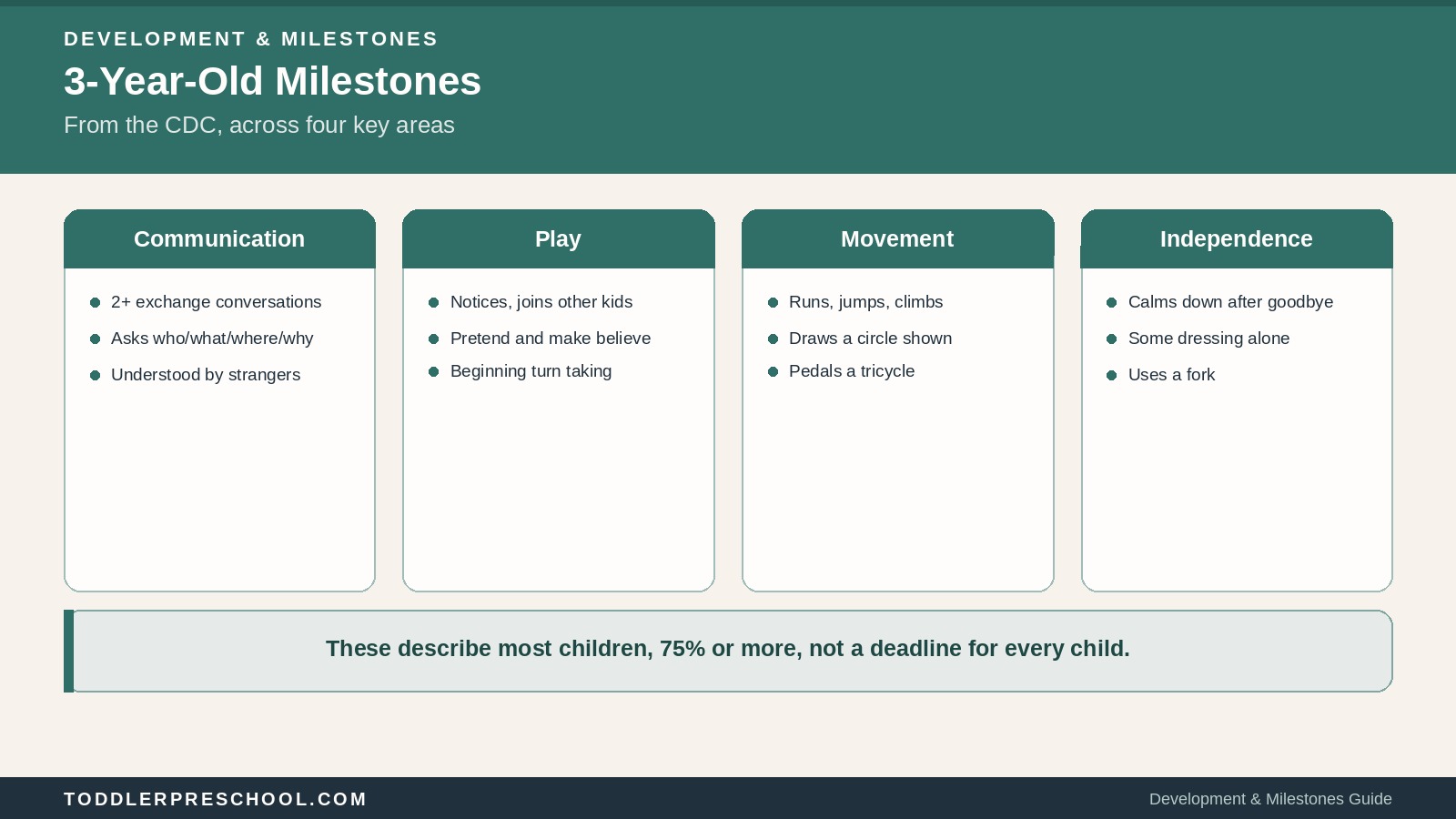
Here’s the direct answer. The CDC’s 3-year milestone checklist covers four areas: social and emotional skills, language and communication, cognitive thinking, and movement. It describes what most children, 75 percent or more, can do by this age. It’s not a deadline every single child must hit on schedule. This guide walks through those milestones organized around communication, play, movement, and independence. It explains what monitoring and screening actually mean. It gives you a clear next step, whether everything looks on track or something feels off.
This is a long guide, deliberately so. The third birthday brings together language, social skills, physical coordination, and genuine independence all at once. Giving each area real depth matters more than a quick, surface-level summary.
What “3-Year-Old Milestones” Actually Means
Before the list itself, a few things about how milestones work are worth understanding clearly.
Milestones Are Patterns, Not Deadlines
A milestone describes what most children can do by a certain age. It doesn’t describe what every single child must do by that exact date. It isn’t a test your child passes or fails, however much a checklist format might make it feel that way.
Two children can both be developing completely typically while reaching the same skill months apart. General guidelines describe a population pattern, not a personal deadline for your specific three-year-old.
This distinction matters because it changes how you use this guide. A missing skill on this list is useful information worth noting, not evidence of a problem requiring immediate action.
The CDC’s Own Threshold: 75 Percent
The CDC’s current milestone checklists were updated in 2022. They specifically describe skills that at least 75 percent of children demonstrate by a given age. This threshold matters. It means roughly one in four typically developing children hasn’t reached a given milestone on this checklist’s timeline. That’s still within the range of normal, not a marker of genuine concern on its own.
This number isn’t meant to eliminate your questions if something feels off. It’s meant to give the checklist itself the right amount of weight: a useful reference point, not a strict pass-fail line.
Before 2022, the CDC’s milestones used a different, lower threshold, closer to 50 percent. The update to 75 percent was intended to make the checklist a clearer signal. If your child hasn’t reached a milestone most children have, that’s genuinely worth a conversation. A marker only half of children reach isn’t nearly as useful.
Why This Guide Organizes Differently Than a Checklist
The CDC’s official checklist groups skills into social/emotional, language/communication, cognitive, and movement/physical categories. This guide organizes the same underlying skills around communication, play, movement, and independence. These are the actual moments where you’ll notice these skills showing up in daily life, at home and out in the world.
Play, in particular, draws from more than one CDC category. The social skill of joining other children, and the cognitive skills involved in symbolic and pretend play, both show up here. This isn’t a different set of milestones, just a more practical way to think about where you’ll actually see them.
Tracking More Than One Child at Once
Families with more than one 3-year-old sometimes find it useful to track observations separately for each child. This includes twins, close-in-age siblings, or children in a shared caregiving arrangement. This holds even when comparing them feels natural. Each child’s own individual pattern matters more than how they compare to each other on any single milestone.
How to Actually Use This Guide
Reading through every section in one sitting can feel like a lot. A more useful approach: skim the headings first. Then read closely through whichever section currently feels most relevant, whether from specific curiosity or because something has been genuinely on your mind.
Nothing in this guide requires immediate action. Reading it is itself a form of monitoring, described later in this guide. It’s simply paying informed, careful attention to a pattern over time, rather than reacting to any single observation alone.
Communication Milestones at 3 Years
Language moves quickly during this year, and the CDC checklist reflects several specific, observable markers. This section covers each one in depth, along with the broader language patterns surrounding them.
Back-and-Forth Conversation
By 3 years, most children can talk with you in conversation using at least two back-and-forth exchanges. This means a real, if simple, dialogue: you ask something, your child responds, you respond back, and your child adds something more.
This is a genuinely different skill from simply naming objects or repeating words. It requires holding a thread of conversation across multiple turns. This is a meaningful cognitive and social leap from the one and two-word requests common at age two.
Two-way conversation also requires a kind of patience and attention that’s still developing at this age. A 3-year-old genuinely engaged in a back-and-forth exchange is practicing turn-taking in language, the same underlying skill that supports turn-taking in play.
This skill often shows up most clearly during a calm, unhurried moment, rather than in the middle of a busy transition. A rushed exchange at drop-off might only get a single response. The same child engages in genuine back-and-forth during a slow bath time or car ride instead.
Asking Questions
Most 3-year-olds ask “who,” “what,” “where,” or “why” questions, like “where is mommy?” This often marks the start of a relentless questioning phase.
This skill reflects real curiosity about how the world works, not just a request for something specific. A child asking “why” repeatedly is often testing the boundaries of an explanation, not simply repeating a word for attention.
The “why” phase in particular can feel exhausting for a tired parent fielding dozens of questions a day. It’s worth remembering that this repetitive questioning reflects genuine cognitive engagement. Your child is actively building a model of cause and effect, testing what kind of answer follows what kind of question.
Not every question needs an elaborate, fully accurate answer. A simple, honest response works well too. Even “I’m not sure, let’s find out” genuinely supports this developing skill just as well as a complete explanation.
Describing What’s Happening
By this age, most children can say what action is happening in a picture or book when asked. They use words like “running,” “eating,” or “playing.” This shows a real, functional understanding of verbs, not just nouns.
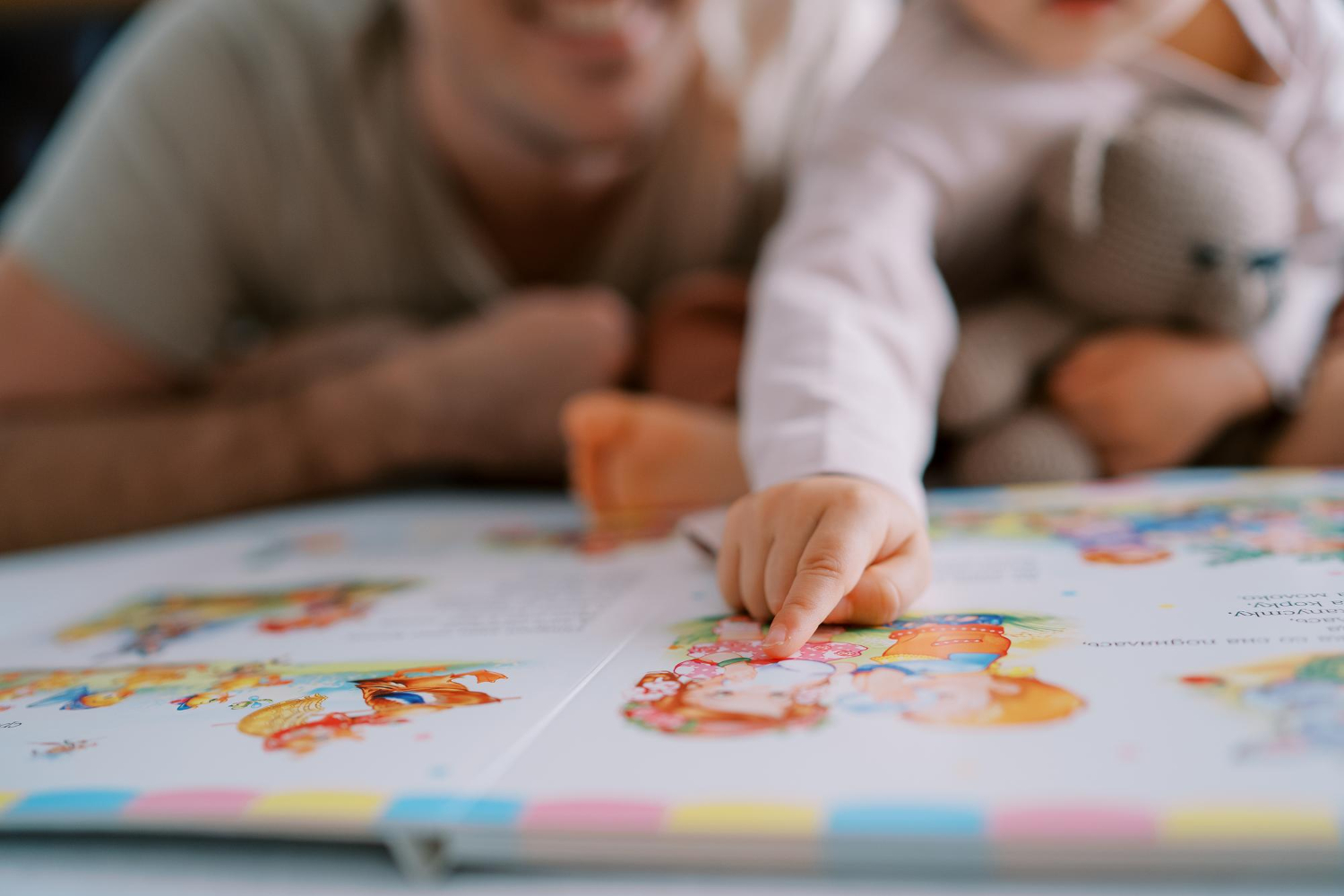
This skill is worth watching for specifically during shared reading. A book with clear, simple illustrations gives your child an easy, low-pressure opportunity to demonstrate it.
Action words, verbs specifically, often develop somewhat later than noun vocabulary in early language development generally. A 3-year-old confidently naming objects but hesitating on action words isn’t unusual; this milestone specifically checks whether that verb vocabulary has started catching up.
Saying Their Own Name
Most 3-year-olds say their first name when asked. This simple-sounding skill actually reflects a meaningful step. It ties language directly to self-identity, a real sense of “who I am.”
This milestone sometimes surprises parents with how straightforward it seems, precisely because a child’s own name is used constantly around them from birth. The skill being measured isn’t recognizing the name, which happens far earlier, but producing it themselves on request.
Being Understood by People Outside the Family
By 3 years, most children talk well enough for others to understand them most of the time. This goes beyond just familiar caregivers used to their particular speech patterns. This is a genuinely important marker, since it reflects real progress in clarity of pronunciation, not just vocabulary size.
Parents and close caregivers often understand a child’s speech well before an unfamiliar adult can, simply from daily exposure and context. This specific milestone asks about strangers and unfamiliar adults specifically, which is a more demanding, objective test of clarity.
Certain speech sounds genuinely take longer to master than others. Sounds like “r,” “l,” “th,” and consonant blends often aren’t fully mastered until several years later. A 3-year-old who still says “wabbit” for rabbit isn’t necessarily behind. This milestone is about overall intelligibility, not perfect pronunciation.
Receptive Language: Understanding More Than They Say
Alongside the CDC’s specific expressive language markers, receptive language continues to run ahead of expressive language at this age. What your child understands outpaces what they can say. A 3-year-old often follows multi-step directions, understands simple stories, and grasps concepts well beyond what their own sentences reveal.
This gap between understanding and speaking is completely normal. It’s worth remembering when a 3-year-old seems to grasp far more than their vocabulary alone would suggest.
Try this to notice the gap: ask your child to follow a slightly complex instruction, like “put your cup in the sink and then get your shoes.” A child who completes both steps, even silently, shows real receptive language.
Vocabulary Size at This Age
Many 3-year-olds have an expressive vocabulary in the hundreds of words, with some children well beyond a thousand. Exact counts vary enormously and matter far less than the CDC’s functional milestones above. Vocabulary size alone is a less reliable indicator on its own. Whether a child can actually use language functionally, in conversation, matters more.
Sentence Length and Grammar
By age three, many children combine words into short sentences of three or four words, sometimes longer. They begin using early grammar markers like plurals, past tense, and simple pronouns, even if imperfectly. Grammatical errors at this age, like “I goed to the park” instead of “I went,” are a genuinely normal part of language development. They reflect a child actively, if imperfectly, applying grammar rules they’re still learning.
Everyday Examples of Communication at 3
A few concrete, real moments show how these skills show up in daily life.
At the dinner table. Your child says “I want more crackers.” You ask “why do you want more?” They respond “because I’m still hungry.” That’s a genuine two-exchange conversation, using real reasoning language.
During a car ride. Your child asks “where are we going?” This kind of spontaneous question, without prompting, reflects real curiosity and comfort using question words functionally.
While reading together. You point to a picture of a dog running and ask “what’s the dog doing?” Your child answers “running” or “he’s running fast.” This demonstrates the action-description milestone.
During pretend phone play. Your child picks up a toy phone and has a one-sided “conversation,” including pauses that mimic listening. This shows an internalized sense of conversational turn-taking, even in solo pretend play.
At a family gathering. A relative your child sees only occasionally asks them a simple question. Your child answers clearly enough for that relative to understand, without needing you to “translate.” This is the being-understood-by-others milestone in a real moment.
Play Milestones at 3 Years
Play at this age looks meaningfully different than it did even six months earlier. It offers real insight into social and cognitive development.
Noticing and Joining Other Children
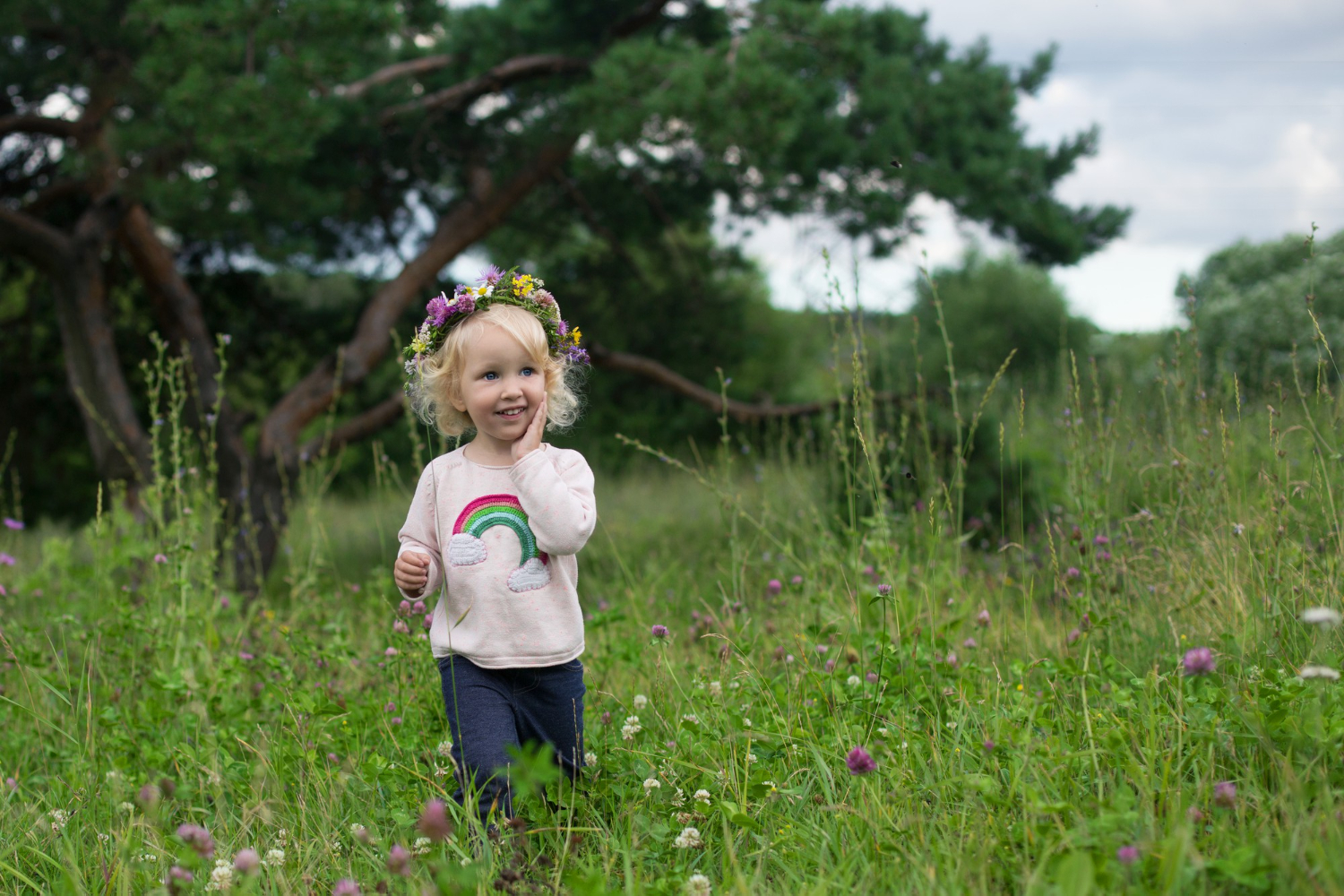
The CDC checklist specifically notes that most 3-year-olds notice other children and join them to play. This marks a real shift away from playing purely alongside other children, sometimes called parallel play, toward actively seeking out shared play.
This doesn’t mean every interaction runs smoothly. Sharing, taking turns, and negotiating who’s in charge of the pretend scenario are all still developing skills. The basic instinct to join in becomes more consistent first.
Joining play also requires a specific social skill: reading a situation well enough to find a natural entry point. A 3-year-old watching two children play, then finding a way to join, is demonstrating genuine social awareness. Bringing an extra toy or copying an action are both real strategies. This holds even without sophisticated language to negotiate entry.
The Shift From Parallel to Interactive Play
Many toddlers spend much of their second year playing near other children without much direct interaction. Each child stays absorbed in their own activity. By age three, many children start genuinely playing with others. Building the same block tower together. Chasing each other. Taking on complementary pretend roles.
This shift happens gradually, not overnight, and it varies widely by temperament. A more cautious child may continue preferring parallel play longer, while still developing the underlying social skills that eventually support more interactive play.
This transition also depends heavily on opportunity and exposure. A child with regular, frequent contact with same-age peers, through preschool, playgroups, or close-in-age siblings, often has more practice moving into interactive play. This holds true independent of any underlying difference in social skill.
Pretend and Make-Believe Play
Symbolic, make-believe play is well established by age three for many children. Feeding a doll. Pretending a block is a phone. Acting out a simple story with toy figures. This kind of play reflects real cognitive growth. It’s the ability to hold two realities in mind at once: the actual object, and its pretend meaning.
Pretend play at this age often includes simple, familiar scripts drawn from real life. Cooking. Going to the doctor. Putting a baby to sleep. These scripts reflect your child’s own observations of daily life, replayed and practiced through play.
As pretend play matures across the preschool years, it typically grows more elaborate. More characters. More complex plots. Eventually, genuine collaborative storytelling with other children. At three, this is often still fairly simple and repetitive, which is exactly where it’s expected to be.
Pretend play also offers a genuine, low-pressure way for a child to process real experiences and feelings. A child who recently visited the doctor might spend days afterward giving “shots” to stuffed animals. This works through the experience through repeated, controlled play, rather than direct conversation.
Turn-Taking and Simple Rules
A 3-year-old is often just beginning to understand simple turn-taking and basic game rules. Genuine mastery of this skill typically continues developing well into the preschool years. A simple game like rolling a ball back and forth, or taking turns choosing a book, offers real practice.
This skill is worth approaching with realistic expectations. A 3-year-old who struggles to wait for a turn isn’t behind. This is an active, ongoing skill, still very much under construction at this age.
Games with very simple, clear rules tend to work best at this age. A board game with complex strategy is well beyond what most 3-year-olds can meaningfully engage with. A simple matching game or a basic physical game like tag offers rules concrete enough to genuinely grasp.
Attention Span During Play
Attention span during play varies enormously at this age, both between different children and within the same child on different days. A single, absorbing activity might hold a 3-year-old’s attention for twenty minutes. A less engaging one loses their interest in two, a normal pattern within these 3 year old milestones.
This variability is normal and doesn’t reflect a fixed, single “attention span number” for your child. Interest, energy level, and the specific activity all genuinely shape how long a three-year-old stays engaged.
Novelty plays a real role here too. A brand new toy often holds attention longer initially, simply because it’s unfamiliar. A well-known favorite might get a shorter but more focused burst of engaged play instead.
Play With Objects and Materials
Beyond social and pretend play, how a 3-year-old engages with physical materials, blocks, puzzles, art supplies, also reflects real developmental progress. Building a simple block tower shows growing cognitive and motor control. So does completing a basic puzzle with a handful of pieces, or scribbling with intentional back-and-forth motion.
This kind of solo, focused play with materials is just as valuable developmentally as social play. Many 3-year-olds move fluidly between both throughout a single play session. Alone with blocks one moment, inviting a sibling to help the next.
Everyday Examples of Play at 3
A few real moments illustrate these skills in action.
At the playground. Your child notices another child building a sandcastle and walks over to help. This spontaneous joining reflects the social play milestone directly.
During pretend play at home. Your child puts a doll to bed, saying “night night, baby,” then picks up a toy phone to “call” grandma. This layered pretend scenario shows genuine symbolic thinking.
Playing a simple game together. You roll a ball to your child and say “your turn now,” gently guiding them to roll it back. Repeated practice like this builds the turn-taking skill gradually.
During independent block play. Your child builds a tower, knocks it down laughing, and immediately starts rebuilding it, absorbed for several minutes without needing any adult involvement. This sustained, self-directed engagement reflects genuine focus and motor planning.
At a playdate. Two children negotiate, somewhat clumsily, over who gets to be the “mommy” in a pretend game, eventually settling on taking turns. This messy negotiation is exactly the kind of real social practice this age is built for.

Movement Milestones at 3 Years
Both gross motor (whole body) and fine motor (hands and fingers) skills continue developing rapidly during this year.
Gross Motor: Running, Jumping, and Climbing
By age three, most children run with reasonable coordination. They climb on and off furniture and playground equipment without much difficulty, and can jump with both feet leaving the ground at once. These skills build on the walking and basic climbing established in the toddler years, adding real speed, balance, and coordination.
Running at this age typically looks confident and purposeful, though genuine speed and agility continue improving well into the school years. A 3-year-old can usually run to avoid an obstacle, change direction with some warning, and stop without immediately falling over. These are all real advances from the more stiff-legged running common at two.
Jumping with both feet leaving the ground simultaneously is a genuinely more advanced skill than it might sound. It requires the coordination to push off with both legs at once and land with enough balance to stay upright. This is a meaningful step beyond simply stepping down from a low height.
Pedaling a Tricycle
Many 3-year-olds can pedal a tricycle, though this specific skill varies more than some others. It depends partly on practice and access to a tricycle, not just underlying physical readiness. A child without regular access to ride-on toys may simply need more practice opportunities, not necessarily more time.
Pedaling requires coordinating both legs in an alternating circular motion while simultaneously steering, a genuinely complex combination of skills happening at once. Many children need several sessions of practice before this motion feels smooth and automatic, rather than mastering it on a first try.
Stairs
Most 3-year-olds can climb stairs using alternating feet, one foot per step, rather than the two-feet-per-step pattern common at younger ages. Coming down stairs with alternating feet often develops a bit later than going up, since it requires more balance and confidence.
A handrail, or a hand held for support, remains a completely reasonable accommodation at this age. This holds even for a child who has technically mastered alternating feet. Confidence and full independence on stairs often continues developing for another year or more.
Throwing and Catching
Many 3-year-olds can throw a ball with some direction and intention, though accuracy remains genuinely limited. Catching is typically harder than throwing at this age. It often requires a large, soft ball and a relatively short, predictable toss to succeed.
This asymmetry between throwing and catching skill is completely normal. Catching requires tracking a moving object and coordinating a response in real time. This is a more demanding combination of visual and motor skills than throwing alone.
Balance and Single-Leg Skills
Standing briefly on one foot is a skill many 3-year-olds are actively developing. So is walking along a low balance beam or a line on the ground. Genuine stability often continues improving for another year or two. A wobbly, brief attempt at standing on one foot is a completely typical demonstration of this developing skill, not a sign it’s missing.
Fine Motor: Drawing a Circle
The CDC checklist specifically notes that most 3-year-olds can draw a circle when shown how. This is a genuinely meaningful fine motor and visual-motor milestone. It requires the hand control to trace a continuous curved line, and the visual processing to judge when the circle closes.
This doesn’t mean a perfectly round circle; an approximate, recognizable circular shape counts. The skill being measured is the coordinated motion, not artistic precision.
Drawing skills at this age typically also include other basic marks: vertical and horizontal lines, and sometimes simple crosses when shown how. A full range of geometric shapes, including squares and triangles, generally develops over the following year or two, well after circles.
Stringing Items Together
Most 3-year-olds can string items together, like large beads or macaroni, onto a string or shoelace. This requires real pincer grasp precision combined with hand-eye coordination to align a small hole with a moving string end.
This specific skill also reflects bilateral coordination, using both hands together in a coordinated way. One hand holds the string steady while the other manipulates the bead. This two-handed coordination continues refining throughout the preschool years.
Turning Book Pages One at a Time
Turning pages one at a time, rather than grabbing several pages at once, is a specific fine motor milestone many 3-year-olds reach. This requires enough finger dexterity to isolate a single thin page from the rest of the book.
Using Scissors, in a Beginning Way
Many 3-year-olds are beginning to use child-safe scissors. Genuine control, like cutting along a line, remains a skill that develops significantly over the next year or two. At this age, simply opening and closing the scissors with some purpose, even without precise cutting, represents real progress.
Building With Blocks
Stacking a tower of six or more blocks is a common skill at this age. So is building simple structures, like a bridge, when shown how. This reflects both the fine motor control to place blocks precisely and the visual-spatial planning to build a stable structure.
Everyday Examples of Movement at 3
A few concrete moments show these skills in daily life.
At the park. Your child runs across the grass, then jumps with both feet off a low step, landing with a wobble but staying upright. This combination shows real running and jumping coordination.
During craft time. You draw a circle and ask your child to try one too. Their circle is a bit lopsided but clearly recognizable as a circle, a lasting record of this specific milestone.
While reading together. Your child reaches for the book and turns a single page carefully, rather than flipping through several at once. This shows the isolated finger control this skill requires.
Riding a tricycle in the driveway. After a few wobbly attempts, your child gets the pedaling motion going. They ride a short distance independently, a satisfying milestone moment for both of you.
During a bath time game. Your child stands briefly on one foot to demonstrate a “flamingo,” wobbling and giggling before putting the foot back down. This is a real, if brief, display of developing balance.

Physical Growth Context Alongside 3 Year Old Milestones
Alongside the four skill areas this guide focuses on, general physical growth continues at a steady, if slower, pace around the third birthday.
Typical Growth Patterns
Many 3-year-olds gain a modest amount of weight and height over the year following their third birthday. This is generally slower growth than the rapid pace of infancy. A complete set of primary teeth is also typically in place by this age for most children.
Why Growth Charts Matter Less Than Trend
A single measurement on a growth chart matters less than the overall trend over time. A child consistently tracking along their own established growth curve is usually a more reassuring sign than a single percentile number. This holds true even if that curve sits lower or higher than average.
Appearance Changes Around This Age
Many parents notice their 3-year-old starting to look less like a baby and more like a child around this time. The rounded toddler belly evens out, and body proportions shift as legs lengthen relative to the rest of the body. This is a normal, expected part of the physical transition out of toddlerhood.
Cognitive and Thinking Skills at 3 Years
Alongside communication, play, and movement, the CDC checklist includes a distinct cognitive category, covering how a 3-year-old thinks, reasons, and solves problems.
Simple Sorting and Categorizing
Many 3-year-olds can sort objects by an obvious shared feature, like color or size, when given a simple example first. This reflects real early categorical thinking, recognizing what makes a group of objects similar.
Early Counting
Many 3-year-olds can count a small number of objects, often up to three, with some accuracy. Truly understanding what the final number represents, sometimes called cardinality, typically develops further into the preschool years. Reciting numbers in order, “one, two, three, four,” is a genuinely different skill from accurately counting a specific set of objects. Both are actively developing at this age.
Understanding Simple Comparisons
Concepts like “bigger” and “smaller,” or “more” and “less,” are often becoming meaningful to a 3-year-old. This is especially true with a clear, direct comparison in front of them. Abstract or less obvious comparisons remain more challenging and typically develop further over the following year or two.
Basic Problem-Solving
Working out how to fit a puzzle piece is an everyday example of problem-solving. So is reaching a toy slightly out of reach, or stacking blocks so they don’t fall. This happens constantly during ordinary play. This kind of trial-and-error reasoning is a genuine cognitive skill, not just physical persistence.
Memory and Following a Sequence
Many 3-year-olds can remember and follow a familiar sequence, like the steps of a bedtime routine. They don’t need each step re-explained every time. This reflects a growing ability to hold and use sequential information, a building block for later, more complex planning and organization.
Understanding Cause and Effect
The safety-warning milestone discussed under independence, avoiding a hot stove after being warned, is itself a cognitive skill. It connects an action to a likely consequence. This same underlying skill shows up across many other everyday moments. Understanding that pressing a button makes a toy light up. Understanding that a tipped cup spills.

Independence Milestones at 3 Years
A growing sense of independence shows up across several areas at this age, from self-help skills to emotional regulation.
Calming Down After a Caregiver Leaves
The CDC checklist specifically notes a common pattern. Most 3-year-olds calm down within 10 minutes after a caregiver leaves, like at childcare or preschool drop-off. This doesn’t mean no tears at all. It means the distress genuinely resolves within a reasonable window, rather than persisting throughout the entire separation.
This particular milestone reflects real emotional regulation and a developing trust that a caregiver’s absence is temporary, not permanent. A child who takes longer than 10 minutes some days, especially during a transition like starting a new program, isn’t necessarily behind. Consistency over several weeks matters more than any single hard morning.
Separation distress often follows a genuine, predictable pattern. It’s worse on Mondays after a weekend at home, and worse after an illness or schedule disruption. It generally eases once a consistent routine is well established. This pattern reflects normal emotional processing, not a sign that something is going wrong.
A consistent, brief goodbye routine, rather than a prolonged, drawn-out departure, often genuinely helps a 3-year-old settle faster. Lingering, even out of a parent’s own difficulty leaving, can sometimes extend a child’s distress rather than shorten it.
Dressing Themselves
Most 3-year-olds can put on some clothes by themselves, like loose pants or a jacket. Full independent dressing, including trickier fasteners, usually continues developing over the next year or two. Loose, easy-to-manage clothing genuinely helps a child practice this skill successfully.
Dressing independence typically develops in a fairly predictable order. Pulling on loose bottoms first, then simple tops. Buttons, zippers, and shoe fastening generally come later, often well into the preschool years. A 3-year-old who can pull on pants but still needs help with a zipper is following a completely typical sequence. They aren’t falling behind on the skill as a whole.
Offer a genuine choice between two outfit options, rather than a single predetermined outfit. This often increases a child’s motivation to participate in dressing themselves, since it gives them real ownership.
Using a Fork
By age three, most children can use a fork to eat, though spillage and imprecise aim are still completely normal and expected. This reflects real progress in hand strength and coordination, building toward the more refined utensil use that develops over the preschool years.
Spoon use for softer foods, like yogurt or soup, is typically more established than fork use for solid foods. This holds true at this age. A spoon simply requires less precise aim. A 3-year-old confidently using a spoon but still working on fork skills is following a completely typical developmental order.
Following Simple Multi-Step Directions
Many 3-year-olds can follow two-step directions that aren’t directly related. Try “pick up your shoes and put them by the door.” This is meaningfully more complex than a single-step direction. It requires holding two separate instructions in mind and completing them in order.
This skill is genuinely affected by distraction and competing interest. A child who reliably follows two-step directions in a calm moment might struggle with the same instruction during an exciting activity. This reflects attention and motivation as much as the underlying cognitive skill.
Understanding Simple Safety Warnings
The CDC checklist notes that most 3-year-olds avoid touching hot objects, like a stove, when warned. This reflects real, if still developing, understanding of cause and consequence, not just obedience to a rule.
This doesn’t mean a 3-year-old has full, reliable safety judgment. Active supervision remains essential at this age for genuine safety, not just as a formality. This milestone describes an emerging understanding, not independent safety competence.
Safety understanding at this age is also highly context dependent. A child who reliably avoids a hot stove at home might not automatically transfer that caution to an unfamiliar hazard in a new environment. Generalizing a safety rule across different contexts is itself a developing skill.
Handwashing and Basic Hygiene
Many 3-year-olds can wash and dry their hands with some assistance. They’re also beginning to understand when handwashing is expected, like before meals or after using the bathroom. Full independence with soap, water temperature, and thorough washing typically continues developing with reminders well past this age.
Simple Household Helping Tasks
Many 3-year-olds enjoy, and are genuinely capable of, simple helping tasks. Carrying a light object to where it belongs. Helping put toys in a bin. Wiping up a small spill with guidance. This kind of participation builds real independence and a sense of contribution, even when the actual help provided is modest.
Where Toileting Fits at This Age
Toileting readiness and progress vary enormously at age three, more than almost any other skill on this list. Some children are fully daytime trained by their third birthday. Many others are still working through this process well into the preschool years. Both patterns are within a wide range of normal.
Toileting timing varies so widely, and depends on so many individual factors. It isn’t part of the CDC’s core milestone checklist for this age, unlike language or motor skills. If you’re actively working through potty training right now, our companion guides cover this specific process in depth. See our guides on potty training readiness and how to start potty training.
Nighttime dryness in particular often lags well behind daytime toileting success, sometimes by a year or more. This is considered typical even into the early elementary years for many children. This is a physiological, bladder-maturation process as much as a learned skill, and it isn’t something a 3-year-old can simply be taught faster.
Emotional Regulation Beyond Separation
Beyond calming down after a caregiver leaves, broader emotional regulation continues developing significantly throughout this year. Many 3-year-olds can name basic emotions, “happy,” “sad,” “mad,” even if they can’t yet fully manage the feelings themselves in the moment.
Tantrums and big emotional reactions remain completely normal at this age, even as language and self-control both continue improving. The gap between understanding a feeling and being able to regulate it independently is a genuine, expected part of this developmental stage. It’s not a sign that emotional skills are missing.
Everyday Examples of Independence at 3
A few real moments show how these skills appear day to day.
At preschool drop-off. Your child cries briefly as you leave, but a teacher reports they were calm and playing within a few minutes. This reflects the emotional regulation milestone in real time.
Getting dressed for the day. You hold out a pair of pants. Your child manages to pull them on themselves, even if you help with the final adjustment. This partial independence is exactly what this milestone describes.
At mealtime. Your child picks up a fork and manages to spear a piece of food. There are some missed attempts and mess along the way. That’s genuine utensil use, imperfection included.
During cleanup time. You ask your child to “put your blocks in the bin and then come sit down.” They complete both steps in order, without needing the instruction repeated. This shows the two-step direction milestone working in a real, everyday moment.
In the kitchen. Your child reaches toward a pot on the stove. You say “hot, don’t touch,” and they pull their hand back and step away. This real-time response demonstrates the safety understanding milestone directly.
Tracking 3 Year Old Milestones: A Simple Home Observation Habit
A few practical suggestions for actually using this guide over time, rather than reading it once and setting it aside.
A Running Note, Not a Formal Chart
A simple, ongoing note, even just a few lines added every week or two, captures real moments far more reliably. Trying to remember specific examples months later at a well-child visit rarely works as well. This doesn’t need to be elaborate or complete; a few concrete examples genuinely beat a vague general impression.
Watching During Natural Moments, Not Staged Tests
The most reliable observations tend to come from ordinary, unstaged moments. A genuine conversation during dinner. Real play with a sibling. An actual attempt at getting dressed. Deliberately testing a skill, like “say your name for me right now,” sometimes produces a different result. It’s often less natural than simply noticing the skill happen on its own.
Revisiting the Full Guide Periodically
Development moves quickly at this age. Reread this guide’s checklist every few months, rather than just once around the third birthday. This can help you notice genuine progress you might otherwise take for granted.
3 Year Old Milestones: Coordinating With Daycare or Preschool
If your 3-year-old spends significant time in a group care setting, that caregiver’s perspective genuinely adds value to your own observations.
Asking Direct, Specific Questions
Rather than a general “how’s my child doing,” ask specific questions instead. Try “does he join other kids in play” or “does she use two-step directions well here.” This produces more useful, comparable information.
Sharing What You’re Seeing at Home Too
Two-way sharing works better than only gathering information. Tell your child’s teacher or caregiver specifically what you’re noticing at home. This helps build a fuller, combined picture than either setting alone could provide.
When Settings Genuinely Differ
A child behaving differently at daycare than at home isn’t unusual and doesn’t necessarily mean either setting is doing something wrong. Comfort level, routine, and the specific social dynamics of each environment all genuinely shape behavior differently.
How This Connects to Preschool and Kindergarten Readiness
While this guide focuses specifically on age-3 milestones, it’s worth understanding how these skills connect to what comes next.
These Are Foundational Skills, Not a Kindergarten Checklist
The skills covered in this guide are foundational building blocks, not a preview of kindergarten requirements. A 3-year-old isn’t expected to demonstrate anything close to kindergarten readiness. That’s a full two years away for most children, with substantial developmental growth still ahead.
What Preschool Programs Typically Look For
Many preschool programs, when evaluating readiness, focus on functional skills. This includes separating from a caregiver with reasonable ease. It includes basic communication of needs. It includes simple self-help skills, like using the bathroom or eating independently. The independence and communication milestones covered in this guide overlap significantly with what most preschool programs actually care about at intake.
If Your Child Is About to Start Preschool
If your 3-year-old is starting preschool or a new childcare program soon, look closely at the separation and emotional regulation milestones. They’re often the most directly relevant. A gradual, practiced goodbye routine, well before the first day, can genuinely ease this adjustment.
Monitoring Versus Screening
These two related but distinct processes both matter for tracking development at this age.
What Monitoring Looks Like at This Age
Monitoring is the everyday, informal tracking of your child’s development. What you notice at home. What a teacher mentions. What comes up during regular conversations with your pediatrician. Reading through this guide’s checklist and comparing it to what you actually see in your child is itself a form of monitoring.
Monitoring happens continuously, not just at a single appointment. It’s the accumulated, everyday attention you’re already paying to your child’s development.
Monitoring also benefits from multiple perspectives. A preschool teacher, a grandparent, or another consistent caregiver often notices things a parent might miss. This comes simply from being close to the situation every single day. Comparing notes across these different vantage points genuinely strengthens the overall picture.
What Screening Looks Like at This Age
Screening uses a formal, validated tool at specific ages to check for developmental concerns more systematically than everyday observation alone. The American Academy of Pediatrics recommends developmental screening at 9, 18, and 30 months, plus autism-specific screening at 18 and 24 months. Your child likely had a formal screening shortly before their third birthday, at the 30-month visit.
A screening result flagging a potential concern isn’t a diagnosis. It’s a structured prompt for a closer look. That might mean a repeat screening, a referral for a fuller evaluation, or simply continued monitoring with a specific area to watch.
Screening tools typically use a parent-completed questionnaire covering several developmental domains at once, not just one area in isolation. This structured, standardized format helps catch patterns a purely informal conversation might miss. It prompts specific questions a busy visit might not otherwise cover.
The 3-Year Well-Child Visit
Many pediatric practices schedule a well-child visit around the third birthday, sometimes combined with or shortly following the 30-month screening visit. This is a genuinely good moment to raise any specific concerns directly. Bring concrete examples, rather than a general sense that something feels off.
Prepare a few specific notes before this visit, rather than trying to remember everything in the moment. This tends to make the conversation more productive. Note which milestones from this guide you’ve clearly seen, and which you haven’t. Add any specific behaviors that concern you. This gives your pediatrician real, usable information.
Why Both Matter Together
Monitoring alone can miss subtle patterns that a structured tool catches. A parent deeply familiar with their own child’s typical behavior can find it harder to notice gradual changes. Screening alone, done only at scheduled intervals, can miss changes that happen between visits. Together, they offer a more complete, reliable picture than either approach alone.
The Wide Range of Normal
A few genuine sources of variation are worth naming directly, since these milestones need to flex for real families and real children.
Multilingual Families
A child learning more than one language may show a smaller vocabulary in each individual language. Their combined vocabulary across all languages is often on track. The CDC’s language milestones, like using two-word combinations or clear speech, should be considered across a bilingual child’s full language repertoire. Don’t look at just one language in isolation.
Code switching is a normal, expected part of bilingual development, not a sign of confusion. This means mixing words or phrases from different languages within the same sentence.
Families raising a multilingual child sometimes receive well-meaning but inaccurate advice to simplify to a single language if any delay is suspected. Current guidance doesn’t support this approach. Multilingual exposure itself isn’t a cause of language delay. Switching to a single language doesn’t reliably speed up development if a genuine delay is present.
Disability and Developmental Differences
For a child with a diagnosed disability, these general milestones may follow an entirely different timeline. Your child’s care team is a far better guide than any general checklist. This guide to 3 year old milestones describes typical patterns, not requirements for every child, particularly a child already receiving specialized support.
For a child with a diagnosed disability, progress is often better measured against their own previous skills over time. A general population checklist, designed for typically developing children, matters less. Your child’s specialists and therapists are positioned to help define what meaningful progress looks like for your specific child.
Temperament
A cautious, slow-to-warm-up child may show real skills more readily in familiar settings than in a doctor’s office or an unfamiliar environment. A quieter child observing before joining play, for instance, isn’t behind on the social play milestone. They may simply need more time to feel comfortable before actively participating.
Temperament also shapes how a child demonstrates language skills specifically. A more reserved child might reliably use two-way conversation at home but go quiet with an unfamiliar pediatrician during a brief visit. This reflects situational comfort, not an actual gap in the underlying skill.
Different Family Structures
Whoever spends the most time with your child is often best positioned to notice genuine changes over time. This holds true regardless of their specific relationship to the child, whether one or two parents, a grandparent, or another caregiver.
Families with shared custody arrangements, multigenerational households, or other regular caregivers benefit from a shared, simple way to communicate observations across settings. A single caregiver’s view is necessarily partial.
Prematurity
For a child born significantly early, use corrected age, adjusted for how early they were born, rather than calendar age. This remains a reasonable way to think about expected timing, though it matters less by age three than in the first year or two.
Most pediatricians stop routinely adjusting for prematurity in milestone tracking somewhere between ages two and three. A child born extremely early may benefit from continued adjustment a bit longer, though. Your child’s pediatrician can advise on when this adjustment is no longer needed for your specific child.
Birth Order and Sibling Effects
A younger sibling with an older brother or sister who anticipates their needs and speaks for them sometimes shows a milder expressive language delay, simply from less practice. This comes simply from reduced practical need to communicate independently. This is a real, documented, generally mild pattern, not something to be alarmed by on its own.
Access to Early Childhood Education
A 3-year-old attending preschool or a structured childcare program often has more daily opportunities to practice social play, turn-taking, and peer interaction. A child primarily at home has fewer of these chances. This doesn’t mean a child without preschool access is behind. It simply means the specific opportunities to practice certain skills vary by circumstance, not just by underlying ability.
Individual Variation Within Every Domain
Even setting aside every specific factor above, individual variation within a single developmental domain is simply large at this age. Two completely typically developing 3-year-olds can differ by many months in language, physical coordination, or social comfort. Both can still remain solidly within the range of normal.
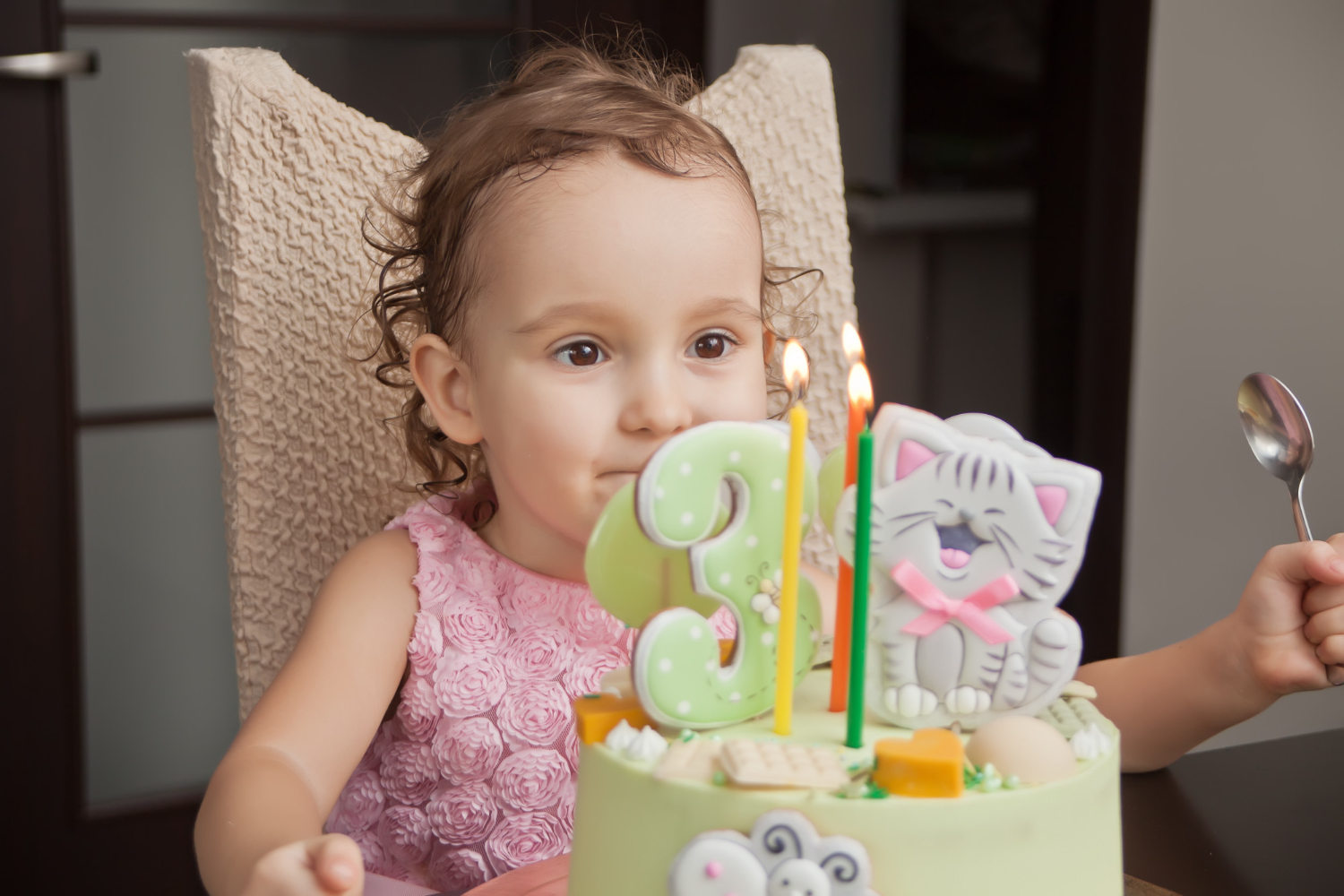
The Third Birthday and 3 Year Old Milestones: A Marker, Not a Reset
A brief note on what actually changes, and doesn’t, right at the third birthday itself.
Development Doesn’t Pause and Restart on a Specific Date
Your child doesn’t develop differently the day after their third birthday compared to the day before. These milestones describe a general window, roughly around this age, not a hard switch on a single calendar date. A skill emerging a few weeks before or after the birthday itself is a developmentally meaningless distinction.
Why the Age 3 Marker Still Matters
Despite this, age three carries genuine practical significance. It’s when formal screening schedules include a checkpoint, when the Early Intervention to Part B transition takes effect, and often when preschool enrollment becomes a live question. The marker matters for these practical, systemic reasons. Your child’s actual development continues on its own continuous timeline, unaffected by the calendar itself.
Using the Birthday as a Natural Checkpoint
Even without any of these formal systems being relevant to your family, the third birthday remains a reasonable, natural moment. It’s a chance to pause and reflect on your child’s development. It’s a clear, memorable point in time that most families already mark in some way.
Putting the Four Areas Together
Communication, play, movement, and independence don’t develop in isolation from each other, and it’s worth understanding how they connect.
Skills Overlap Across Categories
A single everyday moment often draws on more than one area at once. A 3-year-old negotiating a turn in a game uses several skills at once. Communication skills to express their preference. Play skills to understand the game’s structure. Emotional regulation to handle not going first.
Strength in One Area Can Support Another
A child with strong language skills sometimes uses that strength to navigate social situations more easily. Clear communication helps smooth over the natural friction of learning to share and take turns with peers. This doesn’t mean a quieter child struggles socially. It simply illustrates how these domains genuinely interact, each one supporting and drawing on the others in ways that aren’t always obvious.
A Delay in One Area Can Affect How Another Shows Up
A child with a physical coordination difference might show less interest in active group games. This isn’t because the social skill itself is missing, but because the physical demands create a barrier to full participation. This is exactly why professionals evaluating a specific concern often look across multiple domains at once. A single, isolated cause rarely explains everything they’re observing.
What to Do If a Skill Is Missing
If your child hasn’t reached one or more of these milestones, here’s a clear, calm next step.
Give It Focused, Specific Attention
Rather than a vague sense of “waiting to see,” pick the specific skill that feels most uncertain. Watch for it directly over the next few weeks. Try creating natural opportunities for your child to demonstrate it, without turning this into pressure or a test.
For a communication skill, pay closer attention during calm, unhurried moments, like bath time or a car ride. Rushed transitions rarely show the full picture. For a motor skill, offer genuine, low-pressure opportunities to practice. Time at a playground with climbing equipment gives you a fairer chance to observe it.
Keep a Simple, Specific Log
A brief, dated note, even just a sentence or two, every few days genuinely helps. It beats trying to recall weeks of observations from memory alone when a pediatric visit finally arrives. This doesn’t need to be elaborate; a running note on your phone works fine.
Bring Specific Observations to Your Pediatrician
Rather than a general “I’m not sure they’re on track,” bring concrete examples: what you’ve seen, what you haven’t, and how consistently. Specific, concrete information helps your pediatrician give you a more useful, targeted response than a vague worry alone would.
Remember the 75 Percent Threshold
A single missing item from these 3 year old milestones doesn’t mean something is wrong. It means your child is part of the meaningful minority who haven’t reached this specific skill on this specific timeline. That’s still within a genuinely normal range.
Consider the Whole Pattern, Not One Skill in Isolation
A single missing milestone, on its own, is different information than several missing milestones clustered across multiple domains at once. If most of this guide’s checklist matches what you see in your child, with just one or two exceptions, that’s a different picture. Several gaps appearing together tells a different story.

What to Do If a Skill Was There, Then Lost
Losing a skill your child previously had is a different situation from a skill simply arriving later than average. It deserves a different response.
This Deserves a Prompt Call
Regression is worth a prompt call to your pediatrician, not a wait-and-see approach. This means a child who used to say a word, use a gesture, or demonstrate a skill, and now doesn’t. Call directly and describe specifically what you’ve noticed: which skill, when you first noticed the change, and whether it happened gradually or suddenly.
It Doesn’t Automatically Mean Something Serious
Illness, a major life transition, or simple individual variation can sometimes explain a temporary dip in a specific skill. Still, genuine loss of a previously demonstrated skill deserves a direct, prompt conversation, not continued at-home monitoring alone. A pediatrician is far better positioned to sort out which explanation actually fits.
Distinguishing a Plateau From True Regression
A plateau means a skill simply stops advancing for a while, without disappearing entirely. This is a different pattern than genuinely losing a skill your child once reliably demonstrated. Both are worth mentioning at a visit, but true loss of a previously mastered skill deserves the more urgent, prompt conversation described above.
What to Do If Concern Remains
If you’ve watched closely, talked to your pediatrician, and concern still remains, a clear path exists for getting more support.
Trust Your Own Observation
You see your child far more than any single appointment allows. If something feels off despite reassurance from a screening or a pediatrician, ask for a second opinion or a direct evaluation. That’s a completely reasonable choice, not an overreaction.
Parents are frequently the first to notice a genuine pattern, sometimes well before it shows up clearly on a formal screening tool. This comes from the sheer volume of everyday observation a parent accumulates that no single appointment can match.
The Referral Pathway
Your pediatrician can refer your child for a fuller developmental evaluation if concern remains after screening and discussion. This evaluation looks at your child’s skills in depth, across multiple domains, using standardized tools rather than a checklist alone.
A full evaluation typically takes longer and covers more ground than an office screening. It often involves a specialist like a developmental pediatrician, psychologist, or speech-language pathologist, depending on the concern.
The Age 3 Transition: Early Intervention to Preschool Special Education
This specific age carries a genuinely important, distinct transition worth understanding directly, whether or not your child is currently receiving any services.
What changes at age 3. Children under 3 with a developmental delay or disability typically receive services through Early Intervention. This is governed by Part C of the Individuals with Disabilities Education Act, IDEA. These services are usually delivered in a child’s natural environment, like home or daycare. They’re guided by a document called an Individualized Family Service Plan, or IFSP.
At age 3, this system changes. IDEA’s Part B governs services for children 3 and older. These are typically delivered through the local school district’s preschool special education program, guided by a document called an Individualized Education Program, or IEP.
This transition isn’t automatic. A child receiving Early Intervention services under Part C isn’t automatically eligible for Part B preschool special education. The two systems use different eligibility criteria. A transition planning meeting is required no later than 90 days before your child’s third birthday. It determines whether a referral and new evaluation for Part B eligibility makes sense.
The timeline in practice. This transition planning process typically begins even earlier, sometimes up to nine months before the third birthday. This gives families and providers genuine time to plan, rather than facing a last-minute scramble. If your child currently receives Early Intervention, and this conversation hasn’t started yet as their third birthday approaches, raise it directly with your service coordinator.
What the Part B Transition Means in Practice
What this means practically. If your child currently receives Early Intervention services and is approaching their third birthday, ask your service coordinator about this transition timeline. Raise it if it hasn’t already come up. If your child is found eligible for Part B services, an IEP should be in place by their third birthday. This ensures no gap in support.
The evaluation itself. A Part B evaluation typically looks across several domains: communication, motor skills, social-emotional development, adaptive behavior, and early learning or pre-academic skills. This is a genuinely comprehensive look, not a narrow check of just one concern.
If your child doesn’t qualify for Part B. Some children who benefited genuinely from Early Intervention don’t meet Part B’s specific eligibility criteria at age 3. Sometimes the earlier support was effective enough that ongoing special education services aren’t currently needed. If this happens, your Early Intervention team can typically connect you with other community resources and programs. This outcome doesn’t mean the earlier support was wasted. It may well be exactly why your child no longer meets the threshold.
Where services happen. Part B preschool special education services are typically provided in an educational environment. The specific setting, a dedicated classroom, an integrated preschool program, or another arrangement, depends on your child’s individual needs and your state’s programs.
Starting Fresh at Age 3
If your child hasn’t previously received any services but concern is emerging now, you can request an evaluation directly. Go through your local school district’s preschool special education program. A doctor’s referral generally isn’t required first. This is the same Part B system described above, just entered fresh rather than through a Part C transition.
Most school districts have a formal process, sometimes called Child Find. It’s specifically designed to identify and evaluate children who might benefit from these services, even without a prior Early Intervention history.
3 Year Old Milestones: Comparing Siblings and Other Children Fairly
Comparing a 3-year-old to an older sibling, or to other children the same age, is one of the most common sources of unnecessary worry for parents. It’s worth addressing directly.
Why Sibling Comparisons Rarely Help
Each child has their own individual temperament, birth order position, and developmental timeline. A younger sibling reaching a specific milestone later than an older one did at the same age doesn’t predict much. Either child’s long-term development can still follow its own course.
A More Useful Comparison
Rather than comparing your 3-year-old to a sibling or another child, try comparing them to themselves a few months ago. Use the observation habits described earlier in this guide. This gives you a more accurate, less anxiety-inducing way to track progress. Is there more language now than three months ago? More physical confidence? That comparison actually tells you something useful.
What You Don’t See in Other Families
A brief interaction with another family’s 3-year-old, at a playground or a birthday party, shows only a narrow slice of that child’s full development. It’s not their complete picture, and it leaves out whatever challenges that family navigates privately. Comparing your full, close-up view of your own child to a brief glimpse of someone else’s rarely produces a fair or useful comparison.

Managing Your Own Worry While Reading a Checklist Like This
Reading through a detailed milestone list can stir up genuine anxiety, even when a child is developing completely typically. That’s worth naming directly.
Why This Kind of Reading Can Feel Stressful
A long, detailed list naturally invites a kind of mental scorecard, checking off what your child has and hasn’t done. This isn’t how the list is meant to be used, but it’s a genuinely common, human reaction to reading through something this comprehensive.
A More Useful Frame
Rather than reading this guide as a pass-fail exam, treat it as a reference you can return to, section by section, over time. This tends to feel far less overwhelming. You don’t need to resolve every single item today.
If You Notice Yourself Spiraling
Late-night searching is extremely common. So is comparing your child to every other child you encounter. So is imagining worst-case scenarios. Both are common responses to this kind of detailed information. If this happens, step away from the list. Simply spending calm, connected time with your child is often more useful than continuing to search for reassurance online.
Common Obstacles
A few specific situations come up often enough to address directly.
“My child is behind on one thing but way ahead on another.”
This is genuinely common and doesn’t indicate a problem on its own. Development rarely progresses at a perfectly even pace across every single 3 year old milestones domain at once. An early talker with less interest in physical risk-taking, or an active climber with typical language timing, are both common patterns.
“I don’t know if what I’m seeing counts as the milestone or not.”
When in doubt, describe what you’ve actually observed to your pediatrician in plain, specific language. Don’t try to determine yourself whether it technically counts. This is exactly the kind of judgment call a pediatrician is well positioned to help sort through.
“The pediatrician says everything looks fine, but I’m still not sure.”
Trust your own instinct here. You can ask directly for a referral to a specialist, request a repeat screening, or seek a second opinion. None of these require your pediatrician’s enthusiastic agreement.
“I feel guilty comparing my child to a checklist at all.”
This is an understandable feeling. Using a checklist as information, not as a verdict on your parenting or your child’s worth, is exactly what it’s designed for. A checklist is a tool for noticing patterns, not a measure of how well you’re doing as a parent.
“My child seems totally different at daycare than at home.”
This is a genuinely common, normal pattern, not a red flag on its own. Different environments produce different comfort levels and different behavior. Combining observations from both settings gives you a more complete picture than either alone.
“We just moved, changed childcare, or had a major family change, and everything feels off right now.”
Major life transitions genuinely, if temporarily, affect a young child’s behavior and apparent skill level across multiple domains at once. Give a specific concern a few extra weeks to settle after a major transition, before treating it as a lasting pattern. This is a reasonable approach, unless a skill was clearly lost rather than simply inconsistent.
“I’m getting conflicting information from different sources.”
A pediatrician, a teacher, and a family member might genuinely see different things, since each interacts with your child in a different context. Rather than treating this as contradictory, treat it as useful information. Share each perspective with your pediatrician directly, and let them weigh the full picture.
Sharing 3 Year Old Milestones Information Across Every Caregiver
If more than one adult is involved in your child’s care, a little coordination around this guide’s content genuinely helps.
A Shared, Simple Reference Point
Share this guide, or your own specific notes from it, with a co-parent, grandparent, or regular caregiver. This gives everyone the same basic reference point, rather than each person forming a separate, conflicting impression.
Keeping the Focus on Observation, Not Judgment
When sharing concerns with another caregiver, try framing it as “here’s what I’ve noticed” rather than “do you think something is wrong.” This tends to produce more useful, collaborative information than a framing that invites reassurance or alarm.
Respecting Different Comfort Levels
Not every caregiver will feel equally comfortable discussing developmental concerns, and that’s worth respecting genuinely. Share specific, factual observations, rather than pressing for a particular emotional response. This usually works better across a range of family relationships and comfort levels than trying to force a reaction.
Adapting This to Every Family’s Situation
Budget. Monitoring your child’s development, and the observation habits in this guide, cost nothing. Formal evaluations through your local school district’s Part B program are free, by federal law.
Schedule constraints. If a formal evaluation feels like too much right now, simply raise a specific concern at your child’s next pediatric visit. That’s a reasonable, low-effort first step.
Access to care. If you don’t have a regular pediatrician, community health centers can typically help. They connect you with developmental screening and your local school district’s evaluation process directly.
Multilingual and immigrant families. Developmental evaluations are required to accommodate your family’s home language, including providing a qualified interpreter when needed, at no cost to your family.
Different family structures. Whoever knows your child best is the right person to raise concerns and advocate during any evaluation or referral process. This holds regardless of the specific caregiving arrangement.
Families managing multiple children’s needs. If you’re tracking milestones for more than one child at once, focus your closest attention on whichever child currently has an active concern. Applying equal scrutiny to every child at every moment isn’t necessary or sustainable.
Working parents with limited time. Observation for this guide’s purposes doesn’t require dedicated extra time. It fits into the daily routines and interactions you’re already having with your child.
Families new to the U.S. system. If pediatric well-child visits, screening schedules, or the special education referral process feels unfamiliar, ask for help. Your pediatrician’s office or a local community health center can walk through how these systems work in your state.
Frequently Asked Questions
Questions About the Milestones Themselves
Is this the complete CDC checklist, or are there more milestones at this age? This guide covers the CDC’s core 3 year old milestones, organized around communication, play, movement, and independence. The CDC’s official checklist is available directly through their Milestone Tracker app or printable checklist. It’s worth reviewing directly if you want the complete, official list.
Do boys and girls reach these milestones at different rates? Some research shows modest average differences in certain areas, particularly language timing. Girls sometimes reach certain verbal milestones slightly earlier on average. Individual variation within each sex is far larger than this average difference, so it shouldn’t be used to predict any specific child’s timeline.
My child reached most of these months ago. Does that mean they’re gifted? Reaching these 3 year old milestones earlier than average doesn’t necessarily predict long-term academic or intellectual outcomes on its own. It simply reflects this specific child’s current developmental pace, which can shift in either direction over time.
Why did the CDC change its milestone checklists in 2022? The update moved the threshold from roughly 50 percent to 75 percent of children. This was intended to make the checklist a clearer, more actionable signal. A milestone only about half of children have reached isn’t a very useful marker for concern. One that three in four children have reached offers more genuine, useful information.
Questions About What to Do Next
Should I be worried if my 3-year-old isn’t interested in pretend play at all? Not necessarily, though it’s worth mentioning at a well-child visit if it persists alongside other differences in play or social interaction. Some children simply show less interest in pretend play specifically while developing typically in every other way.
How is this different from the milestones at 2 or 4 years old? Each age has its own specific, distinct set of markers reflecting what’s developmentally expected at that particular stage. Our companion guides on 2-year-old and 4-year-old milestones cover those specific ages in the same depth as this guide covers age 3.
If my child was adopted or joined our family after infancy, do these milestones still apply? Generally yes. A child’s history before joining your family, including any early adversity or limited early language exposure, can genuinely affect developmental timing, though. Sharing this history directly with your pediatrician helps them interpret any specific milestone questions in the right context.
Is it normal for a 3-year-old to regress slightly after a new sibling arrives? Yes, this is a well-documented, common pattern. A temporary step back in a previously mastered skill, like toileting or independent dressing, often resolves on its own within a few weeks. This happens as a child adjusts. Still, it’s worth mentioning at a visit if it persists much longer.
A Few More Practical Questions
Does screen time affect whether my 3-year-old reaches these milestones? Excessive passive screen time is associated with somewhat slower language development in some research. It largely displaces the interactive, back-and-forth engagement that builds these skills most effectively. This doesn’t mean any screen time at all is harmful; the concern is more about what it may be replacing.
My 3-year-old was born prematurely. Should I use their actual age or their due date when checking this list? For a child born significantly early, your pediatrician can advise on whether corrected age still applies at this point. By age three, this adjustment often matters less than it did in infancy. If your child was born only a few weeks early, this adjustment is typically minimal or unnecessary by this age.
How often should I actually reread or check this list? There’s no required schedule. Many families find it useful to revisit a guide like this around a birthday. Others do it before a well-child visit, or whenever a specific new concern comes up. There’s no need for a fixed, recurring schedule.
Is it normal for my 3-year-old to have an imaginary friend? Yes, imaginary friends are a common, normal part of pretend play development for many children around this age and beyond. This reflects healthy, active imagination, not a sign of loneliness or a cause for concern on its own.
Simple Ways to Support Development at This Age
This guide focuses on describing milestones, not teaching techniques. Still, a few general, low-pressure habits genuinely support development across all four areas covered here.
Everyday Conversation Matters More Than Flashcards
Genuine, back-and-forth conversation during ordinary moments, meals, car rides, bath time, does more for communication development than structured drills or educational materials. Our companion guide, How to Encourage Toddler Language During Meals, Play, and Daily Routines, covers specific, practical techniques for this in depth.
Unstructured Play Time Matters
Open-ended play, without a predetermined “right” outcome, supports pretend play, problem-solving, and social skills all at once. A block set, some dolls, or simple art supplies, with time and space to explore them freely, does real developmental work.
Physical Activity Supports More Than Just Motor Skills
Active, physical play, like running, climbing, and jumping, supports gross motor development directly. It also contributes to attention, emotional regulation, and overall well-being. Regular time outside or in an open indoor space genuinely matters.
Consistent Routines Support Independence
Predictable daily routines, dressing, mealtime, bedtime, give a 3-year-old repeated, low-pressure opportunities to practice the independence skills covered in this guide. The same routine, repeated daily, is exactly the kind of consistent practice that builds these skills over time.
What This Guide Cannot Do
A direct, honest note on the limits of any milestone guide, including this one.
This Isn’t a Diagnostic Tool
No article, checklist, or general guide can diagnose a developmental condition, and this one doesn’t attempt to. Only a qualified professional, using formal evaluation tools and direct, hands-on assessment, can make a genuine diagnosis.
This Isn’t a Substitute for Your Pediatrician’s Judgment
Your pediatrician knows your child’s specific history. They’ve observed them directly over time, and can weigh factors this general guide simply can’t account for. Use this guide to prepare for that conversation and bring real, specific information to it, not to replace it entirely.
General Patterns Don’t Capture Every Individual Child
Even with every variation and caveat named throughout this guide, no general resource can fully capture the reality of your particular three-year-old. Your own close observation, combined with professional guidance when genuinely needed, remains the single most reliable approach available to any family.
Finding the Official CDC 3 Year Old Milestones Resources Directly
This guide draws directly from CDC materials, and knowing where to find the originals is genuinely useful too.
The Milestone Tracker App
CDC’s free Milestone Tracker app is available for both iOS and Android devices. It lets you complete an interactive checklist, track progress over time, and receive reminders about upcoming well-child visits and screenings.
The Printable Checklist
A printable, two-page checklist is also available directly through the CDC’s Learn the Signs. Act Early. website, useful if you’d rather work through a physical copy or bring a printed version along to a pediatric visit for direct reference during the conversation.
Materials in Other Languages
CDC’s milestone checklists are also available translated into multiple languages beyond English. This is a genuinely useful resource for multilingual families, ensuring every caregiver has equal access to the same clear, accurate information.
Recognizing the Difference Between Mild Uncertainty and Genuine Concern
A brief, honest framework helps calibrate how urgently to respond to what you’re noticing. Not every observation deserves the same level of urgency or action.
Mild Uncertainty Usually Warrants Watching, Not Urgent Action
A single milestone that seems slightly behind, without any other pattern of concern, usually warrants continued watching. Mention it at the next regular visit, rather than making an urgent, immediate call. This measured pace respects both the genuine variability described throughout this guide and your own reasonable desire for information and reassurance.
Several Signs Together Warrant a More Prompt Conversation
A few signs warrant a more prompt, direct conversation with your pediatrician, rather than an extended wait-and-see period. Multiple missing milestones clustered across different domains. A skill that was clearly present and is now genuinely gone. A consistent gut feeling that something is different.
When in Doubt, Ask
If you’re ever unsure which category your specific situation falls into, asking your pediatrician directly is always the reasonable choice. No concern is too minor to mention. No pediatrician will fault a parent for asking a genuine question about their own child’s development. This holds true even for one that turns out to need no further action.
Your One Next Step
Pick one section from this guide: communication, play, movement, or independence. Spend a few days simply noticing what you actually see, without judgment either way. Write down a few specific examples. That concrete record is more useful at your next pediatric visit than a general impression alone, whatever it turns out to show.
Whatever you find, remember the number at the heart of this whole guide to 3 year old milestones. These skills describe most children, not every single one. Your own close attention to your specific child matters more than any single item on this list. This holds true today, and at any point along the way.
Sources consulted: Centers for Disease Control and Prevention, Learn the Signs. Act Early., 3-year milestone checklist (2022 update); American Academy of Pediatrics developmental screening schedule; U.S. Department of Education guidance and multiple state education agency resources on the IDEA Part C to Part B transition at age 3.