

Maybe a preschool application just asked whether your child can recognize letters and count to twenty, or another parent mentioned their 3-year-old already “knows all her letters,” and now you’re wondering about preschool readiness in a way that feels more like a test than a transition. Or maybe you’re just trying to figure out, in practical terms, whether your family and your child are actually set up for this to go reasonably well.
Here’s the direct answer: preschool readiness is not primarily about academic skills like knowing letters, numbers, or being able to sit still for long stretches. According to the Head Start Early Learning Outcomes Framework — the most widely used U.S. framework for what “ready” actually means at this age — readiness spans five broad areas of whole-child development, most of which have nothing to do with academics at all, and Head Start’s own approach explicitly frames readiness as something a child, a family, and a program all share responsibility for together, not a test a 3- or 4-year-old passes or fails alone. This guide walks through what actually matters — for your child, and for the practical realities your family is managing — so you can figure out what to focus on instead of chasing a letters-and-numbers checklist that was never the real bar to begin with.
Young children change quickly, and the same worry that feels urgent this week can look completely different in a month, for reasons that are themselves useful information rather than a verdict either way. This guide is organized so you can use whichever part actually applies to your situation right now — the developmental picture if you’re wondering whether your child is “ready” in the abstract, or the practical logistics section if what you actually need is a plan for cost, schedule, or a specific policy question — rather than needing to read the whole thing before you can act on any of it.
The Direct Answer: What Preschool Readiness Actually Means
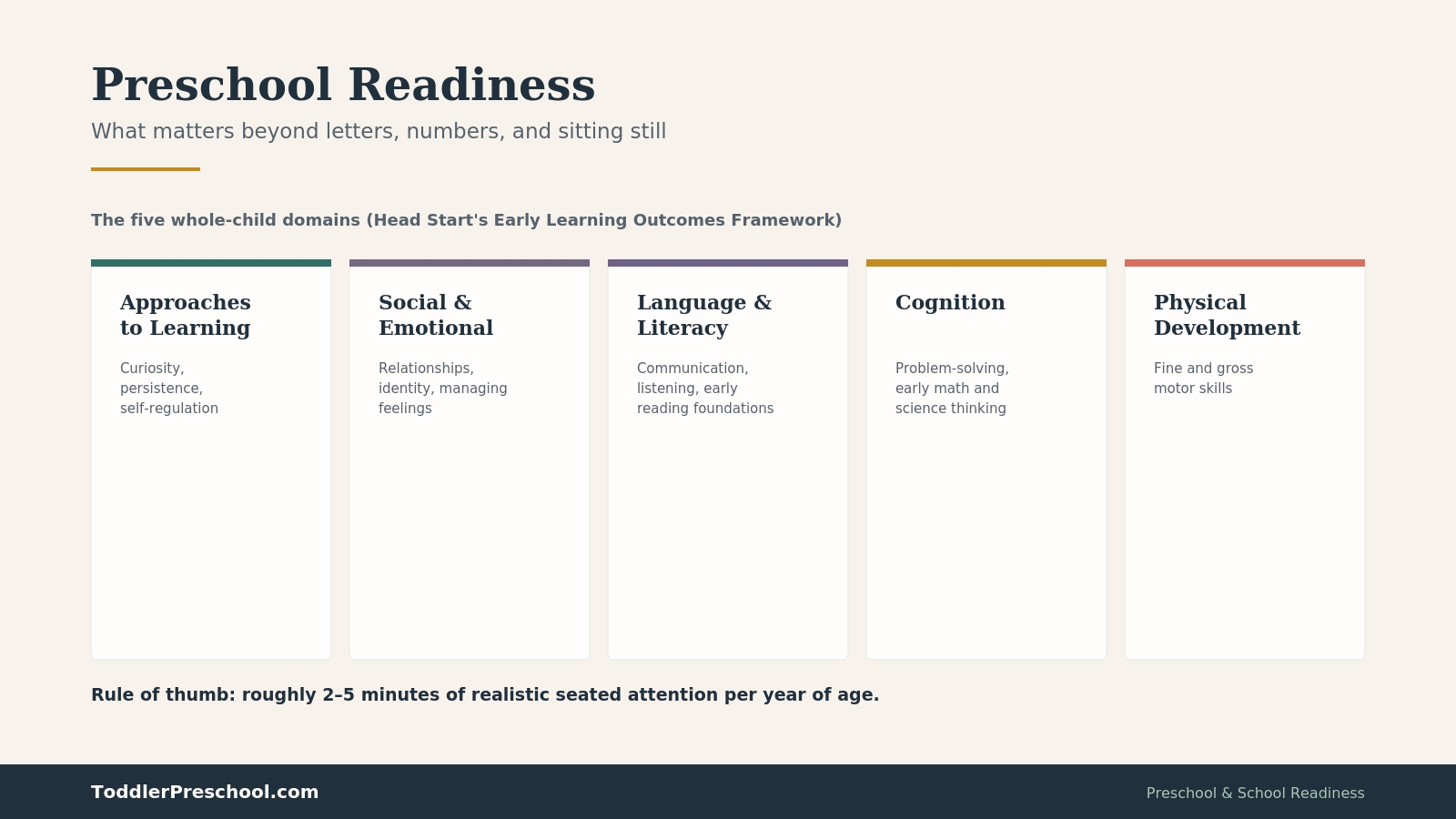
If you take one thing from this guide, let it be this: sitting still for a long period and reciting the alphabet were never the actual definition of preschool readiness, and a program worth choosing doesn’t expect either from most 3- and 4-year-olds walking in the door. Sustained, quiet sitting is a skill that develops gradually over the preschool years themselves — it’s something good programs help build through short, engaging activities, not a prerequisite children are supposed to arrive already having mastered. A commonly cited rule of thumb among early-childhood educators is roughly two to five minutes of realistically sustained focused attention per year of a child’s age for a seated, adult-directed task — meaning a genuinely typical 3-year-old might manage something like six to fifteen minutes before needing to move, not the twenty or thirty minutes an anxious comparison to an older sibling or a formal classroom might suggest. This is exactly why a well-designed preschool day, covered in detail below, is built around short blocks and frequent movement rather than long stretches of seated instruction.
Head Start’s Early Learning Outcomes Framework (ELOF) — used to guide school-readiness goals across Head Start programs nationwide and widely referenced by early-childhood researchers and state pre-K systems — organizes early learning into five central domains:
- Approaches to Learning — curiosity, persistence, self-regulation, and creativity
- Social and Emotional Development — relationships, identity, and managing emotions
- Language and Literacy — communication, listening, and the early foundations of reading and writing
- Cognition — problem-solving, early math and science thinking, and general knowledge
- Perceptual, Motor, and Physical Development — both fine and gross motor skills, and physical well-being
Notice what’s not a separate headline category in preschool readiness: reciting letters, counting past ten, or sitting quietly on command. Those things show up in small pieces inside the broader domains above, but they’re outcomes of healthy whole-child development over the preschool years — not entrance requirements.
Just as importantly, Head Start’s own approach to school readiness explicitly defines it as three-part, not child-only: children are ready for school, families are ready to support their children’s learning, and schools are ready for children. That third piece matters more than most readiness content admits — a genuinely “ready” family isn’t one whose child has memorized flashcards, and a genuinely “ready” program is one equipped to meet children where they actually are, including children with disabilities, multilingual children, and children with a wide range of temperaments and life experiences. Readiness is a fit to build together, not a solo hurdle for a 3-year-old to clear.
The Five Whole-Child Preschool Readiness Domains
Here’s what each ELOF domain actually looks like in an ordinary child, with realistic examples and — just as important — what’s not worth worrying about at this stage.
Approaches to Learning: Curiosity, Persistence, and Self-Regulation
This domain covers how a child engages with new things, not what they already know. It includes noticing something interesting and investigating it, trying again after something doesn’t work the first time, and — gradually, imperfectly — managing big feelings well enough to stay engaged in an activity.
What this looks like day to day: a 3-year-old who gets frustrated when a puzzle piece doesn’t fit, throws it down, and then — sometimes with help, sometimes on their own — comes back to try again a few minutes later. A child who asks “why” repeatedly isn’t being difficult; that’s curiosity, which is exactly what this domain is tracking. By around 36 months, many children can maintain focus on a simple activity for short periods and use a strategy (seeking a familiar adult, stepping away briefly) to handle strong feelings — “short periods” and “a strategy,” not sustained calm concentration or full independent emotional regulation.
What’s not worth worrying about: a child who still needs significant adult help to calm down, who loses interest in an activity after a few minutes, or who has a hard time with transitions between activities. All of that is typical for this age range and is exactly the kind of thing a good preschool classroom is structured to support, not something your child needs to have already solved.
A variation worth naming directly: a child with a disability affecting attention, sensory processing, or emotional regulation may show this domain very differently than the general pattern above, and that’s a reason for an individualized conversation with your program and any specialists involved — not a reason to assume something is categorically wrong.
Social and Emotional Development: Relationships and Feelings
This domain covers how a child connects with adults and other children, understands who they are, and expresses and manages emotions — not whether they already have a best friend or share effortlessly.
What this looks like day to day: a child who checks in with a trusted adult in an unfamiliar situation, who shows interest in another child playing nearby even without joining in yet, or who’s beginning to use a word for a feeling (“mad,” “sad”) instead of only showing it physically. Parallel play — playing near other children without much direct interaction — is a typical, expected stage at this age, not a sign of a social gap.
What’s not worth worrying about: shyness in new situations, difficulty sharing, or needing an adult’s help to resolve a conflict with another child. These are ordinary parts of this developmental stage, and they’re precisely why preschool classrooms have teachers actively involved in social coaching, not passive observers waiting for children to arrive with these skills already in place.
A variation worth naming directly: cultural norms around eye contact, physical affection with unfamiliar adults, and appropriate assertiveness vary across families, and a program experienced with cultural and linguistic diversity should be reading a child’s social behavior in that context, not against one narrow cultural default.
Language and Literacy: Communication, Not Reading Fluency
This domain covers listening, understanding, and expressing themselves with language, plus early groundwork for reading and writing — not decoding words or writing legible letters.
What this looks like day to day: a child who can follow a simple two-step instruction, who’s building vocabulary steadily (even if slowly, or across more than one language), who enjoys being read to and can talk about a picture in a book, or who’s starting to notice that print carries meaning (pointing at a stop sign, “reading” a familiar book from memory). None of that requires knowing the alphabet by name or writing their own name legibly — those are later-developing skills within this same broad domain, not readiness prerequisites for entering it.
What’s not worth worrying about: a child who isn’t yet combining longer sentences, who mixes languages if raised multilingual, or who has no interest in letters or writing yet at age 3. All typical. A child learning more than one language at home is often working with a smaller vocabulary in each individual language while their combined vocabulary is comparable to or larger than a monolingual peer’s — a pattern, not a delay.
Cognition: Problem-Solving and Curiosity About the World
This domain covers thinking, reasoning, and general knowledge — early math and science thinking through play and exploration, not academic instruction.
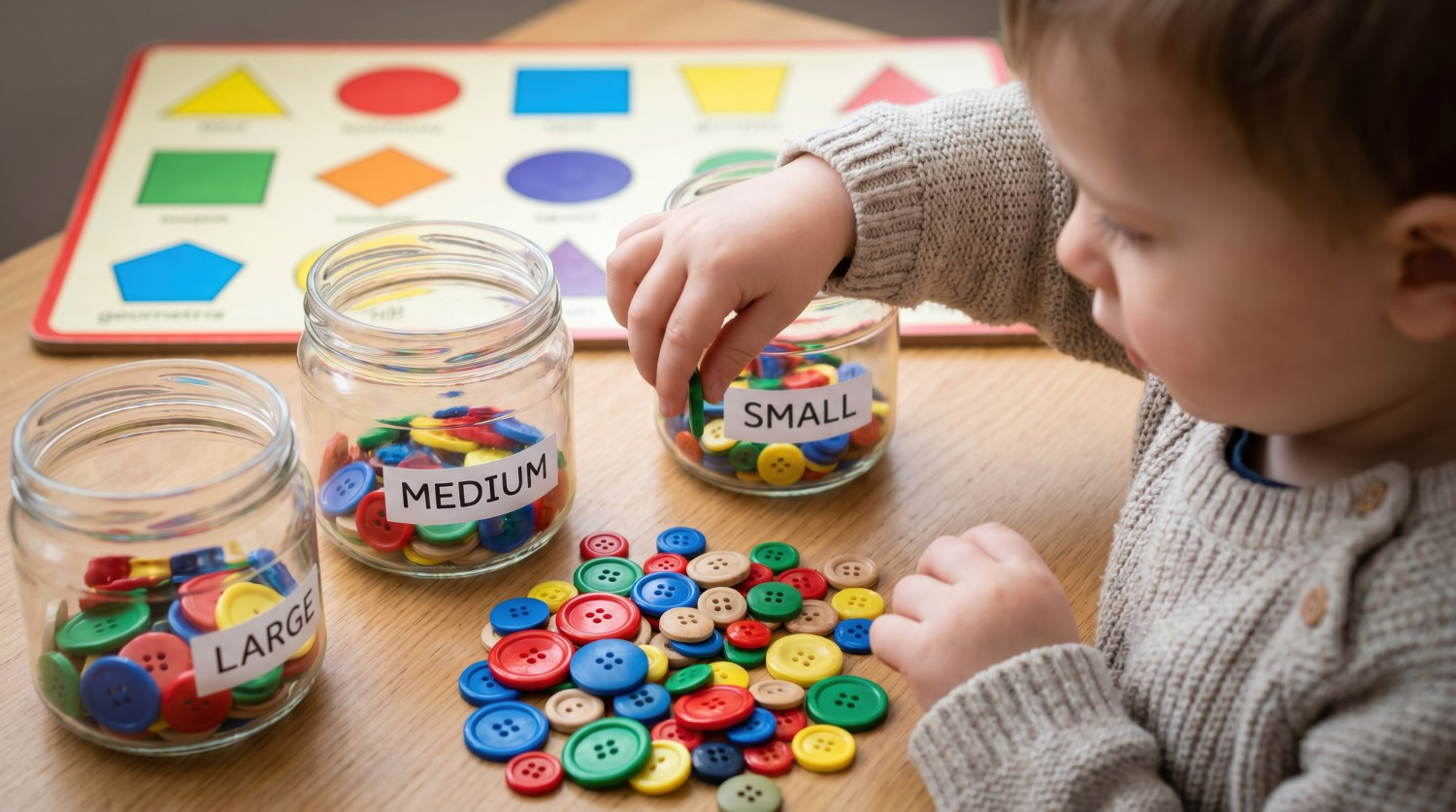
What this looks like day to day: sorting objects by color or size, noticing that a taller cup holds more water than a short one, counting a few objects out loud (even if the count doesn’t always match the number of objects yet), or asking questions about how something works. This is the domain most often mistaken for the academic side of preschool readiness, but at this age it happens almost entirely through play, conversation, and hands-on exploration — a sandbox and a set of measuring cups do more of this work than a workbook.
What’s not worth worrying about: not yet counting accurately past five or ten, not knowing shape names beyond circle and square, or not showing interest in numbers at all yet. This domain develops enormously across the preschool years themselves; it’s the process the preschool years are for, not a gate in front of them.
A variation worth naming directly: a child who’s had less exposure to counting, shapes, or measurement concepts at home — for reasons of family schedule, resources, or simply different priorities — isn’t behind in ability, just in exposure, and a quality program actively builds this regardless of what a child arrives already having practiced.
Perceptual, Motor, and Physical Development
This domain covers both fine motor skills (grasping a crayon, using scissors with help, stacking small objects) and gross motor skills (running, climbing, throwing and catching), plus general physical well-being.
What this looks like day to day: a child who can walk up and down stairs with some independence, climb playground equipment with a bit of caution, hold a crayon with a developing (not necessarily “correct”) grip, and manage some self-help physical tasks like pulling off a loose sock. Fine motor control in particular develops gradually and unevenly — a child might climb confidently and still find using scissors genuinely difficult, and that’s a completely typical combination, not a red flag.
What’s not worth worrying about: an immature pencil grip, difficulty with scissors, or being more cautious than peers on physical equipment. Quality preschool programs build in daily opportunities to practice all of this — that’s part of what the preschool years are for, not something a child needs to bring already polished.
A variation worth naming directly: a child with a physical disability or motor delay may reach this domain’s milestones on a very different timeline or through different means entirely (adaptive equipment, alternative movement patterns), and that’s a matter for an individualized plan with your child’s specialists and the program, not a mark against general readiness.

Self-Help and Everyday Independence: The Quiet Side of Preschool Readiness
Alongside the five ELOF domains, most preschool programs also care — informally, but genuinely — about a set of everyday self-help skills, because they affect how smoothly a classroom day runs for everyone. It’s worth naming these directly and separately, since they’re often what parents are actually anxious about when they ask about “readiness”:
- Toileting. Covered in detail below — policies vary widely, and full independence is not a universal requirement.
- Basic dressing. Managing some clothing independently (pulling pants up, attempting a jacket) helps, but most programs expect to assist with this regularly, especially early in the year. Clothing with simpler fasteners (elastic waists, Velcro shoes) can make a real difference in how independent a child feels capable of being, faster than practicing the skill itself sometimes does.
- Eating with some independence. Using a utensil reasonably, even messily, and eating a meal in a group setting without one-on-one adult feeding. A child who’s mostly eaten solo at home may need a few practice meals at a table with other people present, even just family members, to get used to eating in a group.
- Following a simple routine. Transitioning between activities when a teacher signals it’s time, with support — not silently and instantly, just without prolonged distress every single time. Practicing transitions at home with a simple warning (“two more minutes, then we clean up”) gives a child the same kind of heads-up a classroom routine will use.
- Basic communication of needs. Some way — verbal, gestural, sign, or an alternative communication method — to indicate hunger, needing the bathroom, or being hurt, even if that communication isn’t sophisticated yet. If your child uses an alternative or augmentative communication method, sharing it with the program in detail before day one, not after a problem comes up, gives staff the best chance of understanding your child correctly from the start.
None of these need to be fully mastered before day one. They’re areas where a good program expects to keep teaching, not a checklist a family needs to complete in advance — and for a child with a disability affecting any of these areas, an individualized plan developed with the program (more on this below) is the right tool, not a private effort to catch up beforehand.
What a Typical Preschool Day Actually Looks Like
Part of preschool readiness anxiety comes from simply not knowing what the day involves. Programs vary — a half-day program compresses this into two to three hours, while a full-day program stretches it across six to ten hours with more built-in rest and multiple outdoor blocks — but a common structure for a play-based preschool classroom looks something like this:
| Time Block | What’s Typically Happening |
|---|---|
| Arrival and free play | Children settle in, often with quiet choice activities (blocks, puzzles, a book corner) as everyone arrives at slightly different times |
| Circle time | A short, whole-group gathering — a song, a calendar routine, a story, an introduction to the day’s theme. Usually brief; long seated circle time isn’t developmentally realistic for most 3- and 4-year-olds |
| Centers or choice time | The heart of a play-based day — children rotate through or choose among areas like dramatic play, art, blocks, sensory bins, and a writing or math center, mostly self-directed with teacher support |
| Outdoor or gross-motor time | Playground time or an indoor movement alternative on bad-weather days; often more than once across a full day |
| Snack or meal | A seated group snack or meal, sometimes with a self-serve or family-style component that also builds fine motor and self-help skills |
| Story time | A read-aloud, often with discussion, sometimes tied to the day’s theme |
| Rest or quiet time | Especially in full-day programs — a nap opportunity for children who sleep, quiet independent activity for those who don’t |
| Closing circle and dismissal | A short wind-down, sometimes a goodbye song or a review of the day, staggered pickup |
Two things worth noticing in that structure: very little of the day is spent in extended seated instruction, and most of the actual learning described in the five ELOF domains above happens inside “centers” and “outdoor time,” not in a separate academic block. If a program’s actual daily schedule looks dramatically different from this — long stretches of required seatwork, minimal free play, no outdoor time built in — that’s worth asking about directly during a tour, since it’s a meaningful departure from what early-childhood research supports at this age.
Preschool Readiness Beyond the Child: What to Look For in a Program
This is the part of preschool readiness that has nothing to do with your child’s skills at all — and it’s often where families spend the least intentional time, even though it affects daily life just as much as any developmental domain.
Safety
Ask directly about the basics rather than assuming: staff-to-child ratios and whether they meet your state’s licensing minimums, background check and training requirements for staff, emergency and evacuation procedures, allergy and medication protocols, and how the program handles pickup authorization and visitor access. Licensed programs are required to meet your state’s specific safety and ratio standards — you can typically verify a program’s licensing status and any past violations through your state’s child care licensing agency website. It’s also reasonable to ask directly about playground equipment safety checks, how the program secures the building against an unauthorized person entering, and whether staff are trained in basic first aid and CPR — these are standard questions any licensed program should be able to answer confidently and specifically, not vaguely.
Play-Based Learning vs. Academic Drilling — What Preschool Readiness Quality Looks Like
Given everything above, a program heavy on worksheets, flashcard drills, and long periods of required quiet sitting for 3- and 4-year-olds is working against the research, not toward it — leading early-childhood organizations consistently point to play-based, hands-on learning as the developmentally appropriate approach at this age, not a lesser alternative to direct instruction. When you tour a program, dramatic play areas, blocks, art materials, sensory bins, and outdoor time in daily use are stronger readiness signals than a wall of alphabet worksheets. A good program teaches early literacy and math concepts constantly — just mostly through conversation, books, songs, and hands-on materials rather than seatwork.
Inclusion and Accommodations for Disability in Preschool Readiness Programs
Under federal law (the Americans with Disabilities Act and, for public programs, IDEA), preschool-age children with disabilities generally have a right to appropriate accommodations, and many attend the same classrooms as their peers with individualized supports in place. If your child has an IEP, an IFSP transitioning toward an IEP, or other documented needs, ask a prospective program directly and early: what experience they have supporting children with similar needs, how they’ll implement any existing plan, and who the point person for coordinating that support will be. A program’s honest answer to “we haven’t done this before, but here’s how we’d approach it” can be a reasonable sign of good faith — a program that seems unwilling to engage with the question at all is a more meaningful concern than one still building specific experience.
If your child has been receiving Early Intervention (Part C) services under an IFSP, the transition process toward a preschool-based IEP (Part B, which covers ages 3 through 21) typically starts with a transition planning meeting before your child’s third birthday, coordinated through your local school district’s special education office. This process generally includes a new evaluation specific to preschool eligibility criteria, which can differ somewhat from the Part C criteria your child was originally evaluated under — meaning a child who qualified for Early Intervention doesn’t automatically, by default, qualify for preschool special education services, though many do. Starting this conversation with your Early Intervention coordinator well before the third birthday, rather than waiting for it to be initiated for you, tends to make the transition smoother and reduces the chance of a service gap right at the transition point.
Rest and Nap Policies
Ask directly what the daily rest expectation is and how it’s handled for children who don’t nap. Many preschool classrooms still include a rest period even for non-sleeping children (quiet books, a mat, soft music), since sleep needs vary widely at this age and there’s no fixed age when napping is “supposed” to end.
Toileting Expectations
Policies vary enormously by program, and it’s worth asking directly rather than assuming: some centers require full daytime toilet independence to enroll, others don’t, and licensed child care centers are generally required to have accident-handling procedures regardless of their enrollment policy. If your child isn’t fully toilet trained by a program’s stated cutoff, ask specifically whether any flexibility or timeline exists — policies are sometimes more negotiable in practice than the official paperwork suggests, especially for a child close to ready. It’s also worth asking what supplies you’re expected to provide (spare clothes, diapers or pull-ups if still needed, wipes) and how the program handles the transition once your child is fully trained, so nothing gets awkwardly stuck at “almost there” longer than it needs to.
Meals and Snacks
Ask what’s provided versus what you need to send, how allergies are handled (and get the program’s specific food policy in writing if your child has one), and whether meals are eaten family-style at a table or another way. Budget-conscious families should also ask directly whether the program participates in a federal nutrition program like CACFP (the Child and Adult Care Food Program), which can reduce what a family needs to provide or pay out of pocket. If your child has strong food preferences or a limited range of accepted foods — common and typical at this age — it’s worth asking whether the program allows any accommodation for a child still working through ordinary pickiness, separate from a diagnosed allergy or feeding concern.
Communication With Teachers and the Program
Ask how the program routinely communicates with families — a daily app or note, a designated pickup-time check-in, scheduled conferences — and how to reach a teacher directly with an ongoing concern rather than only in a crisis. Programs vary enormously here, and a mismatch between how much communication you want and how much a program provides is a common, fixable source of frustration if it’s addressed directly and early rather than assumed. It also helps to ask how the program prefers to receive information going the other direction — a change in your child’s routine at home, a stressful event in the family, a new word or behavior you want them watching for — since good communication runs both ways, not just program-to-family.
Cost and Financial Assistance
Preschool cost varies enormously by state, program type, and whether a family qualifies for public funding — enough that a single national number isn’t very useful, but rough context still helps with planning. Part-day and community-based programs often run roughly $400 to $900 a month; full-time private preschool commonly falls somewhere between $800 and $2,000-plus a month depending heavily on region, with major metro areas on the coasts routinely at the high end and many Southern and Midwestern states considerably lower. Free or near-free options — Head Start, income-eligible state pre-K, and CCDF-subsidized care — exist specifically to close this gap for qualifying families, which is exactly why it’s worth researching eligibility directly rather than assuming a program is out of reach based on its sticker price alone.
It’s worth directly asking any program about the full cost breakdown (tuition, registration fees, supply fees, before/after care add-ons) and separately researching what’s available in your specific state and county:
- Head Start and Early Head Start provide free, federally funded programming for income-eligible families (and, in most programs, guaranteed spots for children with diagnosed disabilities regardless of income).
- State-funded pre-K exists in most, but not all, states — some offer it universally to all 4-year-olds regardless of income, some restrict it by income or specific need categories (disability, being an English language learner, involvement with child protective services), and a handful of states currently have no state-funded program at all. Eligibility and available slots vary by district even within a state that offers it.
- Child Care and Development Fund (CCDF) subsidies, administered by each state, can help income-eligible families afford private child care and preschool tuition.
- Sliding-scale and nonprofit programs, often run through community organizations, houses of worship, or local nonprofits, sometimes offer reduced tuition based on income even outside the state and federal systems above.
Because eligibility rules, income thresholds, and available funding change by state and by year, your state’s child care resource and referral agency (searchable through childcare.gov) is a more reliable, current source than a general estimate — worth contacting directly rather than assuming your family doesn’t qualify for anything.
Schedule and Days-Per-Week Fit
Programs vary from a couple of mornings a week to full-day, five-days-a-week care, and the “right” schedule depends entirely on your family’s actual work, caregiving, and budget situation — not on what maximizes a child’s academic exposure. A half-day, two-or-three-day program is a completely legitimate choice for a family for whom it fits better, not a lesser version of “real” preschool.
Transportation
Ask directly whether a program offers transportation, whether it has any cost, and what backup plan exists if your usual drop-off or pickup arrangement falls through on a given day. For families without reliable transportation, this is sometimes the single most practical readiness factor — worth confirming before enrollment, not after, since a program that’s otherwise a great fit isn’t functional if you can’t consistently get your child there.
State and District Variation in Preschool Readiness Programs
Nearly everything above — funding, eligibility age cutoffs, licensing standards, required ratios — varies by state and often by school district within a state. A child who turns 4 by September 1 might qualify for a given state’s public pre-K in one state, while a neighboring state uses a different cutoff date entirely (some fall in August, some in October or December), or bases eligibility on income rather than age alone. Some states currently run universal pre-K available to every 4-year-old regardless of income; others restrict state-funded seats specifically to lower-income families or children with disabilities; a handful of states currently run no state-funded preschool program at all, leaving Head Start and private tuition as the primary options. Even within a single state, participating school districts, available seats, and whether a program is full-day or part-day can differ considerably by neighborhood. There’s no substitute for checking your specific state and district directly; a national guide (including this one) can tell you what questions to ask, not what your local answer will be.
Program Tour Checklist
A single table to bring with you, mentally or literally, when touring or calling a program:
| Topic | Ask This |
|---|---|
| Safety | What’s the staff-to-child ratio, and is the program currently licensed in good standing? |
| Play vs. academics | What does a typical morning actually look like, hour by hour? |
| Inclusion | What’s your experience supporting children with an IEP or IFSP, and who coordinates that? |
| Rest | Is there a daily rest period, and what happens for kids who don’t nap? |
| Toileting | What’s your policy, and is there flexibility for a child who’s close but not fully there? |
| Meals | What’s provided, how are allergies handled, and do you participate in CACFP? |
| Communication | How do you routinely update families, and how do I reach a teacher directly? |
| Cost | What’s the full cost breakdown, and do you accept subsidies or offer sliding-scale tuition? |
| Schedule | What schedule options exist, and is part-time genuinely available? |
| Transportation | Do you offer transportation, and what’s the backup plan if my usual arrangement falls through? |
Signs a Program Is a Good Fit, Beyond the Checklist
Some of the most useful information during a tour won’t come from a direct answer to a direct question — it comes from what you notice. A few things worth paying attention to:
- How teachers talk to children in the room, not just to you. Warm, specific, respectful language toward children during a tour (“I see you’re building something tall!”) is a better signal than a polished pitch aimed at parents.
- How the room handles a conflict or a meltdown in real time, if you happen to see one. A calm, matter-of-fact response from staff tells you more about actual practice than any brochure claim about “positive discipline.”
- Whether children seem genuinely engaged, not just busy. Purposeful mess, focused play, and a range of activities in progress at once is a good sign; a silent, uniformly tidy room during active hours is sometimes a sign of more adult-directed control than child-led engagement.
- What’s on the walls. Children’s own varied artwork and documented projects suggest process-focused, individualized learning; a wall of identical, adult-made crafts suggests something more templated.
- How your specific questions are received. A program that answers direct questions about cost, toileting policy, or disability accommodations plainly and without defensiveness is telling you something useful about how they’ll communicate with you once your child is enrolled.

Common Obstacles to Preschool Readiness and Realistic Troubleshooting
A few specific preschool readiness situations come up often enough to address directly, rather than leaving families to guess.
“My child isn’t potty trained yet and enrollment is close.”
Ask the specific program about their actual flexibility rather than assuming the stated policy is final — many programs have more room here than their paperwork suggests, especially if you’re honest about where your child is and communicate a realistic plan. If a program’s policy is genuinely firm and your child isn’t there yet, it’s reasonable to look at other options with a later start date or a different toileting policy rather than trying to force training on a deadline, which tends to backfire and can make the process take longer, not shorter. A rushed, pressure-driven approach to toilet learning in the weeks before a hard deadline is one of the more common ways this particular obstacle turns into a genuinely stressful few weeks for everyone.
“We can’t afford full-day care, but that’s what’s available near us.”
Ask every program you’re considering about part-time options even if their marketing emphasizes full-day — some offer more flexibility than advertised. Community-based and nonprofit programs, along with state pre-K (which is often part-day), are worth researching specifically if cost is the primary barrier, alongside CCDF subsidy eligibility in your state. It’s also worth asking whether a program allows splitting the week with another family or a part-time nanny share arrangement to cover the gap between a part-day program and a full work day, which some communities have informal networks for even without a formal program offering it.
“Our first-choice program has a waitlist, and we’re not sure what to do in the meantime.”
Ask directly how the waitlist works — whether it’s ranked by application date, priority category (siblings, income, need), or another system, and roughly how often spots open up. It’s reasonable to stay on a waitlist while also actively enrolling somewhere else for the interim; most families don’t lose their waitlist spot by doing this, but it’s worth confirming that specific program’s policy rather than assuming. A temporary placement that’s “good enough” for a semester or a year is a completely reasonable bridge, not a permanent compromise.
“My child is shy, not very verbal yet, or gets overwhelmed easily.”
This is common and not, on its own, a reason to delay preschool — it’s exactly the kind of thing worth telling a prospective teacher directly before day one, so they can plan a gentler entry (a shorter first day, extra check-ins, a familiar comfort item if the program allows one). A good teacher would rather know this in advance than discover it on day one.
“There’s no public pre-K option near us, or we don’t qualify.”
Look specifically at Head Start eligibility (which has its own income and need-based criteria, separate from state pre-K), community and nonprofit programs, and your state’s CCDF subsidy program for private tuition assistance. Your state’s child care resource and referral agency is the most efficient single place to ask what you actually qualify for, rather than researching every program type independently.
“My child has an IEP or IFSP and I’m nervous about the transition.”
Start the coordination conversation with prospective programs earlier than you would otherwise — ideally as soon as you’re seriously considering options, not after you’ve committed. Ask specifically how the transition from an IFSP (if your child has had Early Intervention services) to a preschool-based IEP typically works in your district, since this process and timeline is coordinated through your local school district and has its own required steps separate from general enrollment.
“My child seems anxious just thinking or talking about starting.”
This is genuinely common and doesn’t require a special intervention beyond the ordinary tools for easing any big transition — a preview visit, simple and honest conversation about what to expect, a consistent goodbye routine, and patience with a rocky first few weeks. If anxiety is severe, persistent, or paired with other concerns, that’s worth a conversation with your pediatrician, separate from ordinary transition nerves.
“My child has a strict food allergy and I’m nervous about a group setting.”
Get the program’s written food-allergy policy before enrolling, not after, and ask specifically who is trained to recognize a reaction and administer emergency medication if your child needs it on-site. A written allergy action plan, developed with your pediatrician or allergist, should be on file with the program, and it’s reasonable to ask for a specific meeting with staff before day one to walk through it together rather than assuming the paperwork alone covers it.
“We’re moving, or switching programs mid-year, and I’m worried about the disruption.”
A mid-year transition is genuinely harder on some children than others, but it’s a manageable one with the same tools used for any preschool start: previewing the new space if possible, keeping sleep and morning routines as stable as you can through the move, and giving the new teacher context about your child’s previous routine and any specific supports that were working. Expect a shorter adjustment period than a first-ever preschool start for most children, since they already have some framework for what “going to school” involves.

Preschool Readiness and Waiting Another Year: Is It Ever Right?
Sometimes, and there’s no single correct answer that applies to every child or family. Delaying a year is a legitimate choice for some families — because of a late birthday relative to a cutoff date, a child who seems to need more time, a family circumstance that makes this year genuinely harder, or simply a preference. It’s also completely legitimate to start on the typical timeline even if your child isn’t “ahead” in every domain above, since — as this whole guide has tried to make clear — most of what preschool readiness actually measures develops during the preschool years themselves, not before them.
It’s worth knowing that most of the formal research on delaying entry (“redshirting”) looks specifically at kindergarten timing, not preschool start age, but the general pattern it finds is still a useful caution: delaying entry sometimes produces a short-term academic edge in the early grades, but multiple studies find that edge commonly fades by around third grade, while the real costs — an extra year of child care expense, and for some families a later workforce re-entry — are immediate and certain. Evidence genuinely isn’t settled, and different studies land in different places, which is itself useful information: there’s no strong research consensus telling any individual family that waiting is clearly the right or wrong call. If you’re genuinely torn, a conversation with your pediatrician or a prospective program about your specific child’s preschool readiness, rather than a general rule or a research headline, is more useful than trying to find a universal answer.
Preparing Your Child at Home for Preschool Readiness, Without Turning It Into Homework
If everything above has convinced you that flashcards aren’t the point of preschool readiness, you might reasonably wonder what — if anything — is worth doing at home before your child starts. A few genuinely useful, low-pressure options, organized around the same domains covered above rather than academics:
Talk about it, plainly and a few times, not constantly. A simple, honest description of what to expect — “you’ll have a teacher, other kids to play with, snack time, and I’ll pick you up after” — a week or two out tends to help more than either avoiding the topic or bringing it up every day, which can accidentally build anticipatory anxiety instead of easing it.
Practice self-help skills in low-stakes moments, not as a drill. Let your child attempt to pull on their own shoes or jacket when you’re not in a hurry, even if it’s slower and messier than doing it yourself — the goal is familiarity with the attempt, not mastery before day one.
Read together, and talk about the books, rather than testing letters. Any regular shared reading builds the language and literacy domain more than isolated letter drills would at this age — talking about a story’s pictures and events matters more than naming letters on a page.
Arrange some practice with group settings and other children, if you can. A library story time, a playground with other toddlers and preschoolers, or a playdate gives low-stakes practice with the social skills a classroom will actually ask for — sharing space, waiting a turn, being near unfamiliar children — without any pressure attached to the outcome.
Visit the actual space, if the program allows it. Nothing reduces first-day uncertainty like having already seen the classroom, met the teacher, and located the bathroom once before it matters.
Start shifting sleep and morning routines a few weeks ahead, not the night before. This has nothing to do with academic readiness and everything to do with how bearable the actual first weeks feel for everyone in the house.
Resist the urge to add academic pressure because you’re anxious. If flashcards, letter drills, or “getting ahead” workbooks feel like the productive thing to do with your limited prep time, it’s worth remembering that this entire guide — grounded in the same federal framework early-childhood programs themselves use — points the other direction. Your energy is generally better spent on the routine, the goodbye ritual, and honest conversation than on academic content your child will encounter naturally, through play, once they’re actually there.

Adapting Preschool Readiness to Every Family’s Situation
Multilingual families. A child learning more than one language is not behind for having a smaller vocabulary in any single language, and it’s worth asking prospective programs directly about their experience and approach with multilingual learners and English language development — strong programs build on a child’s home language rather than treating it as an obstacle to work around. If a program serves a significant number of families who speak your home language, ask whether any staff share it; this can meaningfully ease the first weeks even in an English-primary classroom.
Disability and developmental variation. Readiness, as this guide has tried to show throughout, is about a program’s fit with your specific child — including a child with a diagnosed disability or one still being evaluated — not about your child reaching a generic bar alone. Your child’s Early Intervention team, therapists, or pediatrician are valuable partners in this specific transition conversation, alongside the program itself. If your child doesn’t yet have a diagnosis but you have concerns, this transition point is also a reasonable moment to pursue a developmental screening if you haven’t already, since many families notice gaps more clearly once they’re comparing their child to a larger peer group.
Different family structures. Whoever handles day-to-day logistics and decisions for your child — a parent, grandparent, foster parent, or another primary caregiver — is the right person to lead this process, ask these questions, and advocate during enrollment and the early weeks, regardless of family structure. In shared-custody situations, it’s worth confirming directly with a program how they’ll handle communication and pickup authorization across two households, since policies and assumptions here vary and are worth settling before day one rather than discovering mid-year.
Budget. As covered above, cost assistance exists at federal, state, and local levels, and it’s worth actively researching rather than assuming your family doesn’t qualify — eligibility rules shift, and a “no” one year doesn’t necessarily mean “no” the next. It’s also worth asking a program directly whether they offer a payment plan, a sibling discount, or a reduced rate tied to volunteering or work-trade, since these exist informally at some community-based and nonprofit programs even without being advertised.
Schedule and access to care. A program’s fit with your actual work hours, transportation, and caregiving situation is just as much a “readiness” factor as anything on your child’s developmental checklist — a technically excellent program that’s impossible for your family to get to and from reliably isn’t the right fit, regardless of its reputation. If your work schedule is irregular or unpredictable, ask directly how a program handles late pickups or inconsistent drop-off times before assuming a rigid-looking policy is actually rigid in practice.

Frequently Asked Questions About Preschool Readiness
Does my child need to know their letters and numbers before starting preschool? No — as this guide has covered throughout, that’s not what readiness frameworks like Head Start’s ELOF actually measure, and quality preschool programs teach early literacy and math concepts through play rather than expecting children to arrive already knowing them.
Is it a problem if my child cries at drop-off during the first weeks? No, and it’s extremely common — separation distress in the first few weeks of a new program is a typical part of the transition for many children, not a sign your child wasn’t ready. It generally eases as the routine becomes familiar; a short, consistent goodbye tends to help more than a long one.
How do I know if a preschool program is actually “developmentally appropriate,” not just claiming to be? Watch what actually happens during a tour more than what’s written in the brochure: substantial time for child-directed play, hands-on materials in daily use, outdoor time, and teachers interacting warmly and individually with children, rather than long stretches of required seated instruction for the whole group at once.
What if my child was in a very different kind of child care before — more structured, or much less structured — than the preschool we’re considering? Most children adapt to a new structure within the first several weeks, even a fairly different one, and it’s worth mentioning your child’s previous routine to the new teacher so they can ease the transition intentionally rather than assuming your child needs to adjust entirely on their own.
Should I be worried if my child seems ready in some domains and not others? No — uneven development across the five domains above is the norm, not the exception, and it’s exactly why readiness is described as a whole picture rather than a single score. Mentioning a specific area you’re watching to your child’s pediatrician or a prospective teacher is reasonable; it doesn’t mean something is wrong.
Is there a real difference between “preschool” and “pre-K”? The terms overlap heavily and are often used interchangeably, but “pre-K” (short for pre-kindergarten) more often specifically refers to the year immediately before kindergarten (typically age 4 to 5), sometimes run through a public school district, while “preschool” is used more broadly for programs serving children from roughly 2 or 3 up through kindergarten entry. Exact usage varies by state and program, so when a specific program uses one term or the other, it’s worth confirming directly what ages and structure they actually mean by it.
How much does it matter which specific preschool we choose, versus just starting somewhere? Program quality genuinely matters, but “quality” per the research and guidance throughout this piece is mostly about the whole-child, play-based factors covered above — warm teacher relationships, safety, inclusion, and developmentally appropriate practice — not about a prestigious name or an academically accelerated reputation. A solid, nearby, affordable program that’s actually accessible for your family is very often a better real-world choice than a theoretically “better” one your family can’t sustainably get to or afford.
My child has already been in daycare since infancy — is preschool readiness different for them than for a child starting group care for the first time? Somewhat, and generally in your favor: a child already used to a group setting, a caregiver other than a parent, and a daily routine away from home has already built comfort with several of the biggest adjustment points a first-time starter faces. The main change is usually the shift in structure and expectations — more organized activities, a bigger group, a more academically oriented (even if still play-based) environment — which is worth mentioning to the new program so they can ease that specific transition rather than assuming your child needs the full first-time-away-from-home adjustment as well.
Your One Next Step
Pick one practical preschool readiness question from the “Program Tour Checklist” above that you haven’t actually asked yet — cost, toileting policy, or communication style are common gaps — and ask it directly, this week, either of your current program or one you’re considering. If you’re further out from enrollment and mostly needed the reassurance that letters and numbers aren’t the real bar, that’s a completely legitimate reason to have read this far, too — you can put the flashcards down.
Sources consulted: Office of Head Start — Head Start Early Learning Outcomes Framework and the Head Start Approach to School Readiness; general guidance on state-funded pre-K variation compiled from multiple state and district public program pages, current as of the research date and subject to change by state and year.