
Your toddler said a new word today, or maybe didn’t say much of anything. Either way, you’re doing the mental math against every other kid at the park. You’re searching for toddler speech milestones because you want a real answer, not just reassurance or a scary checklist.
Here’s the direct answer. Toddler speech milestones move through a predictable general sequence. Gestures and a few words around 12 months lead to short conversations by 36 months. The exact timing varies widely between individual children. This guide covers the actual milestones by age. It explains monitoring versus screening, and gives you a clear next step whether a skill seems on track, missing, or worth a closer look.
You’re not the only parent doing this mental math. Speech is one of the most closely watched, most anxiety-provoking areas of early development. Most of that worry resolves once you see the actual range of normal.
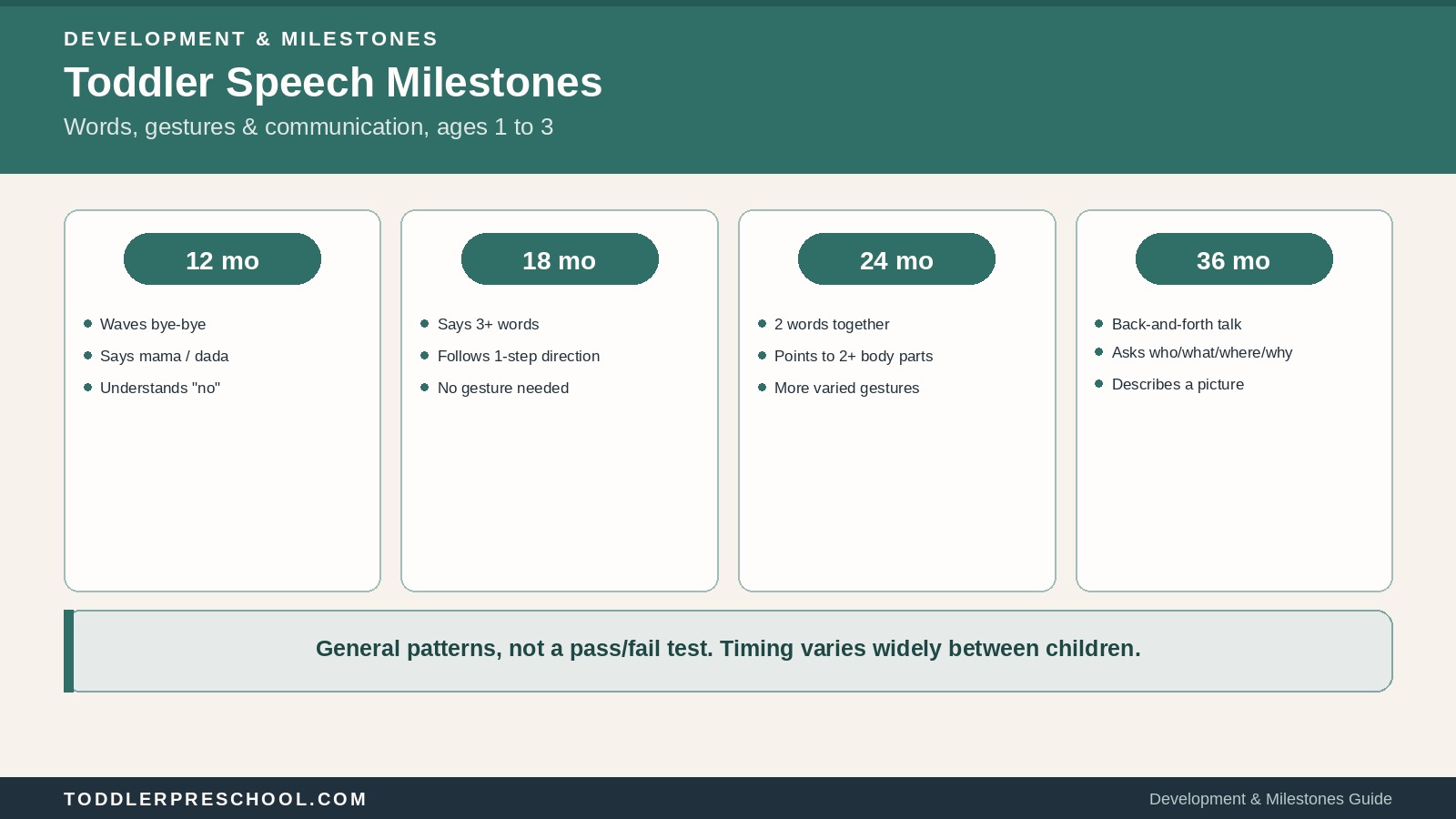
The Direct Answer: What Toddler Speech Milestones Actually Look Like
Most toddlers move from gestures and single words around their first birthday to short phrases by two. Simple back-and-forth conversation typically follows by three. This is a general pattern, not a strict deadline for any individual child.
Two things matter more than any single word count. Is your child making steady progress over time? Are they gaining skills or losing them? This guide walks through both.
This guide also covers something many milestone articles skip. That’s the actual difference between monitoring and screening, and the real referral pathway if you do have a genuine concern.
Two Kinds of Toddler Speech: Understanding and Talking
Speech development actually involves two separate skills, and it helps to know the difference.
Receptive Language
Receptive language is the ability to understand words and sounds. A toddler who follows a simple direction, like “get your shoes,” is using receptive language, even without saying a word back.
Receptive language is harder to observe directly than expressive language. It doesn’t produce an obvious, countable result the way spoken words do. Watching for it specifically, rather than assuming its absence just because your toddler isn’t talking much, gives you a more complete picture.
Expressive Language
Expressive language is the ability to use speech, gestures, and words to communicate. This is what most people picture when they think about toddler speech milestones.
Expressive language includes far more than spoken words alone. Gestures, sounds, and even facial expressions all count as genuine expressive communication at this age. A toddler who shakes their head “no” with real conviction is expressing themselves just as clearly as one saying the word aloud.
Why Understanding Often Comes First
Most toddlers understand far more words than they can say. A one-year-old might understand dozens of words while speaking only one or two. This gap is completely normal and tends to narrow gradually over the next two years.
This gap explains why a toddler who seems to understand everything you say, but barely talks, isn’t necessarily behind. The two skills simply develop on slightly different timelines.
Toddler Speech Milestones by Age
These milestones reflect current guidance consistent with the CDC’s Learn the Signs. Act Early. framework. Remember these describe typical patterns, not a pass or fail test for your specific child.
A Quick Reference Table
| Age | Common Milestones |
|---|---|
| 12 months | Waves bye-bye, says mama or dada, understands “no” |
| 15 months | Says 1 to 2 words beyond mama or dada, points to ask for help |
| 18 months | Says 3 or more words, follows one-step directions without a gesture |
| 24 months | Says 2 words together, points to 2+ body parts |
| 30 months | Says around 50 words, combines words with an action word |
| 36 months | Holds a back-and-forth conversation, asks who/what/where/why |
12 Months
Most toddlers around this age wave “bye-bye.” They call a parent “mama” or “dada” or another special name, and understand the word “no.”
A child at this stage is often communicating far more through gesture and tone than through actual words, and that counts as real, meaningful communication.
This is also the age where babbling often starts to sound more speech-like. Rising and falling intonation mimics real conversation, even before actual words emerge clearly. Parents sometimes describe this as their toddler sounding like they’re “having a whole conversation” in babble. It even includes pauses that sound like waiting for a response.
15 Months
Most toddlers try to say one or two words beyond “mama” or “dada.” They look at a familiar object when you name it. They also point to ask for something or get help.
At this age, a toddler often follows a direction only when you pair a gesture with the words. Reaching your hand out while saying “give me the toy” is a common example.
A toddler’s first “words” at this stage often sound approximate rather than exact, like “ba” for ball or “wa” for water. This still counts as a genuine word attempt.
18 Months
Most toddlers try to say three or more words beyond “mama” and “dada.” They also start following one-step directions without needing a gesture alongside the words.
This shift, from needing a gesture to understanding words alone, is a genuinely important milestone worth watching for specifically.
Many families notice a real jump in new words right around this age, sometimes called a vocabulary spurt. The exact timing of this jump varies quite a bit between children. Some toddlers add a new word almost daily during this window, while others progress more gradually.
24 Months
Most 2-year-olds point to things in a book when asked. They say at least two words together, like “more milk,” and point to at least two body parts on request. They also use more gestures than just waving and pointing.
Putting two words together is one of the most closely watched milestones at this age. It marks a real shift from single words to actual sentence building.
This is also the age where many toddlers start using simple pronouns like “me” or “mine.” The grammar isn’t always correct yet, and that’s fine. Hearing “me do it” or “mine truck” reflects genuine, meaningful progress, even though the grammar isn’t fully formed.
30 Months
Most toddlers at this age say around 50 words. They start combining two or more words with an action word, like “doggie run.” They can also name things in a book when you point, and use words like “I,” “me,” or “we.”
The 50-word mark is a commonly cited benchmark, though individual children vary quite a bit above and below this number.
Speech at this age is often still only partly clear to unfamiliar listeners. This is developmentally typical, not a warning sign on its own. A grandparent visiting occasionally might need more translation help from you than a parent who hears this speech daily.
36 Months
Most 3-year-olds can hold a back-and-forth conversation with at least two exchanges. They ask “who,” “what,” “where,” or “why” questions, and can describe what’s happening in a picture or book.
This is a genuinely big shift from single requests to real, reciprocal conversation.
By this age, most children’s speech is understandable to familiar adults most of the time. A stranger might still struggle with certain sounds.
Toddler Speech Milestones: Gestures Matter Just as Much as Words
Gestures are an often overlooked part of toddler speech milestones, and they deserve real attention.
Why Gestures Are an Early Communication Milestone
Pointing, waving, and reaching are all genuine communication, often appearing before spoken words do. A toddler who gestures frequently but talks less is usually building the same underlying communication skill, just through a different channel first.
Gestures also predict later spoken language in a genuinely meaningful way. A toddler with a wide range of gestures at 18 months often shows stronger spoken vocabulary a few months later.
Common Gestures at Each Stage
Early gestures include waving and reaching. By 12 to 18 months, pointing to ask for something becomes common. By 24 months, most toddlers use a wider range of gestures. This includes nodding, shaking their head, and more complex pointing to share attention with you.
Shared Attention: A Gesture Worth Watching For
One specific gesture pattern is considered a particularly important early communication milestone. This is pointing at something simply to share interest, rather than to request an object. A toddler pointing at a dog and looking back at you to check that you saw it too is demonstrating this specific skill.
This particular gesture, sometimes called joint attention, is worth understanding because it reflects a social communication skill that goes beyond simply wanting something. It shows a toddler actively including you in their experience of the world.
Monitoring Versus Screening: What’s the Difference
These two terms get used interchangeably, but they mean genuinely different things.
What Monitoring Looks Like
Monitoring is the ongoing, informal tracking of your child’s development over time. This happens at every well child visit, and it happens informally too, every time you notice your toddler try a new word or gesture.
Monitoring doesn’t require a special tool or appointment. It’s simply the habit of paying attention to your child’s development as an ongoing process, not a single event.
What Screening Looks Like
Screening is a formal, structured check using a validated tool at specific ages. Pediatricians typically use a general developmental screening tool around 9, 18, and 30 months. Specific autism screening happens at 18 and 24 months, per current pediatric guidance.
A screening tool usually involves a short questionnaire you fill out, either in the waiting room or ahead of time. It covers several developmental areas at once, not just speech.
Why Both Matter
Monitoring catches gradual changes over time, while screening catches things a quick office visit conversation might miss. Neither replaces the other, and both work together to build a fuller picture of your child’s development.
What Happens After a Screening Flags a Concern
A screening tool flagging a possible concern doesn’t mean a diagnosis. It means a referral for a fuller evaluation is a reasonable next step, the same evaluation process covered later in this guide.
Many toddlers flagged by an initial screening go on to a full evaluation that finds development within a typical range. A flag is simply a prompt for a closer look, not a conclusion in itself.
Everyday Examples of Speech Milestones in Action
Seeing how these milestones actually show up day to day sometimes makes them clearer than a list alone.
A 15-Month-Old at Snack Time
A toddler at this age might point at the fridge and say “ba” for banana, or simply point without a word yet. Both are meaningful communication attempts at this stage.
An 18-Month-Old During Cleanup
An 18-month-old might follow “put the blocks in the bin” without you pointing or gesturing at all. This shows the shift toward understanding words alone, rather than needing a visual cue alongside them.
A 24-Month-Old During Play
A 2-year-old might say “more truck” while handing you a toy. Or they might point to two body parts, like nose and toes, when you ask. This shows both expressive language and receptive understanding working together.
A 30-Month-Old Reading a Book Together
A toddler at this age might point to a picture and say “doggie run” while looking at you. This combines a simple action phrase with genuine shared attention over the book.
A 36-Month-Old at the Dinner Table
A 3-year-old might ask “why is the sky dark?” and follow up with another question after your answer. This shows a genuine back-and-forth conversational exchange.
Hearing and Speech: A Connection Worth Knowing
Hearing plays a foundational role in speech development, and it’s worth understanding this connection directly.
Why Hearing Matters So Much
A toddler learns spoken language largely by hearing it repeatedly and modeling what they hear. Even a mild, intermittent hearing loss, like one caused by frequent ear infections, can meaningfully affect speech development during this critical window.
Signs Worth Noticing
A few signs are worth mentioning to your pediatrician specifically. A toddler who doesn’t respond to their name, seems to need the TV unusually loud, or doesn’t startle at sudden loud sounds. These can point toward a hearing related cause behind a speech concern.
A Hearing Check Is Often an Early Step
If a speech evaluation is pursued, a hearing check is frequently one of the first steps. It’s a common, treatable contributor that’s worth ruling out early in the process.
The Wide Range of Normal for Toddler Speech Milestones
A few sources of genuine variation are worth naming clearly.
Individual Variation
Two children can hit these milestones months apart and both be completely typical. A general range, rather than an exact age, is the more accurate way to think about any of these milestones.
Multilingual and Bilingual Families
Children learning more than one language may show slightly different patterns. They sometimes have a smaller vocabulary in each individual language, while their total combined vocabulary across languages is on track. This is well documented and not a sign of delay on its own.
Code switching is a normal part of bilingual development at this age, not a sign of confusion. This means mixing words from two languages in the same sentence. A toddler saying “quiero leche please” is demonstrating real skill with both languages at once, not struggling with either one.
Birth Order and Siblings
Later born children sometimes talk somewhat later than firstborns. Older siblings may interpret and speak for them, reducing the younger child’s own need to talk. This is a mild, population level pattern, not a rule for any individual child.
Prematurity
For a child born significantly early, using corrected age rather than calendar age is a reasonable approach. This applies at least through the first couple of years.
Temperament and Personality
A quieter, more cautious toddler may simply talk less in unfamiliar settings, like a pediatrician’s office. This doesn’t reflect their actual skill level at home.
Disability and Developmental Differences
For a child with a diagnosed disability, these milestones may follow a different timeline entirely. Your child’s care team is a better guide here than any general list.
Screen Time and Speech Development
Passive screen time, especially before age 2, is associated with somewhat slower language development in some research. This largely happens because it typically replaces the back-and-forth interaction that builds speech most effectively. This doesn’t mean any screen exposure causes a delay, but it’s worth being aware of the general pattern.
What to Do If a Skill Seems Missing
A missing skill at one single checkpoint isn’t automatically concerning, but it’s worth a closer, honest look.
Give It a Few Weeks of Attention
Before assuming something is wrong, spend a couple of weeks paying closer attention. Sometimes a skill is present but simply hasn’t been witnessed yet in the specific way a checklist describes it.
Try creating a few natural opportunities for the specific skill to show up. Asking your toddler to point to a body part during bath time works better than only observing passively.
Mention It at the Next Well Visit
If a specific milestone genuinely seems absent, mention it directly at your child’s next appointment. Don’t wait for the visit itself to bring it up for you.
Write down the specific concern before your visit, rather than trying to recall it in the moment. This helps you communicate clearly during a typically short appointment window.
Trust Your Own Observation
You see your child far more than any single appointment allows. If something feels off to you, that instinct is worth acting on, even if a single visit doesn’t flag a formal concern.
Parents are frequently the first to notice a genuine pattern, well before any formal screening tool catches it. You’re observing your child across so many more moments than any single visit could capture.
What to Do If a Skill Was There, Then Lost
Losing a previously acquired skill is a different situation from a skill simply arriving late, and it deserves more immediate attention.
This Is Worth a Prompt Conversation
Regression is worth mentioning to your pediatrician promptly. This means a toddler who used to say a word or use a gesture and now doesn’t, rather than waiting for a scheduled visit.
Call your pediatrician’s office directly to describe what you’re seeing. This specific pattern often warrants a sooner conversation than waiting for the next regularly scheduled appointment.
It Doesn’t Automatically Mean Something Serious
Illness, a major life change, or simple normal variation can sometimes explain a temporary dip. Still, this specific pattern is different enough from typical variation that it deserves a direct conversation, not just continued monitoring at home. A pediatrician can help sort out which explanation actually fits your specific situation.
What Your Pediatrician Will Likely Ask
Expect a few specific questions. When did you first notice the change? Did it happen gradually or suddenly? Do any other skills seem affected alongside speech? Having rough answers ready before the call helps the conversation move efficiently.
Speech Sounds: A Separate Track From Vocabulary
Vocabulary size and clear pronunciation actually develop somewhat separately, and it helps to understand both.
Why Clarity Lags Behind Vocabulary
A toddler can know and use a word correctly in meaning while still pronouncing it imperfectly. This is completely normal and doesn’t mean the word “doesn’t count” toward their vocabulary.
Which Sounds Come Earlier
Sounds like p, b, m, h, and w tend to develop earlier, often mastered between 1 and 2 years. Sounds like k, g, f, t, d, and n typically develop somewhat later, often between 2 and 3 years.
Which Sounds Come Later Still
More complex sounds often take longer to master. Sounds like r, l, s, and combinations like “th” or “sh” aren’t fully mastered until well into the preschool years, sometimes even later. A toddler mispronouncing these specific sounds is rarely a concern on its own at this age.
These later developing sounds are genuinely some of the hardest for young mouths to physically produce. They require precise tongue and lip coordination that simply takes more practice and physical development to master.
The Overall Clarity Benchmark
A helpful general guideline applies here. By around age 3, familiar listeners should understand most of what a child says, even if strangers still struggle with some words. By age 4, most speech should be clear even to unfamiliar listeners. These are general benchmarks, useful for a rough sense of typical progress, not strict individual deadlines.
Signs Worth a Closer Look at Any Age
According to the American Speech-Language-Hearing Association, a few specific signs are worth a closer look regardless of your child’s exact age.
ASHA released updated developmental milestones for children birth to 5 for a specific reason. Families and providers can recognize these patterns clearly, rather than relying on vague impressions alone.
Language Signs
- Not babbling by 7 months
- Only a few sounds or gestures by 12 months
- Not understanding simple words or phrases by 7 months to 2 years
- Saying only a few words by 12 to 18 months
- Not combining two words by 18 months to 2 years
- Saying fewer than 50 words by 2 years
Speech Sound Signs
- Saying p, b, m, h, and w incorrectly in words between 1 and 2 years
- Saying k, g, f, t, d, and n incorrectly in words between 2 and 3 years
- Speech that’s unclear even to familiar people between 2 and 3 years
None of these signs alone is a diagnosis. They’re simply worth a direct conversation with a professional who can look at your specific child.
When Concern Remains: The Referral Pathway
If concern remains after monitoring, screening, and a conversation with your pediatrician, a clear path exists for getting more support.
Talking to Your Pediatrician First
Start here. If your pediatrician shares your concern, they’ll typically refer you for a full speech and language evaluation.
Bring specifics to this conversation. What you’ve noticed, how long it’s been going on, and any patterns you’ve observed, like whether it happens more in certain settings. A brief, focused summary tends to get a more productive response than a general sense of worry alone.
If Your Pediatrician Isn’t Concerned but You Still Are
Trust your own instinct here. A second opinion or a direct evaluation by a speech-language pathologist is a completely reasonable next step, even without a doctor’s referral.
Seeking a second opinion doesn’t require your pediatrician’s permission or a difficult conversation. You can pursue an outside evaluation on your own timeline, alongside continuing your regular pediatric care.
Early Intervention for Children Under 3
Every U.S. state has a free early intervention program for children under 3, and you can access an evaluation directly, without needing a doctor’s referral first in most states.
Early intervention programs are federally mandated, so every state must offer this service. The specific program name and exact process varies somewhat by state.
School District Evaluation for Children 3 and Older
For a child 3 or older, your local public school district provides free evaluations, even if your child doesn’t attend that school. This is a federally protected service available in every state.
This evaluation covers speech and language specifically, alongside other developmental areas if relevant. It doesn’t require enrollment in that school district’s programs to access.
Finding a Private Speech-Language Pathologist
ASHA maintains a searchable directory called ProFind specifically for locating certified speech-language pathologists in your area. This is useful if you want a private evaluation alongside or instead of the free public options.
Private evaluations sometimes offer faster scheduling than public programs, though cost and insurance coverage vary significantly by provider and location. Checking with your insurance provider directly about coverage before scheduling can help avoid an unexpected bill.
An Evaluation Itself Isn’t Stressful
A speech and language evaluation typically involves play based activities, familiar toys, and questions directed mostly at you as the parent. It’s not a stressful test for your toddler.
Most evaluations take place in a comfortable, low pressure setting. They often look more like a supervised play session than any kind of formal testing your toddler would notice as unusual.
Supporting Speech Development Every Day
A few everyday habits genuinely support speech development, without needing to feel like formal practice.
Narrate What You’re Doing
Simply describe your own actions out loud during everyday routines: “I’m pouring the milk now.” This gives your toddler ongoing language exposure without any extra effort.
This works especially well during routine tasks you’re already doing anyway, like getting dressed or making dinner. It requires no extra time carved out of your day.
Respond to Every Attempt
Respond warmly to a gesture, a babble, or an attempted word, even an unclear one. This reinforces that communication works and is worth continuing.
A toddler who points and grunts toward a cup, and gets a warm, immediate response, learns something valuable. Communication is effective and worth repeating, regardless of how clear the actual attempt was.
Read Together Daily
Read simple books together, even briefly. This builds vocabulary and gives your toddler a low-pressure way to point, label, and eventually talk about pictures.
Repetitive books are genuinely valuable for language learning, not just a phase to push through. This includes the kind a toddler wants read the exact same way every single time.
Avoid Correcting Too Directly
Repeating a word back correctly, rather than pointing out that your toddler said it wrong, tends to work better. If your child says “wa-wa” for water, responding with “yes, water!” models the correct word without criticism.
Follow Your Child’s Lead in Play
Talk about whatever your toddler is already interested in, rather than redirecting to a planned topic. This tends to build more genuine back-and-forth exchange than a structured lesson would.
Pause and Wait
Leave a genuine pause after asking a question, rather than immediately answering for your toddler. This gives them real space to attempt a response, even if it takes a few extra seconds to come.
Coordinating With Daycare and Other Caregivers
If your toddler spends significant time with another caregiver, their observations add real value to the picture.
Asking Directly What They’re Seeing
A teacher or regular caregiver often has useful comparative context. Having observed many toddlers over time, they can help you understand whether a pattern is worth flagging.
Sharing What You Notice at Home
Two way sharing works better than only asking questions. Telling a teacher specifically what you’re seeing at home helps build a fuller, more accurate combined picture than either setting alone. This kind of open exchange also helps a teacher tailor their own approach to what already works well for your specific child.
When Settings Show Different Pictures
A toddler who talks confidently at home but rarely at daycare, or the reverse, isn’t unusual. Different settings genuinely produce different comfort levels, and this difference alone isn’t cause for alarm.
Common Myths About Toddler Speech Milestones
A few persistent myths are worth clearing up directly.
Myth: Boys Always Talk Later Than Girls
Population averages show a modest difference in some research, but individual variation within each sex is far larger than this average gap. Plenty of boys talk earlier than plenty of girls.
Myth: A Bilingual Home Causes Speech Delays
Research consistently shows bilingual exposure doesn’t cause speech or language disorders. A bilingual toddler’s combined vocabulary across both languages is the accurate comparison point, not either language alone.
Myth: “He’ll Talk When He’s Ready” Is Always the Right Approach
Waiting is reasonable for typical variation, but it’s not the right response to every situation, especially skill loss or multiple missed milestones together. Knowing the difference matters more than a blanket rule either way. A pattern that includes several concerning signs together deserves more active attention than a single, isolated difference.
Myth: Speech Therapy Is Only for Severe Cases
Speech-language pathologists work with a wide range of needs, from significant delays to milder concerns a family simply wants addressed early. An evaluation doesn’t require a severe problem to be worthwhile.
A Note on Pacifiers and Speech
This specific question comes up often enough to address directly.
The General Guidance
Extended pacifier use, especially well into the toddler years and used almost constantly, is sometimes associated with mild speech sound differences. This largely happens because it limits mouth movement and babbling opportunities during key hours of the day.
This Isn’t an Urgent Concern
Occasional or nap and bedtime only pacifier use isn’t generally considered a meaningful speech risk. If you’re working on reducing pacifier use for other reasons, like dental health, that’s a reasonable goal on its own timeline. It doesn’t need to happen specifically to protect speech development. Most families find this reassuring rather than one more thing to worry about.
Managing Your Own Worry
Watching speech development closely, especially against other children, understandably brings up real anxiety for many parents.
It’s Normal to Compare, Even When You Know Better
Playground conversations, family group chats, and social media all make comparison nearly automatic. This happens even when you understand intellectually that every child develops differently.
What Comparison Actually Misses
You don’t see another family’s full picture, their own worries, their own late milestones in other areas. You’re comparing your complete, close-up view of your own child to someone else’s brief, curated snapshot.
A More Useful Comparison
Compare your child to your child, a few weeks or months ago. Is there more talking now than last month? That comparison actually tells you something useful, unlike comparing across different children entirely.
Common Obstacles With Toddler Speech Milestones
A few specific situations come up often enough to address directly.
“My toddler understands everything but barely talks.”
This pattern, strong receptive language with limited expressive language, is common and often resolves with time. It’s still worth mentioning at a well visit if the gap feels unusually wide for your child’s age.
“We’re a bilingual family and I can’t tell if my toddler is behind.”
Look at your child’s combined vocabulary across both languages, not just one language in isolation. A bilingual toddler’s total vocabulary across all languages is the more accurate comparison point.
“My toddler talks a lot, but I can’t understand most of it.”
This is common, especially between 2 and 3 years old, when vocabulary often outpaces clear pronunciation. If speech remains largely unclear to familiar people past 3, that’s worth a direct conversation with your pediatrician.
“Daycare says my toddler talks less there than at home.”
This is a common, often reassuring pattern. A toddler may simply talk more in a comfortable, familiar setting. Sharing what you’re seeing at home with the teacher helps build a fuller picture together.
“My toddler stutters sometimes. Should I worry?”
Some disfluency, repeating sounds or words, is common between 2 and 4 as language skills rapidly develop. This often resolves on its own. If it persists for several months, involves visible tension, or comes with avoidance of talking, mention it to your pediatrician.
“We just moved, and my toddler seems to have stopped talking as much.”
A stressful transition, like a move, can genuinely, temporarily affect a toddler’s talking, similar to how it affects sleep or eating. Giving it a few weeks to settle, while still watching for a genuine plateau versus simple quietness, is a reasonable approach.
Adapting This to Every Family’s Situation
Different family structures. Whoever spends the most time with your child is often best positioned to notice gradual changes in speech over time. This holds regardless of the specific relationship to the child.
Budget. Monitoring your child’s speech costs nothing. Early intervention evaluations for children under 3 are free by law in the United States. So are school district evaluations for children 3 and older.
Schedule constraints. If a formal evaluation feels like too much right now, start smaller. Simply mentioning a specific concern at your next regular pediatric visit is a reasonable, low effort first step.
Access to care. If you don’t have a regular pediatrician, community health centers can typically help connect you with your state’s early intervention program directly.
Multilingual and immigrant families. Early intervention and school district evaluations are required to accommodate your family’s home language, including providing an interpreter when needed.
Working parents with limited time. Supporting speech development doesn’t require a dedicated daily lesson. Narrating routine tasks you’re already doing, like driving or cooking, builds the same language exposure without adding anything new to your schedule.
Families with limited transportation. Many early intervention programs offer home visits specifically to remove transportation as a barrier. Some school district evaluations can also be arranged at a convenient local school, rather than requiring travel to a central office.
Frequently Asked Questions
Questions About Milestones and Timing
Is there a specific word count my toddler needs to hit by a certain age? General benchmarks exist, like around 50 words by 30 months, but individual variation is wide. A steady upward trend over time matters more than hitting an exact number on an exact date. Some toddlers cluster many new words together in a short burst, rather than adding words at a perfectly steady pace.
My toddler was ahead of these milestones, then seemed to plateau. Is that concerning? A brief plateau, especially around a transition like starting daycare or a new sibling arriving, is common and often temporary. A plateau lasting several months, rather than weeks, is more worth mentioning at a visit.
Do boys typically develop speech later than girls? Some research shows a modest average difference, with girls sometimes reaching certain language milestones slightly earlier on average. Individual variation within each sex is far larger than this average difference.
Questions About Getting Support
Will seeking an evaluation feel like admitting something is wrong? Not necessarily. Many evaluations conclude that a child is developing typically, simply confirming what a parent hoped to hear. An evaluation is information gathering, not a verdict.
How long does it typically take to get an early intervention evaluation scheduled? This varies by state and region. Most states are required to complete an evaluation within a specific timeframe after referral, often around 45 days. Contacting your state’s program directly gives you the most accurate local timeline.
Can I request a speech evaluation even if my pediatrician says to wait and see? Yes. You can access early intervention services for a child under 3 directly, without a doctor’s referral, in most states. Trusting your own observation is a reasonable basis for seeking an evaluation.
Does a late talker automatically catch up on their own? Many toddlers who are simply late talkers, with no other developmental concerns, do catch up over time. This isn’t guaranteed for every child, which is exactly why monitoring progress, rather than assuming catch-up will happen, matters.
Is it normal for my toddler to use a made-up word consistently for the same thing? Yes, this is common and actually shows real language skill. A consistent, made-up word used the same way every time demonstrates real skill. Your toddler understands the concept of a word representing a specific thing, even if the word itself isn’t standard.
Should I be concerned if my toddler prefers pointing over talking, even at an age where more words are expected? This is worth noting rather than ignoring, but gesture use alongside limited words isn’t automatically concerning on its own. If gestures are largely replacing words rather than supplementing them well past the expected age, mention this specific pattern at your next visit.
Comparing Siblings Fairly
Comparing one child’s speech development to an older sibling’s is one of the most common, and least useful, comparisons parents make.
Why This Comparison Rarely Helps
Each child has their own temperament, birth order position, and individual timeline. A younger sibling talking later than an older one, or the reverse, doesn’t predict much about either child’s long term development.
A More Useful Frame
Try a different question instead. Rather than asking “is this child behind their sibling,” ask “is this child making steady progress along their own timeline.” This shift in framing tends to reduce unnecessary worry without ignoring genuine concerns.
Tracking Progress Without Adding Pressure
Some families find it useful to notice speech patterns over time.
A Simple, Private Log
Keep a rough note of new words or gestures as they appear. This gives you the same useful information as a formal chart. It does so without adding stress to the process or letting your toddler sense the pressure.
Looking at the Trend, Not a Single Week
A single quiet week doesn’t undo months of steady progress. Looking back over several weeks, rather than judging any single day, usually gives a clearer, more accurate picture.
When to Stop Tracking Closely
Once you feel confident your toddler’s speech is progressing steadily, formal tracking usually isn’t necessary anymore. Ongoing, relaxed awareness, rather than constant logging, is enough for most families most of the time.
Your One Next Step
Spend this week simply noticing, without judging: what gestures, sounds, and words does your toddler actually use in a typical day? Write down what you observe, since that honest, specific list tells you more than any general age chart alone.
Whatever that list looks like, it’s useful information, not a verdict on your parenting or your child’s overall potential.
Sources consulted: Centers for Disease Control and Prevention, Learn the Signs. Act Early. developmental milestones; American Speech-Language-Hearing Association, developmental milestones and signs of speech and language disorders; HealthyChildren.org (American Academy of Pediatrics) guidance on raising concerns about a child’s speech and language development.