
Maybe your child just turned 2 and a well-visit is on the calendar, and you want to walk in knowing what’s actually being checked instead of guessing. Or maybe you were at a birthday party, watched another 2-year-old rattle off a four-word sentence, and came home to look up 2 year old milestones because you weren’t sure if your own child’s mostly-single-word chatter was something to think about.
Here’s the direct answer: 2 year old milestones, per the CDC’s current “Learn the Signs. Act Early.” checklist, cover four areas — social/emotional, language/communication, cognitive (thinking and play), and movement/physical development — and they’re set at the level of skills most children (75% or more) have reached by 24 months, not an average or a pass/fail line. This guide goes through each area in real depth, with everyday examples of what these milestones actually look like at home, the genuinely wide range of normal within each one, how developmental monitoring differs from a formal screening at this specific age, and exactly what to do if something feels off — whether that’s a single missing skill, a lost one, or a feeling you can’t quite name yet.
This guide is organized so you can use whichever part actually applies to you right now: read straight through if you want the full picture, or jump directly to the domain you’re wondering about, the well-visit preparation section if an appointment is coming up soon, or the “what to do” section if you already have a specific concern in mind.
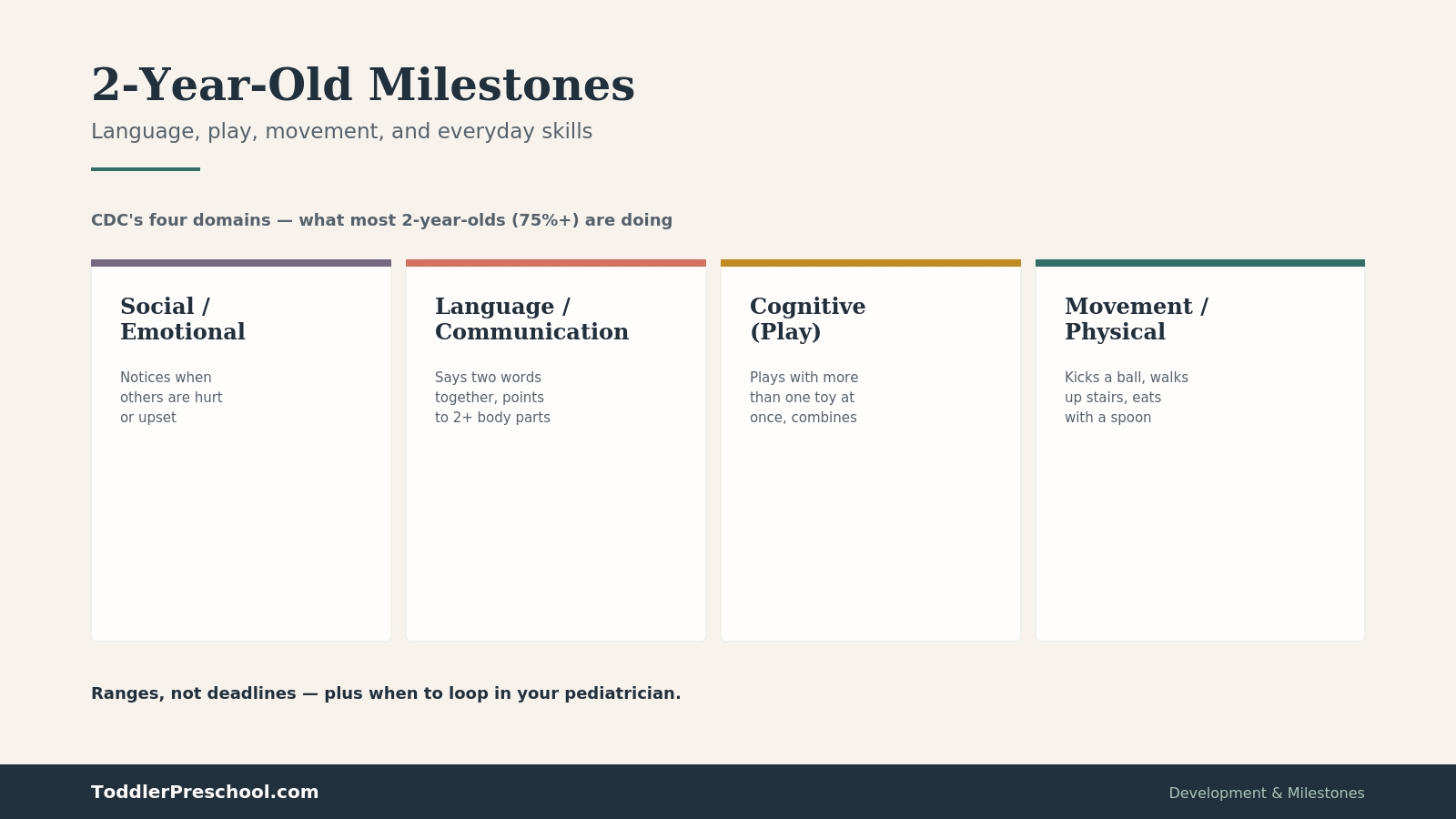
The Direct Answer: What 2 Year Old Milestones Actually Cover
CDC revised its milestone checklists in 2022, in partnership with the American Academy of Pediatrics, specifically to make them clearer and more actionable for families. One of the most useful, least-known parts of that update: the milestones now reflect what roughly 75% or more of children can do by a given age, not the 50th-percentile average used in the older version. In practice, that means the 2-year-old milestones checklist you’ll see today is already set at a fairly generous, inclusive bar — a child who hasn’t quite reached one of these yet isn’t automatically behind “average,” since a genuinely typical range of 2-year-olds hasn’t reached every single item on the list either. The update also added checklists at 15 and 30 months specifically, so there’s now a version aligned with every recommended well-child visit from 2 months through 5 years, rather than leaving a gap between visits.
The four areas CDC organizes 2-year-old milestones into are:
- Social/Emotional — how your child connects with others and expresses feelings
- Language/Communication — how your child understands and uses words and gestures
- Cognitive — thinking, problem-solving, and how play itself is changing
- Movement/Physical Development — both gross motor (whole-body) and fine motor (hands) skills
A fifth area worth naming even though it’s not a separate official CDC category: everyday self-help skills — eating, attempting to dress, following a simple routine — which show up as a natural byproduct of growth across the four domains above rather than their own checklist, but are often exactly what parents are picturing when they think about what their 2-year-old “should” be able to do. This guide covers that too.
2-Year-Old Milestones at a Glance
A single reference table pulling together everything covered in depth below:
| Domain | What Most 2-Year-Olds Are Doing |
|---|---|
| Social/Emotional | Notices when others are hurt or upset (pausing or looking sad when someone cries) |
| Language/Communication | Says two words together (“more milk”); points to two body parts; uses gestures beyond waving/pointing; points to things in a book when asked |
| Cognitive (Play/Thinking) | Tries switches, knobs, or buttons on a toy; plays with more than one toy at once, like putting toy food on a toy plate |
| Movement/Physical | Kicks a ball; walks up a few stairs with or without help; eats with a spoon |
| Everyday Skills (not an official CDC domain) | Attempts dressing tasks; follows one-step instructions; may show early toileting interest, without a deadline |
This table is a starting reference, not a complete or required checklist — a child can be solidly on track while showing a different mix of these than another child the same age. The sections below go through each domain with real depth: everyday examples, the actual range of normal, and when a pattern is worth a closer look.
2 Year Old Language and Communication Milestones
What Most 2 Year Olds Are Doing With Language
Per CDC’s current 2 year checklist, milestones in this area include saying at least two words together (like “more milk”), pointing to at least two body parts when asked, using gestures beyond simple waving or pointing (like blowing a kiss or nodding yes), and pointing to things in a book when asked “where’s the…?”
Everyday examples of what this looks like in a real house: a 2-year-old who points at the family dog in a picture book when you ask “where’s the doggy?”, who says “more juice” while holding out an empty cup, or who nods emphatically when asked if they want to go outside. Two-word combinations at this stage are often functional rather than grammatically complete — “Daddy go,” “big truck,” “no nap” — and that’s exactly what the milestone is looking for, not full sentences.
A few more everyday moments worth recognizing as genuine language milestones even though they don’t look like “talking”: a 2-year-old who brings you a shoe and grunts insistently to communicate “help me put this on,” who shakes their head firmly at a food they don’t want, or who repeats the last word of a sentence you just said (“time for bed” → “bed!”). All of these count as real communication progress at this age, whether or not they involve a full two-word phrase.
The Range of Normal for Language at 2
Vocabulary size varies enormously among typically developing 2-year-olds — some are combining words into short phrases constantly by their second birthday, others are just beginning to put two words together and rely heavily on gesture and single words the rest of the time. Both patterns are within range. A few specific sources of normal variation worth naming directly:
Multilingual households. A 2-year-old learning more than one language often has a smaller vocabulary in each individual language than a monolingual peer, while total vocabulary across all languages is comparable or larger. Pediatricians experienced with multilingual development generally look at combined vocabulary, not just English, when thinking about whether language milestones are on track.
Temperament and personality. Some 2-year-olds are simply more observational and less chatty by nature, taking in language for longer before producing it themselves — this is a personality difference more than a developmental one, though it’s still worth mentioning at a well-visit if it’s a significant, persistent pattern.
Birth order. A younger sibling with an older child anticipating their needs sometimes talks a bit later, since there’s less functional pressure to use words; an only child with more one-on-one adult conversation sometimes talks a bit earlier. Neither pattern is concerning on its own.
Hearing and ear infections. Frequent ear infections or fluid buildup can temporarily affect how clearly a child hears speech sounds, which can show up as a language delay that’s really a hearing issue — worth mentioning to your pediatrician directly if your child has had several ear infections, since a hearing check is a simple, useful thing to rule out.
When Language Is Worth a Closer Look
A single missing item on the language checklist — not yet combining two words, for instance — is common at exactly 24 months and often resolves within weeks to a couple of months without any specific intervention, especially if your child’s overall communication (gestures, single words, understanding of what you say) is otherwise progressing. It’s worth mentioning at your next well-visit either way, simply so it’s on record.
What’s different: a 2-year-old who was previously using clear words and has stopped, who shows very little interest in communicating at all (not just few words, but minimal gesture, eye contact, or attempts to get your attention), or whose understanding of simple instructions seems to be lagging as much as their spoken language. These patterns are worth raising with your pediatrician proactively rather than waiting for the next scheduled visit.
2 Year Old Play and Thinking (Cognitive) Milestones
What Most 2 Year Olds Are Doing With Play and Thinking
Per CDC’s current checklist, this domain at 2 years includes trying to use switches, knobs, or buttons on a toy, and playing with more than one toy at the same time in a connected way — the checklist’s own example is putting toy food on a toy plate, which reflects an early, simple form of combining objects meaningfully rather than handling one item at a time in isolation.
Everyday examples: a 2-year-old who tries repeatedly to make a toy’s button light up or a switch click, who sets a toy cup on a toy saucer, or who puts a small toy person “in” a toy car before pushing it. This is also the age when simple pretend play often becomes more visible — feeding a stuffed animal, “talking” on a toy phone — building on the more solitary object exploration of the previous year.
A few more everyday examples of this domain in action: a 2-year-old who stacks two or three blocks and knocks them down repeatedly (testing cause and effect, not just building), who tries the same puzzle piece in the wrong spot several times before either succeeding or asking for help, or who imitates a household task like “sweeping” with a toy broom or “wiping” the table with a cloth. Simple sorting — putting all the crayons in one pile and all the cars in another, even imperfectly — is another common sign of this domain developing at 2.
The Range of Normal for Play and Thinking at 2
Cognitive development at this age happens almost entirely through hands-on play and everyday exploration, not structured teaching, and the pace varies with how much unstructured play time and variety of materials a child has had access to as much as with pure developmental timing. A few things worth naming:
Exposure matters as much as ability. A 2-year-old who hasn’t had much access to toys with switches, knobs, or combinable pieces (blocks, play food, simple containers) may show this milestone a bit later simply from less practice opportunity, not from a difference in underlying ability — offering a bit more of this kind of open-ended play is a reasonable, low-pressure response if this is a factor.
Interest varies as much as ability. Some 2-year-olds are drawn to books and quiet, focused play; others are drawn to movement and large-motor exploration and show less interest in small manipulative toys for now. Both are normal variations in what a child chooses to practice, not necessarily what they’re capable of.
Screen exposure is worth a mention, without alarm. Cognitive milestones at this age are built through hands-on, interactive play and real-world exploration in a way that passive screen time doesn’t substitute for — this isn’t a reason to panic over occasional screen use, but if screens make up a large share of a 2-year-old’s day, shifting some of that time toward hands-on materials is a reasonable, low-pressure adjustment worth considering alongside anything else in this section.
When Play and Thinking Patterns Are Worth a Closer Look
A 2-year-old who shows little interest in combining or exploring objects at all, who plays with toys in a very repetitive, identical way without variation over weeks, or who seems to have lost interest in play skills they previously had is worth mentioning to your pediatrician. As with every domain in this guide, a single missing item on its own is common and not urgent — a pattern across several signs, or a lost skill specifically, is what shifts this from “keep watching” to “worth a call.”
2-Year-Old Movement Milestones
What Most 2-Year-Olds Are Doing Physically
Per CDC’s current checklist, movement and physical development milestones at 2 years include kicking a ball, walking (not climbing) up a few stairs with or without help, and eating with a spoon. This domain covers both gross motor skills (the whole-body kicking and stair-walking) and fine motor skills (the hand control involved in using a spoon) under one combined category.
Everyday examples: a 2-year-old attempting to kick a soft ball rolled toward them (even if the aim is inconsistent), holding a railing or an adult’s hand while stepping up onto a low stair one foot at a time, or managing a spoonful of yogurt to their mouth with real spills along the way. None of these need to look polished — the milestone is about the attempt and general capability, not smooth execution.
A few more everyday markers of this domain: a 2-year-old who can carry a small object (a ball, a toy) while walking without dropping it constantly, who climbs onto a low couch or chair independently, who turns a doorknob or twists a jar lid with growing success, or who scribbles on paper with a back-and-forth or circular motion rather than only isolated dots and dashes. Running with a somewhat more coordinated gait than the wide-legged toddle of a year earlier is another common physical marker of this stage.
The Range of Normal for Movement at 2
Physical milestones tend to have some of the widest normal timing ranges of any domain, since they’re shaped by opportunity (how much space and encouragement a child has had to practice), temperament (a cautious child may be capable of a skill but slower to attempt it), and simple individual variation in strength and coordination development.
Practice opportunity genuinely matters. A 2-year-old who hasn’t had much access to stairs, open space for kicking, or practice with a spoon (versus being fed) may show these skills a little later purely from fewer chances to try, not from an underlying difference in physical ability.
Caution is not the same as inability. A naturally careful, watchful 2-year-old may be fully capable of walking up stairs or kicking a ball but hesitant to attempt it in a new or unfamiliar setting — try observing at home in a familiar, low-pressure moment before assuming a skill isn’t there yet.
Body build and general activity level. A sturdier or naturally less physically driven 2-year-old may show gross motor milestones a bit later than a leaner, high-energy child, without any difference in underlying developmental health — this is closer to individual variation in build and temperament than a marker of concern.
When Movement Is Worth a Closer Look
A 2-year-old who isn’t yet walking independently at all (rather than simply not yet managing stairs), who has an unusual or asymmetric gait, or who has lost a previously solid physical skill is worth raising with your pediatrician promptly rather than waiting. A child who’s simply slower to manage stairs or spoon use specifically, with otherwise typical walking and hand use, is much more commonly a timing variation than a concern — mentioning it at the next well-visit is a reasonable, unhurried approach.
2-Year-Old Social-Emotional Milestones
What Most 2-Year-Olds Are Doing Socially and Emotionally
Per CDC’s current checklist, this domain at 2 years centers on noticing when others are hurt or upset — the checklist’s own example is pausing or looking sad when someone nearby is crying. This reflects an early but genuine form of empathy: a 2-year-old doesn’t yet reliably know how to respond to someone else’s distress, but noticing it at all is the developmental marker being tracked.
Everyday examples: a 2-year-old who stops playing and looks concerned when a sibling cries, who pats a crying parent’s arm without fully understanding why, or who looks to a caregiver’s face for a reaction in an unfamiliar or slightly startling situation (a loud noise, a new person) before deciding how to feel about it themselves.
A few more everyday signs of social-emotional growth at this age: a 2-year-old who shows clear preferences for specific people and protests when a favorite caregiver leaves, who brings a toy to share (even briefly, before wanting it back) with a parent or sibling, or who imitates an adult’s facial expression — mirroring a worried look, or breaking into a grin when you smile first. A budding sense of identity often shows up too, like correcting someone who uses the wrong name for a toy or possession (“that’s MY cup”).
The Range of Normal for Social-Emotional Development at 2
This is also the age range when many of the behaviors popularly associated with “the terrible twos” — frequent tantrums, a strong pull toward independence, an emerging and enthusiastic “no” — are at their most visible, and none of that is in tension with typical social-emotional development. If anything, tantrums and assertions of independence reflect a child who is developmentally on track for this stage, not a child who’s behind on emotional regulation they’re not developmentally positioned to have yet.
Temperament varies enormously here. Some 2-year-olds are naturally more outwardly expressive with empathy (visibly upset by another child’s tears); others notice just as much internally but show it less outwardly. Both are normal styles, not different levels of underlying social awareness.
Group care experience shapes this domain visibly. A 2-year-old in a group child care or preschool setting often has more day-to-day practice noticing and responding to peers’ emotions than a child who is mostly around adults, simply from more exposure — this is a difference in practice opportunity, not ability.
Family and cultural norms around emotional expression vary. Some families and cultures encourage more outward emotional display; others place more value on composure, even in young children — a 2-year-old’s visible emotional expressiveness partly reflects what’s modeled at home, not solely an internal developmental marker.
When Social-Emotional Development Is Worth a Closer Look
A 2-year-old who shows very little response to other people’s distress across many different situations and people, who doesn’t seek comfort from a trusted caregiver when hurt or scared, or who has become markedly more withdrawn than they previously were is worth mentioning to your pediatrician. A child who is simply strong-willed, prone to tantrums, or more reserved by temperament is showing typical variation, not a concern on its own.
Everyday Skills: What Independence Looks Like at 2
Beyond CDC’s four official domains, most families are also quietly tracking a set of everyday self-help skills, since these affect daily life directly. It’s worth naming these separately and clearly, since they blend cognitive, movement, and social-emotional growth into practical daily moments:
- Eating. Using a spoon with real (if messy) success, as covered in the movement domain above, alongside a growing — though often narrow and choosy — range of accepted foods. Selective eating at 2 is extremely common and not, on its own, a developmental concern. Many 2-year-olds also start showing a preference for feeding themselves finger foods over being fed, even when a spoon would technically be faster.
- Dressing. Attempting to help with dressing (pushing an arm through a sleeve, trying to pull up loose pants) rather than full independence, which typically develops further across the preschool years. Removing simple items (pulling off socks or an unzipped jacket) often comes before putting them on independently.
- Simple routines. Following a one-step, concrete instruction (“bring me the ball”) more reliably than a multi-step one, and beginning to anticipate familiar routines (heading toward the door when it’s time to leave, or toward the bathroom at the start of a familiar bedtime sequence).
- Toileting readiness signs, without a requirement. Some 2-year-olds show early interest in the toilet or notice when they’re wet or dirty; many others show no interest yet, and neither pattern is a milestone CDC tracks or one this guide will treat as a deadline — toilet learning timing varies enormously and isn’t a 2-year-old requirement.
- Hand-washing and basic hygiene participation. Many 2-year-olds can participate in hand-washing with help (holding hands under water, rubbing them together when prompted) even without full independent technique yet.
None of these need to be fully mastered at 24 months. They’re areas of ongoing growth across the next year or two, not a checklist your 2-year-old needs to have completed already.
Common Behaviors at 2 That Are Often Mistaken for Problems
Part of researching 2-year-old milestones is often really an attempt to figure out whether a specific behavior is typical for this age or worth real concern. A few of the most commonly misread patterns, explained plainly:
Frequent Tantrums
Tantrums, often several times a day, are one of the most universal experiences of this exact age, tied to a genuine gap between big feelings and the verbal and emotional-regulation skills to manage them — not a sign of a behavior problem or a parenting issue. Frequency and intensity vary enormously between individual 2-year-olds and don’t reliably predict anything about a child’s broader development.
The Sudden “No” Phase
A near-constant “no” — to questions, to offers, even to things a 2-year-old clearly wants — reflects the same push toward independence and control showing up across development at this age, not personal defiance. It’s often a 2-year-old testing what happens when they assert themselves, simply because they’ve recently discovered they can.
Playing Near Other Kids Without Playing “With” Them
Parallel play — occupying the same space as another child while each does their own thing — is the developmentally typical pattern at 2, not a social skills gap. More interactive, cooperative play develops gradually over the next year or two, and it isn’t one of the 2-year-old milestones CDC tracks for exactly this reason.
Picky or Inconsistent Eating
A 2-year-old who loved a food last week and refuses it this week, or who eats well at one meal and barely touches food at the next, is showing an extremely common pattern tied to slowing growth rate and increasing food awareness at this age — not necessarily a feeding problem. Significant concerns (a very limited food range, weight loss, gagging, distress around meals) are worth a separate conversation with your pediatrician.
Biting, Hitting, or Other Physical Frustration
A 2-year-old who bites, hits, or throws things when frustrated is demonstrating the same gap mentioned above — big feelings arriving before the tools to handle them appropriately — not a preview of character or a parenting failure, even though it’s genuinely hard to manage in the moment. A calm, consistent response tends to help more over time than punishment, and this is common enough at this age that most pediatricians and child care providers see it regularly without alarm.
Renewed Clinginess or Separation Worry
A 2-year-old who was previously easygoing about separations and suddenly isn’t is often showing a normal resurgence tied to increased awareness of a caregiver’s comings and goings, not a step backward. This can appear and fade more than once across the toddler years.
Repeating Words, Phrases, or Whole Lines From a Show
Toddlers at this age commonly repeat words, phrases, or lines they’ve heard — from you, a sibling, or a favorite show — as part of typical language learning and practice. This is a normal way young children acquire language, not something to be concerned about on its own, though it’s worth mentioning to your pediatrician if repeated phrases seem to replace, rather than support, a child’s own original communication over time.
Insisting on Sameness and Routine
A 2-year-old who wants the same book, the same cup, or the same bedtime sequence every single time, and melts down over small changes to it, is showing a very common pull toward predictability at an age when so much else feels new. This typically softens with time and isn’t something that needs active correction unless it’s extreme or paired with significant distress across many parts of the day.
None of this means every behavior is automatically fine to dismiss — the point isn’t “never worry,” it’s that these specific patterns, on their own, are common enough at exactly this age that they aren’t themselves signs of a missed milestone. If any of them are severe, don’t ease with any consistency over time, or come with a lost skill, that’s a different situation worth raising with your pediatrician, covered in more detail below.
Developmental Monitoring vs. Developmental Screening at the 2-Year Checkpoint
If you’re looking up 2-year-old milestones partly because a well-visit is coming up, it helps to understand what’s actually happening at that appointment, since “monitoring” and “screening” mean two different things even though they’re related.
What Monitoring Has Looked Like So Far
Developmental monitoring is the ongoing, informal process — done by you, other caregivers, and your pediatrician together — of watching how your child plays, learns, speaks, and moves over time, using general milestone guidance like the checklist above as a reference point. It’s been happening at every well-visit since birth, not just this one. No special training or tool is required for this everyday version — noticing that your child started a new word, or that they’re not yet doing something most 2-year-olds are doing, is monitoring in itself, and it’s something you’ve likely been doing without necessarily labeling it that way.
Why 24 Months Specifically Is Often a Formal Screening Point
The American Academy of Pediatrics recommends general developmental screening using a standardized, validated tool at 9, 18, and 30 months, with autism-specific screening layered in at both the 18- and 24-month visits regardless of whether any concern has come up. That makes the 2-year well-visit, specifically, one of the two dedicated autism-screening points in early childhood — worth knowing walking in, since a screening being offered or performed at this particular visit isn’t a signal that your pediatrician has noticed something concerning; it’s standard, recommended practice for every child at this age.
In practice, this usually looks like a short, structured questionnaire (something like the Modified Checklist for Autism in Toddlers, or M-CHAT, is a commonly used example at this specific age) that you fill out about specific everyday behaviors, sometimes paired with your pediatrician directly observing your child during the visit. It typically takes a few minutes, and a result either way isn’t a diagnosis — it’s a tool for deciding whether a closer, more comprehensive evaluation is worth pursuing next.
Concretely, a tool like the M-CHAT asks about specific, observable behaviors — things like whether your child points to show you something interesting, responds when you call their name, or imitates you — rather than abstract judgments about development in general. Many of the questions overlap directly with the social-emotional and language milestones already covered in this guide, which is part of why keeping your own informal monitoring going throughout the year makes the actual screening moment feel less like a surprise test and more like confirming what you’ve already been noticing.
Monitoring and Screening Work Together, Not Separately
If your own monitoring at home has raised a question — a missing milestone, a lost skill, a general sense something feels different — that’s worth mentioning specifically at this visit even beyond whatever standard screening happens, since you don’t need to wait for a scheduled screening tool to flag a concern you’re already seeing day to day.
How to Actually Use a Milestone Checklist Without It Becoming Stressful
Knowing 2-year-old milestones in this much detail is useful right up until it starts generating more anxiety than clarity. A few ways to keep this genuinely useful:
Check in around the actual checkpoint, not constantly. The 2-year checklist is designed to be used around this specific age, roughly aligned with the well-visit timing — not as a running weekly scorecard. If you find yourself re-checking it multiple times a month “just in case,” that’s worth noticing as a sign to step back, not a sign of appropriate thoroughness.
Use CDC’s own checklist as your single primary source. The free Milestone Tracker app or printable checklist is a reasonable reference point. Cross-referencing a parenting influencer’s post, a different country’s milestone list, and a relative’s memory of their own kids all in the same week tends to produce manufactured worry rather than real clarity, since different sources use different benchmarks and thresholds.
Separate “interesting to note” from “urgent.” Most of what this checklist tells you is context about where your child is right now, not a problem requiring an immediate response. Reserve real urgency specifically for a lost skill or a persistent, multi-domain pattern — covered in detail below — rather than applying that level of concern to an isolated missing item.
Let your child’s actual demeanor inform the picture too. A 2-year-old who is curious, connects with you, communicates needs somehow (even imperfectly), and seems generally content is giving you real information a checklist alone can’t fully capture. That doesn’t replace screening when something specific is on your mind, but it’s a legitimate part of how you and your pediatrician should weigh what you’re seeing together.
Preparing for Your Child’s 2-Year Well-Visit
CDC’s own materials suggest a short list of questions worth thinking through before this specific visit, beyond the milestone checklist itself — and having answers ready, even loosely, tends to make the appointment more useful:
- What are some things you and your child do together?
- What are some things your child likes to do?
- Is there anything your child does or does not do that concerns you?
- Has your child lost any skills he or she once had?
- Does your child have any special healthcare needs, or was he or she born prematurely?
That last pair of questions matters more than it might seem — a “yes” to either one is exactly the kind of context that helps your pediatrician interpret everything else about your child’s 2-year-old milestones accurately, rather than applying a generic timeline that doesn’t account for your child’s specific starting point.
It’s also worth bringing a completed milestone checklist if you’ve filled one out (CDC’s free Milestone Tracker app or printable checklist both work), even an imperfect or partially-answered one — it gives the conversation a concrete starting point instead of a vague impression under time pressure.
Beyond the developmental conversation, a typical 2-year well-visit also usually includes a physical exam (height, weight, and head circumference tracked on a growth chart), a check of vision and hearing responses, a review of nutrition and any remaining bottle or pacifier use, and a look at your child’s immunization record to confirm what’s due. Knowing this ahead of time can help you budget realistic time for the appointment — a thorough 2-year visit covering all of this, plus the developmental conversation and any screening, often runs longer than a typical follow-up visit, so building in some slack rather than scheduling it during a tight window helps the whole appointment go more smoothly for everyone, including a 2-year-old who’s been asked to sit still longer than usual.
What to Do If a 2-Year-Old’s Skill Is Missing, Lost, or You’re Still Concerned
A Single Missing Milestone
One missing item on the 2-year-old milestones checklist, especially if everything else in that domain is progressing, is common and often resolves with time. The reasonable response: keep monitoring, mention it at (or before) the next visit, and ask directly whether it’s worth screening now or reasonable to keep watching a bit longer.
A Lost Skill
This is the one situation where waiting is not the recommended default at any age, including 2. Losing a previously solid skill — words your child used to say, a physical skill they used to do, social responsiveness that used to be there — is something CDC and pediatric guidance consistently treat as worth a prompt call, not something to monitor quietly until the next scheduled visit. If you have any concrete memory of the skill being present (a video, a story you told a relative), mention it even if you’re not fully certain; that’s still useful information for your pediatrician.
If You’re Not Sure It’s “Really” Worth Mentioning
You don’t need certainty before raising something. A vague sense that your 2-year-old’s development feels different from what you expected is a legitimate reason to ask for a developmental screening, even without a specific item to point to — you know your child across far more hours and settings than any single appointment can capture.
A few questions that tend to move this kind of conversation forward, if you’re not sure how to start it:
- “Is this something to keep watching, or would a screening make sense now rather than waiting for the scheduled one?”
- “What would you expect to change in the next month or two if this is just timing?”
- “If a screening does flag something, what happens next, and how quickly?”
- “Does anything about our specific situation — prematurity, a family history, multiple languages at home — change how you’d think about this?”
There’s no rule against requesting a second opinion, asking for an Early Intervention evaluation yourself without waiting for a referral, or asking your pediatrician to walk through their reasoning if an answer doesn’t sit right with you. You’re a genuine source of information here, not an inconvenience to a 15-minute visit.
Early Intervention at This Age
If a screening or evaluation at this stage identifies a delay, Early Intervention — Part C of IDEA — remains available through your child’s third birthday, the same system covered in more depth in our guide on toddler development generally. A few points specific to acting on this at age 2 rather than later: the evaluation is free by federal law regardless of income or insurance, most states allow you to self-refer without a doctor’s referral first, and starting the process now, rather than waiting to see if a 3-year-old shows the same pattern, preserves more of the eligibility window before the Part C system transitions to school-district-based services at the third birthday.
The Wide Range of Normal at Age 2
Beyond what’s already been covered domain by domain, a few broader sources of variation are worth naming directly, since generic “every child is different” reassurance doesn’t actually help interpret what you’re seeing:
Prematurity. For a child born more than three weeks premature, CDC’s own guidance is to use corrected age — based on the original due date, not the birth date — when checking milestones, generally through at least the first two years. A child born eight weeks early, for instance, might reasonably be assessed against the 18-month checklist at their actual 20-month birthday, rather than the 2-year checklist — worth confirming the specific approach with your own pediatrician, since the exact adjustment can vary by how early the birth was and by individual provider preference.
Twins and multiples. It’s common for one twin to reach a specific 2-year-old milestone well before the other, sometimes by a meaningful stretch, without either timeline being a concern on its own; providers experienced with multiples generally evaluate each child against general population milestones individually rather than against their co-twin. It’s also worth knowing that twins, especially identical twins raised in very close daily contact, sometimes develop shared or unusual communication patterns between themselves that don’t map neatly onto a general-population checklist — this is a recognized pattern, not something to assume signals a problem with either child.
Disability and known developmental differences. For a 2-year-old with a diagnosed disability or a difference already being monitored, the general milestone ranges in this guide may be a less useful frame than an individualized plan developed with your child’s specific care team — that doesn’t make the general checklist worthless as a starting conversation point, just not the final word for your specific child.
Comparing to daycare or playgroup peers. A classroom or playgroup is a small, informal sample, not a clinical reference group — noticing another 2-year-old ahead on one specific skill rarely tells you anything a pediatrician’s broader framework doesn’t already account for.
Comparing to an older sibling at the same age. It’s tempting to measure a 2-year-old against what an older brother or sister was doing at the same age, but siblings raised in broadly the same household can hit individual 2-year-old milestones months apart from each other while both being entirely typical — birth order, individual temperament, and simple chance all play a role.
Seasonal and recent-history context. A 2-year-old who just went through a household move, a new sibling’s arrival, an illness, or even a stretch of disrupted sleep may show a temporary dip in one or two areas that isn’t really about that specific milestone at all — worth factoring in before assuming a pattern is a lasting one.
Adapting This to Every Family’s Situation
Multilingual families. As covered above, combined vocabulary across all languages — not just English — is the more accurate way to think about language milestones for a multilingual 2-year-old, and developmental screening tools and Early Intervention services are required to be available in a family’s home language. If your pediatrician’s office doesn’t have ready experience with multilingual development, it’s reasonable to ask directly whether the provider administering a screening has worked with bilingual or multilingual children before.
Disability and developmental variation. Readiness to assess any individual domain against the general population range should always account for a child’s specific, known differences — your child’s specialists and Early Intervention team are better positioned to interpret milestones in that context than a general checklist alone. This doesn’t mean the checklist in this guide is irrelevant for your child; it means treating it as one input among several, weighted by your child’s specific situation.
Different family structures. Whoever spends the most everyday time with your 2-year-old — a parent, grandparent, foster parent, or other primary caregiver — is the right person to lead monitoring and raise questions at the well-visit, regardless of legal or biological relationship. In shared-custody situations, it can help to keep a simple shared note between households of what’s been noticed, since a child sometimes shows different behaviors in different environments, and both pictures are useful.
Budget and insurance access. Developmental screening at a well-visit is standard preventive pediatric care, typically covered by both private insurance and Medicaid under U.S. law, and Early Intervention evaluations are free nationwide regardless of insurance status — cost shouldn’t be the reason a concern goes unspoken. If you don’t currently have a regular pediatrician, community health centers and local health departments can often connect you to no-cost developmental screening resources directly.
Time and schedule constraints. If getting to well-visits on the recommended schedule is genuinely hard, say so directly to your pediatric office — many offer flexible hours, phone or video check-ins for some concerns, or can help connect you to an Early Intervention program that evaluates in a more accessible setting, including your home or child care setting.
Adoption and foster care. For a 2-year-old whose early history is partially or fully unknown, treating milestones as a flexible starting conversation — in partnership with your child’s pediatrician — is often more useful than applying the calendar age as the whole story, and a pediatrician experienced with foster and adoptive families can help interpret what you’re seeing with that context in mind.
Frequently Asked Questions About 2-Year-Old Milestones
My 2-year-old hits every movement milestone but is behind on language — is that a pattern to worry about? Uneven development across domains is extremely common at this age and isn’t, on its own, a sign of a problem — most 2-year-olds are ahead in some areas and still developing in others. It’s worth mentioning the specific gap at your next well-visit so it’s on record and can be tracked over time, which is different from it being a cause for immediate concern.
Do 2-year-old milestones look different for a child who was in daycare from infancy versus one who’s mostly been home with a parent? Not in terms of the underlying milestones themselves, but the day-to-day expression can differ — a child with more group-care experience sometimes shows more visible social-emotional milestones (noticing peers’ feelings) sooner simply from more practice opportunity, while a child mostly at home may show other strengths from more one-on-one language exposure. Neither setting is inherently better for hitting 2-year-old milestones specifically.
Is it normal for my 2-year-old to seem to lose a skill temporarily during a stressful time, like starting daycare or a new sibling arriving? A brief, temporary dip tied to a specific, identifiable stressor (a new sibling, a move, starting a new child care setting) is a different pattern than an unexplained loss of skills, and it’s reasonable to watch it for a few weeks in that specific context. If it doesn’t resolve as the stressor eases, or if you’re genuinely unsure whether it’s situational, mentioning it to your pediatrician is still a reasonable, low-stakes step.
How is the 2-year checklist different from the 18-month or 30-month one? Each CDC checklist reflects what most children (75% or more) can do by that specific age, so the 2-year list sits between the 18-month and 30-month versions in difficulty, with somewhat more complex language, cognitive, and movement expectations at each step. If your child’s age falls between two checklist ages, CDC’s own guidance is to use the checklist for the younger age rather than the closer one.
My child just turned 2 but was born several weeks premature — which checklist should I actually use? CDC’s own guidance is to use your child’s corrected age — based on their original due date rather than their birth date — for a child born more than three weeks premature, generally through at least the first two years. In practice, this usually means using an earlier checklist than the one matching your child’s actual birth date until they catch up to their corrected age.
Does it matter if my 2-year-old hits milestones in a different order than the checklist lists them? No — the checklist format lists items for organizational clarity, not as a required sequence. Some 2-year-olds show a cognitive milestone before a corresponding language one, or the reverse, and there’s no meaningful significance to which specific order your child’s skills appear in within a domain.
My 2-year-old was meeting milestones fine and then plateaued for a few months with no new progress — should I be concerned? A brief plateau, especially one that coincides with a big life change (a move, a new sibling, starting child care) or simply happens without an obvious cause, is common and often followed by a period of rapid catch-up once your child settles or simply is developmentally ready for the next stretch of growth. A plateau lasting several months with genuinely no new skills across any domain, rather than a temporary slowdown in one area, is worth mentioning at your next visit.
Your One Next Step
Pick one of CDC’s suggested well-visit questions from this guide — “has my child lost any skills, and is there anything that concerns me” is a good place to start — and write down your honest answer today, before the appointment, rather than trying to remember it in the room. If there’s no visit on the calendar yet, that same honest reflection is still worth doing now; you can always call your pediatrician’s office directly if the answer surprises you.
Sources consulted: Centers for Disease Control and Prevention — Learn the Signs. Act Early., the official 2-year milestone checklist and digital checklist tool, and general guidance on developmental monitoring and screening; American Academy of Pediatrics developmental and autism screening schedule as cited across current CDC materials.