
Maybe you just handed over the tablet for the third time today because you genuinely needed twenty quiet minutes, and now you’re searching for screen time for toddlers half hoping for reassurance and half bracing for guilt. Or maybe you’re just trying to figure out an actual number — how much is actually fine — before you set a family rule you can realistically stick to.
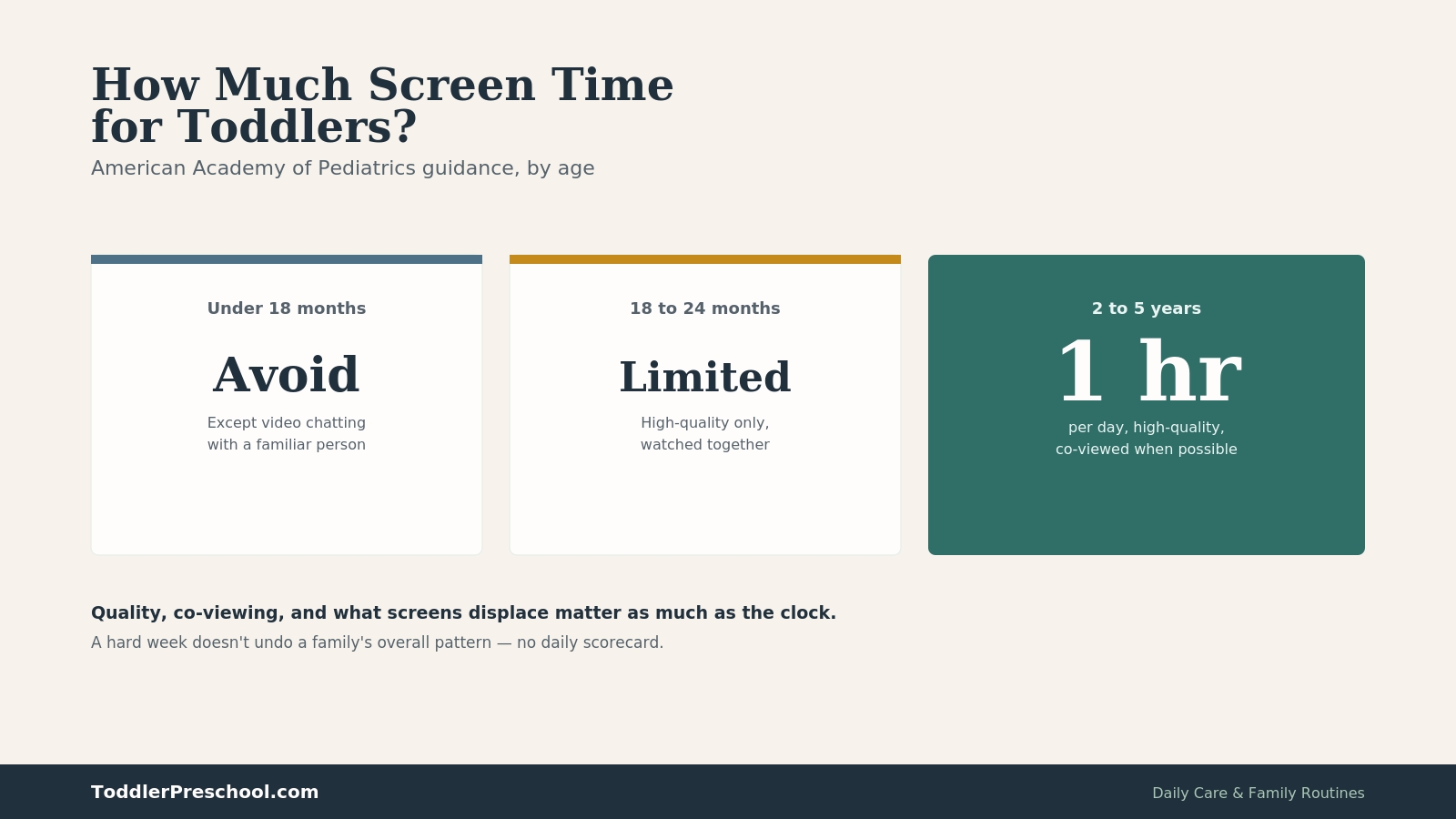
Here’s the direct answer: for children under 18 months, the American Academy of Pediatrics recommends avoiding screen media entirely except video chatting with a familiar person; for 18 to 24 months, keep any screen use limited and centered on high-quality, co-viewed content; and for ages 2 to 5, the guideline is up to one hour a day of high-quality programming, ideally watched together. But the honest, fuller answer is that the number is only part of the picture — what your child watches, whether you’re present, what the screen use is replacing, and how transitions on and off the screen actually go all matter as much as the clock. This guide walks through all of it: the real numbers, what “high quality” actually means, how to build a workable family approach, and — since this is often the hardest part — how to start and end screen time without a daily meltdown.
This guide is organized so you can use whichever part actually helps today: the numbers and quality guidance if you’re just getting oriented, the transitions section if meltdowns at screen-off time are your actual daily struggle, or the troubleshooting section if you’re trying to figure out a specific recurring situation, like travel or a working-from-home schedule.
The Direct Answer: How Much Screen Time Is Recommended for Toddlers
The American Academy of Pediatrics’ current guidance, organized by age:
- Under 18 months: Avoid screen media other than video chatting (FaceTime, Zoom, a call with a grandparent) with someone your child knows.
- 18 to 24 months: If you choose to introduce any screen media at this age, keep it limited, stick to high-quality programming, and watch together so you can help your child understand and engage with what they’re seeing.
- 2 to 5 years: Limit screen time to about one hour a day of high-quality programming, with co-viewing whenever possible — watching alongside your child and talking about what’s happening turns passive viewing into something closer to an interactive, shared activity.
- 6 and older: The AAP shifts to family-determined, consistent limits rather than a specific number, with continued attention to content quality and what screen time might be displacing.
The World Health Organization’s guidance is slightly stricter — no sedentary screen time for children under 2, and no more than one hour for ages 2 to 4 — but both organizations agree on the same underlying principle: screen time for toddlers shouldn’t replace physical play, sleep, reading, or in-person interaction, regardless of exactly where the number lands.
Screen Time Guidelines at a Glance
| Age | AAP Guidance | WHO Guidance |
|---|---|---|
| Under 18 months | Avoid, except video chatting | No sedentary screen time |
| 18–24 months | Limited, high-quality, co-viewed only | No sedentary screen time |
| 2–5 years | Up to 1 hour/day, high-quality, co-viewed | Up to 1 hour/day (ages 2–4) |
| 6 and older | Family-determined, consistent limits | Individualized, balanced with activity |
It’s worth saying plainly, before going any further: these are population-level guidelines meant to inform your own family’s approach, not a pass-or-fail test applied day by day. A sick day, a long flight, a genuinely hard week — these don’t undo anything, and there’s no research suggesting that occasionally going over the guideline on a specific day causes lasting harm. What matters more is the general pattern over weeks and months, not any single afternoon.
Why These Screen Time Numbers Matter for Toddlers
Children younger than 5 generally don’t learn as effectively from screens as they do from in-person exploration and interaction — this isn’t a moral judgment about screens, it’s a reflection of how young children’s brains build early skills. Talking, problem-solving, motor development, and emotional expression all develop primarily through hands-on exploration and real relationships with the people who love them, in a way that even well-designed screen content can’t fully replicate at this age. This is the core reasoning behind the AAP’s numbers, and it’s also why quality and co-viewing get as much emphasis in the actual guidance as the time limit itself — a screen used alongside a present, engaged adult functions differently than the same screen used alone.
This doesn’t mean screens are inherently harmful in any amount, and it doesn’t mean a toddler who watches more than the guideline suggests is being damaged. It means screen time for toddlers works best as one small piece of a day built mostly around other kinds of activity, rather than the default filler for open time.
A related concept worth understanding: researchers sometimes describe a “video deficit” in very young children, referring to the well-documented pattern that toddlers often learn a skill more slowly (or not at all) from a video demonstration compared to the same skill demonstrated in person, even when the video content is identical. This gap narrows somewhat as children move through the preschool years and gain more experience connecting two-dimensional screen content to the three-dimensional world around them, which is part of why the AAP’s guidance shifts meaningfully between the under-2 and 2-to-5 age bands rather than using one blanket rule.
Quality: What Counts as High-Quality Screen Time for Toddlers
Not all screen time for toddlers is equal, and the type of content matters as much as the duration. According to the AAP, high-quality programming for this age group tends to share a few traits: it’s age-appropriate and designed by developmental experts to be genuinely understandable to a young child, it’s interactive in some way (encouraging a child to sing along, name a color, or move), and it’s educational — teaching something about emotions, letters, numbers, or the world, rather than simply moving fast enough to hold attention.
Specific examples the AAP points to include PBS Kids programming, Sesame Street, Blue’s Clues, and Daniel Tiger’s Neighborhood — shows research has shown can teach toddlers real facts, healthy behaviors, and early strategies for managing emotions. These shows also tend to avoid the rapid-fire pacing and advertising common in other children’s media, both of which can be overstimulating for a young child.
The YouTube and Algorithm Problem
Toddlers are often drawn to YouTube content — cartoons, unboxing videos, influencer channels — that isn’t necessarily harmful in a single viewing but tends to include more marketing, less educational structure, and sometimes poor behavior modeling compared to curated children’s programming. If your toddler does watch YouTube, the AAP’s specific recommendation is to build a playlist of high-quality videos in advance rather than letting the platform’s recommendation algorithm choose what plays next, and to turn off autoplay specifically — autoplay is designed to keep a viewer (child or adult) watching past a natural stopping point, which works directly against the predictable, bounded viewing sessions that make transitions easier later in this guide.
Many streaming platforms and devices also offer a dedicated “kids” mode or app, which typically restricts content more tightly than a general account and removes some of the autoplay and algorithm-driven recommendation features found in the standard version. Setting this up once, rather than relying on manually supervising every session, reduces the chance of your toddler drifting into unplanned content even during a moment you can’t watch closely.
Co-Viewing Changes What Screen Time Actually Does
Watching alongside your toddler — narrating, asking questions, connecting what’s on screen to your child’s own life — is one of the most consistently emphasized parts of AAP guidance on screen time for toddlers, and it’s not just a nice-to-have. A show watched together, with real conversation woven in, functions more like a shared, language-rich activity than a passive one; the same show watched entirely alone doesn’t offer the same benefit. This doesn’t mean every single minute needs a parent glued to the couch — but building in co-viewing for at least some of your toddler’s screen time meaningfully changes what that time is actually doing developmentally.
In practice, co-viewing doesn’t require constant narration or a running commentary — even occasional, genuine engagement (asking “what do you think happens next?” once or twice, reacting to something funny together, pointing out a color or a word) accomplishes most of the benefit. For a parent who genuinely needs the screen time to be hands-off — cooking dinner, taking a call — that’s a legitimate use too, covered in the troubleshooting section below; the point isn’t that every minute must be co-viewed to count, but that building in co-viewed moments where possible adds real value beyond what the same show does alone.
Be Skeptical of “Educational” Marketing Claims
An app or show labeled “educational” on its packaging or app-store listing hasn’t necessarily been evaluated against any real standard — the word itself isn’t regulated, and plenty of products marketed this way haven’t been tested with actual children or reviewed by child development experts. A more reliable approach than trusting the label: look for content from established children’s media organizations (PBS Kids, Sesame Workshop) with a public track record of working with early-childhood researchers, and treat a flashy “educational” claim on an unfamiliar app with the same skepticism you’d apply to any other marketing claim aimed at parents.
Screens and Sleep
Screen use in the hour or so before bedtime is worth a specific mention, since it affects toddlers through two separate mechanisms: the stimulating content itself can make settling down harder, and the light from a screen can interfere with the body’s natural signal to wind down for sleep. A consistent, screen-free wind-down routine before bed — books, a bath, dimmer lighting — tends to support easier bedtimes than a screen used right up until lights-out, regardless of how calm the specific content is.
Context: The Other Factors That Matter as Much as the Clock
The AAP’s broader framework for thinking about media and young children — built around five key questions, often called the “5 C’s” — goes well beyond a simple time limit, and it’s worth walking through each piece.
Child: Know Your Specific Kid
Toddlers vary enormously in how they react to and use media. Some are intensely drawn to screens and protest hard when they’re taken away; others lose interest quickly and move on without much fuss. Neither pattern is a problem on its own — knowing your specific child’s reaction helps you set boundaries that actually fit them, rather than applying a generic rule that doesn’t match your household’s reality. A toddler who tends to get overstimulated or dysregulated by screen use in general may do better with shorter, calmer sessions and more frequent breaks than the general guideline alone would suggest, while a child who engages calmly and transitions easily may have more natural flexibility within the same overall time limit.
Calm: Screens Aren’t the Tool for Big Feelings or Boredom
This is one of the more important, and more commonly overlooked, pieces of AAP guidance on screen time for toddlers: try not to reach for a device specifically when your child is upset or bored. Big emotions and boredom are both genuine opportunities for a toddler to practice skills they’ll need for years — sitting with a feeling, self-soothing, or finding their own way into play — and consistently short-circuiting that practice with a screen can reduce the chances to build it. The AAP’s suggested alternative for big emotions: stay calm yourself, name what you think your child is feeling (“it’s okay to feel sad or frustrated”), and help them work through it directly. Reserve screens for more predictable, planned moments — a regular time of day, a long car ride — rather than as the automatic response to distress.
In practice, this distinction is really about the reason a screen goes on, not the screen itself. The same show, watched at a consistent time each afternoon, functions very differently from that identical show handed over specifically to stop a meltdown in its tracks — the first builds a predictable routine, while the second teaches that big feelings reliably produce a screen, which tends to make future emotional moments harder to work through without one.
Crowding Out: What Screen Time Actually Displaces
At this age, screen time for toddlers most commonly displaces active play, movement, outdoor time, looking at books, and conversation with family members — all activities that build social and cognitive skills in ways screens generally don’t replicate as effectively. The AAP is specific here: avoid giving a toddler open, unsupervised access to a tablet or phone, since that tends to expand screen use well past whatever a family originally intended, simply through availability. Setting aside dedicated daily time for play, reading, or outdoor time — even a modest amount — helps ensure screen time is filling genuinely open time, not replacing something else your child needs.
A useful way to check whether crowding out has become a real issue: over a typical week, does your toddler still have regular stretches of active outdoor play, being read to, and unstructured pretend play, alongside their screen time? If those are still happening reasonably regularly, screen time is likely filling gaps rather than displacing core needs. If they’ve become rare, that’s a more useful signal to act on than the exact number of screen minutes per day.
Does the Type of Device Matter?
A TV screen, a tablet, and a phone aren’t developmentally identical, even when showing the same content. A shared TV screen tends to naturally support co-viewing, since it’s positioned for a group rather than one close-up face, and it’s harder for a toddler to carry around and use independently in another room. A tablet or phone is more portable and often more interactive (touch-based apps, games), which can be genuinely engaging, but also makes solo, unsupervised use easier to fall into simply because the device goes wherever your toddler does. Neither format is inherently better across the board — a well-chosen tablet app used together can be excellent, and a TV left on as background noise all day isn’t automatically fine just because it’s a shared screen — but it’s worth factoring device type into your family’s plan rather than treating “screen time” as one undifferentiated category.
Communication: Talking About What They See
Toddlers and preschoolers understand more language than they can produce, which makes this a genuinely useful age to start talking about media directly — what a character did that was kind or unkind, what an advertisement is trying to get you to do, or simply what happened in an episode. Following up a show with a related activity (acting out a scene, reading a book on the same topic) extends the value of the screen time itself and reinforces that what your child watches is something you’re engaged with, not something that happens in a separate, unremarked-on part of the day.
A few concrete conversation starters that work even with a toddler’s limited vocabulary: “What was your favorite part?”, “Was that character being kind or not kind?”, “What do you think happens next?” before starting a new episode of something familiar. None of this needs to happen after every single viewing — even occasional conversations about media build the habit of treating screen content as something to think and talk about, not just passively absorb.

Building a Realistic Screen Time Plan for Toddlers
The AAP offers a free, customizable Family Media Plan tool specifically designed to help translate general guidance into rules that fit your actual household — worth using as a starting point rather than building a plan entirely from scratch. A workable plan for screen time for toddlers usually covers a few concrete pieces:
- When screens are used — a consistent time of day (after nap, before dinner prep) rather than an unpredictable, on-demand basis. Toddlers generally do better with “screen time happens at 4 o’clock” than with a schedule that shifts daily based on how the day is going, since the consistency itself is part of what makes transitions easier later.
- What gets watched — a short list of pre-approved, high-quality shows or a curated playlist, rather than open browsing. Sitting down once to build this list, rather than deciding fresh each day, removes a recurring decision point and a recurring opportunity for negotiation.
- Where screens are used — commonly a shared family space rather than a bedroom, which also makes co-viewing more natural and keeps screen use visible rather than happening in a separate, harder-to-monitor space.
- How long a session runs — a specific, consistent duration your toddler can eventually learn to expect. Some families find one longer, predictable session works better than several shorter ones scattered through the day, since each transition carries some friction and fewer transitions can mean less total friction.
- What happens when it ends — covered in detail in the transitions section below, since this is often the actual sticking point in a family’s plan, not the viewing itself.
A plan doesn’t need to be elaborate or written down to be useful — even an informal, consistent household pattern that answers these five questions tends to produce far fewer daily struggles than making the decision fresh each time. It’s also worth revisiting the plan periodically rather than treating it as fixed forever — what works for a 2-year-old often needs adjusting by 4, and a plan that fit your family six months ago may need a small update as your child’s attention span, vocabulary, and independence all continue to grow.
Transitions: Starting and Ending Toddler Screen Time Without a Meltdown
This is frequently the hardest part of screen time for toddlers in practice, and it’s worth treating as its own real skill to build, separate from the question of how much time is appropriate.
Why Endings Are Genuinely Hard
Ending screen time often triggers a real emotional reaction — not because your toddler is being manipulative, but because screen content is generally engaging and stimulating in a way that produces a real, if modest, dip in mood when it stops. Young children don’t yet have mature emotional regulation skills, so that dip can show up as crying, protest, or even physical resistance, especially if the ending feels sudden or arbitrary from your child’s point of view. Understanding this as a genuine, if temporary, emotional shift — rather than defiance — tends to help parents respond with more patience in the moment.
It also helps to remember that this reaction is largely proportional to how abrupt and unpredictable the ending feels, not simply to the fact that screen time is ending at all. A toddler who’s watched the same show at the same time every day, and who reliably knows what comes next, tends to have an easier time than one facing an unexpected interruption mid-episode with no established pattern to fall back on — which is exactly why the routine-based approach below tends to outperform relying on warnings alone.
What Actually Helps: Predictable Routines, More Than Last-Minute Warnings
Common advice suggests giving a two- or five-minute warning before screen time ends, and that can help some children. But research from the University of Washington on how families actually end screen time found something slightly more nuanced: transitions went more smoothly when screen time was already part of a predictable daily routine — the same show at the same point in the day, every day — than when a warning was the main tool being relied on. A child who reliably turns off the TV when breakfast is ready, because that’s simply always the pattern, tends to have an easier time than one negotiating an unpredictable stopping point each time, warning or not. In practice, this suggests investing more in a consistent daily pattern for screen time for toddlers than in perfecting the wording of an in-the-moment warning, though warnings still have a place for many families and aren’t harmful to use alongside a consistent routine.
A Practical Script and Approach for Ending Screen Time
A few concrete tools, drawing on AAP guidance specifically for this age group:
- Set the time and the plan before the screen goes on, not during: “We’re watching one episode, and then it’s bath time.” Stating the plan upfront, rather than negotiating at the end, gives your toddler a clearer expectation to hold onto.
- Use a visible timer for a toddler who doesn’t yet understand “five more minutes” — a simple kitchen timer or sand timer gives a concrete, visual cue that abstract time language doesn’t.
- Let a natural stopping point do some of the work — ending right as an episode finishes, rather than mid-episode, tends to go more smoothly, since it doesn’t feel like an arbitrary interruption.
- Have the next activity ready before you turn off the screen, rather than announcing the end and then scrambling to figure out what’s next — an empty gap right after a screen turns off is exactly when boredom-driven protest tends to escalate.
- Stay calm and brief if protest happens anyway: “I know you wanted more. Screen time is done for now. Let’s go [do the next thing].” Extended negotiation at this point tends to prolong the distress rather than resolve it.
- Consider a consistent “closing” ritual — turning the screen off together, saying goodbye to the characters, or closing the device the same way each time — which gives a young toddler a concrete, repeatable action that marks the transition, similar to how a consistent bedtime routine signals sleep is coming.
If a Meltdown Happens Anyway
Some protest at the end of screen time is common enough that it doesn’t need to derail your whole approach. If your toddler does have a real meltdown when a device goes off, the same core toddler-tantrum tools apply here as anywhere else: stay calm yourself, make sure they’re safe, let the feeling happen without over-explaining mid-meltdown, and reconnect once it passes. A consistent, calm-but-firm response — not giving the screen back to stop the crying — teaches over time that the limit is real, even on the days it’s genuinely hard to enforce.
If You’re Trying to Reduce From a Higher Starting Point
If your family’s current screen time for toddlers runs well above the guideline and you’d like to bring it down, a gradual shift tends to work better than an abrupt cutoff — both for your toddler’s adjustment and for how sustainable the change actually is for your household. Pick one specific piece to change first (moving from three scattered sessions to one consistent one, or swapping less structured content for a higher-quality show) rather than overhauling everything on day one. Expect some pushback during the adjustment period itself, similar to the transition protest covered above, and know that it typically eases within one to two weeks of consistent follow-through, not instantly.

Common Screen Time Scenarios for Toddlers and Troubleshooting
Long Car Rides or Flights
Travel is one of the situations the AAP’s own guidance explicitly carves out room for — screens used specifically for a long car, bus, or plane ride are a reasonable, practical exception to a family’s usual pattern, not a failure of the plan. Treating travel screen time as its own separate, occasional category (rather than folding it into your daily allowance and feeling like you’ve blown the budget) tends to reduce the guilt that doesn’t actually serve anyone here. Downloading content in advance, since travel wifi is unreliable, and bringing headphones sized for a small child’s head (many standard headphones don’t fit well and can be uncomfortable) both make this specific use case go more smoothly.
Sick Days
A day (or several) with more screen time than usual while your toddler is genuinely unwell and needs to rest is a reasonable, temporary adjustment, not a habit that undoes your regular routine. Returning to your normal pattern once your child is feeling better is usually all that’s needed — there’s no special “screen detox” required to reset after a sick-day bump, and a toddler generally returns to their usual interests and routines readily once they’re feeling well again.
Working From Home or Needing Focused Time
Many families genuinely rely on screen time for toddlers to cover blocks of time when a parent needs to be on a call or focused on something that can’t include active supervision. This is a completely realistic use of screens, not something to feel uniquely guilty about — the goal is making sure it’s balanced by the rest of the day’s pattern (active play, outdoor time, co-viewed moments when possible), not eliminating this use case entirely, which isn’t realistic for most working families. If this is a regular, predictable need (the same meeting time each day, for instance), building it into your consistent daily schedule — the same show at the same time — tends to work better than an ad hoc decision each time the need arises.
Restaurants, Waiting Rooms, and Other Public Waits
A device that buys ten calm minutes in a restaurant or a waiting room is a reasonable tool, not a parenting failure — plenty of families use screens specifically for these predictable, bounded situations while keeping most of the day screen-free. If this is a recurring pattern, it’s worth having a specific, short show or app reserved just for these moments, which also keeps it feeling special and effective rather than diluted by constant availability.
Siblings at Different Ages With Different Rules
When one child’s appropriate screen guideline is different from a younger sibling’s, it helps to be direct about why, in simple terms a toddler can understand (“your sister is older, so her screen time rules are a little different”) rather than trying to make the rules identical, which usually isn’t developmentally appropriate for either child. Older siblings’ screen habits will also realistically influence a toddler’s exposure to some degree, and that’s worth factoring into your overall family plan rather than treating each child’s screen time as fully separate.
Grandparents or Other Caregivers With Different Rules
It’s common for a grandparent or another regular caregiver to have a more relaxed (or stricter) approach to screens than your own household’s plan, and this is worth a direct, low-drama conversation rather than letting it become a recurring source of tension. A useful framing: share your specific plan’s key pieces (the approved shows, the time limit) as a practical request rather than a criticism of their judgment, and accept that some variation across settings is normal and not something a toddler needs shielded from entirely.
A Toddler Who Asks for Screens Constantly
If your toddler is frequently requesting screen time throughout the day, well beyond your planned window, it’s worth checking whether the current plan has enough predictability — a toddler who isn’t sure when (or whether) screen time is coming tends to ask more often than one who knows it reliably happens at a specific time. Consistently redirecting the request to the established time (“screen time is after your nap, not now”) rather than negotiating a new exception each time tends to reduce the frequency of the requests over a few weeks, even though it can feel like the opposite is happening in the short term.

When Toddler Screen Time Becomes a Bigger Concern
Most screen time for toddlers, even when it runs a bit over the guideline on a regular basis, isn’t a sign of a serious problem. It’s worth a closer look, and a conversation with your pediatrician, if:
- Screen time is consistently displacing sleep, meals, or physical activity in a way that’s affecting your child’s overall health or mood.
- Your toddler shows significant, escalating distress around screen use — well beyond typical transition protest — that isn’t easing with a consistent routine over several weeks.
- Screen time has become the only thing that reliably calms or engages your child, with little interest left in other kinds of play.
- You notice your child withdrawing from other activities they used to enjoy, specifically in favor of more screen time.
- Your child’s language or social development seems to be lagging in a way that coincides with heavy screen use, particularly solo, non-co-viewed use.
None of this is about diagnosing “screen addiction” in a toddler, which isn’t a recognized clinical term at this age — it’s about noticing a pattern that’s genuinely affecting daily functioning and bringing it to a professional who can help assess it in the context of your specific child, rather than trying to sort it out from a general guide alone.
If you do raise this with your pediatrician, it helps to bring specifics: a rough sense of daily screen time across a typical week, what’s being watched, whether it’s co-viewed or solo, and what specifically prompted your concern. This gives your pediatrician something concrete to work with, and they can help you figure out whether an adjustment to content, timing, or context would help more than simply cutting the total time further.
No Shame About Where Your Family Actually Lands
It’s worth saying directly: plenty of families, for entirely reasonable reasons, use more screen time for toddlers than the AAP guideline on a regular basis — a parent managing a health condition, a family with limited access to alternative child care, a household where both parents work full-time with no other support, a single parent stretched thin on a given week. None of that makes a family’s approach to screen time a moral failure, and this guide isn’t intended to add guilt on top of an already hard situation. The guidance in this piece is aimed at helping you make screen time work better within your real constraints — more predictable, higher-quality, easier to transition out of — not at implying that any family not hitting an exact number is falling short.
It’s also worth noting that screen time guilt itself has a real cost — parents who feel anxious or ashamed about their family’s screen use don’t tend to make better decisions because of that guilt; if anything, guilt can make it harder to think clearly about what would actually help. A calmer, more honest look at your family’s actual pattern, without the emotional weight of feeling like you’re failing a test, tends to produce more sustainable change than a guilt-driven attempt at a strict overnight overhaul that’s hard to maintain.
If you’re comparing your family’s screen time to another family’s — a friend whose kids “don’t watch any TV,” a relative who seems to have strict rules you can’t match — it’s worth remembering you’re seeing a curated version of their reality, not the full picture, and that different households have genuinely different constraints that make different approaches reasonable.
Adapting This to Every Family’s Situation
Multilingual families. High-quality children’s programming exists in many languages, and screen time in a family’s home language can genuinely support bilingual development rather than working against it — it doesn’t need to be in English to count as high-quality, co-viewed content. If you’re raising a child in more than one language, choosing some screen content in each language, rather than defaulting entirely to whichever language has more available children’s media, helps keep the balance you’re aiming for at home.
Disability and developmental variation. For a toddler with a sensory processing difference, a communication delay, or another developmental difference, general screen time guidelines may not map cleanly onto what’s actually helpful for that specific child — some children benefit from certain interactive or communication-focused apps as part of a broader therapy plan, and a toddler with sensory sensitivities may need shorter or calmer sessions than the general guideline would suggest, or occasionally more, depending on their specific needs. This is a conversation for your child’s specific care team, not something a general guide can responsibly individualize.
Different family structures. Whoever manages your toddler’s day-to-day care — one or two parents, grandparents, a nanny, rotating caregivers in a shared-custody arrangement — benefits from aligning on a consistent approach to screen time across settings, since inconsistency (unlimited screens at one house, none at another) tends to make transitions harder everywhere, not easier anywhere. In shared-custody households specifically, a brief, direct conversation about the core pieces of your plan (approved content, rough timing) is worth having even if the two households can’t align on every detail.
Budget and access. Screens are sometimes the most affordable, accessible form of entertainment or brief respite a family has, especially compared to paid activities or additional child care, and that’s a legitimate, practical reality — the quality and consistency guidance in this piece works regardless of whether your family’s screen access is a tablet, a shared TV, or a library-borrowed device. Many public libraries also offer free access to children’s educational apps and streaming content through library card programs, worth checking if cost is a barrier to accessing higher-quality options specifically.
Time and schedule constraints. A full, elaborate media plan isn’t necessary for any of this guidance to help — even one consistent element (the same time of day, one pre-approved show, a simple ending routine) makes a real difference without requiring a complete household overhaul. Families with unpredictable schedules (shift work, irregular caregiving arrangements) can still build predictability around screen time even when the rest of the day varies, by anchoring it to an event rather than a clock time — “after lunch” or “after bath” works even when the actual clock time shifts day to day.
Frequently Asked Questions About Screen Time for Toddlers
Does video chatting with grandparents count toward the screen time limit? No — the AAP specifically excludes video chatting from its screen time guidance at every age, including under 18 months, since the real-time, responsive interaction with a familiar person functions very differently from passive viewing.
My toddler watches educational apps on a tablet, not TV — does the same one-hour guideline apply? Yes — the AAP’s guidance counts all screen media used for entertainment or engagement purposes together, regardless of device, though interactive apps that genuinely require a child to respond, create, or problem-solve may offer somewhat more engagement than passive video, depending on design.
Is background TV (on but not actively being watched) a concern too? Yes, and it’s worth its own mention — research on background media suggests it can reduce the quality of parent-child interaction and play happening in the same room, even when a toddler isn’t directly watching, simply by adding noise and distraction to the environment. Turning the TV off between intentional viewing sessions, rather than leaving it on as ambient background, is a reasonable, low-effort adjustment.
What if my 2-year-old had almost no screen exposure and is about to start preschool where screens are used occasionally? A toddler with minimal prior screen exposure generally adapts without difficulty to occasional, supervised use in a classroom setting — there’s no “catching up” required, and a low-screen-exposure background isn’t something to worry about heading into a program that uses screens in a limited, structured way.
Should I feel guilty about the days screen time runs well over an hour? No — as covered above, these are population-level guidelines meant to inform a general pattern, not a daily scorecard, and an occasional high-screen day doesn’t undo the rest of your family’s routine. Guilt tends to make consistent follow-through harder, not easier, so it’s worth setting it aside in favor of just returning to your usual pattern the next day.
Do “brain training” or “IQ boosting” apps marketed for toddlers actually work? Be skeptical of specific claims like this — as covered above, marketing language on children’s apps isn’t independently regulated or verified, and there’s no strong evidence that a specific app reliably boosts intelligence or accelerates development in ways that matter long-term. A genuinely well-designed, age-appropriate app can still be a reasonable part of screen time for toddlers; just don’t let a bold marketing claim substitute for evaluating the content the same way you would any other show or app.
My toddler seems to genuinely learn words and concepts from their favorite show — does that mean more screen time would help even more? Not necessarily — learning something from a high-quality, co-viewed show doesn’t mean scaling up the amount produces proportionally more learning, and the AAP’s one-hour guideline already accounts for the fact that some screen time, used well, has real value. More time on screens generally means less time for the in-person exploration and interaction that still does more of the developmental work at this age, even when the screen content itself is genuinely good.
What if my child care program or preschool uses screens differently than I do at home? It’s reasonable to ask your program directly about their screen use policy — how often, what content, for how long — and factor that into your own at-home plan, similar to how you’d account for a sibling’s different needs. A brief, occasional, high-quality use during a school day (a calm-down video, a specific curriculum tool) generally isn’t something to worry about even if it differs somewhat from your home approach.
Your One Next Step
Pick just one piece of your family’s current screen time routine to make more consistent this week — the same time of day, the same short pre-approved show, or a simple ending phrase you say every time — rather than trying to overhaul the whole approach at once.
Sources consulted: American Academy of Pediatrics / HealthyChildren.org — Kids & Screen Time: 5 C’s Questions for Toddlers & Preschoolers and Screen Time & Temper Tantrums guidance by Jenny Radesky, MD, FAAP; World Health Organization 2019 guidelines on screen time for young children; University of Washington research on screen time transitions and family routines.