
Maybe your toddler just turned 2, and every other parent at the playground seems to be asking about potty training readiness. Or maybe your child is already showing odd little signs, like hiding behind the couch to poop, and you’re wondering if that means something.
You’ve probably already noticed how much conflicting advice is out there. One relative says start at 18 months. Another says wait until 3. Neither answer accounts for your actual child.
Here’s the direct answer: potty training readiness shows up as a cluster of physical, behavioral, and cognitive signs, usually somewhere between 18 and 30 months, and it matters far more than your child’s exact age. A 2 year old showing several real signs is often more ready than a 3 year old showing none. This guide walks through exactly what those signs look like, what the research actually says about timing, and what to do whether your child is showing every sign on the list or none of them yet.
Nothing here is about rushing. It’s about noticing what’s already there.
The Direct Answer: What Potty Training Readiness Actually Looks Like
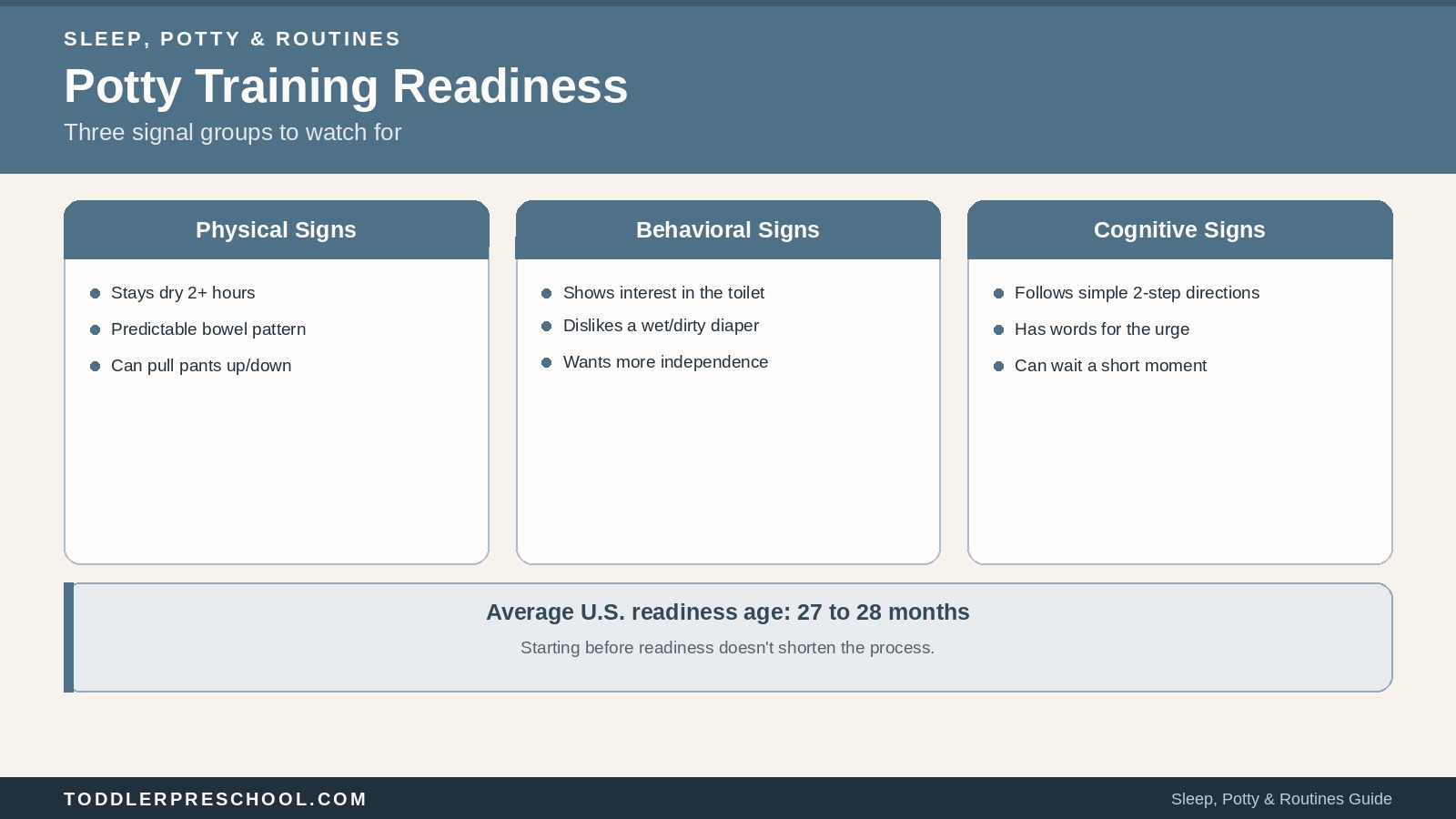
Potty training readiness isn’t one single skill. It’s a cluster of signs across three areas: your child’s body, their behavior, and their thinking. When several signs show up together, most children have an easier time learning to use the toilet.
The Typical Age Range
Most children show at least some readiness signs between 18 and 24 months. Most families start active training somewhere between 2 and 3 years old. That’s a wide window, and it’s supposed to be.
Genuine readiness rarely shows up all at once. It builds gradually, sign by sign, often over several months.
Readiness Matters More Than Age
Two children can be the exact same age and be in completely different places. One might show five clear signs. The other might show one, or none yet. Both are normal.
The American Academy of Pediatrics is direct about this: don’t wait for a specific birthday. Watch the signs instead. Starting because your child is ready tends to go more smoothly than starting because a birthday or a calendar says it’s time.
Physical Signs of Potty Training Readiness
Physical readiness comes first for most children on the path to potty training readiness. It’s also the easiest set of signs to notice, since you can watch for them during an ordinary day.
Bladder and Bowel Control
Watch for stretches of dryness. A child who stays dry for two hours or more during the day, or wakes up dry from a nap, is showing real bladder control. This doesn’t need to happen every single time. A consistent pattern is what matters.
Bowel movements that happen on a predictable schedule are another good sign. A child whose poop shows up around the same time each day has more body awareness than one whose pattern is completely random.
Sitting Still Long Enough
Your child needs to sit on a potty or toilet for a minute or two at a time. This sounds small, but it’s a real physical and attention skill.
If your toddler can’t sit still for a short book or a snack yet, sitting on a potty long enough to actually use it may still be a few weeks or months away. That’s fine. This skill tends to develop alongside general attention span.
Managing Clothing
Can your child pull elastic waistband pants up and down, even clumsily? This matters more than it sounds like it should.
A child who can’t yet manage their own clothing will need help with this step regardless of bladder readiness. That’s not a barrier to starting. It’s just one more thing an adult will be doing hands on for a while.
Walking to the Bathroom
Your child needs to physically get to the bathroom, ideally on their own. Most toddlers in the readiness age range have this skill already, since walking itself usually shows up well before other potty training readiness signs.
Behavioral Signs of Potty Training Readiness
Behavioral signs are just as central to potty training readiness as physical ones. They show how your child is thinking and feeling about their own body, not just what their body can physically do.
Curiosity About the Bathroom
Does your toddler follow you into the bathroom? Ask questions about the toilet? Want to flush it themselves?
This curiosity is a genuinely useful sign. It means your child is already paying attention to something most toddlers eventually need to learn.
Discomfort With a Wet or Dirty Diaper
A toddler who used to sit happily in a wet diaper and suddenly starts fussing, pulling at it, or asking for a change is showing real body awareness. This shift often happens before a child can fully verbalize what’s bothering them.
Not every child shows obvious discomfort, though. Some stay comfortable in a wet diaper well into the readiness window. That alone doesn’t rule out readiness in other areas.
Communicating the Need to Go
This can look like words (“pee,” “potty”), a sign, or simply a consistent facial expression or posture right before or during an accident. Even a delayed announcement (“I went pee pee”) is a meaningful sign. It shows your child is starting to connect the physical sensation with what’s happening.
Following Simple Instructions
Can your child follow a two step direction, like “get your shoes and bring them to me”? Potty training involves a string of small instructions: sit down, wait, wipe, stand up, flush, wash hands. A child who can follow simple sequences already has a head start on this part.
Cognitive Signs of Potty Training Readiness
Cognitive signs are quieter and easier to miss, but they matter just as much as the physical ones.
Understanding Cause and Effect
Does your child understand that pee and poop go in the toilet, even before they’re using it themselves? Many toddlers show this understanding through pretend play, like putting a doll on a toy potty, well before they’re ready to use one themselves.
Imitating Others
Toddlers learn an enormous amount by copying the people around them. A child who imitates a parent, a sibling, or even a favorite character using the potty is doing real cognitive work, even if they’re not using the toilet yet.
Why Independence and Control Matter to Potty Training Readiness
Potty training sits right in the middle of a bigger developmental push toward independence. Understanding this helps explain why the process can feel emotionally bigger than a simple skill.
The Toddler Drive Toward Control
Toddlers in this age range are working hard on the idea that they’re separate people with their own preferences. Using the toilet, on their own terms, taps directly into that drive.
Why Power Struggles Sometimes Appear
A toddler who feels pushed, rather than invited, sometimes resists specifically because resisting is itself an act of control. This is a completely normal response, not defiance for its own sake.
Working With the Drive Instead of Against It
Offering small, genuine choices (which potty, which underwear, when to try) tends to work better than a fully adult directed approach. This channels the same independence drive productively instead of triggering a standoff.
When Timing Matters as Much as Signs
Readiness signs tell you about your child. Timing tells you about your family’s current situation. Both matter.
Avoiding Major Life Changes
A new sibling. A move. Starting a new child care program. Any of these can make an otherwise ready child regress or resist.
This doesn’t mean you need a perfectly calm month with nothing happening. It means a major disruption is a reasonable reason to pause or delay, even if your child is showing plenty of signs.
Building a Consistent Routine First
Potty training goes more smoothly with some kind of predictable daily rhythm already in place. You don’t need a rigid schedule. You just need enough consistency that a new routine has somewhere stable to attach to.
What the Research Says About Potty Training Readiness and Age
It helps to know the actual numbers here, not just general reassurance.
Average Age of First Success
Research on U.S. children puts the average age of first toilet training success around 27 to 28 months, with more consistent daytime success following shortly after. That’s an average, not a target. Half of all children reach this milestone later than that number, and that’s completely normal.
Why Starting Too Early Rarely Helps
Here’s something worth knowing: starting intensive training before about 27 months doesn’t actually get most children trained faster. Bodies and brains need to reach a certain point of readiness regardless of how early a family starts pushing.
Pushing before readiness signs appear often means a longer, harder process, not a shorter one.
The Wide Range of Normal
By age 3, roughly 6 in 10 children are trained. By age 4, nearly all are. Night dryness usually comes later, often between 3 and 4 years old, sometimes later still.
Daytime accidents remain common for typically developing 3 and 4 year olds. Some children still need overnight protection until age 5. None of this is unusual.
Three Real Patterns of Potty Training Readiness
Seeing how readiness actually plays out in different children sometimes makes the whole picture clearer than a list of signs alone.
The Early, All At Once Pattern
Some toddlers show several signs within a short window, often around 20 to 24 months. Physical control, curiosity, and communication all show up close together. Training tends to move quickly once it starts.
The Slow, Uneven Pattern
Other toddlers show one or two signs early, then nothing new for months. A dry stretch might appear at 22 months, but real interest doesn’t show up until 30 months. This pattern is just as normal as the first one.
The Late Bloomer Pattern
A smaller group of children show almost nothing until closer to 3, then move through the whole process relatively quickly once they do start. Later readiness doesn’t mean a harder process. It often means a faster one.
Potty Training Readiness Versus Willingness
These two things get confused constantly, and separating them helps.
What Readiness Means
Readiness describes your child’s actual physical and cognitive capability. It’s mostly about what their body and brain can currently do.
What Willingness Means
Willingness describes whether your child wants to engage with the process right now. A fully ready child can still be unwilling, often because of mood, timing, or plain stubbornness.
Why the Difference Matters
A child who’s ready but unwilling usually responds to patience and a lower pressure approach. A child who isn’t ready yet won’t be helped by more patience alone. They need more time for the underlying skills to develop.
A Simple Way to Check Potty Training Readiness at Home
You don’t need a formal test to assess it. A simple, honest look at your own child works fine.
Over the next week or two, notice:
- Dry stretches. Does your child stay dry for two or more hours some days?
- Awareness. Do they seem to notice when they’ve gone, even after the fact?
- Interest. Do they show curiosity about the bathroom or the toilet?
- Communication. Can they tell you, in any form, that they need to go or have gone?
- Physical skills. Can they sit briefly, walk to the bathroom, and manage simple clothing?
You don’t need a perfect score. A handful of consistent yes answers is a reasonable sign to start exploring.
Potty Training Readiness: Some Signs But Not Others
Uneven potty training readiness is extremely common, and it’s not a problem to solve. Most toddlers show readiness signs unevenly. A child might have strong physical control but zero interest in the bathroom. Another might be fascinated by the toilet but still have very little bladder awareness.
Uneven readiness is the rule, not the exception. There’s no requirement to check every box before trying. Many families start with a soft introduction, like reading books about potty training or letting a toddler sit on the potty fully clothed, while waiting for a few more signs to show up.
Potty Training Readiness: No Signs Yet
If your toddler isn’t showing much of anything yet, and they’re under 2, this usually just means more time. There’s no benefit to rushing.
If your child is closer to 3 with genuinely no readiness signs at all, it’s still often just individual timing. It’s also a reasonable, low pressure thing to mention at a well visit, simply so it’s on record.
Waiting is not the same as ignoring it. You can keep gently introducing the bathroom as a normal part of life (a step stool, a potty in the room, matter of fact conversation) without pushing active training.
Starting Even Though You’re Not Sure
Some families start with a mix of signs present and some genuinely unclear. That’s a reasonable place to start too, especially with a low pressure, no punishment approach.
If it doesn’t go well after a few weeks, backing off for a month or two and trying again isn’t a failure. It’s simply useful information about timing.
Does the Time of Year Matter for Potty Training Readiness?
Plenty of families factor season into their decision, and there’s some practical logic behind it.
Why Warmer Weather Sometimes Helps
Lighter clothing and more time outdoors or in easy to clean spaces can make the early, accident heavy days less stressful. Fewer layers means faster access to the potty too.
Why This Isn’t a Requirement
Plenty of families train successfully in any season. If your child’s signs point toward starting in the middle of winter, there’s no real reason to wait months for warmer weather.
A Reasonable Compromise
If your child’s readiness signs are borderline and a warmer season is only a few weeks away, waiting that short stretch is a completely reasonable, low cost choice. It’s not necessary if signs are strong and the season doesn’t line up.
How Potty Training Readiness Connects to Different Approaches
You’ll eventually run into named methods once you start researching further. It helps to know how readiness fits into them, even though methods themselves are a separate topic from this guide.
Child Led Approaches
These methods wait for the child to initiate most steps, using readiness signs almost exactly like the ones in this guide as the starting signal.
Structured, Intensive Approaches
Some families use a concentrated, short timeframe approach, often over a long weekend. These still work better when genuine readiness signs are already present beforehand, rather than replacing the need for them.
Neither Approach Skips Readiness
Every credible method assumes some baseline readiness exists first. The signs in this guide apply no matter which specific approach a family eventually chooses.
Preparing Your Home Before You Start
You don’t need much. A few small choices ahead of time make the actual start smoother.
Bathroom Setup
A step stool and a child sized seat insert, or a separate small potty chair, both work. Neither is objectively better. Pick whichever your child seems more comfortable with when you let them explore it.
Keep it in the bathroom, or nearby if that feels less intimidating at first. Familiarity matters more than exact placement.
Clothing Choices
Elastic waistbands beat buttons, snaps, or zippers by a wide margin. A child who’s still building the physical skill to pull pants down doesn’t need a fussy closure working against them too.
This is a small change, but it removes one genuine obstacle before training even starts.
Books and Modeling
A simple picture book about using the potty gives your child a low pressure way to absorb the idea. Many toddlers ask to read the same one repeatedly, and that repetition is doing real work.
Letting your child see a parent or older sibling use the toilet, when your family is comfortable with that, is another form of the same modeling.
A Simple Supply List
You genuinely don’t need much:
- A potty chair or toilet seat insert
- A step stool
- Several pairs of easy on, easy off underwear
- A change of clothes kept handy for the first weeks
That’s it. Elaborate reward charts, special toilet paper, or themed decorations are optional extras, not requirements.
Nighttime Potty Training Readiness Is a Separate Skill
Daytime and nighttime readiness develop on different timelines. It helps to treat them separately from the start.
Why Night and Day Develop Differently
Staying dry overnight depends on a different physical skill. Your child’s body needs to produce less urine overnight, or wake up when their bladder is full. This usually develops later than daytime bladder control, sometimes by a year or more.
Signs of Nighttime Readiness
Waking up dry from naps is an early clue. Consistently dry mornings, not just occasional ones, is the clearer sign that nighttime readiness is arriving.
No Rush on Night Training
Most children aren’t dry overnight until somewhere between 3 and 4 years old. Some take longer. This isn’t a sign that daytime training didn’t work. It’s simply a separate skill on its own timeline.
Constipation Can Masquerade as “Not Ready”
This connection surprises a lot of parents, and it’s worth understanding clearly.
How Constipation Interferes With Readiness
A child dealing with ongoing constipation often withholds bowel movements out of discomfort. This can look like disinterest or resistance, when the real cause is physical.
Signs Worth Noticing
Infrequent, hard, or painful bowel movements, or a pattern of stool withholding, are worth mentioning to your pediatrician before assuming the issue is purely behavioral.
Why This Matters for Readiness
Treating an underlying constipation issue sometimes resolves what looked like a readiness problem entirely. This is exactly the kind of situation where a quick medical check genuinely helps.
Cultural and Family Differences in Approach
Readiness signs are fairly universal, but families approach training itself very differently, and that’s worth naming.
Different Traditions, Same Underlying Signs
Some cultures and families start earlier, using consistent routine and caregiver cues rather than waiting for a child to initiate. Others wait longer and follow the child’s own lead closely. Both traditions work with the same basic readiness signs described throughout this guide.
There’s No Single “Right” Approach
What matters most is that your family’s specific approach is calm, consistent, and free of shame. The exact method matters far less than that foundation.
Talking to Your Toddler About Starting
What you say matters, even before training officially begins.
Simple Words to Use
Keep language plain and consistent: “pee,” “poop,” “potty,” or whatever simple words your family prefers. Consistency matters more than which specific words you choose.
What Not to Say
Avoid framing accidents as bad or gross, even casually. Toddlers absorb tone quickly, and shame tends to slow progress rather than speed it up.
Letting Your Child Ask Questions
Toddlers often ask blunt, repetitive questions about the toilet. Answering simply and matter of factly, without much drama either way, tends to work best.
Potty Training Readiness Signs by Setting
Readiness can look different at home than it does at daycare or with another caregiver.
What Daycare Staff Often Notice First
Group care staff see many toddlers over time, and they often notice a dry stretch or a curiosity cue before a parent does, simply from comparison and repetition.
Comparing Notes Between Home and Care
It’s worth asking directly what a caregiver has noticed. A quick conversation at pickup can surface readiness signs a busy parent might miss during a normal evening.
When Home and Daycare See Different Things
A child who seems ready at daycare but not at home, or the reverse, isn’t confused or behind. Different environments genuinely produce different comfort levels at this age.
Resist Comparing Your Child to Others
This deserves its own section, because it comes up constantly.
Why Comparison Feels So Automatic
Playground conversations, family group chats, and social media all make it easy to hear about another toddler’s progress. That information rarely includes the full picture.
What Comparison Actually Misses
You don’t see another family’s setbacks, their false starts, or the weeks they quietly paused. You’re comparing your full picture to someone else’s highlight.
A More Useful Comparison
Compare your child to your child, a few weeks ago. Are more signs showing up now than last month? That’s the only comparison that actually tells you something useful.
A Simple Weekly Observation Log
Some families find it easier to track signs on paper rather than trying to remember everything.
| Day | Dry Stretch Noticed | Showed Interest | Told You Afterward | Notes |
|---|---|---|---|---|
| Monday | ||||
| Tuesday | ||||
| Wednesday | ||||
| Thursday | ||||
| Friday | ||||
| Saturday | ||||
| Sunday |
A simple week like this, filled in honestly, often reveals a clearer pattern than trying to recall everything from memory at the end of a long day.
Potty Training Readiness Signs You Might Be Misreading
A few common behaviors get misread in both directions.
Hiding to Poop
Many toddlers hide behind furniture or duck into a corner to have a bowel movement. This looks like avoidance, but it’s actually a positive sign. It shows real awareness of what’s happening in their body.
Refusing the Potty Isn’t Always “Not Ready”
Some toddlers show every other readiness sign but flatly refuse to sit on the potty. This is often about the specific object, the sounds, or the unfamiliar sensation, not a lack of underlying readiness.
Asking About the Toilet Constantly
Repetitive questions about the toilet, flushing, or other people’s bathroom habits can feel excessive. It’s actually a strong behavioral readiness sign, not a quirk to redirect away from.
A Single Successful Attempt Doesn’t Mean “Trained”
One lucky trip to the potty is exciting, but it doesn’t mean training is complete. Genuine readiness shows up as a pattern over days and weeks, not a single event.
What Regression Really Means
Regression deserves its own explanation, since it worries parents more than almost anything else in this process.
Regression Is Common, Not Rare
A child who was doing well and suddenly starts having frequent accidents again is going through something extremely common. It doesn’t erase the progress that already happened.
Common Triggers
A new sibling, starting a new child care setting, illness, travel, or even a change in the home routine can all trigger temporary regression. The connection isn’t always obvious right away.
When to Simply Wait It Out
If a trigger is identifiable and mild, giving it two to four weeks while staying calm and consistent usually resolves things on its own.
When to Involve Your Pediatrician
Persistent regression lasting more than a month, or regression paired with pain, fever, or unusual thirst, is worth a call. This helps rule out a physical cause like constipation or a urinary tract infection.
Older Toddlers Who Haven’t Started Yet
Sometimes a child closer to 3 hasn’t shown much interest at all, and that raises its own specific worry.
This Is Still Within Normal Range
Plenty of children start closer to 3 than 2, especially when real readiness signs simply arrived later. This isn’t unusual, even though it can feel that way when peers seem ahead.
What’s Different About Starting Later
Older toddlers sometimes catch on faster once they do start, since their communication and physical skills are more developed overall. A later start doesn’t necessarily mean a longer process.
When It’s Worth a Conversation
If your child is approaching 4 with genuinely no readiness signs at all, mentioning it at a well visit is reasonable. This is about gathering information, not raising alarm.
Common Myths About Potty Training Readiness
A few persistent myths are worth clearing up directly.
Myth: There’s a Perfect Age
There isn’t. The 18 to 36 month range is wide on purpose. A specific birthday means far less than the signs themselves.
Myth: Faster Starts Mean Faster Results
Research doesn’t support this. Starting before physical and behavioral readiness shows up often means a longer process, not a shorter one.
Myth: One Missed Sign Means “Not Ready”
Readiness is a cluster, not a checklist that needs every box checked. A child missing one or two signs can still be a reasonable candidate to start.
Myth: Boys Always Take Longer Than Girls
Population averages show a modest difference in some studies. Individual variation is far larger than the average gap between sexes. Plenty of boys train earlier than plenty of girls.
Getting Every Caregiver on the Same Page
Consistency across everyone in your child’s life makes a real difference once signs point toward starting.
Why Consistency Matters So Much
A toddler who gets different expectations from different adults takes longer to build a clear, confident routine. This isn’t about perfection. It’s about rough alignment.
A Simple Way to Share Information
A short written note, even a text message thread, covering the words your family uses and what you’ve noticed works better than assuming everyone will remember a verbal conversation.
Grandparents and Other Regular Caregivers
Older generations sometimes learned very different approaches. A brief, kind conversation about your family’s current approach tends to go further than expecting automatic agreement.
Bladder and Bowel Potty Training Readiness Aren’t Identical
Most guides lump these together, but they often develop on slightly different timelines.
Bowel Control Often Comes First
Many toddlers show predictable, controllable bowel patterns before bladder control catches up. A consistent daily bowel movement time is a genuinely strong early sign.
Bladder Control Is Usually the Longer Process
Staying dry requires noticing a building sensation and acting on it before it’s too late. This skill typically takes more repetition to fully develop than bowel awareness does.
Training Both at Once Is Still Standard
Most approaches introduce both together, since separating them fully isn’t necessary for most children. Understanding that one may lag behind the other just helps set realistic expectations.
What About Pull-Ups and Training Pants?
This decision comes up for nearly every family, and there’s no single right answer.
What Pull-Ups Offer
Pull-ups provide backup protection during the learning phase, which reduces stress about accidents in public or during travel.
What Cloth Training Pants Offer
Cloth training pants let a child feel wetness more directly, which some families find speeds up the connection between sensation and action.
There’s No Required Choice
Some families use pull-ups only for sleep and outings, cloth or regular underwear at home. Others use one or the other exclusively. Both paths lead to the same destination.
Common Obstacles
A few situations come up often enough to address directly.
“My child shows every sign, but refuses to sit on the potty.”
Interest and willingness aren’t the same thing. Some very ready toddlers are still nervous about the actual toilet or potty chair. A slower, more playful introduction, without pressure to actually perform, often resolves this over a few weeks.
“My child was doing great, then suddenly regressed.”
Regression is common, especially around a stressful change. Rule out a physical cause like constipation with your pediatrician first. After that, respond calmly and without punishment, and expect the old progress to return once the underlying stress eases.
“We started too early and it’s a battle.”
It’s fine to stop. Put the diapers back on, drop the topic entirely for a few weeks, and let your child lead the next attempt. This isn’t giving up. It’s resetting to a better starting point.
“My child is interested but has very little bladder control yet.”
This is a common, specific mismatch. Interest can show up before physical control does. A gentle, low stakes introduction (sitting on the potty, no pressure to produce anything) works well here while the physical piece catches up.
“My child only wants to potty train at daycare, not at home.”
This split is more common than it sounds. Group settings sometimes create motivation through watching peers that home alone doesn’t. Ask your provider what’s working there and try borrowing the same approach at home.
“My twins are showing readiness at completely different times.”
This is typical, not a coincidence to worry about. Twins develop independently in this area just like any two siblings would. Training them on separate timelines, rather than forcing them to match, usually goes more smoothly.
Medical Boundaries: When to Call Your Pediatrician
Most potty training readiness questions don’t need a medical visit. A few specific situations do.
Call your pediatrician if your child:
- Shows signs of painful constipation or holds stool for long stretches
- Has made no real progress by age 4
- Experiences a sudden regression paired with pain, fever, or unusual thirst
- Seems to have physical difficulty, not just disinterest, with bladder or bowel control
None of these situations are about blame. They’re simply worth ruling out with someone who can actually examine your child.
What Actually Happens at That Visit
A pediatrician typically asks about your child’s bathroom patterns, checks for physical signs of constipation, and asks about family history. This is usually a quick, low drama conversation, not an extensive workup.
Bringing Notes Helps
A rough log, even a few lines on your phone about frequency and any pain, gives your pediatrician something concrete to work with rather than a general impression.
How Long Does Training Typically Take Once You Start?
Timelines vary enormously, but rough patterns exist.
The First Few Weeks
Many families see real, if inconsistent, progress within the first two to four weeks once genuine readiness signs were present before starting. Accidents remain common during this stretch. That’s expected, not a sign of failure.
Full Daytime Independence
Consistent daytime dryness, with occasional accidents still possible, often arrives within a few months of a genuine, readiness based start. Children who start before showing real signs sometimes take considerably longer.
Why Some Children Take Longer
Temperament plays a real role. A cautious, routine loving toddler sometimes takes longer to feel confident with a new skill, even with strong physical readiness already in place. This isn’t a reflection of intelligence or general development.
Are There Real Timing Differences Between Girls and Boys?
This question comes up constantly, so it deserves a direct answer.
What the Research Shows
Some studies find a modest average difference, with girls showing readiness signs slightly earlier on average. Other research finds the gap smaller than commonly believed, or explained more by how parents approach training than by biological sex itself.
Why Individual Variation Matters More
The spread within each sex is far wider than the average gap between them. A specific boy or girl in front of you tells you far more than a population average ever could.
The Practical Takeaway
Watch your own child’s actual signs. Skip the comparison to a general rule about sex, and skip comparing your child to a sibling or a friend’s child too.
The Wide Range of Normal
A few sources of real variation are worth naming directly.
Multilingual households. Learning potty words in more than one language doesn’t slow readiness. It’s genuinely fine to use whatever words your family already uses at home.
Twins and close siblings. Two children in the same family often show readiness signs on completely different timelines. This isn’t a coincidence to solve. Training each child according to their own signs, rather than matching them, usually works better for both.
Disability and developmental differences. For a child with a diagnosed disability or developmental delay, general readiness signs may show up on a different timeline, or in a different order. Your child’s care team is a better guide here than a general list.
Family structure. Whoever spends the most time with your child during the day, a parent, grandparent, or another caregiver, is the right person to notice these signs first. It doesn’t need to be a specific parent.
Prematurity. For a child born significantly early, using corrected age rather than calendar age is a reasonable way to think about the typical readiness window.
Children with a history of frequent illness or hospital visits. A toddler who has spent extra time in medical settings sometimes develops a more complicated relationship with bathroom related routines. Extra patience, and involving your pediatrician if concerns come up, is entirely reasonable here.
Adapting This to Every Family’s Situation
Budget. None of the readiness signs in this guide cost anything to notice. A potty chair, when you’re ready for one, is one of the least expensive items in early parenting, often under fifteen dollars.
Schedule and child care. If your child is in daycare or preschool, ask directly how they handle readiness and training. Many programs are genuinely happy to coordinate timing and approach with families, rather than working against home efforts.
Different family structures. Co-parenting households benefit from a quick, direct conversation about which signs each household has noticed, since a child sometimes shows different readiness signals in different settings. Agreeing on the same words and the same basic approach across both homes tends to help more than either household succeeding alone.
Access to care. If you don’t have a regular pediatrician yet, community health centers and local health departments can usually answer basic readiness and timing questions at low or no cost.
Working parents with limited flexibility. A full week of focused, home based observation isn’t realistic for every family’s schedule. Even a few evenings and one weekend day of paying closer attention gives you a reasonable, honest picture.
Frequently Asked Questions
Questions About Signs and Timing
Is it true that girls are usually ready before boys? Some research shows a modest average difference, with girls sometimes showing readiness signs slightly earlier on average. This is a population level pattern, not a rule for any individual child. Plenty of boys are ready earlier than plenty of girls.
Does using pull-ups delay readiness? Not inherently. What matters more is whether your child can feel wetness and connect it to their own body. Some families find pull-ups genuinely helpful for the transition; others find cloth training pants make wetness more noticeable. Both approaches can work.
Should I wait for every single readiness sign before starting? No. Most families start with a solid handful of potty training readiness signs present, not a perfect checklist. Waiting for absolute certainty on every sign tends to delay things without adding much real benefit.
Is it normal for my toddler to want to potty train “like” an older sibling or cousin before showing their own signs? Yes, and this kind of motivated imitation is actually a legitimate readiness booster. It doesn’t replace the underlying physical and behavioral signs, but it can genuinely speed up interest once those signs are already present.
Questions About Setbacks and Support
My child was fully day trained, then had a big setback. Does that mean they weren’t actually ready? No. Setbacks after real success are common. They don’t erase the readiness that was already there. A specific stressor, illness, or simple developmental wobble is a more likely explanation than a mistaken original assessment.
Can daycare potty train my child for me? Not entirely, though a good program can genuinely help. Consistency between home and daycare matters more than which setting does the actual work. Ask your provider directly how they’d like to coordinate.
My child seemed ready, we started, and now they refuse to go entirely. What happened? This is often a sign that the actual start felt rushed or pressured, even if the underlying readiness signs were real. Stepping back for a week or two, removing any pressure entirely, and letting your child reapproach it often works faster than pushing through.
Your One Next Step
Spend one week simply noticing, without changing anything yet: does your child stay dry for stretches, show curiosity about the bathroom, or try to tell you when something’s happened? Write down what you see.
That single week of honest observation tells you more than any age chart. Whatever you find, it’s useful information, not a verdict.
Sources consulted: American Academy of Pediatrics and HealthyChildren.org general guidance on toilet training readiness and timing; multiple current pediatric and child development sources summarizing average U.S. toilet training age data, cross-checked for consistency.