
Maybe today was your child’s very first day, and the crying caught you off guard. Maybe drop-off has been fine for months, and this week it suddenly isn’t. Or maybe preschool drop off crying has been happening every single day for a while now. You’re starting to wonder if this is just how it’s going to be.
Here’s the direct answer. Preschool drop off crying is common at every one of those stages. Most of it eases with a short, consistent goodbye routine and a little patience. There’s also a real point where it’s worth bringing in your child’s teacher or pediatrician. This guide covers what actually helps, why drop-off tears show up, and how to tell ordinary separation distress from a pattern that deserves extra support.
The Direct Answer: What Helps With Preschool Drop-Off Crying
A short, predictable goodbye works better than a long one for preschool drop off crying. Staying calm yourself matters as much as anything you say. Most children who cry at drop-off settle within minutes once you’re actually gone, even when the goodbye itself feels awful.
None of this requires a perfect script. It requires consistency, repeated daily, even on the mornings it doesn’t feel like it’s working yet.
This guide covers the full picture. Why drop-off crying happens. What genuinely helps. How to build a partnership with your child’s teacher. And how to tell ordinary distress from a pattern that deserves extra support.
Why Preschool Drop-Off Crying Happens
Understanding why preschool drop off crying happens makes the whole situation easier to sit with, even before anything changes.
Separation Is Genuine Work for a Young Child
A young child’s brain is still building the skill of trusting that a parent who leaves will actually come back. This isn’t a character flaw or a sign of insecurity. It’s a developmental skill still under construction.
It’s Not Always About Missing You
Preschool drop off crying often has more to do with the transition itself than with any specific fear. Leaving a comfortable home environment, entering a busier space, and shifting from one-on-one attention to a group setting are all genuinely big adjustments.
The Skill Builds Gradually, Not Overnight
Trust in a caregiver’s return builds through repetition, day after day, not through a single reassuring conversation. Each successful goodbye and reunion adds to that trust, even on days the goodbye itself was hard.
Different Patterns of Drop-Off Crying
Not every child’s preschool drop off crying looks the same, and the pattern itself is useful information.
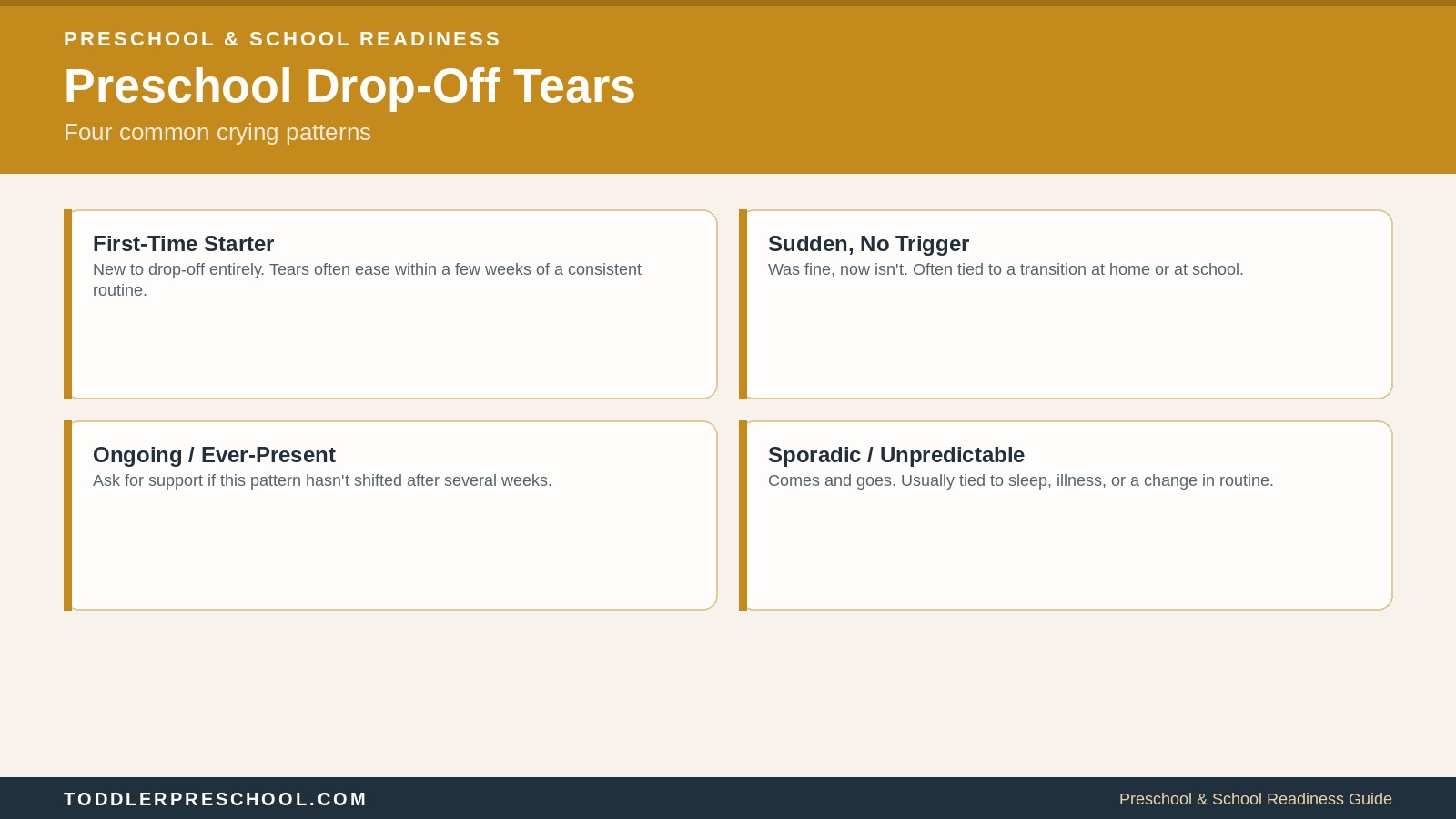
Starting Preschool for the First Time
A brand-new starter crying at drop-off is about as expected as it gets. There’s no prior routine to draw confidence from yet, and the whole setting is unfamiliar.
Most first-time starters show real improvement within two to three weeks of a consistent routine. A rough first week doesn’t predict a rough month.
Crying That Starts Suddenly, With No Clear Trigger
Some children are completely fine for weeks or months, then start crying out of nowhere. This is genuinely common and doesn’t always have an identifiable cause, even after some thought.
A brief phase like this often resolves on its own within a couple of weeks. This is especially true if you keep the routine steady, rather than changing your approach out of concern.
An Ongoing, Ever-Present Pattern
Other children cry at drop-off consistently, day after day, without much variation. This pattern is worth watching over time, covered in more depth later in this guide. It isn’t automatically a red flag on its own.
Some children simply take longer to build comfort with separation. A consistent pattern that’s gradually softening, even slowly, is different from one that isn’t moving at all.
A Sporadic, Unpredictable Pattern
Some children cry some days and sail through others, with no obvious rhyme or reason from the outside. This is common too, and often tracks more closely with sleep, mood, or minor daily variables than anything happening at school itself.
Keeping a loose mental note of hard mornings can sometimes reveal a pattern. A specific day of the week, or a specific caregiver doing drop-off, isn’t always obvious in the moment.
Everyday Triggers Behind Preschool Drop-Off Crying
Before assuming preschool drop off crying reflects something deeper, a few ordinary factors are worth checking.
Hunger and Tiredness
A tired or hungry child has fewer emotional resources for anything hard, and drop-off is hard even on a good day. A rushed morning with a skipped breakfast can turn a manageable goodbye into a much harder one.
An Illness Brewing
Kids sometimes cry more at drop-off in the day or two before a cold or other illness becomes obvious. If a hard morning is quickly followed by clear sickness, that connection is worth remembering for next time.
A Change You Might Not Have Connected
A new babysitter, a shifted bedtime, a recent houseguest, or a schedule change at home can quietly affect drop-off. The connection isn’t always obvious on the surface. A quick mental review of the past week sometimes reveals a pattern.
A Change at School Itself
A new classmate, a substitute teacher, or a rearranged classroom can all be enough to unsettle a child temporarily. This can happen even without anything changing at home. Asking the teacher directly whether anything changed recently in the room is a reasonable question.
What Actually Helps With Preschool Drop-Off Crying
These strategies come directly from AAP guidance on childhood separation distress, adapted for the specific moment of preschool drop off.
A Short, Consistent Goodbye Ritual
Use the exact same phrase and gesture every single day. A specific hug, a particular phrase, then leaving, works better than a goodbye that changes day to day.
The ritual’s power comes from its predictability, not its content. A simple wave and “see you after lunch” repeated exactly the same way works as well as anything more elaborate.
Arriving a Few Minutes Early
A few extra minutes lets your child settle into the room before the actual goodbye moment. This beats facing a rushed drop-off on top of everything else.
This also gives your child a moment to notice something interesting happening in the room. A puzzle out, a friend arriving, can ease the transition before the goodbye itself.
A Small Transitional Object
A small photo, a tucked-away note, or a soft item from home can give a child something tangible to hold onto during the day. Confirm with your child’s teacher what’s allowed before relying on this.
Some children never take to a transitional object and do just as well without one. This is a tool to try, not a requirement.
Letting the Teacher Take the Handoff
Handing your child directly to a teacher, rather than lingering nearby, often helps a child transition faster than a prolonged goodbye does. Teachers are usually well practiced at this exact moment.
A teacher scooping up a crying child works well. Say your goodbye phrase, then step out, rather than an extended, back-and-forth goodbye at the door.
What to Say in the Moment
Be specific about when you’ll return. Use a concrete reference point a young child understands, like “I’ll be back after snack time,” rather than a clock time. Validate the feeling briefly, then follow through on your stated plan.
A few real examples: “I see you’re sad. I’ll be back after nap.” Or simply, “Hugs, then I’ll see you soon. I love you.” Said the same way daily, these short scripts do real work.
What Tends to Make It Worse
Sneaking away while a child is distracted tends to erode trust once they notice, even if it avoids a scene in the moment. Returning to the room after you’ve said goodbye, even briefly, often restarts the distress rather than easing it.
Long negotiations at the door, however well-intentioned, tend to signal uncertainty rather than confidence. A brief, warm, and firm goodbye communicates more safety than an extended one.
Building a Partnership to Ease Drop-Off Crying
Your child’s teacher is a genuine ally here, not just someone managing the morning handoff.
What to Share Before Drop-Off Struggles Start
Let the teacher know about anything relevant happening at home. A new sibling, a recent move, a disrupted sleep stretch, all give context for what they’re seeing.
Share this proactively, rather than only after a hard week. It gives the teacher a head start on connecting the dots if a pattern does emerge.
Asking What Happens After You Leave
Most children settle faster than the doorway goodbye would suggest. Ask directly how long the crying typically lasts once you’re actually gone. That information is often more reassuring than what you personally witness.
A Simple Way to Check In Without Hovering
A quick end-of-day question works well: “how did the morning go?” It gives you an ongoing read on the pattern without needing to linger at drop-off itself.
When to Schedule a Longer Conversation
If a quick daily check-in isn’t enough, or you’re genuinely worried, ask for a short, separate conversation. A phone call, or a few minutes after pickup, lets you both talk more fully than a rushed hallway exchange.
Managing Your Own Emotions at Drop-Off
Your own state matters more than it might seem in this specific moment.
Kids Pick Up on Parental Anxiety
A child is often reading your face and tone as much as listening to your words. A parent who seems anxious or uncertain, even while saying reassuring things, can unintentionally signal that there’s something to worry about.
A Quick Reset Before You Walk In
If you’re feeling rushed, stressed, or anxious yourself, take a moment first. A few deep breaths in the car or parking lot before heading inside can genuinely change how the goodbye goes.
It’s Fine to Feel Sad About It Too
Drop-off crying is hard on parents too, and that’s a normal, legitimate feeling, not something to suppress entirely. Processing that feeling later, rather than during the actual goodbye, tends to work better for both of you.
Public Drop-Off: Managing an Audience
Crying in front of other parents and children adds a layer most families don’t expect to think about.
You Don’t Owe Anyone an Explanation
A brief, calm goodbye works the same whether or not other people are watching. You don’t need to explain or apologize for your child’s tears to other parents nearby.
Other Parents Have Been There Too
Most parents in a preschool hallway have experienced this exact moment themselves, or will soon. The audience is far less judgmental than it can feel in the moment.
Siblings and Multiple Drop-Offs
Managing more than one child’s drop-off at once adds real logistical complexity.
Different Children, Different Timelines
One child struggling while another sails through isn’t a sign of favoritism or a parenting difference. Siblings often have genuinely different temperaments around separation.
A Brief, Individual Goodbye for Each Child
Even a short, individual moment with each child works better than one rushed group goodbye. Trying to manage multiple goodbyes simultaneously rarely goes smoothly.
Drop-Off Support for a Child With a Disability or Sensory Differences
For some children, drop-off crying is tied to something more specific than typical separation distress.
Sensory Triggers Worth Naming
Noise level, lighting, or a crowded entryway can all be genuine sensory triggers distinct from separation itself. Identifying a specific trigger sometimes opens up a specific, targeted fix.
A quieter entrance, a slightly staggered arrival time, or noise-reducing headphones are all reasonable, specific adjustments once a sensory trigger is identified.
Working With Your Child’s Care Team
If your child has a diagnosed disability or sensory processing difference, their occupational therapist or care team can help. Together you can build a drop-off plan tailored to their specific needs, which may look different from general advice.
This might include a specific visual schedule, a longer transition window, or a consistent staff member handling the handoff each day.
A Modified Routine Is a Reasonable Accommodation
A longer transition window, a specific quiet space to start the day, or a different handoff process are all reasonable adjustments. None of these signal that the general approach has failed.
Coordinating an IEP or IFSP Transition Plan
If your child has an IEP or IFSP, include drop-off routine details directly in that plan. A written, agreed-upon approach tends to stay consistent even if staff changes happen during the year.
What Happens in the Classroom After You Leave
Understanding this part of the picture often eases a parent’s own worry more than anything else.
Most Children Settle Faster Than Expected
Teachers consistently report that most children who cry hard at the door are calm and engaged within a short window afterward. The doorway moment is rarely representative of the whole morning.
Teachers Have Specific Strategies for This Moment
Experienced preschool teachers have their own calm, practiced approach to a crying child right after a parent leaves. This often involves a specific activity or task designed to redirect attention.
Trusting the Report, Even When It’s Hard to Believe
If a teacher tells you your child settled in ten minutes, believe that report. It can be hard to square with the image of your child crying at the door, but both things are true. Both things can be true at once.
The Wide Range of Normal for Preschool Drop-Off Crying
A few sources of genuine variation in preschool drop off crying are worth naming clearly.
How Long This Typically Lasts
Most children move past the acute distress within minutes to hours once a parent has actually left, even when the goodbye itself was rough. During a real transition, like starting a new program, it commonly takes a few weeks for a child to settle into the new routine fully.
Some children take a bit longer, closer to a month, without that extra time being any kind of concern. Timeline alone rarely tells the whole story.
Temperament and Individual Differences
A cautious, slow-to-warm-up child may take longer to feel confident with drop-off. This happens independent of how well any specific strategy is being applied. This is a temperament difference, not a sign anything is going wrong.
Age-Related Patterns
Younger preschoolers, closer to age 2 or 3, often show more visible distress than older preschoolers closer to kindergarten age. They simply have less verbal ability to process and express what they’re feeling. This gap narrows naturally with age.
Multilingual and Multicultural Families
Every goodbye ritual and script in this guide works in any language your family speaks at home. Comfort with separation also varies by what’s culturally modeled, and that variation is normal too.
When to Ask for Support
This is the question behind the second half of this guide’s title, and it deserves a direct, honest answer.
What Typical Drop-Off Crying Looks Like
According to the American Academy of Child and Adolescent Psychiatry, typical separation distress can resurface at transitions. It usually resolves within minutes to hours once separation actually happens. A child showing typical distress can usually be distracted into play, and often ends up enjoying the day once settled.
This pattern is well within the range of expected preschool experience, even when it’s hard to watch. It doesn’t need a specialist evaluation on its own.
Signs the Pattern Has Shifted
A few signs suggest the pattern has moved beyond typical, everyday separation distress:
- Crying that doesn’t ease at all even after a full 20 to 30 minutes
- Distress that doesn’t improve over several weeks of a consistent, calm approach
- Physical complaints like stomachaches or headaches that appear only on school mornings and disappear on weekends
- Sleep disruption, including nightmares specifically about being lost or left behind
- Regression in previously mastered skills, paired with the drop-off distress
- Anxiety that spreads beyond drop-off into other separations, like a babysitter or a grandparent’s house
Any single item on this list, on its own, is worth watching rather than panicking over. A cluster of several together, or any one item persisting for weeks, is what shifts this from ordinary to worth a closer look.
Talking to Your Child’s Teacher First
A teacher who sees your child daily has real, comparative information. They know whether the pattern is easing, staying flat, or getting worse over time. This is a reasonable, low-stakes first conversation before involving anyone else.
Ask specifically: has this gotten better, stayed the same, or gotten worse over the past few weeks? A teacher’s honest comparative read is often more useful than a single day’s snapshot.
Talking to Your Pediatrician
According to AAP guidance, mention ongoing separation anxiety to your pediatrician if it continues well past the age and timeframe where it’s typically expected to ease. Bring specifics: how long it’s been happening, what’s been tried, and any of the shifted-pattern signs above.
Your pediatrician can also help rule out or address any physical symptoms. Recurring stomachaches, for instance, might be tangled up with the anxiety itself.
When a Specialist Evaluation Makes Sense
The American Academy of Child and Adolescent Psychiatry notes that separation anxiety disorder affects a real but relatively small share of children. It involves persistent, excessive worry that interferes with daily functioning, not just difficult mornings. Sometimes distress is severe, or it doesn’t ease over a genuinely reasonable trial period. Sometimes it affects school attendance or family functioning broadly. In these cases, an evaluation from a qualified mental health professional is a reasonable, non-alarming next step.
Evidence-based approaches, including specific behavioral strategies used by trained therapists, exist and can genuinely help when general strategies alone aren’t enough. This isn’t a last resort; it’s a different, more targeted tool.
None of This Means You Did Anything Wrong
A referral or evaluation isn’t a verdict on your parenting or your child’s overall development. It’s a way to get more targeted support when general strategies genuinely aren’t enough on their own.
Common Obstacles With Preschool Drop-Off Crying
A few specific situations come up often enough to address directly.
“My child is fine within minutes, but the goodbye itself never gets easier.”
This is one of the more common, reassuring patterns. Trust your teacher’s report about what happens after you leave more than your own read of the doorway moment.
“We’ve tried a consistent goodbye ritual for weeks with no improvement.”
If a genuinely consistent approach hasn’t produced any real change after several weeks, that’s worth raising with your child’s teacher or pediatrician. Don’t keep waiting indefinitely.
“My child cries hard at drop-off but is completely fine with a babysitter or grandparent.”
This is a meaningful, useful distinction. It often points to something specific about the preschool setting or transition itself. This is worth mentioning to the teacher directly, rather than assuming a broader separation issue.
“Drop-off was fine for months, then suddenly fell apart with no clear cause.”
This is genuinely common and doesn’t always resolve with an identifiable explanation. Returning to the basic toolkit (consistent ritual, calm handoff, follow-through on your return time) often eases things again within a couple of weeks.
“My child cries only on days I drop off, but not when my partner does.”
This is a common, specific pattern. It often reflects who a child feels safest expressing big feelings with, rather than a sign that one parent is doing something wrong. Using the exact same goodbye ritual regardless of which parent is dropping off tends to narrow this gap over time.
“Other kids in the class don’t cry, and I’m worried something is different about my child.”
Comparing across children in the same room rarely tells you much, since temperament varies enormously and you don’t see another family’s full picture. A teacher’s direct comparison over time is a far more useful data point than a single morning’s observation.
Preparing Before Drop-Off Struggles Even Start
A little groundwork before crying becomes a pattern can genuinely help, whether you’re starting a new program or simply want to be proactive.
A Preview Visit, If Your Program Offers One
Visit the classroom together before the first real day, even briefly. This gives a child a mental picture to draw on during that first, hardest goodbye.
Practicing the Goodbye Ritual at Home
Rehearse your chosen phrase and gesture at home first. A low-stakes moment, like leaving for a quick errand, helps it feel familiar before it’s actually needed under pressure.
Reading About Starting School Together
A simple book about starting preschool or a new routine gives a child language and context for what’s coming, without needing an elaborate conversation.
Adapting This to Every Family’s Situation
Different family structures. Whoever handles drop-off, one or two parents, a grandparent, another regular caregiver, should use the same consistent ritual and approach. Aligning on a shared script across caregivers helps more than any single technique.
Budget. Nothing in this guide requires spending money. A consistent phrase and a calm handoff cost nothing and fit into any family’s existing morning routine.
Schedule constraints. If arriving a few minutes early isn’t realistic most days, focus on the parts that don’t depend on extra time. The short goodbye ritual and being specific about your return matter most.
Access to care. If you don’t have a regular pediatrician yet, community health centers can help. They can typically assess whether a referral makes sense for a pattern that’s concerning you.
Working parents with tight morning schedules. A rushed morning doesn’t cancel out the value of a short, consistent ritual. Even thirty seconds, done the same way daily, carries real weight over time.
Frequently Asked Questions
Questions About What Helps
Is it better to stay a few extra minutes on the hardest mornings? Generally no. A short, consistent goodbye tends to work better even on hard days, since lingering can signal that leaving is something to be uncertain about.
Should siblings or other caregivers rotate handling drop-off to see if that helps? Consistency in the ritual itself matters more than who delivers it. If drop-off duty does rotate, aligning everyone on the same phrase and approach helps more than trying different caregivers as a troubleshooting strategy.
Does a transitional object need permission from the teacher? Yes, worth checking directly. Some programs have specific rules about outside items, particularly for younger age groups, so a quick check avoids an awkward first-day surprise.
Questions About Timing and Support
How many weeks of consistent effort should we try before considering it hasn’t worked? Two to four weeks of a genuinely consistent approach is a reasonable trial period before concluding it isn’t helping. Real, if gradual, improvement within that window is a good sign to keep going; no movement at all is worth raising with your teacher or pediatrician.
Is it normal for drop-off crying to come back after a school break or illness? Yes, this is extremely common and usually resolves with the same consistent approach that worked before, typically within one to two weeks.
Can preschool drop-off anxiety indicate a broader anxiety issue, or is it usually isolated? Most preschool drop off crying is isolated to the specific transition and doesn’t indicate a broader pattern. If anxiety shows up across many different separations and situations, not just this one, that broader spread is worth mentioning. Tell your pediatrician specifically.
Does it help to explain in detail why we have to go to preschool? A brief, honest explanation works better than an elaborate one. A young child generally absorbs a short, concrete reason (“this is where you play and learn with your friends”) better than a longer justification.
Should we consider switching preschools if drop-off crying doesn’t improve? Rarely, and only after other explanations have been genuinely ruled out. A change in setting doesn’t usually resolve separation distress. The underlying skill your child is building travels with them, regardless of which classroom they’re in.
Your One Next Step
Pick one piece of this guide to try tomorrow morning. Most likely, that’s a short, specific goodbye phrase, repeated exactly the same way every day this week. Give it that full week before deciding whether it’s helping.
Sources consulted: American Academy of Child and Adolescent Psychiatry guidance on separation anxiety and separation anxiety disorder; American Academy of Pediatrics guidance on childhood separation distress and coping strategies; Office of Head Start, Head Start Early Learning Outcomes Framework.