
You found the costume your toddler will not stop pointing at. Before you buy it, a few practical toddler Halloween costume safety questions matter more than how cute it looks in the photo.
This guide is general information, not individualized medical or safety advice for your specific child. For an urgent reaction or injury, call 911 or your local emergency number.
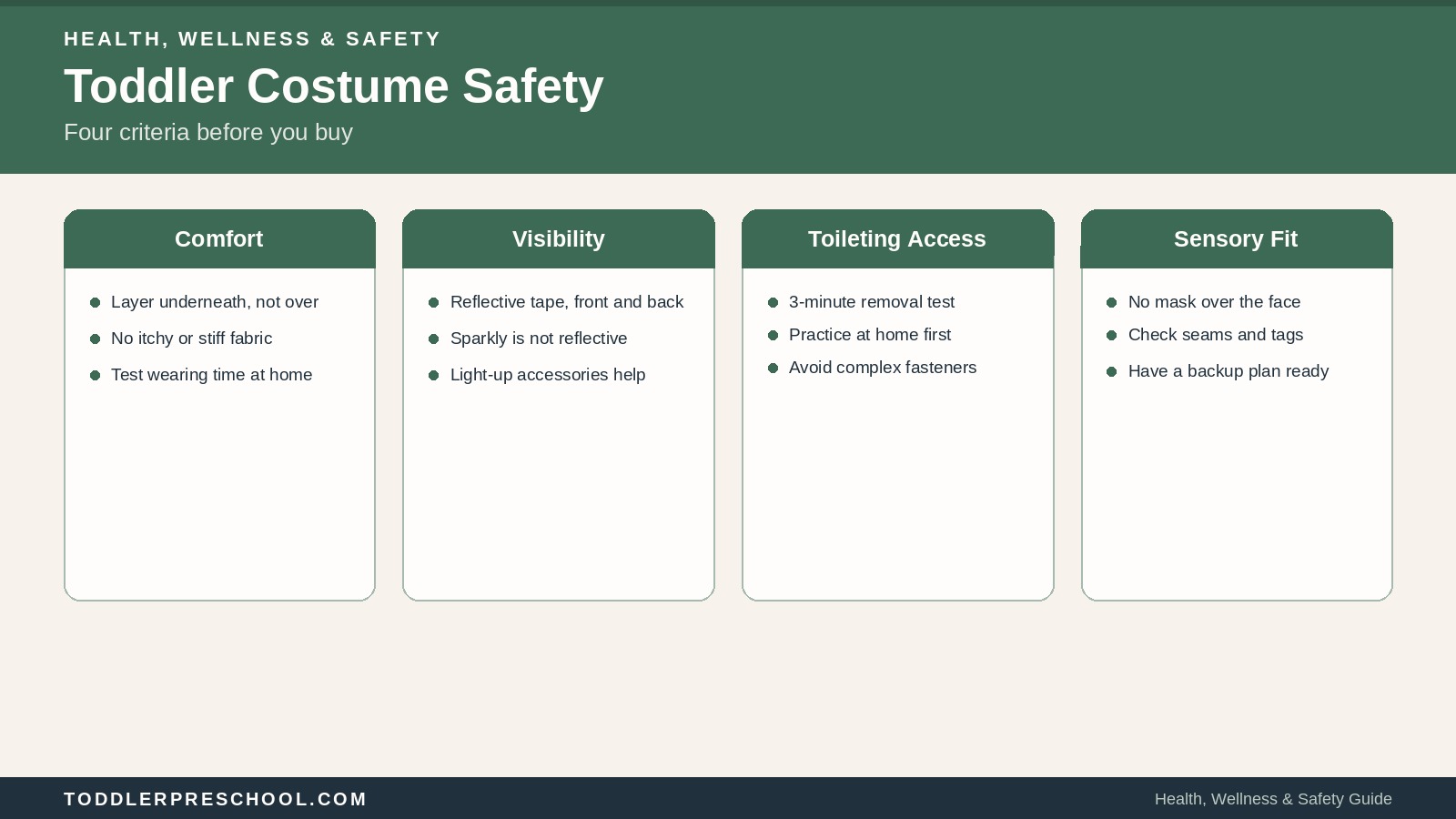
Here’s the direct answer: toddler Halloween costume safety comes down to four practical details most costume listings never mention: whether your child can move and breathe comfortably in it, whether drivers can actually see your child in low light, whether it allows a fast bathroom trip, and whether the fabric and fit will genuinely be tolerated for a full evening. This guide covers each one in depth. Then it walks through a 60-day timeline, so none of it becomes a last-minute scramble.
The Most Urgent Safety Facts First
A few points about toddler Halloween costume safety matter enough to state plainly before anything else in this guide.
Visibility Is Not Optional
Halloween evening consistently ranks among the most dangerous times of year for child pedestrians, according to national crash data. A costume that’s hard for a driver to see in low light adds real risk. This is on top of an already higher-risk evening.
This is exactly why visibility gets its own full section later in this guide. It deserves real attention, not a single bullet point.
Flame Resistance Still Applies
Costumes, wigs, and beards labeled flame resistant, per current U.S. Consumer Product Safety Commission guidance, resist burning and extinguish quickly if they do catch fire. This labeling matters most near candles, jack-o’-lanterns, and other open flames.
Check this label before buying, not after. A costume without it isn’t automatically dangerous. It does need extra caution though, kept away from any flame source all evening.
A Note on Sparkle Versus Actual Reflectivity
A pediatrician from the University of Rochester Medical Center makes a specific point worth repeating. Sparkly or shiny fabric is not the same thing as reflective material. Genuine reflective tape or trim, not glitter, is what actually shows up in a car’s headlights.
This distinction matters because a costume can look bright and eye-catching under indoor lighting while still being nearly invisible to a driver at dusk.
Choosing a Toddler Halloween Costume for Comfort
A costume your toddler refuses to wear by the second house isn’t serving toddler Halloween costume safety or anything else, regardless of how it looks.
Fabric Against Skin
Soft, breathable fabric worn directly against skin tends to be tolerated far longer than stiff or scratchy material. A thin, familiar layer underneath a scratchier costume piece often solves discomfort without needing a different costume entirely.
Cotton and soft cotton-blend fabrics generally work better against skin than synthetic materials. Synthetics can feel stiff or trap heat during an active evening of walking.
Room to Move Freely
A toddler needs to walk, sit, squat, and reach without the costume binding at the shoulders, knees, or waist. Try a full range of movement at home before the actual night. A quick look in the mirror isn’t enough.
Watch specifically for a costume that rides up when a toddler sits down, or restricts arm movement enough to make climbing stairs awkward.
Weight and Bulk
A lightweight costume is easier for a toddler to wear for a full outing than a heavy, structured one. Excess bulk also makes walking, sitting in a stroller, and using a car seat more difficult.
A costume with a rigid frame or heavy padding might look impressive. Test it for a full hour of real wear first.
Choosing a Toddler Halloween Costume for Weather
Late October evenings are often cold across much of the U.S., which affects both comfort and the safety picture.
Layer Underneath, Not Over
A thin layer worn underneath a costume works better than a bulky coat worn over it. A heavy coat can hide flame-resistant material and change how the costume fits and moves.
Thermal or fleece-lined leggings and a long-sleeve base layer both work well under most costume styles without adding much bulk.
A Backup Layer in the Treat Bag
Pack a hat and mittens at the bottom of the treat bag, even if the evening starts mild. They’re available if the temperature drops, without needing to head home first.
Rain and Wet Weather Adjustments
A costume that gets wet loses some of its flame-resistant properties temporarily and can also become heavier and less comfortable. A simple, weather-appropriate backup plan, even just staying closer to home if rain starts, is worth having in mind.
Choosing a Toddler Halloween Costume for Visibility
Visibility deserves its own real depth in any toddler Halloween costume safety plan, not just a passing mention.
Reflective Elements That Actually Work
Genuine reflective tape, trim, or stickers meaningfully increase how far away a driver can see your child. Apply them to the front and back of a costume, the treat bag, and even shoes. Hardware and craft stores both carry reflective tape by the roll.
Apply tape to both the front and back. A driver may approach from either direction on a residential street. A strip across the chest and another across the back covers both angles.
Light-Up and Battery-Powered Options
A small LED clip light, a glow stick necklace or bracelet, or a battery-powered light woven into the costume all add visibility beyond what reflective material alone provides. Fresh batteries before heading out matter more than it might seem.
Many stores carry Halloween-specific light-up accessories that toddlers genuinely enjoy wearing. This solves both the visibility need and the challenge of getting a young child to keep an accessory on.
Color Choice Still Matters
Light or bright costume colors are inherently easier to see than dark ones, even before adding reflective elements. A dark costume isn’t off-limits, but it needs more added visibility to reach the same safety level.
If your toddler is set on a naturally dark costume, like a black cat or a witch, extra reflective trim matters even more. A bright accessory becomes more important than it would be for a lighter costume.
Testing Visibility Before the Actual Night
Stand in a dim room, or use a car with headlights on, at a real distance. This gives you an honest read on how visible the finished costume actually is. This is worth doing once, ahead of time, rather than assuming.
A simple test: have your child wear the full costume and stand across a dark room or driveway while you look from a realistic driver’s distance. If reflective elements aren’t catching light clearly, more may be needed.
What to Add to a Stroller or Wagon
If your toddler will be riding in a stroller or wagon rather than walking, add reflective tape directly to the stroller itself. This extends the same visibility principle to wherever your child actually is.
Choosing a Toddler Halloween Costume for Toileting Access
This is a detail general Halloween safety guidance rarely addresses, yet it matters a great deal for toddler Halloween costume safety specifically.
Why This Matters More With a Toddler Than an Older Child
Many toddlers are newly toilet trained, still building the physical skill of managing their own clothing, or both. A costume that takes two adults and three minutes to remove creates a genuine, avoidable problem mid-evening.
A newly trained toddler often has limited warning time between noticing the need and an actual accident. This makes speed a real practical priority, not a minor inconvenience.
Costume Features That Slow Down a Bathroom Trip
Full-body zip-up costumes, elaborate multi-piece outfits, and costumes worn over multiple layers all add real time. This happens right at an already urgent moment. A costume with a single back zipper and no separate under-layer to manage is usually faster.
Costumes with an attached cape, wings, or a tail sometimes require removing or repositioning the whole piece before a bathroom trip is even possible. Test this directly.
A Practical Test at Home
Before the actual night, run a real bathroom trip in the full costume, start to finish, timing roughly how long it takes. If it’s slow or frustrating during a calm test, it will be worse during an actual urgent moment.
Try this test more than once, at different points in an evening, since fatigue and distraction both affect how smoothly a toddler manages the process.
A Simple Adaptation Worth Considering
For a costume that’s genuinely difficult to manage independently, try a different approach. Treat it as a layer worn over easy-access regular clothing, rather than an all-in-one suit, to keep the look while solving the practical problem.
A costume that opens with a single zipper or set of snaps down the front is generally faster. This beats requiring a full over-the-head removal for a bathroom trip.
Choosing a Toddler Halloween Costume for Sensory Fit
For many toddlers, sensory tolerance matters as much as any other factor in toddler Halloween costume safety.
Common Sensory Triggers in Costumes
Tags, seams, tight elastic, unfamiliar textures, and restrictive necklines are frequent culprits. A costume that looks simple can still contain several of these triggers at once.
A few quick checks help. Cut out tags before the actual night. Turn a costume inside out to check seam placement, and press on any tight elastic to gauge your child’s reaction.
Face Paint, Masks, and Hoods
Masks can restrict a young child’s vision and breathing, and many toddlers find them genuinely uncomfortable regardless of fit. Nontoxic face paint or simply skipping the mask entirely both work as alternatives.
A hood that shifts and blocks vision creates its own frustration. Testing a hood’s fit and range of motion at home catches this before the actual evening.
If face paint itself feels overwhelming to a sensory-sensitive toddler, even that can be skipped entirely without losing the spirit of the costume.
Noise and Environment Beyond the Costume Itself
Sensory overwhelm on Halloween often comes from more than the costume. Loud doorbells, sudden decorations, and crowded porches all add up. A costume that’s comfortable on its own can still feel like too much layered on top of an overstimulating evening.
Adapting a Costume Without Losing the Fun
A themed t-shirt, a single accessory, or face paint alone can capture a costume’s spirit. None of these require a toddler to tolerate an outfit that genuinely bothers them. This isn’t a lesser version of Halloween, just a realistic one.
Adaptive Costumes for a Child With a Disability
Adaptive costumes exist specifically for children with physical, sensory, or developmental disabilities. Some feature Velcro closures, openings for medical equipment, or designs built to fit over mobility equipment. A handful of retailers now carry these as a standard product line, not a special order.
Search specifically for “adaptive Halloween costume” alongside your child’s specific need. A feeding tube opening, or a design that fits over a wheelchair, often surfaces faster this way than browsing general costume listings.
Buying Versus Making a Toddler Costume
Both approaches can meet every safety and comfort criterion in this guide, and the right choice depends on your family’s time and preferences.
Advantages of a Store-Bought Costume
A commercially made costume usually comes with a clear flame-resistance label already in place, and sizing tends to be more standardized than a homemade version. This saves time for a family without much to spare.
Advantages of a Homemade Costume
Building a costume from clothing and accessories you already own gives you full control. Fabric choice, fit, and ease of bathroom access all become easier to manage, especially for a toddler with specific sensory or toileting needs.
A homemade costume can also be significantly cheaper, and repurposing existing clothing means less waste from a single-use costume.
A Hybrid Approach
Many families combine a simple store-bought base piece with homemade or added elements. Reflective trim or a specific comfort adjustment both work well this way. This often captures the best of both approaches without requiring a fully custom build.
The 60-Day Toddler Halloween Costume Safety Timeline
Most toddler Halloween costume safety preparation is quick and spread out when it doesn’t happen in the final week.
60 to 30 Days Out
Start looking at costume options against the criteria in this guide, comfort, visibility, toileting access, and sensory fit, rather than appearance alone. If your toddler has strong sensory preferences, involve them directly in this early browsing stage.
This window is also a reasonable time to decide whether you’re buying a costume or assembling one. A homemade approach benefits from more lead time.
30 to 14 Days Out
Purchase or assemble the costume, checking the flame-resistance label and confirming reflective elements are included or easy to add. Order any reflective tape or light-up accessories now, while shipping time isn’t a pressure point.
If you’re planning to add reflective trim yourself, use this window to practice. It gives enough time to attach it neatly, rather than rushing the job the night before.
Final 2 Weeks
Run the full trial: comfort, range of motion, a real bathroom trip, and a visibility check in a dim room. Fix or swap anything that fails one of these tests while there’s still time.
This is also the point to finalize your weather layering plan, once you have a clearer sense of the forecast trend for late October.
The Costume Safety Checklist at a Glance
| Category | What to Check |
|---|---|
| Flame resistance | Label present; kept away from candles and open flames |
| Visibility | Reflective tape front and back; light-up accessory with fresh batteries |
| Comfort | Full range of motion tested; no binding at shoulders, knees, waist |
| Toileting access | Real bathroom trip timed and tested at home |
| Sensory fit | Tags removed; seams and elastic checked; mask or face paint tolerated |
| Accessories | Short, soft, flexible; no small detachable pieces |
Closer to the Event: A Final-Week Update Checklist
A few things are worth reconfirming specifically in the days right before Halloween.
- Check the weather forecast and finalize your layering plan.
- Confirm batteries are fresh in any light-up accessory or flashlight.
- Re-check the costume for any tears, loose trim, or new tripping-length fabric that appeared during trial wear.
- Reconfirm the bathroom-access plan, especially if the costume changed at all since the initial test.
Common Obstacles
A few specific situations come up often enough to address directly.
“My toddler refuses to wear the costume after all this preparation.”
This is common, and it doesn’t waste the preparation you’ve already done. A themed shirt, face paint, or a single accessory still lets your child participate without a fight over a full costume.
“The costume passed every test at home but our toddler still struggled on the actual night.”
Excitement, cold, and a longer evening than the home trial all add real variables. A shorter outing, or carrying a backup layer, often solves a problem that only shows up under real conditions.
“We can’t find a costume that meets all four criteria in this guide.”
Prioritize based on your specific child. A toddler with no sensory sensitivities but a recent toilet-training milestone might prioritize bathroom access over sensory softness, while another child needs the reverse. No single costume needs to be perfect on every dimension.
“Our toddler wants to wear the costume for days before and after Halloween.”
This is common and generally harmless. Just make sure the costume stays clean and doesn’t develop a safety issue, like a loose seam or ripped trim, from repeated wear. Checking it again right before the actual event, even if it’s been worn casually already, is still worth doing.
“We have two different events, a daytime preschool party and evening trick-or-treating, and need the costume to work for both.”
Prioritize comfort and toileting access for the daytime event, since that’s a longer stretch of wear. Add the visibility elements, reflective tape and a light-up accessory, specifically before the evening outing rather than all day.
Safety Notes
A few additional points are worth stating plainly.
Small Accessories and Choking Risk
Detachable costume accessories, buttons, or small decorative pieces are a genuine choking risk for a toddler who still mouths objects. A rough test: anything that fits through an empty toilet-paper tube, about 1.25 inches across, is too small. Skip small detachable pieces for this age group entirely.
This includes small sewn-on decorations that could work loose during an evening of active movement, not just obviously removable pieces.
Props Stay Soft and Short
Any sword, wand, or prop accessory should be short, soft, and flexible rather than rigid or sharp, per current CPSC guidance. A rigid plastic prop, even one that looks harmless, can cause a real injury during a fall or a bump with another child.
Footwear Matters as Much as the Costume
Sturdy, well-fitting shoes your child already walks comfortably in are safer than costume footwear that doesn’t fit securely. This includes anything oversized or with an unfamiliar sole. Save a new costume shoe for a home trial before the actual night.
If a Costume Causes a Skin Reaction
Remove the costume and wash the affected skin if redness, itching, or a rash appears. Contact your child’s pediatrician if the reaction is significant or doesn’t resolve quickly, and avoid that specific fabric or face paint product going forward.
On CPSC Recalls Specifically
Check current CPSC recall listings before purchasing. This matters particularly for lesser-known brands. This takes only a few minutes and catches an issue before it reaches your home.
The Wide Range of Normal
A few sources of genuine variation are worth naming clearly.
First Halloween versus a toddler who remembers last year. A first costume experience often involves more unpredictability. Your child has no prior context for wearing something unusual for hours. A repeat year usually goes more smoothly from familiarity alone.
Temperament. Some toddlers tolerate a full elaborate costume without complaint; others need the simplest possible version. Neither pattern says anything about your child beyond their individual preferences.
Multilingual and multicultural families. Every safety principle in this guide applies regardless of language spoken at home or whether your family celebrates Halloween in a traditional way.
Twins and siblings. Coordinating matching or themed costumes across siblings is a fun tradition for some families. Even so, each child’s individual comfort, sensory, and toileting needs still matter more than a matching set. A themed color palette, rather than an identical costume, often satisfies both goals.
Growth between seasons. A costume that fit well last year may run smaller this year. This is especially true layered over a base garment. Trying the actual costume on, rather than assuming last year’s size still works, avoids a last-minute surprise.
Adapting This to Every Family’s Situation
Budget. A costume doesn’t need to be purchased new to meet every criterion in this guide. A simple, homemade option built from clothing you already own can meet comfort, visibility, and toileting-access standards as well as anything store-bought.
Disability and sensory differences. Adaptive costume lines, described above, are worth a direct search if standard options aren’t working. Your child’s occupational therapist can also help identify specific fabric or fit adjustments worth trying.
Access to care. If you don’t have a regular pediatrician yet, community health centers can typically answer basic questions about a skin sensitivity or reaction before the holiday.
Schedule constraints. If a full 60-day timeline isn’t realistic, prioritize two things: the flame-resistance label and a genuine bathroom-access test. Everything else in this guide is a real bonus, not a requirement.
Working parents. A costume trial doesn’t need to be a dedicated event. Run the bathroom-access test during a normal weekday evening. This catches the same problems without waiting for a free weekend.
Families new to trick-or-treating traditions. If your family is new to this specific holiday tradition, ask directly. A neighbor or your child’s program can explain local norms. What time trick-or-treating typically happens, whether costumes are expected at daycare, these unwritten expectations aren’t obvious from the outside.
Frequently Asked Questions
Questions About Choosing a Costume
Is it worth buying a costume specifically labeled for toddlers, or do kids’ sizes work fine? A toddler-specific size and cut usually fits better than a scaled-down kids’ size. This matters most around the neck, wrists, and ankles, where a poor fit becomes a genuine safety issue.
Are homemade costumes as safe as store-bought ones? Yes, as long as the same criteria apply: flame-resistant or flame-resistant-treated fabric, good visibility, comfortable fit, and easy bathroom access. A homemade costume actually makes it easier to customize for a specific sensory or toileting need.
Does face paint need to meet a specific safety standard? Yes. Look for face paint or makeup that meets FDA cosmetic safety standards. Test a small patch of skin a day or two ahead of time if your child has sensitive skin or known allergies.
Questions About Practical Fit
How do we handle a costume for a toddler still in diapers versus one who’s toilet trained? For a toddler still in diapers, prioritize easy diaper-change access over independent toileting speed. For a newly toilet-trained toddler, prioritize genuine independent bathroom access. That’s the more urgent practical need at this specific stage.
What if our costume choice doesn’t meet the flame-resistant labeling guidance? Keep the child away from any open flame sources, including candles in jack-o’-lanterns, and choose battery-operated lights instead. Checking the label before buying is the more reliable fix going forward.
Is it safe to layer a costume over a winter coat if it’s cold? Layering underneath works better than layering a costume over a bulky coat. A bulky coat can obscure flame-resistant material and change the fit. A thin, warm base layer under the costume, with the coat added only during actual walking between houses, is a reasonable compromise.
How often should a costume be washed if it’s worn to more than one event? Following the care label is the safest approach, and spot cleaning between full washes usually keeps a costume presentable without excessive laundering. Check that washing doesn’t affect any flame-resistant treatment, particularly for a homemade or treated fabric.
Do costume shoes need to be flame resistant too? Flame-resistance labeling specifically applies to the main costume, wig, or beard rather than footwear. Regardless, sturdy, well-fitting shoes matter more for fall and trip prevention than any flame-related property.
Should we buy a costume a size up so it lasts longer? Sizing up specifically to extend a costume’s use across more than one year usually creates a fit and safety trade-off not worth the savings. A costume that’s too large increases tripping risk and can bunch in ways that reduce reflective tape’s visibility.
Your One Next Step
Before you finalize this year’s costume, run four tests at home. Comfort during real movement, a dim-room visibility check, an actual timed bathroom trip, and a full trial wear for fit and tolerance.
Sources consulted: U.S. Consumer Product Safety Commission costume and accessory safety guidance; National Highway Traffic Safety Administration and CDC pedestrian safety data for Halloween evening; University of Rochester Medical Center pediatric safety guidance on costume visibility; general guidance on adaptive costumes for children with disabilities. This article is general information and does not replace individualized guidance from your child’s pediatrician or emergency services.