
Your preschooler comes home with an unopened lunch box more days than you’d like to admit. The food inside is fine. The latch, the seal, or the zipper simply beat a 3 or 4 year old before a teacher had time to help. This is exactly the problem this guide to the best lunch box for preschool is built to solve.
This guide is general information about product features and fit. It’s not a substitute for checking your specific program’s supply list or your pediatrician’s guidance on feeding. Read the full comparison before spending money on a container that looks impressive but doesn’t match the hands actually using it.
Here’s the direct answer: the best lunch box for preschool is not the one with the most compartments or the best insulation. It’s the one your specific child can open, close, and manage independently. A beautifully organized lunch a 3 year old can’t access might as well be empty. This guide explains the criteria that actually matter, then compares real, currently available options against them.
How We Chose the Best Lunch Box for Preschool Options
Selection criteria. To make this list, a lunch box or container had to meet three tests. It needed to be currently available from a real retailer in the U.S., work for the general preschool age range, and represent a genuinely different mechanism or priority, rather than six near identical bento boxes.
Review basis. Every listed spec (dimensions, price, materials, latch type) was checked against current brand and retailer listings. We ran a Consumer Product Safety Commission recall search on each product line and found none affecting the specific items reviewed here. The notes on ease of opening, drawbacks, and who tends to skip each option come from verified customer reviews. We looked for consistent patterns across multiple independent listings, not a ToddlerPreschool.com staff member’s own hands on test of this specific batch. We’re saying that directly, since implying testing that didn’t happen is exactly the kind of unearned claim this guide is trying to help you see past.
What Actually Matters for a Preschool Lunch Box
Independent opening ability should come before appearance, capacity, or brand recognition when choosing the best lunch box for preschool.
The Core Question: Can Your Child Open It Alone
A preschool teacher is managing many lunches at once. Independent access matters more here than at home, where an adult is usually right there to help. Testing the actual mechanism with your own child, before buying, tells you more than any product description.
Watch specifically for whether your child can open the box with hands that might be a little sticky, tired, or rushed. A calm demonstration at the store rarely predicts a real lunchroom moment.
Latch Type Varies More Than It Looks
A single, large latch is generally easier for small hands than multiple small clasps or a zipper. Some designs use one lid that seals every compartment at once, which removes the need to manage several separate closures.
Magnetic closures, spring loaded clips, and simple snap lids all behave differently under a child’s grip strength. That grip strength genuinely varies month to month during the preschool years.
Capacity Matters Less Than Fit With Your Program
Check your specific program’s actual policy before assuming more compartments is better. Some programs want a simple container; others expect a full, sectioned lunch. A four year old with a program requiring quick, one motion opening needs something specific. A program with more relaxed timing allows more flexibility.
A container that’s technically the right size but structurally slow to open creates real daily friction. This holds true even if it looks perfect on a supply list.
Washing and Care Realistically
Many bento style boxes require hand washing specific parts to protect a seal, while others go fully in the dishwasher. Check your family’s actual evening routine honestly first. A box that adds a hand washing step only helps if you’ll reliably keep up with it.
A container that sits unwashed because the care routine didn’t fit your evening isn’t actually the better choice, regardless of its other features.
What Independent Lunch Box Opening Looks Like by Age for Preschool
Fine motor skill for opening the best lunch box for preschool develops gradually across the preschool years, and expecting too much too early sets a family up for daily frustration.
Younger Preschoolers, Around 3
Many 3 year olds can manage a single large latch or a simple snap lid with some practice. Multiple separate closures are often still genuinely difficult. A single mechanism design tends to work better at this age.
Older Preschoolers, Closer to 5
By 4 or 5, many children can manage two latches or a slightly more complex mechanism, though individual variation remains wide. A child who’s had more practice with buttons, zippers, and other fine motor tasks at home often transfers that skill here too.
This Isn’t a Fixed Milestone
None of this is a pass or fail marker. A child struggling with a specific latch at 4 isn’t behind. They simply haven’t built that specific skill yet, and a different mechanism or a bit more practice usually closes the gap.
Packing Food for the Best Lunch Box for Preschool Use
The container matters, but so does what goes inside it, and the two are connected.
Portion Sizes That Match the Container
A compartment sized for an adult portion, crammed into a smaller preschool container, often spills or crushes during transport. Matching portion size to the actual compartment reduces mess your child then has to manage alone.
Foods That Don’t Need Extra Tools
A preschooler managing an unfamiliar latch doesn’t need to also wrestle with a food that requires cutting or careful handling. Simple, ready to eat pieces reduce the total number of skills needed at once during a rushed lunch period.
Quick Pick Summary
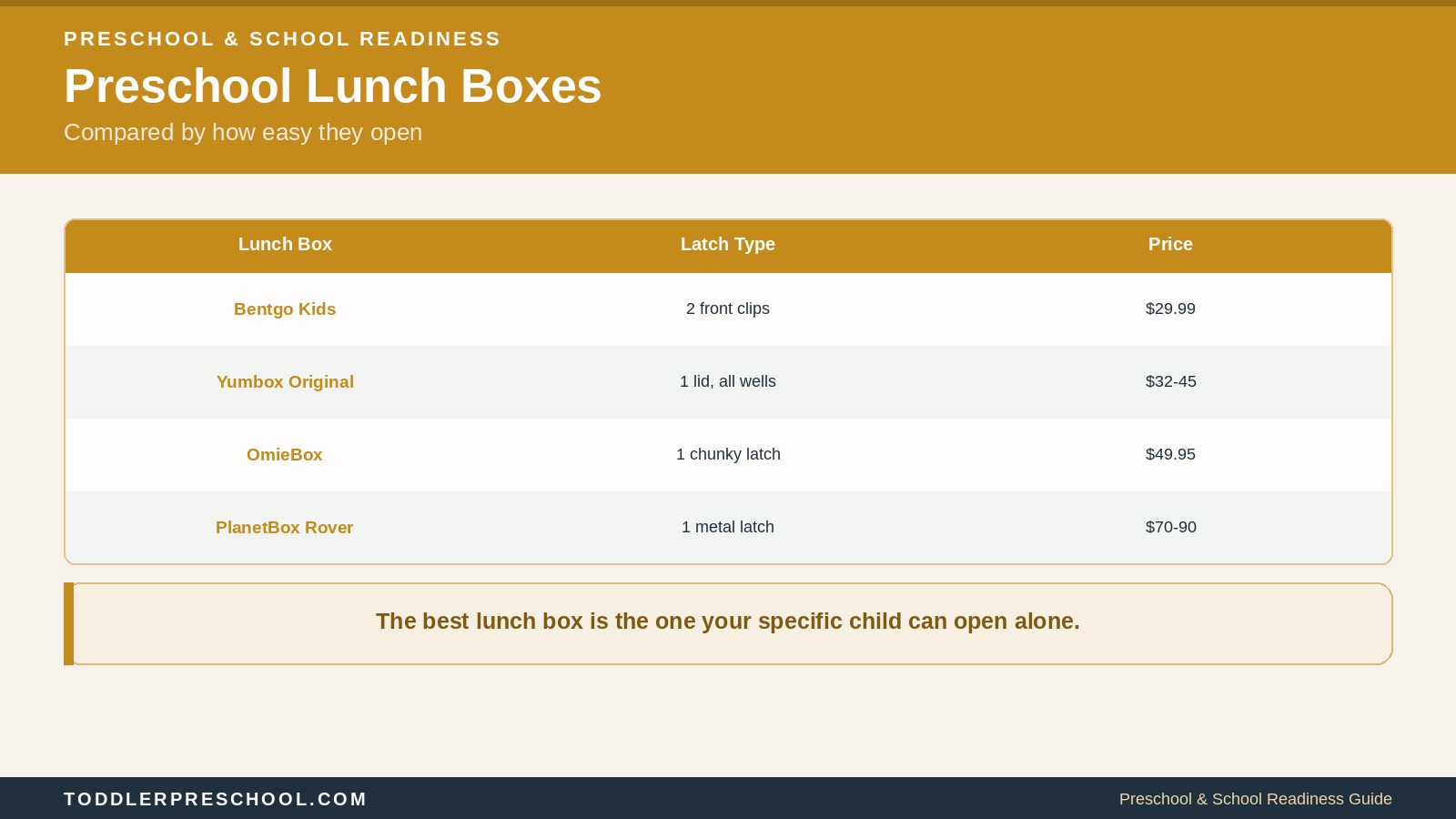
| Lunch Box | Best For | Latch Type | Price |
|---|---|---|---|
| Bentgo Kids | A dishwasher safe option with two manageable latches | 2 front clip latches | $29.99 |
| Yumbox Original or Panino | The simplest single mechanism for younger preschoolers | 1 latch sealing all compartments | $32 to $45 |
| OmieBox | Families who want hot and cold food in one container | 1 chunky latch | $49.95 |
| PlanetBox Rover | A durable, plastic free stainless steel option | 1 metal latch | $70 to $90 |
| A basic 2 to 3 compartment plastic container | The lowest cost option that still meets most needs | Snap on lid | Often under $15 |
The Lunch Boxes, Compared
1. Bentgo Kids
A widely available bento style box built specifically around kid friendly opening, with a removable tray for cleaning.
| Detail | Notes |
|---|---|
| Best for | A family wanting dishwasher, microwave, and freezer safe parts alongside an easy opening mechanism |
| Skip if | Your child struggles with two separate latches rather than one single closure |
| Age and fit | Marketed for toddlers and kids ages 3 to 7; 5 compartments holding about 2.4 cups total |
| Materials | BPA and PFAS free plastic, rubber coated edges |
| Drawback | Two latches, while manageable for many preschoolers, is one more step than a single latch design |
| Sensitivity notes | Wide range of prints and colors without character licensing concerns |
| Review basis | Strong verified ratings across major retailers, with the two latch design specifically praised as kid manageable |
| Library or budget alternative | A basic single compartment container with a snap lid meets the core need at a fraction of the price |
2. Yumbox Original or Panino
A design built around one silicone lined lid that seals every compartment simultaneously. This removes the need to manage multiple separate closures.
| Detail | Notes |
|---|---|
| Best for | A younger preschooler who struggles with more than one latch or seal to manage |
| Skip if | You need a full-size sandwich compartment; the Original’s wells are portioned smaller than the Panino’s |
| Age and fit | Specifically marketed for toddlers through about age 8; 4 to 6 compartments depending on the specific model |
| Materials | ABS outer shell, Tritan tray, silicone seal; BPA and phthalate free |
| Drawback | The single lid design means opening any part of the box exposes the whole meal at once, which some children find messier to manage than separate lids |
| Sensitivity notes | Illustrated trays with neutral, non-licensed themes |
| Review basis | Consistently described across multiple verified retailer listings as manageable even for the youngest preschoolers, with a genuine design award |
| Library or budget alternative | The Bentgo option above meets a similar organizational need at a comparable or lower price point |
3. OmieBox
An insulated option built specifically to keep hot and cold food separated in one container. This is aimed at families who want more meal variety than a cold-only box allows.
| Detail | Notes |
|---|---|
| Best for | A family that regularly wants to send a warm entree alongside cold sides |
| Skip if | You want dishwasher and microwave convenience, since this box specifically recommends hand washing and avoids both |
| Age and fit | Marketed for ages 3 to 7; roughly 47 ounces of box volume plus an 8.5 ounce thermos |
| Materials | 18/8 stainless steel, food grade plastic and silicone; BPA and phthalate free |
| Drawback | Noticeably heavier than an all-plastic box, and the hand washing requirement adds a genuine evening task |
| Sensitivity notes | No licensed character branding; accessories sold separately for personalization |
| Review basis | Verified reviews consistently describe the single latch as easy for young children, while also consistently flagging the extra hand washing step |
| Library or budget alternative | A simple insulated thermos paired with a separate cold container covers the same hot and cold need at a lower cost, with two pieces to manage instead of one |
4. PlanetBox Rover
A stainless steel, largely plastic free option built for long term durability rather than a single school year.
| Detail | Notes |
|---|---|
| Best for | Families prioritizing a plastic free material and a single metal latch a young child can manage |
| Skip if | Budget is the primary concern, since this is the most expensive option reviewed here |
| Age and fit | Marketed from age 3 up; 5 compartment version available alongside a larger option for bigger appetites |
| Materials | 18/8 and 18/0 stainless steel; no lead, PVC, phthalates, or BPA |
| Drawback | The stainless steel construction adds real weight to a preschooler’s bag compared to plastic alternatives |
| Sensitivity notes | Magnetic decorative pieces are sold separately and should be removed before dishwashing |
| Review basis | A parent reviewer specifically noted a 3 year old managing the single latch independently without issue; broader verified reviews echo this pattern |
| Library or budget alternative | The Bentgo or Yumbox options above meet the core independent-opening need without the stainless steel price premium |
5. A Basic Divided Plastic Container
Nearly every general retailer sells an unbranded or store brand container. Most have two or three built in compartments and a simple snap on lid.
| Detail | Notes |
|---|---|
| Best for | A family that simply needs a functional, affordable container that a preschooler can manage |
| Skip if | You want built in insulation or a bento style illustrated tray |
| Age and fit | Generally suits the preschool range, though sizing varies by specific product |
| Materials | Varies by brand; check for a BPA free label |
| Drawback | Quality control varies more between sellers than with an established brand, so checking recent reviews on the exact listing matters here |
| Sensitivity notes | No character branding, a reasonable neutral pick across siblings |
| Review basis | Varies by specific seller; a snap on lid is a well understood, low risk mechanism regardless of brand |
| Library or budget alternative | This already is the budget alternative for most families on this list |
What to Skip When Choosing a Preschool Lunch Box
Boxes with more than two separate closures. A container with a zipper, a clasp, and an inner seal all at once is difficult for most preschoolers to manage independently. This holds true however well organized the inside looks.
Insulated bags with no easy internal structure. A soft insulated bag alone tends to squish food. Without a container that actually holds its shape, it adds an extra layer a young child has to manage.
A container bought before checking your program’s actual policy. Some programs specifically restrict certain closures, materials, or sizes for their cubby or storage system, worth confirming before buying anything elaborate.
Safety Notes
On CPSC recalls specifically. Our search found no recalls affecting the specific products reviewed in this guide at the research date. Checking current CPSC recall listings directly before purchasing any specific product, particularly a lesser known brand, takes only a few minutes.
On choking risk from small parts. Detachable ice packs, small magnetic decorations, or tiny utensil pieces are worth checking. Anything small enough to fit through an empty toilet paper tube, about 1.25 inches across, needs closer supervision for a child who still mouths objects.
On food safety during transport. A container without built in insulation can be a problem. Left in a warm cubby or backpack for several hours, it can allow perishable food to reach an unsafe temperature. Adding a small ice pack is a reasonable, low cost adjustment. This works even in a box not specifically designed for one, regardless of which container you choose.
Common Obstacles When Choosing the Best Lunch Box for Preschool
A few specific situations come up often enough, when choosing the best lunch box for preschool, to address directly.
“We bought a box our child loves at home, but they still need help at school.”
This is common, and it usually reflects time pressure or an unfamiliar setting rather than a lost skill. Practicing the exact same motion quickly, rather than slowly and calmly, closer matches the real lunchroom pace.
“Our program specifically requires a certain size or type we didn’t expect.”
Confirm this directly with your program before buying anything. A beautifully chosen container that doesn’t fit a specific cubby or storage rule creates an avoidable problem on day one.
“My child can open it but really struggles to close it again.”
Closing often requires more precise alignment than opening does. Test both directions specifically, rather than assuming opening ability means closing will follow.
The Wide Range of Normal
A few sources of genuine variation are worth naming directly.
Fine motor differences. A child with a fine motor delay or a diagnosed disability may need a specific adapted closure. An occupational therapist can help identify one, regardless of what a general product review suggests.
Multilingual families. Choosing and using a lunch container doesn’t depend on language spoken at home. Every criterion in this guide applies the same regardless.
Different family structures. Whoever packs lunch, one or two parents, a grandparent, another caregiver, benefits from knowing two things. The program’s specific policy, and your child’s actual independent ability with a given container.
Siblings with different needs. An older sibling managing a more complex container doesn’t mean a younger preschooler is ready for the same one. Choosing separately for each child, rather than matching siblings, often works better during these years specifically.
Adapting This to Every Family’s Situation
Budget. As the comparison shows, a basic divided container meeting your program’s requirements is genuinely inexpensive. It’s often one of the least costly items on a typical supply list, under fifteen dollars. Spending more only makes sense if a specific feature, like insulation or a plastic free material, genuinely matters to your family.
Schedule constraints. If daily hand washing isn’t realistic for your family’s routine, a fully dishwasher safe option helps. It removes that specific friction point regardless of which other features you prioritize.
Access to care. If your child has a diagnosed fine motor difference, community health centers or your pediatrician can help. They can typically connect you with an occupational therapy evaluation at low or no cost if one seems warranted.
Working parents. A rushed morning doesn’t need to mean skipping the independence question entirely. Even a single practice round on a weekend, rather than a dedicated training session, builds real familiarity over a few weeks.
Growing families. A container that works well for one child doesn’t need to be repurchased identically for a younger sibling. Each child’s own fine motor stage matters more than matching the household’s existing supply.
Frequently Asked Questions
Should I buy the same lunch box my child’s friend has, since it clearly works for them? Not necessarily. Fine motor ability varies enough between individual preschoolers. A box working well for one child doesn’t guarantee the same for another. Testing the actual mechanism with your own child matters more than another family’s experience.
Is it worth practicing with a new lunch box at home before the first day it’s used? Yes. A few practice rounds with an empty box tend to build real independence. Opening and closing it repeatedly at home works better than expecting a child to learn the mechanism for the first time at school.
Do preschool programs usually require a specific lunch box size or type? Policies vary widely by program. Checking directly, rather than assuming, avoids buying an elaborate container that doesn’t fit your specific program’s cubby or storage system.
My child can open the lunch box at home but not at school. What’s going on? This is common and usually reflects time pressure or a less familiar setting, not a skill your child has lost. Practicing the same routine at home, including doing it somewhat quickly, can help close this gap.
Should I label every part of a multi-piece lunch container? Yes, this is worth doing regardless of which option you choose. Loose lids, trays, and ice packs are among the most commonly lost preschool items. A simple label reduces both loss and the chance of mismatched pieces going home with another family.
Is it worth buying two of the same container so one is always clean? For a family whose evening routine is genuinely tight, this is a reasonable, practical solution rather than an indulgence. It removes the pressure of a same-day wash cycle entirely.
Your One Next Step
Before buying anything, hand your child an empty container similar to what you’re considering. Even a real one borrowed from a friend works. Watch how many tries it takes them to open and close it on their own.
Sources consulted: U.S. Consumer Product Safety Commission recall records; USDA MyPlate general nutrition guidance for school age children; current brand and retailer listings for all products reviewed, checked for specifications, pricing, and verified customer feedback.