
The leaves are turning, the apples are showing up at the store, and your toddler wants to be outside every spare minute. You’re searching for fall activities for toddlers because you want something that actually uses this specific season. A generic indoor activity with a leaf sticker slapped on top doesn’t cut it.
Here’s the direct answer: the best fall activities for toddlers use materials this season already hands you for free: leaves, apples, pumpkins, acorns, and cooler weather that makes movement genuinely comfortable again. This guide organizes 20 real activities across four categories. Setup time, mess level, and supervision needs are all clearly marked, so you can grab something that fits your actual afternoon.
You don’t need a Pinterest worthy setup or a trip to a specialty craft store. Most of what’s in this guide is already sitting in your yard, your kitchen, or a nearby park, which is exactly the point.
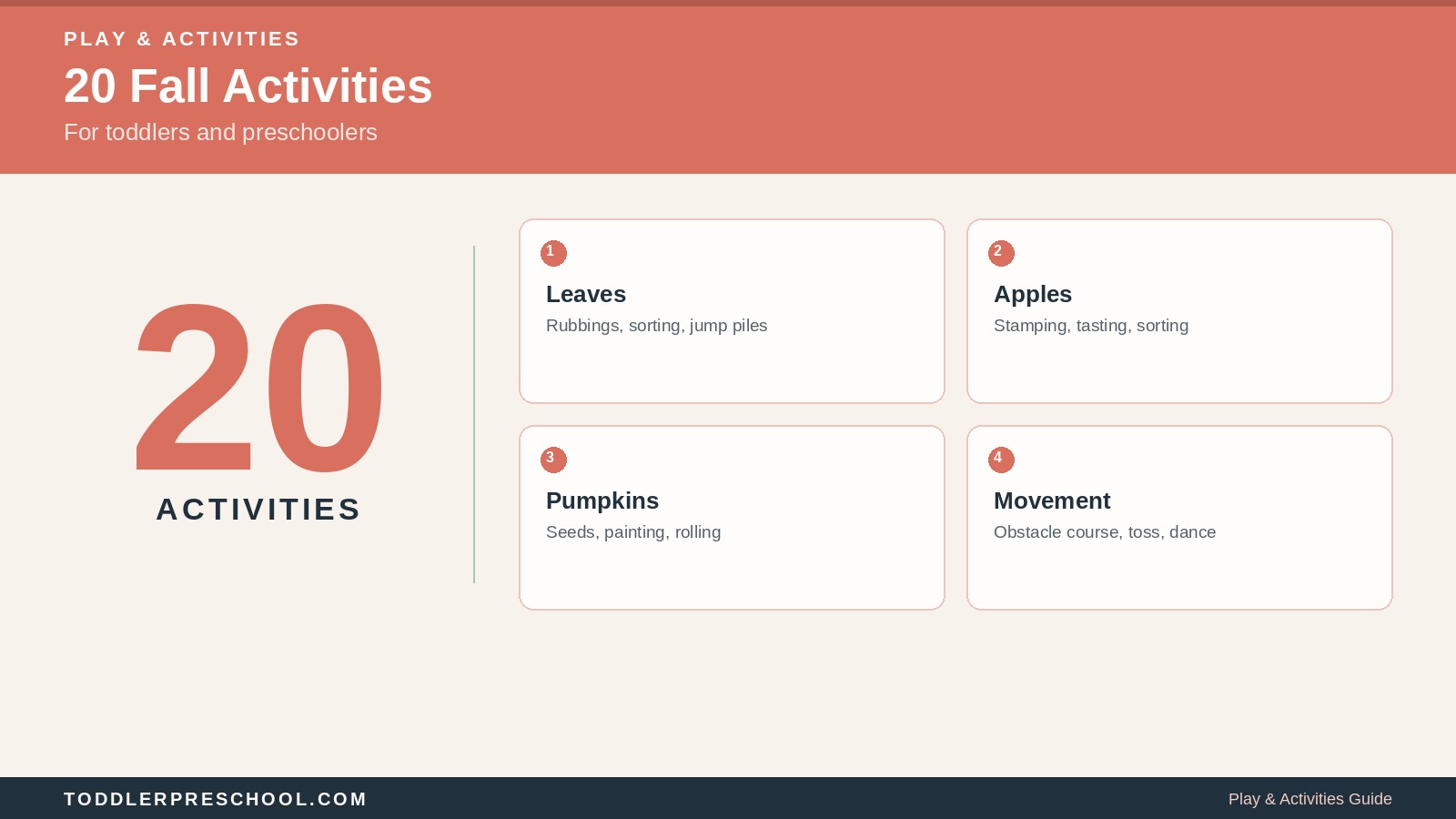
How to Use This List of Fall Activities for Toddlers
Every activity below uses the same shorthand so you can scan quickly instead of rereading definitions 20 times.
Best fit is a loose age range, not a deadline. Toddlers and preschoolers vary enormously in attention span, coordination, and interest, and a wider or narrower range than what’s listed is completely normal.
Time covers setup, then typical active play time. A young child often engages with something for far less time than an adult expects, and that’s fine.
Mess is rated None (put it away and you’re done), Low (a damp paper towel handles it), or Medium (a few minutes with a broom, sponge, or wipe down).
Supervision describes how closely an adult needs to stay involved. Arm’s reach means active, within touching distance supervision, which matters most for anything with small pieces or a food item.
Skills it may support is phrased deliberately as “may,” never as a promise. See the note on this below.
Easier version, Extension, and Stopping point give a way to scale the same activity down, up, or end it early without it feeling like a failure.
A note on “skills it may support.” Play doesn’t need a developmental justification to be worth doing, and a toddler doesn’t need to master anything from stomping in a leaf pile. Where we mention a skill an activity may touch on, it’s a loose, honest connection. It’s not a claim that this specific activity builds that skill, and definitely not a substitute for how your child is actually doing. If you have a real question about your child’s development, your pediatrician is the right person to ask, not an activity list.
A Quick Word on Safety and Supervision
A few of the fall activities for toddlers below use small natural items or actual food, both worth a specific safety note. General guidance from the U.S. Consumer Product Safety Commission is worth keeping in mind for anything with small pieces. Children under 3 still explore objects with their mouths. A rough rule of thumb: anything small enough to fit through an empty toilet paper tube, about 1.25 inches across, is a choking risk. It needs close, active supervision, or should be skipped for a child who still mouths objects.
Acorns, small pinecones, and pumpkin seeds all fall into this category for a younger toddler. Raw apple pieces are a separate, specific choking risk at any age in this range, since firm raw fruit doesn’t break down easily without full chewing ability. None of the activities below require an adult to hover anxiously, but the ones involving small natural items or raw apple genuinely need arm’s reach supervision, and those are labeled clearly.
It’s also worth a quick outdoor check before any of the movement or collecting activities in this guide. Look for any obvious hazards, like broken glass, animal waste, or unstable branches, in the specific outdoor space you’ll be using. This is the same basic scan most families already do before any outdoor play session.
Gathering Fall Activities for Toddlers Materials Ahead of Time
A little advance collecting makes several of these fall activities for toddlers available on short notice, rather than requiring a special trip every time.
A Simple Collecting Basket
Keep a basket by the door for leaves, acorns, and pinecones collected during ordinary walks. You’ll often have materials on hand before you even plan a specific activity. Toddlers frequently enjoy the collecting itself as much as whatever comes after.
Storing Leaves for Later Use
Flat leaves pressed between the pages of a heavy book for a few days work well for crafts like sun catchers or crowns, since fresh leaves can curl and crack. A week or two of pressing is usually enough for most leaf types.
Buying Apples and Pumpkins With Multiple Activities in Mind
A single trip to a farmers market or grocery store can cover several activities at once. A few apples for tasting and stamping, and a couple of small pumpkins or gourds for painting and rolling. Buying slightly more than one activity needs is a reasonable way to stretch a single shopping trip across a week of options.
Reusing Materials Across Several Activities
A single bag of collected leaves can support sorting, rubbing, and crown making across different days, rather than needing a fresh collecting trip for each individual activity. The same logic applies to a bag of acorns, useful for both sorting and tossing games without any additional gathering.
All 20 Fall Activities for Toddlers at a Glance
Leaves and Apples
| Activity | Category | Best Fit | Mess | Time |
|---|---|---|---|---|
| Leaf Rubbing Art | Leaves | 2.5 to 5 | Low | 10 to 15 min |
| Leaf Sorting by Color and Size | Leaves | 2 to 5 | None | 10 to 15 min |
| Leaf Pile Jump | Leaves | 1.5 to 5 | None | 10 to 20 min |
| Leaf Crown Making | Leaves | 3 to 5 | Low | 15 to 20 min |
| Leaf Sun Catcher | Leaves | 3 to 5 | Low | 15 to 20 min |
| Apple Stamping | Apples | 2 to 5 | Medium | 15 to 20 min |
| Apple Taste Comparison | Apples | 2 to 5 | Low | 10 to 15 min |
| Apple Counting and Sorting | Apples | 2 to 5 | None | 10 to 15 min |
| Cinnamon Apple Sensory Bin | Apples | 2 to 5 | Low | 10 to 20 min |
| Apple Slice Threading | Apples | 3 to 5 | Low | 10 to 15 min |
Pumpkins and Movement
| Activity | Category | Best Fit | Mess | Time |
|---|---|---|---|---|
| Pumpkin Seed Scoop and Sort | Pumpkins | 2.5 to 5 | Medium | 15 to 20 min |
| Mini Pumpkin Painting | Pumpkins | 2 to 5 | Medium | 15 to 20 min |
| Pumpkin Rolling Race | Pumpkins | 2 to 5 | None | 10 to 15 min |
| Pumpkin Weighing Play | Pumpkins | 3 to 5 | None | 10 to 15 min |
| Pumpkin Patch Pretend Play | Pumpkins | 2.5 to 5 | Low | 15 to 25 min |
| Fall Obstacle Course | Movement | 2 to 5 | None | 15 to 20 min |
| Acorn and Pinecone Toss | Movement | 3 to 5 | None | 10 to 15 min |
| Scarecrow Freeze Dance | Movement | 1.5 to 5 | None | 10 to 15 min |
| Wagon Leaf Hauling | Movement | 2 to 5 | Low | 15 to 25 min |
| Fall Nature Scavenger Walk | Movement | 2 to 5 | None | 15 to 30 min |
Leaf Fall Activities for Toddlers: The Most Free Material
These fall activities for toddlers use exactly what’s already falling in your yard or a nearby park, at no cost at all.
1. Leaf Rubbing Art
Place a leaf under a thin sheet of paper and rub the side of a crayon over it to reveal the leaf’s texture and shape.
Best fit: 2.5 to 5 years. Time: 3 minutes setup, 10 to 15 minutes play. Mess: Low. Supervision: Same room.
Materials and substitutions: A few collected leaves, thin paper, and a fat crayon or chalk with the wrapper removed. Any leaf shape works, and a slightly curled leaf can be flattened under a book for a day first if needed.
Steps: Place a leaf vein side up under the paper. Hold the crayon on its side and rub gently and evenly across the paper. Reveal the pattern together, then try a new leaf.
Skills it may support: controlled pressure with a whole hand grip, wrist stability, a genuine cause and effect surprise.
Easier version: Use a large, flat leaf for a bold, easy first result. Extension: Collect several leaf rubbings on one page to compare shapes and sizes. Stopping point: A few rubbings is a complete session, no need to use every collected leaf.
Visual direction: Overhead shot of a leaf rubbing in progress, small hand holding a crayon at an angle, warm autumn colors, natural light on a wood table.
2. Leaf Sorting by Color and Size
Collect a mixed pile of leaves and sort them into groups by color, size, or shape.
Best fit: 2 to 5 years. Time: 5 minutes setup (collecting), 10 to 15 minutes play. Mess: None. Supervision: Same room.
Materials and substitutions: A basket or bag of collected leaves in varied colors, and a few bowls, hoops, or simply spots on the ground to sort into.
Steps: Gather a mixed pile of leaves on a walk or in the yard. Offer a sorting category (color first is usually easiest). Sort together, naming each color or size aloud.
Skills it may support: color and size recognition, early sorting logic, fine motor pinching to pick up each leaf.
Easier version: Sort into just two categories instead of several. Extension: Sort by a second category, like size, once color sorting feels easy. Stopping point: However many leaves get sorted is enough; there’s no requirement to use the whole pile.
Visual direction: Overhead flat lay of leaves sorted by color into small piles, small hand mid placement, bright natural outdoor light.
3. Leaf Pile Jump
Rake or gather a pile of leaves large enough for genuine jumping, then jump in, scatter, and rebuild.
Best fit: 1.5 to 5 years. Time: 10 minutes setup (raking), 10 to 20 minutes play. Mess: None (outdoors). Supervision: Arm’s reach for a younger toddler near a pile, since balance while jumping is still developing.
Materials and substitutions: A rake and a yard, park, or open outdoor space with fallen leaves. No rake is needed if leaves can simply be gathered by hand or with a small child sized rake.
Steps: Rake leaves into a genuinely tall pile. Let your child run and jump in, or simply climb and flop for a younger toddler. Rebuild the pile as it flattens and scatters.
Skills it may support: gross motor confidence, whole body coordination, sensory exploration of texture and sound.
Easier version: Let a cautious or younger toddler climb and sit in the pile rather than jumping. Extension: Add a running start of a few steps for an older, more confident child. Stopping point: When the pile is fully scattered or interest fades, that’s a complete session.
Visual direction: Wide action shot of a toddler mid jump into a leaf pile, genuine motion blur okay, golden hour outdoor light.
4. Leaf Crown Making
Tape or glue collected leaves onto a paper strip sized to fit around your child’s head, creating a wearable fall crown.
Best fit: 3 to 5 years. Time: 5 minutes setup, 15 to 20 minutes play. Mess: Low. Supervision: Same room.
Materials and substitutions: A long strip of paper or cardstock sized to fit around your child’s head, tape or a glue stick, and a handful of flat, dry leaves.
Steps: Measure and tape the paper strip into a loose circle sized for your child’s head. Offer leaves and let your child attach them along the strip using tape or glue. Wear the finished crown proudly.
Skills it may support: fine motor placement, a genuine sense of creative ownership, sustained focus on a multi step project.
Easier version: Pre-cut a shorter list of leaf options rather than a large mixed pile to choose from. Extension: Add other fall materials like small twigs or acorn caps for more texture. Stopping point: A finished crown is a complete, wearable project.
Visual direction: Close up of a toddler wearing a finished leaf crown, genuine smile, soft outdoor autumn background.
5. Leaf Sun Catcher
Press flat leaves between two sheets of clear contact paper and hang the finished piece in a window to let light shine through.
Best fit: 3 to 5 years. Time: 5 minutes setup, 15 to 20 minutes play. Mess: Low. Supervision: Same room.
Materials and substitutions: Two sheets of clear contact paper, a handful of flat leaves, and tape or a hole punch and string for hanging.
Steps: Lay one sheet of contact paper sticky side up. Arrange leaves across the surface. Press the second sheet on top, sticky side down, and trim the edges before hanging in a window.
Skills it may support: fine motor arranging, an early sense of composition and spacing, patience through a multi step process.
Easier version: Use fewer, larger leaves for a simpler, bolder result. Extension: Add torn tissue paper alongside the leaves for extra color. Stopping point: One finished sun catcher is a complete, display-worthy project.
Apple Fall Activities for Toddlers: A Classic With Real Food
Apples bring both sensory play and a genuine taste of the season into these fall activities for toddlers.
6. Apple Stamping
Cut an apple in half and use the cut side, dipped in washable paint, to stamp a repeating pattern onto paper.
Best fit: 2 to 5 years. Time: 5 minutes setup, 15 to 20 minutes play. Mess: Medium. Supervision: Arm’s reach, since this involves paint and a firm grip on a cut apple half.
Materials and substitutions: An apple cut in half by an adult, washable paint in a shallow dish, and paper. A pear or a firm potato works as a substitute stamping shape.
Steps: Dip the cut side of the apple half into a shallow dish of paint. Press firmly onto paper to leave a star shaped print. Repeat with fresh paint as needed.
Skills it may support: hand strength for pressing, cause and effect observation, an early introduction to repeating patterns.
Easier version: Use a smaller apple half and less paint for an easier first grip. Extension: Alternate colors or combine with a second fall shape stamp. Stopping point: A full page of prints is a satisfying, complete project.
Visual direction: Overhead close up of an apple half mid stamp on paper, star shaped print visible, small hand pressing down, bright warm light.
7. Apple Taste Comparison
Offer small, adult cut pieces of two or three different apple varieties and compare tastes and textures together.
Best fit: 2 to 5 years. Time: 3 minutes setup, 10 to 15 minutes play. Mess: Low. Supervision: Arm’s reach, since raw apple pieces are a genuine choking risk and need close supervision regardless of age in this range.
Materials and substitutions: Two or three apple varieties, cut into small, thin, age appropriate pieces by an adult. Consider very thin slices or grated apple for a younger toddler still building chewing skill.
Steps: Cut each variety into small pieces and arrange separately. Offer one piece of each, asking which tastes sweeter, tarter, or crunchier. Talk about the differences together.
Skills it may support: descriptive vocabulary, sensory comparison, early exposure to trying new foods in a low pressure way.
Easier version: Offer just two varieties instead of three for an easier comparison. Extension: Try the same comparison with the apples cooked versus raw. Stopping point: A few tasted pieces of each variety is a complete activity.
8. Apple Counting and Sorting
Use small apple shaped cutouts, real mini apples, or apple stickers to practice counting and simple sorting.
Best fit: 2 to 5 years. Time: 5 minutes setup, 10 to 15 minutes play. Mess: None. Supervision: Same room.
Materials and substitutions: Paper apple cutouts in a few colors, or small real apples if available, and a few bowls or numbered cards.
Steps: Offer a mixed group of apple cutouts or small apples. Count them together one at a time. Sort by color into separate bowls once counting feels comfortable.
Skills it may support: one to one counting correspondence, color recognition, early sorting logic.
Easier version: Count a smaller group, like three to five apples, for a younger toddler. Extension: Add simple addition, like counting two groups together. Stopping point: One full count and sort is a complete round.
Visual direction: Overhead flat lay of small red and green apple shapes being sorted into bowls, small hand mid placement, bright clean background.
9. Cinnamon Apple Sensory Bin
Fill a shallow bin with dried apple slices, cinnamon sticks, and a scoop for open ended sensory exploration.
Best fit: 2 to 5 years. Time: 5 minutes setup, 10 to 20 minutes play. Mess: Low. Supervision: Arm’s reach, since small dried pieces are a choking risk for a child who still mouths objects.
Materials and substitutions: A shallow bin or tray, dried apple slices, whole cinnamon sticks, and a small scoop or cup. Dry oats or rice can bulk out the bin if dried apple alone feels sparse.
Steps: Fill the bin with the dried materials. Offer the scoop and let your child explore freely, pouring and scooping. Talk about the smell and texture together.
Skills it may support: sensory exploration, fine motor scooping, an early introduction to fall scents and textures.
Easier version: Use fewer materials and a larger scoop for an easier first grip. Extension: Add small containers to sort dried apple from cinnamon sticks. Stopping point: When attention shifts, pour the materials back into a sealed container for next time.
Visual direction: Overhead close up of hands scooping dried apple slices and cinnamon sticks in a shallow bin, warm textures visible, soft natural light.
10. Apple Slice Threading
Thread pre-cut apple slice shapes cut from felt or paper onto a string, or use real cored apple rings for older, careful eaters under close supervision.
Best fit: 3 to 5 years. Time: 5 minutes setup, 10 to 15 minutes play. Mess: Low. Supervision: Arm’s reach, always, given the choking risk of real apple pieces for this age group.
Materials and substitutions: Felt or paper apple shapes with a hole punched near the top, and a shoelace or string with a stiffened end. This is the safer default; real apple rings should only be considered with an older, confident chewer and full adult supervision.
Steps: Tie a knot at one end of the string. Thread apple shapes on one at a time. Tie off the ends to complete a garland or necklace.
Skills it may support: fine motor precision, hand eye coordination, sustained focus on a repetitive task.
Easier version: Use larger felt shapes with bigger holes for easier threading. Extension: Alternate apple shapes with leaf shapes for a mixed fall garland. Stopping point: One finished garland is a complete project.
Pumpkin Fall Activities for Toddlers: Hands On With the Season’s Icon
Pumpkins offer some of the most genuinely open ended fall activities for toddlers, from scooping to rolling.
11. Pumpkin Seed Scoop and Sort
Scoop the seeds and stringy pulp out of a real pumpkin, then sort seeds from pulp with small hands or a spoon.
Best fit: 2.5 to 5 years. Time: 5 minutes setup, 15 to 20 minutes play. Mess: Medium. Supervision: Arm’s reach, since pumpkin seeds are a choking risk for a younger child who still mouths objects.
Materials and substitutions: A real pumpkin with the top cut off by an adult, a large bowl, and a spoon or scoop. A pre-bagged supply of pumpkin seeds works as a lower mess alternative if you skip the real pumpkin scooping step.
Steps: Let your child reach in and scoop out seeds and pulp into a bowl. Offer a spoon for children who prefer not to use bare hands. Separate seeds from stringy pulp together once scooping is done.
Skills it may support: sensory tolerance for an unusual texture, fine motor scooping, cause and effect through a genuinely novel material.
Easier version: Offer a spoon from the start for a child hesitant about the texture. Extension: Rinse and roast the separated seeds together as a follow up activity. Stopping point: Once the pumpkin is fully scooped, the activity has a natural, obvious end.
Visual direction: Close up of small hands scooping pumpkin seeds and pulp into a bowl, genuine texture visible, warm kitchen lighting.
12. Mini Pumpkin Painting
Paint small, real mini pumpkins or gourds with washable paint instead of carving them.
Best fit: 2 to 5 years. Time: 3 minutes setup, 15 to 20 minutes play. Mess: Medium. Supervision: Same room.
Materials and substitutions: A few small mini pumpkins or gourds, washable paint, and a paintbrush or sponge. A smooth stone or a paper pumpkin cutout works if real pumpkins aren’t available.
Steps: Set out the mini pumpkins on a covered surface. Offer paint and a brush or sponge. Let your child paint freely, adding more pumpkins if interest continues.
Skills it may support: brush or sponge control, color mixing observation, open ended creative expression.
Easier version: Offer just one or two paint colors instead of a full palette. Extension: Let the painted pumpkins dry and use them as a fall display together. Stopping point: One or two painted pumpkins is a complete session.
Visual direction: Overhead shot of small mini pumpkins mid paint, colorful paint visible, small hand holding a brush, bright natural light.
13. Pumpkin Rolling Race
Roll small pumpkins or gourds across a yard or hallway, racing or aiming for a target.
Best fit: 2 to 5 years. Time: No setup, 10 to 15 minutes play. Mess: None. Supervision: Same room.
Materials and substitutions: A few small, round pumpkins or gourds. A ball works as a substitute if pumpkins aren’t available.
Steps: Set a simple starting line. Roll a pumpkin toward a target or across an open space. Race two pumpkins together for older, more competitive players.
Skills it may support: gross motor pushing and rolling, hand eye coordination, an early sense of distance and aim.
Easier version: Roll toward a very close, easy target for a younger toddler. Extension: Set up a simple obstacle for the pumpkin to roll around. Stopping point: A handful of rolls is a complete, satisfying round.
14. Pumpkin Weighing Play
Use a simple kitchen scale or a homemade balance scale to compare the weight of different sized pumpkins or gourds.
Best fit: 3 to 5 years. Time: 5 minutes setup, 10 to 15 minutes play. Mess: None. Supervision: Same room.
Materials and substitutions: A kitchen scale or a simple homemade balance (a hanger with two cups works), and a few pumpkins or gourds of different sizes.
Steps: Offer two pumpkins and ask which one seems heavier by holding them. Weigh each on the scale to check the guess. Compare several pairs together.
Skills it may support: early measurement concepts, comparison vocabulary like heavier and lighter, predicting and checking.
Easier version: Compare just two pumpkins with an obvious size difference first. Extension: Graph or record the weights together on paper. Stopping point: Weighing a few pairs is a complete session.
15. Pumpkin Patch Pretend Play
Set up a small pretend pumpkin patch using real or toy pumpkins, a basket, and pretend money for a simple shopping game.
Best fit: 2.5 to 5 years. Time: 5 minutes setup, 15 to 25 minutes play. Mess: Low. Supervision: Same room.
Materials and substitutions: A few real or toy pumpkins arranged on the floor or a low shelf, a basket, and pretend coins or paper money if available.
Steps: Arrange pumpkins in a simple “patch” area. Offer a basket for your child to select and collect pumpkins. Add a pretend checkout moment with counting and simple exchange.
Skills it may support: imaginative and symbolic play, early counting and exchange concepts, real world sequence understanding.
Easier version: Skip the pretend money and focus simply on selecting and carrying pumpkins. Extension: Take turns being the shopper and the patch worker. Stopping point: One full shopping round is a complete pretend play session.
Visual direction: Wide shot of a toddler selecting a small pumpkin from an arranged pretend patch, basket in hand, warm indoor or porch lighting.
Movement Fall Activities for Toddlers in the Cooler Air
Cooler temperatures make active outdoor play genuinely comfortable again, and these fall activities for toddlers take full advantage of that.
16. Fall Obstacle Course
Build a simple obstacle course using fall materials. Step over a line of acorns, walk along a fallen branch, crawl under a low chair draped with a leafy blanket.
Best fit: 2 to 5 years. Time: 10 minutes setup, 15 to 20 minutes play. Mess: None. Supervision: Same room.
Materials and substitutions: Whatever’s on hand: a taped line, a low branch or pool noodle to step over, a chair to crawl under, a hula hoop or a circle of leaves to jump into.
Steps: Set up three or four simple stations in a loop. Demonstrate the course once. Let your child move through it repeatedly at their own pace.
Skills it may support: gross motor planning, balance, following a multi step sequence.
Easier version: Reduce to two simple stations for a younger toddler. Extension: Add a timer or a second lap for an older, more confident child. Stopping point: A few laps through the course is a complete session.
Visual direction: Wide action shot of a toddler mid movement through an outdoor obstacle course, fall leaves visible on the ground, genuine motion.
17. Acorn and Pinecone Toss
Toss acorns or pinecones into a bucket or basket from a short, adjustable distance.
Best fit: 3 to 5 years. Time: 3 minutes setup, 10 to 15 minutes play. Mess: None. Supervision: Arm’s reach, since acorns and small pinecones are a choking risk for a child who still mouths objects.
Materials and substitutions: A handful of collected acorns or small pinecones, and a bucket or basket as the target. Soft balls work as a substitute for a younger toddler who still mouths objects.
Steps: Set the bucket a short, achievable distance away. Toss acorns or pinecones in together. Move the bucket closer or farther to adjust difficulty.
Skills it may support: hand eye coordination, gross motor throwing, simple counting of successful tosses.
Easier version: Move the bucket very close for an early, easy success rate. Extension: Add a point value to different distances for an older toddler. Stopping point: When the bucket empties out for the last time, that’s a natural end.
18. Scarecrow Freeze Dance
Dance to music outdoors or indoors, freezing in a scarecrow pose (arms out, one leg up) whenever the music stops.
Best fit: 1.5 to 5 years. Time: No setup, 10 to 15 minutes. Mess: None. Supervision: Same room.
Materials and substitutions: Any music source, a phone speaker works fine.
Steps: Start the music and move together. Stop the music and freeze in a scarecrow pose. Repeat, exaggerating the freeze for laughs.
Skills it may support: listening for a stop cue, whole body movement and balance, anticipation and self control.
Easier version: Skip the specific pose and just freeze in place. Extension: Add different fall themed movement styles between freezes, like “blowing leaf” spins. Stopping point: One or two songs is a complete, satisfying session.
Visual direction: Wide shot mid motion of an adult and toddler dancing outdoors among fallen leaves, genuine blur okay, warm afternoon light.
19. Wagon Leaf Hauling
Rake leaves into small piles around the yard and haul them by wagon or wheelbarrow to one big collection pile.
Best fit: 2 to 5 years. Time: 5 minutes setup, 15 to 25 minutes play. Mess: Low. Supervision: Same room.
Materials and substitutions: A small wagon, wheelbarrow, or even a large basket, and a yard with fallen leaves. A rake sized for a child makes this more independent for an older preschooler.
Steps: Rake or gather leaves into a few small piles around the yard. Load leaves into the wagon and haul them to one central collection spot. Repeat until all the small piles are moved.
Skills it may support: gross motor pulling and pushing, a genuine sense of purposeful work, sustained physical effort toward a visible goal.
Easier version: Make smaller, closer piles for a younger toddler with less stamina. Extension: Time each haul or count the total number of trips together. Stopping point: When all the small piles are moved, or interest fades, that’s a complete session.
Visual direction: Wide outdoor action shot of a toddler pulling a small wagon loaded with leaves across a yard, genuine motion, warm fall colors.
20. Fall Nature Scavenger Walk
Take a simple walk with a short list or picture card of fall items to find: a red leaf, an acorn, a pinecone, a yellow leaf.
Best fit: 2 to 5 years. Time: No setup, 15 to 30 minutes. Mess: None. Supervision: Same room, with arm’s reach near any street or parking area.
Materials and substitutions: A simple list or a few printed picture cards of fall items, and a bag or basket to collect finds. No list is needed at all for a younger toddler; simple verbal prompts work just as well.
Steps: Show your child the list or cards before heading out. Walk together, pointing out and collecting items as you spot them. Check off or set aside each find along the way.
Skills it may support: visual scanning and matching, sustained attention during a walk, early categorization.
Easier version: Shorten the list to just two or three items for a younger toddler. Extension: Sort the collected items by category once home. Stopping point: Finding a handful of items is a complete walk; there’s no need to check off every item on the list.
Visual direction: Wide outdoor shot of a toddler crouched examining a fallen leaf on a path, basket of collected items nearby, natural fall colors.
Adapting This to Every Family’s Situation
These fall activities for toddlers are meant to flex, not to be followed exactly as written. The National Association for the Education of Young Children frames developmentally appropriate practice a specific way. It’s play based learning that’s also culturally, linguistically, and individually responsive to the specific child in front of you, not a fixed script every family runs the same way.
Family and Developmental Variation
Multilingual families. Every activity above works in any language your family speaks at home. Naming colors, counting acorns, or narrating a step doesn’t require English specifically, and switching between languages during play is a strength, not something to correct.
Disability and developmental variation. Several activities include an easier version specifically because attention span, motor skills, and sensory preferences vary widely among toddlers, not just by age. If your child uses mobility equipment or has sensory sensitivities, most of these ideas can be adapted directly. A therapist working with your family is a better source for individualized modification than any general list.
Different family structures and caregivers. Nothing here requires two adults, a yard, or a specific relationship to the child. An older sibling, grandparent, or any consistent caregiver can lead any of these activities just as well as a parent could.
Budget, Access, and Location
Budget. Every activity on this list uses materials that are free or already sitting in your kitchen. Fallen leaves, apples, a real or borrowed mini pumpkin, and a handful of acorns cost nothing beyond what you’d already buy or collect on an ordinary fall day.
Access to outdoor space. If your family doesn’t have a private yard, other options work too. A nearby park, a sidewalk with street trees, or even a single potted plant with some fallen leaves nearby can support several of the leaf and movement activities in this guide.
Time and schedule. If you only have five minutes, pick something from the no setup column in the at a glance table above. If today isn’t a project kind of day, that’s a completely normal parenting day, not a missed opportunity.
Regional and climate differences. Fall looks different across the U.S. Much of the Northeast and Midwest sees dramatic leaf color changes, while warmer climates get a much milder, less visually dramatic shift. The core materials in this guide, apples, pumpkins, and cooler outdoor air, are available in some form almost everywhere, even where leaves themselves change less dramatically.
Why Seasonal Materials Matter in Fall Activities for Toddlers
Beyond simple novelty, using real fall materials connects play to the actual world around your child in a way a generic activity doesn’t.
Real Objects Build Real Understanding
Touching an actual pumpkin, smelling a real cinnamon stick, or watching a real leaf change color over a few weeks gives a toddler genuine, first hand experience of the season. A picture or a video simply can’t stand in for that.
Connecting Play to the Calendar
Young children build an early sense of time and season gradually, through repeated exposure to what each part of the year actually feels, smells, and looks like. Fall activities for toddlers, done across several weeks rather than a single afternoon, support that gradual understanding without needing any formal teaching.
This Doesn’t Require a Curriculum
None of this needs to be turned into a structured lesson. A toddler jumping in leaves or scooping pumpkin seeds is already building this kind of understanding through ordinary play, without any additional narration or planning required from you.
Frequently Asked Questions About Fall Activities for Toddlers
Questions About Materials and Safety
My toddler is scared of the pumpkin seed texture. Is that normal? Yes, sensory hesitation around an unusual, stringy texture is common and doesn’t need to be pushed past. Offering a spoon instead of bare hands, or simply watching first while you scoop, are both reasonable ways to participate without full hands on contact.
Do we need real pumpkins and apples, or do toy versions work just as well for younger toddlers? Toy or craft versions work well for activities focused on colors, counting, or pretend play, and they remove any choking risk entirely for a younger toddler who still mouths objects. Save real produce specifically for activities where the genuine texture, weight, or taste is the actual point.
Is it safe to let my toddler eat pumpkin seeds we’ve scooped and roasted together? Whole pumpkin seeds, even roasted, are a choking risk for children under about 4, similar to other whole nuts and seeds. Check with your pediatrician about your specific child’s readiness before offering whole seeds, and consider a well ground or crushed version as a lower risk alternative.
Questions About Timing and Repetition
How do we handle fall activities for toddlers when the weather turns rainy or very cold? Most of the leaf, apple, and pumpkin activities in this guide work just as well indoors on a covered table. A short, bundled up outdoor window on a milder afternoon is enough for the movement activities. There’s no need to skip the whole season because of one rainy week.
Do these activities need to happen in a specific order, like leaves first and pumpkins later in the season? No, there’s no required sequence. Pick whichever category matches what’s actually available to you right now. That might be an early fall day with plenty of leaves, or a later week when pumpkins are more widely available at stores.
My preschooler wants to repeat the same activity every single day. Is that a problem? Not at all. Repetition is a genuinely normal, valuable way young children build mastery and confidence with a new skill or experience. Rotate in something new when your child seems ready or asks for it, not because repetition itself needs correcting.
Your One Next Step
Look at the at a glance table above, and pick one activity marked with no setup. Try it in the next 20 minutes with whatever fall materials are already within reach, before you have time to overthink it. If nothing is within reach right now, a short walk specifically to collect a few leaves or acorns is itself a complete, genuine fall activity on its own.
Sources consulted: National Association for the Education of Young Children, Defining Developmentally Appropriate Practice; U.S. Consumer Product Safety Commission public guidance on choking hazards and small parts sizing for children under 4.