
Apples are everywhere right now. Your preschooler picked one up at the store and asked a dozen questions about it. You’re searching for apple activities for preschoolers because you want something that actually uses this specific fruit well, not a worksheet with a clip art apple on it.
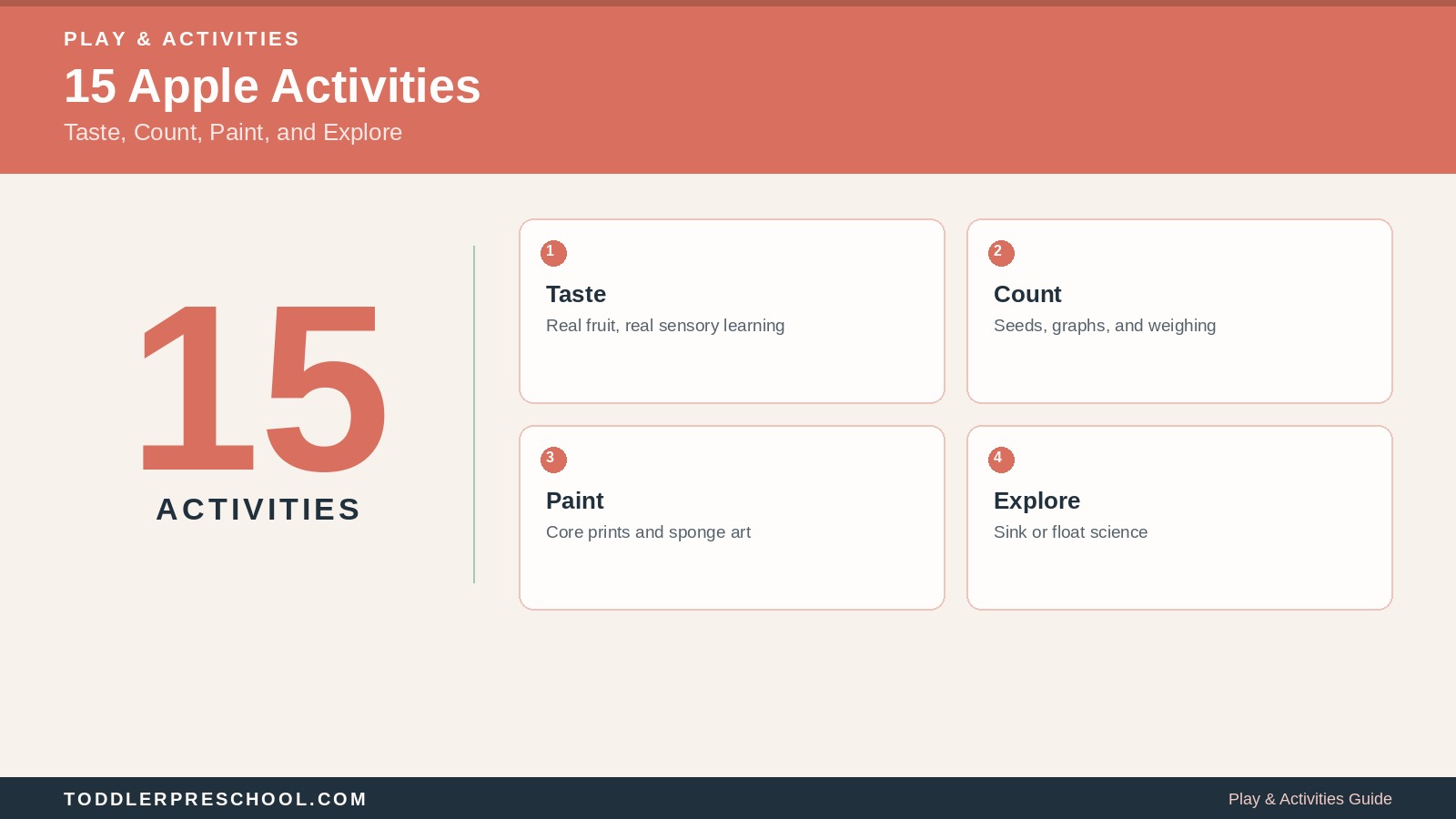
Here’s the direct answer. The best apple activities for preschoolers use real apples for real sensory learning: tasting, counting, weighing, painting, and exploring, not just coloring pages. This guide organizes 15 real activities into four simple categories. Setup time, mess level, and supervision needs are all clearly marked, so you can grab something that fits your actual afternoon.
You don’t need a full curriculum unit or a stack of printables to make this work. Most of what’s in this guide uses apples you’d likely buy anyway this time of year.
How to Use This List of Apple Activities for Preschoolers
Every activity below uses the same shorthand so you can scan quickly.
Best fit is a loose age range, not a deadline. Preschoolers vary widely in attention span and skill, and a wider range than listed is completely normal.
Time covers setup, then typical active play time. A preschooler often engages with something for less time than an adult expects, and that’s fine.
Mess is rated None, Low (a damp paper towel handles it), or Medium (a few minutes with a broom or sponge).
Supervision describes how closely an adult needs to stay involved. Arm’s reach means active, close supervision, which matters most for anything involving a knife, small seeds, or actual eating.
Skills it may support is phrased deliberately as “may,” never as a promise. Play doesn’t need a developmental justification to be worth doing.
A Note on Why These Are Organized Differently From a Classroom Unit
Most existing apple activity collections are written for teachers filling an entire classroom week. This guide is built around a different reality: a parent with one preschooler, an ordinary afternoon, and maybe twenty minutes before dinner needs to start.
That difference shapes everything from the materials chosen, mostly things already in a typical kitchen, to the stopping points built into each activity, which assume one child’s attention rather than a full classroom’s schedule.
A Quick Word on Safety
A few activities below involve real apple pieces, seeds, or a kitchen tool. General guidance from the U.S. Consumer Product Safety Commission is worth keeping in mind: anything small enough to fit through an empty toilet paper tube, about 1.25 inches across, is a choking risk for a child who still mouths objects. Raw apple pieces are a separate, specific choking risk at any preschool age, since firm raw fruit needs real chewing ability to break down safely.
Apple seeds contain a small amount of a compound that’s only a genuine concern in very large quantities, far more than a preschooler would realistically eat from a normal snack. Still, keep seeds out of activities meant for eating, and treat any cutting step as an adult-only task.
Any activity involving a toothpick or a paring knife needs close, arm’s reach supervision throughout, not just during setup. These specific activities are labeled clearly below.
Apple Season Timing in the U.S.
Knowing when apples are genuinely at their best helps you time these activities well.
Peak Availability
Most U.S. apple varieties are harvested between late summer and mid fall, which is exactly why apple activities cluster so heavily around September and October. This timing also tends to mean better prices and fresher fruit at most grocery stores and farmers markets.
Different varieties actually peak at slightly different points within this window. This is part of why a mixed bag from a farmers market this time of year often includes such genuine variety in color, size, and flavor.
Apples Are Available Year Round, Just Not at Their Peak
Even outside peak season, apples remain widely available in U.S. grocery stores thanks to storage and importing. This means none of these activities need to wait for exactly the right week if your family wants to revisit them later in the year.
Off season apples work just as well for most of the activities in this guide. Counting, weighing, and science experiments don’t depend on peak flavor the way a fresh taste test might.
A Note on Apple Picking Trips
If your family visits a local orchard as part of this seasonal tradition, several activities pair naturally with that trip. The taste test and seed counting work especially well with apples brought home the same day.
Why Apples Work So Well for This Age
Beyond simple availability, apples offer something genuinely useful for preschool learning specifically.
A Single Object, Many Senses
Few everyday objects let a child taste, smell, touch, see, and even hear something, the crunch of a bite, all in one activity. This makes apples a naturally rich sensory tool without needing anything specially designed.
This kind of multi sensory input matters more for young children than it might seem. Learning that engages several senses at once tends to feel more memorable and enjoyable than a single sense experience alone. It gives a child more ways to connect with and remember what they’re exploring.
Real Objects Build Real Understanding
Touching an actual apple, smelling real cider, and watching a real apple float gives a preschooler genuine, first hand experience. This tends to stick better than a worksheet showing the same concept.
A preschooler who has actually felt an apple’s weight in their hand, or watched one genuinely float rather than sink, carries that concrete memory forward. It shapes later conversations about size, weight, and buoyancy in a way a picture alone rarely achieves.
Naturally Suited to Math and Science
Apples come in different colors, sizes, and weights, which makes them a natural fit for counting, sorting, graphing, and simple science experiments, all without needing specialized manipulatives or kits.
A single bag of mixed apples already contains most of the variation a preschooler needs. Comparing, sorting, and predicting all become possible without a single dollar spent on specialized educational materials.
Gathering Apples and Supplies Ahead of Time
A little advance planning makes several of these activities available on short notice.
One Trip Covers Most of This Guide
A single grocery or farmers market trip for a small variety of apples, plus pantry basics like flour, baking soda, and vinegar, covers nearly every activity in this guide. Nothing here requires a specialty store.
Checking your own pantry first often reveals you already have most of what’s needed, since flour, salt, baking soda, and vinegar are common staples in many U.S. kitchens already.
Saving Cores and Seeds
If you’re doing several activities across a week, save cores and seeds from one activity to use in another. Moving from the taste test directly into seed counting or core painting also cuts down on food waste.
A single apple, used thoughtfully, can genuinely stretch across two or even three different activities on the same day.
Keeping a Few Apples on Hand Specifically for Play
Setting aside two or three apples specifically for activities, rather than snacking apples, avoids the frustration of running out mid-project. A cheaper or slightly bruised apple works fine for painting or science activities where taste doesn’t matter.
All 15 Apple Activities for Preschoolers at a Glance
| Activity | Category | Best Fit | Mess | Time |
|---|---|---|---|---|
| Apple Taste Test and Vote | Taste | 3 to 5 | Low | 15 to 20 min |
| Apple Cider Tasting Station | Taste | 3 to 5 | Low | 10 to 15 min |
| No-Bake Apple Pie Playdough | Taste | 2.5 to 5 | Low | 15 to 20 min |
| Apple Butter Spreading Snack | Taste | 3 to 5 | Low | 10 to 15 min |
| Apple Seed Counting | Count | 3 to 5 | Low | 10 to 15 min |
| Apple Bar Graph by Color | Count | 3 to 5 | None | 15 to 20 min |
| Apple Print Number Line | Count | 3 to 5 | Medium | 15 to 20 min |
| Apple Weighing and Comparing | Count | 3 to 5 | None | 10 to 15 min |
| Apple Core Painting | Paint | 2.5 to 5 | Medium | 15 to 20 min |
| Apple Tree Sponge Painting | Paint | 2.5 to 5 | Medium | 15 to 20 min |
| Apple Hedgehog Craft | Paint | 3.5 to 5 | Low | 15 to 20 min |
| Torn Paper Apple Collage | Paint | 2.5 to 5 | Low | 15 to 20 min |
| Apple Sink or Float Science | Explore | 2.5 to 5 | Low | 10 to 15 min |
| Apple Orchard Pretend Play | Explore | 2.5 to 5 | Low | 15 to 25 min |
| Apple Fizzing Science | Explore | 3 to 5 | Medium | 10 to 15 min |
Taste: Apple Activities for Preschoolers That Use the Real Fruit
These activities lean into the fact that apples are genuinely good to eat, not just fun to look at. Taste based learning also builds vocabulary in a way that’s hard to replicate with pictures alone. Words like tart, crisp, and juicy only really click once a child has experienced them directly.
1. Apple Taste Test and Vote
Offer small pieces of three or four apple varieties, then vote for a favorite.
Best fit: 3 to 5 years. Time: 5 minutes setup, 15 to 20 minutes play. Mess: Low. Supervision: Arm’s reach, since raw apple pieces are a real choking risk at this age.
Materials and substitutions: Three or four apple varieties, cut into small, thin pieces by an adult. A simple paper chart with each variety’s name or color for voting.
Steps: Cut each variety into small, separate pieces. Taste each one together. Place a sticker or mark next to the winning variety on the chart.
Skills it may support: descriptive vocabulary, comparison, early voting and counting concepts.
Easier version: Offer just two varieties instead of four. Extension: Graph the votes using the bar graph activity later in this guide. Stopping point: One full taste and vote round is complete; there’s no need to try every variety in one sitting.
Visual direction: Overhead flat lay of small apple slices in different colors on a wood table, small hand reaching for a piece, warm natural light.
2. Apple Cider Tasting Station
Set out small cups of apple cider, warm and cold, for a simple sensory comparison.
Best fit: 3 to 5 years. Time: 3 minutes setup, 10 to 15 minutes play. Mess: Low. Supervision: Arm’s reach, since this involves a warm liquid.
Materials and substitutions: Apple cider, two small cups, one warm and one cool to the touch, not hot. Apple juice works as a substitute if cider isn’t available.
Steps: Pour a small amount into each cup. Let your child smell, then taste, each temperature. Talk about the differences together.
Skills it may support: sensory comparison, descriptive language, temperature vocabulary.
Easier version: Offer just one temperature and focus on smell and taste alone. Extension: Add a cinnamon stick to one cup and compare scents. Stopping point: A few sips of each is a complete tasting session.
3. No-Bake Apple Pie Playdough
Make a simple cinnamon-scented playdough that smells like apple pie, without any actual apple inside.
Best fit: 2.5 to 5 years. Time: 10 minutes setup, 15 to 20 minutes play. Mess: Low. Supervision: Arm’s reach if your child helps mix, since this uses a stovetop or hot water step best done by an adult.
Materials and substitutions: Flour, salt, cream of tartar, oil, water, and cinnamon or apple pie spice, mixed and cooked briefly on the stove, or a no-cook version using warm water. Store-bought playdough with cinnamon added works as a shortcut.
Steps: Prepare the dough ahead of time or with your child’s help mixing dry ingredients. Let your child knead and shape the dough freely. Store in an airtight container between uses.
Skills it may support: hand strength through kneading, sensory exploration through scent, open ended creative play.
Easier version: Use a pre-made playdough and simply add cinnamon for scent, skipping the cooking step entirely. Extension: Add small rolling pins or cookie cutters for pretend pie making. Stopping point: A full play session with the dough, however long that lasts today, is complete.
Visual direction: Close up of small hands kneading reddish brown playdough, cinnamon sticks visible nearby, warm cozy lighting.
4. Apple Butter Spreading Snack
Practice spreading apple butter on crackers or toast using a butter knife.
Best fit: 3 to 5 years. Time: 3 minutes setup, 10 to 15 minutes play. Mess: Low. Supervision: Same room.
Materials and substitutions: Apple butter or applesauce, crackers or toast, and a child safe butter knife.
Steps: Offer a small amount of apple butter and a cracker. Show the spreading motion once. Let your child practice spreading, then eat the result.
Skills it may support: fine motor control, bilateral hand coordination, independence with a real kitchen task.
Easier version: Use a spoon to dollop instead of spreading if the knife motion feels too hard right now. Extension: Let your child spread several crackers to share with the family. Stopping point: A few spread crackers is a complete, satisfying snack session.
Visual direction: Close up of small hands spreading apple butter on a cracker with a child safe knife, warm kitchen light, cozy composition.
Count: Apple Activities for Preschoolers That Build Early Math
Apples make natural, edible math manipulatives, and these activities lean into that directly. Counting a real, tangible object tends to build stronger number sense at this age than counting abstract shapes on a page.
5. Apple Seed Counting
Count real apple seeds from a cut apple onto a simple numbered chart.
Best fit: 3 to 5 years. Time: 5 minutes setup, 10 to 15 minutes play. Mess: Low. Supervision: Arm’s reach, since seeds are a choking risk for a child who still mouths objects.
Materials and substitutions: Seeds from a cut apple, and a simple paper with numbered circles or boxes to place seeds into.
Steps: Remove seeds from a cut apple ahead of time. Count seeds together one at a time. Place matching numbers of seeds on numbered spots on the paper.
Skills it may support: one to one counting correspondence, number recognition, fine motor pinching.
Easier version: Count to a smaller number, like five, for a younger preschooler. Extension: Compare seed counts between two different apples. Stopping point: One full counting round is complete.
Visual direction: Overhead close up of small apple seeds being counted onto a numbered paper, small hand mid placement, bright clean background.
6. Apple Bar Graph by Color
Sort apple pieces or paper apple cutouts by color, then build a simple bar graph.
Best fit: 3 to 5 years. Time: 5 minutes setup, 15 to 20 minutes play. Mess: None. Supervision: Same room.
Materials and substitutions: Paper apple cutouts in red, green, and yellow, or real small apples of different colors, and a poster board with columns drawn for each color.
Steps: Sort apples by color into separate piles. Place each pile in its matching column on the graph. Count and compare which color has the most.
Skills it may support: sorting and classification, early data representation, comparison vocabulary like more and fewer.
Easier version: Use just two colors instead of three. Extension: Combine this with the taste test vote from earlier in this guide. Stopping point: One completed graph is a full activity.
Visual direction: Overhead shot of a simple hand drawn bar graph with red, green, and yellow paper apples placed in columns, bright colorful composition.
7. Apple Print Number Line
Stamp apple prints in a row, then write numbers underneath to build a simple number line.
Best fit: 3 to 5 years. Time: 5 minutes setup, 15 to 20 minutes play. Mess: Medium. Supervision: Arm’s reach, since this involves paint and a cut apple half.
Materials and substitutions: An apple half cut by an adult, washable paint, and a long strip of paper.
Steps: Dip the apple half in paint and stamp it in a row across the paper. Write or trace numbers underneath each print. Count along the row together.
Skills it may support: number sequencing, counting practice, hand eye coordination through stamping.
Easier version: Stamp just five prints instead of ten for a shorter number line. Extension: Practice counting forward and backward along the finished line. Stopping point: A full row of prints and numbers is a complete project.
8. Apple Weighing and Comparing
Use a kitchen scale to compare the weight of different apples.
Best fit: 3 to 5 years. Time: 5 minutes setup, 10 to 15 minutes play. Mess: None. Supervision: Same room.
Materials and substitutions: A kitchen scale or simple balance scale, and several apples of different sizes.
Steps: Hold two apples and guess which feels heavier. Weigh each on the scale to check the guess. Compare several pairs together.
Skills it may support: early measurement concepts, predicting and checking, comparison vocabulary.
Easier version: Compare just two apples with an obvious size difference. Extension: Record the weights together on paper. Stopping point: Weighing a few pairs is a complete session.
Visual direction: Overhead shot of two apples on a small kitchen scale, small hand pointing at the display, bright clean background.
Paint: Apple Activities for Preschoolers That Get Hands Messy
These activities use apples as art tools, not just subjects to draw. Using a real fruit as a printing tool, rather than a store bought stamp, adds a genuine sense of discovery to an otherwise familiar art activity.
9. Apple Core Painting
Use the leftover core from a cut apple, dipped in paint, to roll and stamp texture onto paper.
Best fit: 2.5 to 5 years. Time: 3 minutes setup, 15 to 20 minutes play. Mess: Medium. Supervision: Same room.
Materials and substitutions: An apple core saved from another activity, washable paint in a shallow dish, and paper.
Steps: Dip the core in paint. Roll or press it across the paper to leave a textured print. Repeat with fresh paint as needed.
Skills it may support: whole hand grip strength, cause and effect observation, an easy reuse of materials from another activity.
Easier version: Use a larger, easier to grip apple half instead of the smaller core. Extension: Combine core prints with the apple half stamps from the number line activity for a mixed texture piece. Stopping point: A full page of prints is a complete project.
Visual direction: Close up of an apple core dipped in paint rolling across paper, textured print visible, small hand mid motion, bright light.
10. Apple Tree Sponge Painting
Sponge paint a tree trunk, then dab red and yellow sponge prints on top for apples.
Best fit: 2.5 to 5 years. Time: 5 minutes setup, 15 to 20 minutes play. Mess: Medium. Supervision: Same room.
Materials and substitutions: Brown paint for the trunk, red and yellow paint for apples, a sponge or cotton ball, and paper.
Steps: Paint or draw a simple tree trunk and branches first. Dip a sponge in red or yellow paint and dab apple shapes onto the branches. Let dry before displaying.
Skills it may support: color association, dabbing motor control, an early sense of composition.
Easier version: Provide a pre-drawn trunk so your child only needs to add the apples. Extension: Add green sponge dabs for leaves once apples are placed. Stopping point: One finished tree is a complete piece.
Visual direction: Overhead shot of a painted tree trunk with red sponge dabbed apples being added, small hand holding a sponge, colorful bright composition.
11. Apple Hedgehog Craft
Turn an apple half into a hedgehog using toothpicks and small fruit pieces for spikes.
Best fit: 3.5 to 5 years. Time: 5 minutes setup, 15 to 20 minutes play. Mess: Low. Supervision: Arm’s reach, always, since this involves toothpicks, which need close supervision for this age group.
Materials and substitutions: An apple half cut by an adult, toothpicks, and small soft fruit pieces like grapes or raisins to thread onto the toothpick tips.
Steps: Show your child how to gently press a toothpick into the rounded side of the apple half. Thread a small fruit piece onto each toothpick tip. Continue until the hedgehog is fully “spiked.”
Skills it may support: fine motor pressing and threading, spatial patterning, a genuine sense of finished pride.
Easier version: Pre-insert a few toothpicks and let your child focus just on threading fruit onto the tips. Extension: Add two small seed or berry eyes to complete the hedgehog face. Stopping point: One finished hedgehog is a complete, edible project.
Visual direction: Close up of a completed apple hedgehog craft with toothpicks and grape spikes, small hand placing the final piece, bright kitchen light.
12. Torn Paper Apple Collage
Tear colored paper into small pieces and glue them inside a large apple outline.
Best fit: 2.5 to 5 years. Time: 3 minutes setup, 15 to 20 minutes play. Mess: Low. Supervision: Same room.
Materials and substitutions: Red, green, or yellow construction paper, a large apple shape drawn or printed on paper, and a glue stick.
Steps: Tear paper into small pieces together. Spread glue inside the apple outline. Press torn pieces onto the glue until the shape is filled.
Skills it may support: fine motor strength through tearing, hand eye coordination, an early sense of filling a defined space.
Easier version: Pre-tear a starter pile of pieces if tearing itself feels frustrating today. Extension: Add a brown paper stem and green leaf to complete the picture. Stopping point: One filled apple outline is a complete, displayable piece.
Visual direction: Overhead flat lay of a paper apple outline partially filled with torn red paper pieces, small hand placing a piece, bright colorful background.
Explore: Apple Activities for Preschoolers That Spark Questions
These activities turn apples into a genuine, hands-on science moment. A simple, surprising result, like a whole apple floating, often sparks more genuine curiosity than a planned lesson ever could.
13. Apple Sink or Float Science
Predict, then test, whether a whole apple floats or sinks in a bowl of water.
Best fit: 2.5 to 5 years. Time: 3 minutes setup, 10 to 15 minutes play. Mess: Low. Supervision: Same room.
Materials and substitutions: A large bowl or basin of water, and one or more whole apples.
Steps: Ask your child to guess whether the apple will float or sink. Gently place the apple in the water to test the guess. Try a cut apple slice too, and compare.
Skills it may support: predicting and testing, early scientific thinking, genuine curiosity about a surprising result.
Easier version: Skip the prediction step and simply observe together. Extension: Try other fruits or objects and compare results. Stopping point: Testing one or two items is a complete science moment.
Visual direction: Overhead shot of a whole apple floating in a clear bowl of water, small hand reaching toward it, bright natural light.
14. Apple Orchard Pretend Play
Set up a small pretend apple orchard using real or toy apples, a basket, and a simple picking game.
Best fit: 2.5 to 5 years. Time: 5 minutes setup, 15 to 25 minutes play. Mess: Low. Supervision: Same room.
Materials and substitutions: A few real or toy apples arranged on a low shelf or chair “tree,” a basket for collecting, and a pretend ticket or coin if available.
Steps: Arrange apples on the pretend tree. Offer a basket and invite your child to “pick” the apples. Add a pretend checkout moment with simple counting.
Skills it may support: imaginative and symbolic play, real world sequence understanding, early counting through pretend exchange.
Easier version: Skip the pretend checkout and focus simply on picking and carrying. Extension: Take turns being the picker and the orchard worker. Stopping point: One full picking round is a complete pretend play session.
Visual direction: Wide shot of a toddler reaching for a toy apple on a low pretend tree, basket in hand, warm indoor lighting.
15. Apple Fizzing Science
Combine baking soda and vinegar inside a hollowed apple half for a safe, fizzy reaction.
Best fit: 3 to 5 years. Time: 5 minutes setup, 10 to 15 minutes play. Mess: Medium. Supervision: Arm’s reach, since this is an active, messy reaction.
Materials and substitutions: An apple half with the center hollowed out slightly by an adult, baking soda, vinegar, and a tray to contain the mess.
Steps: Place a spoonful of baking soda in the hollowed apple center. Add a splash of vinegar and watch it fizz. Repeat with fresh baking soda as many times as interest allows.
Skills it may support: cause and effect observation, genuine scientific excitement, an early introduction to a simple chemical reaction.
Easier version: Use a smaller amount of each ingredient for a gentler, less dramatic fizz. Extension: Add a drop of food coloring to the vinegar for a more visual reaction. Stopping point: A few rounds of fizzing is a complete, satisfying science session.
Visual direction: Close up of a fizzing reaction inside a hollowed apple half on a tray, colorful bubbles visible, bright overhead light.
Building a Simple Apple Week Without a Full Curriculum
If you’d like to spread these apple activities for preschoolers across several days, a loose structure helps without needing a formal plan.
A Realistic Weekly Rhythm
Picking two or three activities across a week, rather than trying every idea in this guide at once, keeps things enjoyable rather than exhausting for both of you. One activity from each of the four categories, taste, count, paint, and explore, gives a naturally varied week without much planning.
This loose approach also builds in room for a genuinely busy week where only one activity happens, without the whole plan feeling abandoned or incomplete.
Letting Your Child’s Interest Lead
If one activity is a clear hit, repeating a variation of it later in the week often works better than forcing variety for its own sake. A preschooler who loved the sink or float test might enjoy trying other fruits the next day just as much as moving to a brand new activity.
It’s Fine to Skip Days Entirely
A themed week doesn’t need to happen every single day to be worthwhile. Two or three genuinely engaged sessions across a week accomplish more than a rushed daily activity squeezed in out of obligation.
Involving Siblings of Different Ages
Many families doing these activities have more than one child at home, and a little planning helps everyone participate.
Older Siblings as Helpers
An older sibling can take on measuring, pouring, or reading numbers aloud during activities like the bar graph or weighing station. This turns a solo activity into a shared one, without either child feeling left out.
This kind of shared role also builds a genuine sense of responsibility for the older child, who gets to practice explaining and helping rather than only being helped.
Younger Siblings and Safety
For a younger sibling too young for the seed counting or toothpick based activities, sensory options work well. Sink or float, or simply watching and helping stir the playdough, offer a safe way to participate alongside an older preschooler.
Keep a younger sibling’s specific role simple, like pouring water or holding a bowl. This gives them genuine participation without the fine motor or safety demands the older child’s version requires.
When One Child Wants More Time Than the Other
It’s fine for one child to spend twenty minutes on an activity while a sibling moves on after five. Offering a simple parallel option, like free play nearby, keeps things low stress for everyone involved.
Common Obstacles
A few specific situations come up often enough to address directly.
“My preschooler refuses to try new apple varieties.”
This is common and doesn’t need to be pushed past. Offering a very small, low pressure taste, one tiny piece rather than a whole slice, tends to work better than encouraging a big bite of something unfamiliar.
“We started an activity and my child lost interest halfway through.”
This is completely normal at this age. Stopping partway through, rather than pushing to finish, respects your child’s actual attention span today. Most of these activities can be picked back up later or simply left as a shorter version of what was planned.
“I don’t have time for the setup some of these need.”
Focus on the activities marked with the shortest setup time in the at a glance table. The sink or float test and a simple taste test both work with almost no preparation at all.
Adapting This to Every Family’s Situation
These apple activities for preschoolers are meant to flex, not to be followed exactly as written. The National Association for the Education of Young Children frames developmentally appropriate practice as play based learning that’s also culturally, linguistically, and individually responsive to the specific child in front of you.
Family and Developmental Variation
Multilingual families. Every activity above works in any language your family speaks at home. Naming colors, counting seeds, or narrating a step doesn’t require English specifically.
Disability and developmental variation. Several activities include an easier version specifically because attention span, motor skills, and sensory preferences vary widely among preschoolers. If your child has sensory sensitivities to sticky or wet textures, several dry activities work well as alternatives. The bar graph and number line are both good lower sensory options.
Different family structures and caregivers. Nothing here requires two adults or a specific relationship to the child. An older sibling, grandparent, or any consistent caregiver can lead any of these just as well.
Budget, Access, and Schedule
Budget. Every activity on this list uses apples you’d likely buy anyway this time of year, plus household basics like paper, paint, and toothpicks. None of these require special classroom supplies or printable packs.
Access to fresh apples. If fresh apples aren’t easily available or affordable right now, paper or toy apples work for several activities. Counting, graphing, and pretend play all adapt well, though the taste and science activities do need the real fruit.
Time and schedule. If you only have five minutes, the sink or float test or a quick taste test both work with almost no setup. If today isn’t a project kind of day, that’s a completely normal parenting day, not a missed opportunity.
Working parents with limited free time. These activities don’t need a dedicated weekend project time. Many work just as well squeezed into a normal weekday afternoon or the hour before dinner.
Families managing food allergies. For a family avoiding apples specifically due to an allergy, several activities still work well. The counting, graphing, and pretend play activities all use paper or toy apples, letting a child join in fully without any food exposure.
Connecting This to Preschool or Daycare
If your child’s program is also doing an apple theme this season, coordinating can add extra value to both settings.
Asking What They’re Covering
A quick question to your child’s teacher about their current apple activities can help. You can choose complementary ideas at home, rather than repeating exactly what they’re already doing at school.
This kind of quick coordination also gives your child a chance to feel like an expert, showing a parent something they already know from a related classroom experience.
Extending a School Activity at Home
If your child comes home excited about something specific from school, a similar activity from this guide can extend that same interest without needing to guess what might work.
Frequently Asked Questions About Apple Activities for Preschoolers
Questions About Materials and Timing
Do I need special apple varieties for these activities, or will whatever’s in my fridge work? Whatever apples you already have work fine for nearly every activity here. The taste test and bar graph activities specifically benefit from having two or three different colors or varieties on hand, but that’s the only exception.
How long do apple-themed activities typically hold a preschooler’s interest? This varies enormously by child and by day. Some preschoolers happily spend thirty minutes on one activity; others are ready to move on after five. Both are normal, and the stopping points in this guide reflect that variation.
Is it worth turning this into a full week-long apple theme, or should we just pick one or two activities? Either approach works well. A single activity on a Tuesday afternoon is just as legitimate as spreading several across a week. This guide is built so you can pick exactly what fits, rather than feeling obligated to complete a full theme.
Questions About Specific Situations
My preschooler doesn’t like touching messy textures like paint or dough. What should we try first? Start with a lower sensory option like the bar graph, weighing activity, or number line, all of which involve minimal direct hand mess. These can build comfort before trying messier options like the sponge painting or fizzing science.
Can these activities work for a mixed age group with both a toddler and a preschooler? Many can, with a few adjustments. Skip anything involving seeds, toothpicks, or small parts for the toddler specifically. Let the preschooler take the lead on counting or graphing steps, while the toddler focuses on simpler sensory pieces like sink or float.
Is it okay to reuse the same apple across more than one activity in a single day? Yes, this is a genuinely practical approach. An apple used for the sink or float test can move directly into core painting or seed counting afterward, cutting down on both cost and food waste.
Do any of these activities work well for a preschooler with a shorter attention span than most? The sink or float test, the taste test, and the weighing activity all tend to work well for shorter attention spans. Each has a quick, clear result, rather than a long multi-step process.
Realistic Cleanup After Apple Activities
A little planning around cleanup keeps these activities from feeling like more work than they’re worth.
Covering Surfaces Before You Start
A simple plastic tablecloth or a few layers of newspaper under any painting or fizzing activity saves real cleanup time afterward. This matters especially for messier options like sponge painting or the fizzing reaction.
Setting this up before your child is already excited and ready to start also avoids the frustration of a delayed beginning once enthusiasm has already peaked.
Storing Leftover Materials
Playdough keeps well in an airtight container for several weeks. Leftover paint can often be resealed and reused for a second session, so a single supply purchase covers more than one activity day.
Labeling containers with the date they were made helps track freshness, especially for the scented playdough, which is best used within a few weeks for the strongest scent.
When to Let Go of a Perfect Cleanup
A little residual paint on a table, or a few stray apple seeds on the floor, is a normal, expected part of these activities. It’s not a sign anything went wrong. A quick wipe down covers most of what’s genuinely needed.
Setting your own expectations for cleanup before you start, rather than mid-activity, tends to keep the whole session feeling relaxed rather than rushed toward an early, anxious ending.
Your One Next Step
Look at the at a glance table above, and pick one activity marked with low mess and short time. Try it this week with whatever apples are already in your kitchen.
If it goes well, you already have fourteen more ideas ready for the next time apples show up in your fridge, no extra planning required.
Sources consulted: National Association for the Education of Young Children, Defining Developmentally Appropriate Practice; U.S. Consumer Product Safety Commission public guidance on choking hazards and small parts sizing for children under 5.