
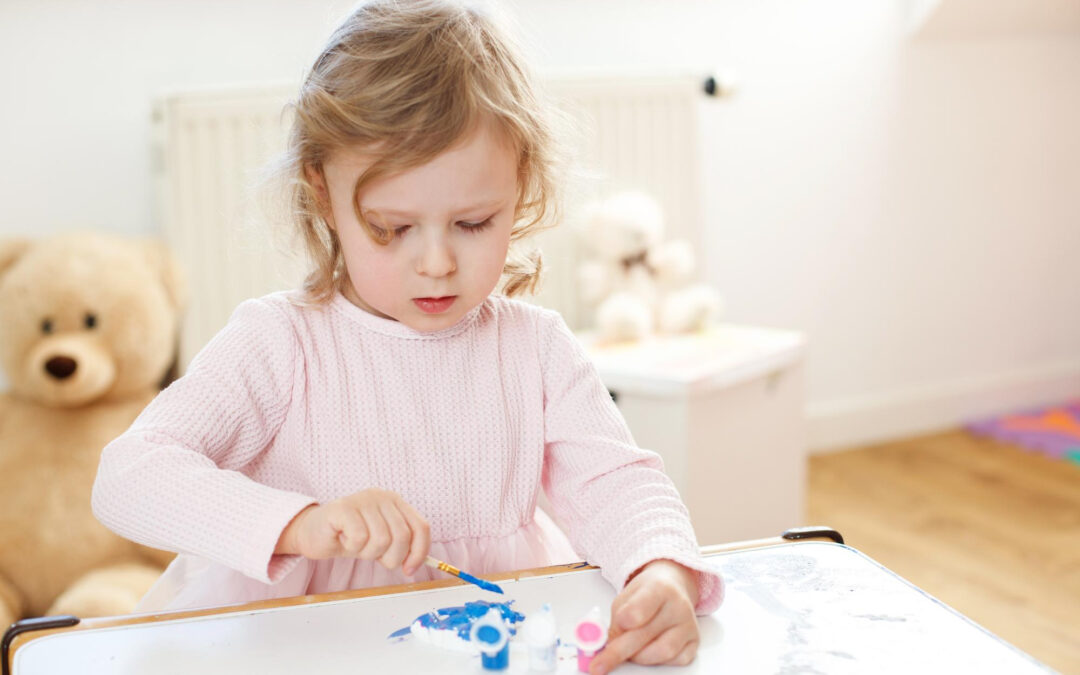
It’s a Tuesday afternoon, your 3-year-old has announced they’re bored for the fourth time today, and you’re searching for activities for 3 year olds that don’t require a craft-store run or twenty minutes of setup you don’t have. That’s the exact moment this guide is for.
Here’s the direct answer: the best activities for 3 year olds aren’t the most elaborate ones — they’re the ones that match your child’s current attention span, the mess you can tolerate today, and materials you already have in the house. This guide organizes 25 real, low-prep ideas across movement, fine motor and art, pretend play, early language and literacy, and hands-on science and discovery — and every single one tells you upfront how long it takes, how messy it gets, how closely to supervise, and when it’s okay to stop. You don’t need to work through this list in order, and you definitely don’t need to do all 25 this month. Pick one that matches your afternoon.
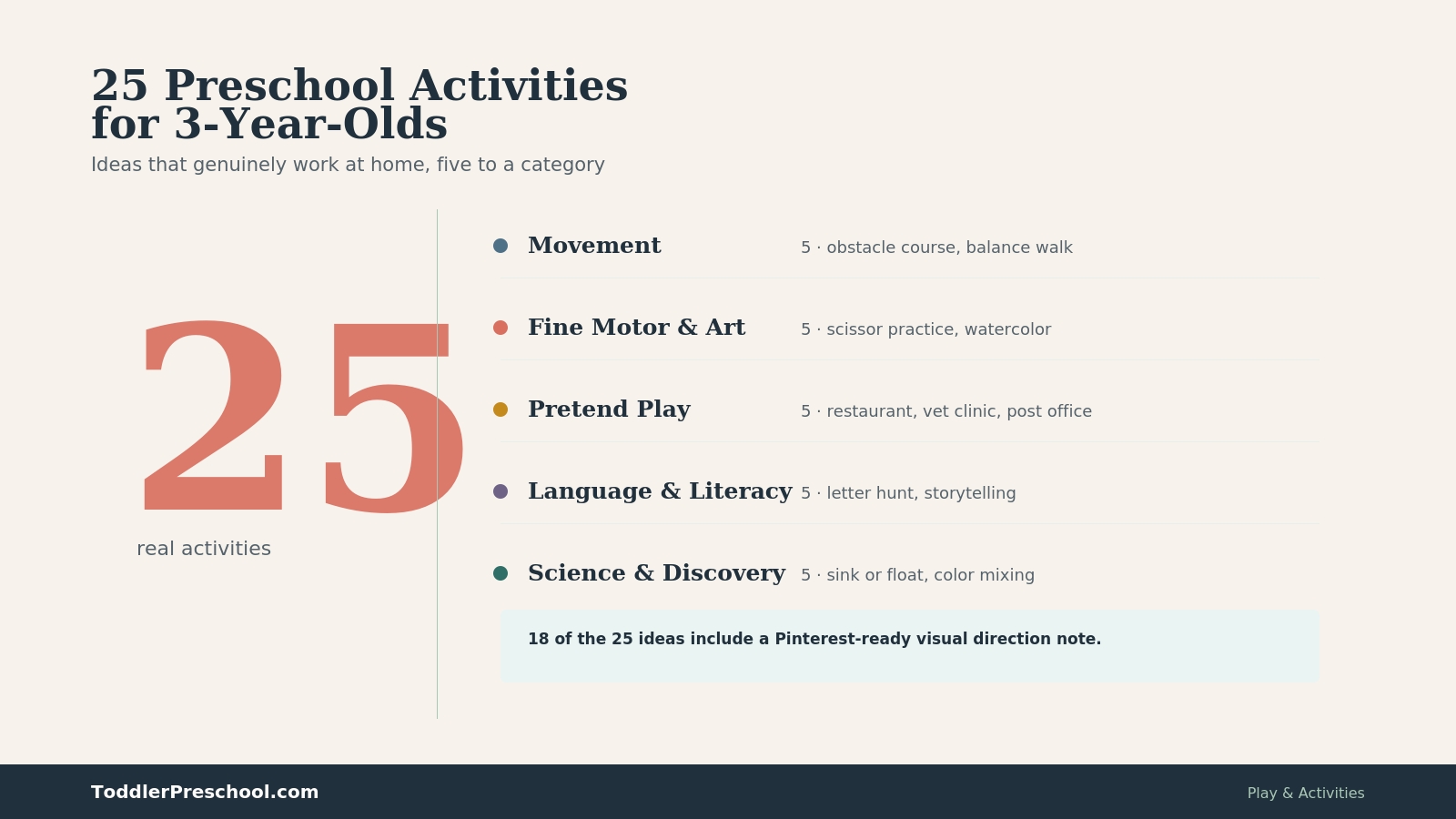
25 Preschool Activities for 3 Year Olds That Work at Home
How to Use This List of Activities for 3 Year Olds
Every activity below uses the same shorthand so you can scan quickly instead of rereading definitions 25 times:
- Best fit: a loose age range, not a deadline. Three-year-olds vary enormously in attention span, coordination, and interest, and a wider or narrower range than what’s listed is completely normal.
- Time: setup time, then typical active play time. Many 3-year-olds can sustain an activity for longer than a 2-year-old could a year earlier, but that range is still wide, and shorter is fine.
- Mess: None (put it away and you’re done), Low (a damp paper towel handles it), or Medium (a few minutes with a broom, sponge, or wipe-down). Nothing on this list is planned as a bath-required mess.
- Supervision: how closely an adult needs to stay involved. “Arm’s reach” means within-touching-distance active supervision, which matters most for anything involving small pieces, scissors, or anything that could be mouthed (see the safety section below — some 3-year-olds still explore objects this way, especially younger ones).
- Skills it may support: phrased deliberately as “may,” never as a promise or a checklist item — see the note on this below.
- Easier version, Extension, Stopping point: a way to scale the same activity down, up, or end it early without it feeling like a failure.
A note on “skills it may support”: play doesn’t need to be justified by a developmental outcome to be worth doing, and a 3-year-old doesn’t need to “achieve” anything from mixing paint colors. Where we mention a skill an activity may touch on, it’s meant as a loose, honest connection — not a claim that this activity builds that skill, and definitely not a substitute for how your child is actually doing. If you have a real question about your child’s development, your pediatrician is the right person to ask, not an activity list.
A Quick Word on Safety and Supervision
A few of the ideas below involve small pieces, scissors, or simple kitchen-cabinet chemistry, and some general safety guidance is worth keeping in mind for all of them. The U.S. Consumer Product Safety Commission’s general choking-hazard guidance applies specifically to children under 3 — a rough rule of thumb is that anything small enough to fit through an empty toilet paper tube (about 1.25 inches across) is a choking risk for a child who still mouths objects — and since 3-year-olds span a wide range of what they still put in their mouths, especially younger and newer three-year-olds, it’s worth applying that same caution rather than assuming the birthday alone changed anything. Child-safety scissors, close supervision during first attempts, and a calm, unhurried approach to any activity involving small parts all apply throughout this guide. None of the activities below require an adult to hover anxiously, but a few genuinely need you within arm’s reach rather than in the next room, and those are labeled clearly.
All 25 Activities for 3 Year Olds at a Glance
| Activity | Category | Best Fit | Mess | Time |
|---|---|---|---|---|
| Obstacle Course Relay | Movement | 3–5yr | None | 5 min setup, 10–20 min play |
| Simon Says | Movement | 3–5yr | None | 0 min setup, 5–10 min play |
| Balance Beam Walk | Movement | 3–5yr | None | 2 min setup, 5–10 min play |
| Animal Yoga Poses | Movement | 3–5yr | None | 0 min setup, 5–10 min play |
| Backyard Treasure Hunt | Movement | 3–5yr | None | 5 min setup, 10–20 min play |
| Scissor Practice with Playdough | Fine Motor & Art | 3–4.5yr | Low | 1 min setup, 10–15 min play |
| Watercolor Painting | Fine Motor & Art | 3–5yr | Medium | 3 min setup, 10–20 min play |
| Lacing Cards | Fine Motor & Art | 3–4.5yr | None | 2 min setup, 10–15 min play |
| Sticker Scene Building | Fine Motor & Art | 3–5yr | Low | 1 min setup, 10–20 min play |
| Playdough with Tools | Fine Motor & Art | 3–5yr | Low | 1 min setup, 15–25 min play |
| Restaurant Pretend Play | Pretend Play | 3–5yr | Low | 5 min setup, 15–25 min play |
| Veterinarian Play | Pretend Play | 3–5yr | None | 3 min setup, 15–20 min play |
| Post Office Pretend Play | Pretend Play | 3–5yr | Low | 5 min setup, 15–20 min play |
| Dress-Up Character Play | Pretend Play | 3–5yr | None | 2 min setup, 15–30 min play |
| Puppet Show with a Stage | Pretend Play | 3–5yr | None | 5 min setup, 10–15 min play |
| Letter Hunt Around the House | Language & Literacy | 3–5yr | None | 2 min setup, 5–15 min play |
| Storytelling with Toys | Language & Literacy | 3–5yr | None | 0 min setup, 10–15 min play |
| Rhyming Word Game | Language & Literacy | 3–5yr | None | 0 min setup, 5–10 min play |
| Name Writing in Sensory Material | Language & Literacy | 3–5yr | Low | 3 min setup, 5–10 min play |
| Retelling a Story with Props | Language & Literacy | 3–5yr | None | 3 min setup, 10–15 min play |
| Sink or Float Experiment | Science & Discovery | 3–5yr | Low | 3 min setup, 10–15 min play |
| Color Mixing | Science & Discovery | 3–5yr | Medium | 3 min setup, 10–15 min play |
| Nature Scavenger Hunt | Science & Discovery | 3–5yr | None | 3 min setup, 15–25 min play |
| Baking Soda and Vinegar Volcano | Science & Discovery | 3–5yr | Medium | 5 min setup, 10–15 min play |
| Magnifying Glass Bug Hunt | Science & Discovery | 3–5yr | None | 2 min setup, 10–20 min play |
Movement Activities for 3 Year Olds
1. Obstacle Course Relay
Set up a multi-step course — crawl under a table, step over a pillow, walk a taped line, hop into a hoop — and time or race through it.
Best fit: 3–5 years · Time: about 5 minutes setup, 10–20 minutes play · Mess: None · Supervision: Same room; check the path for tripping hazards first.
Materials & substitutions: Couch cushions, painter’s tape, a hula hoop or a towel ring, a chair to crawl under — whatever’s on hand.
Steps: 1) Set up 4–6 stations in a simple path. 2) Demonstrate the full course once. 3) Let your child run it repeatedly, timing it if they’re motivated by that.
Skills it may support: multi-step sequencing, gross motor coordination, following a plan from start to finish.
Easier version: Use 2–3 stations instead of a full course. Extension: Add a timer and see if your child can beat their own time, or add a “mission” (deliver a stuffed animal to the finish line). Stopping point: A few laps is a complete session — no need to keep re-running it once interest fades.
Visual direction: Wide shot of the full course laid out, then a second action shot of a child mid-crawl or mid-hop through it, bright natural light, living room or backyard setting.
2. Simon Says
The classic instruction-following game — “Simon says touch your toes” — now genuinely playable since most 3-year-olds can follow a string of verbal directions.
Best fit: 3–5 years · Time: no setup, 5–10 minutes · Mess: None · Supervision: Same room.
Materials & substitutions: None needed.
Steps: 1) Give an instruction starting with “Simon says.” 2) Give one without “Simon says” occasionally, to practice listening for the cue. 3) Take turns being “Simon” once your child has the pattern.
Skills it may support: listening for a specific cue, following multi-word instructions, body-part vocabulary.
Easier version: Skip the “gotcha” trick instructions (the ones without “Simon says”) and just play it as a straightforward follow-along game. Extension: Add two-step instructions (“Simon says touch your nose, then jump”). Stopping point: Five or six rounds is a solid session — stop while your child is still leading enthusiastically if you’ve swapped roles.
Visual direction: Eye-level shot, child mid-pose (touching toes or hopping), genuine candid expression, home setting, natural light.
3. Balance Beam Walk
A strip of painter’s tape or a low, sturdy board becomes a “balance beam” to walk across.
Best fit: 3–5 years · Time: about 2 minutes setup, 5–10 minutes play · Mess: None · Supervision: Arm’s reach, since balance is still developing and a wobble near furniture edges is worth being close for.
Materials & substitutions: Painter’s tape on the floor, or a low wooden board (a 2×4 works if it’s stable and flat on the ground, not elevated).
Steps: 1) Lay the tape line or board on a flat, open stretch of floor. 2) Demonstrate walking heel-to-toe along it. 3) Let your child try, offering a hand for balance at first if needed.
Skills it may support: balance, focus and body control, gross motor confidence.
Easier version: Make the line short and wide, and hold a hand the whole way across. Extension: Add a “cargo” to carry across (a stuffed animal, a small basket) for an extra balance challenge, or try walking backward. Stopping point: A handful of crossings is a full activity — end while it’s still a fun challenge, not a frustrating one.
4. Animal Yoga Poses
Simple yoga-inspired poses named after animals — “cat,” “cobra,” “downward dog,” “frog” — done together as a calm-but-active game.
Best fit: 3–5 years · Time: no setup, 5–10 minutes · Mess: None · Supervision: Same room.
Materials & substitutions: None; a towel or mat is a nice optional touch, not required.
Steps: 1) Name an animal and show the pose. 2) Hold it together for a few breaths, making the animal’s sound if you like. 3) Move to the next pose.
Skills it may support: body awareness, following a modeled movement, a calming transition tool for high-energy moments.
Easier version: Pick 2–3 simple poses your child already enjoys rather than a long sequence. Extension: Let your child invent and name their own “animal pose” for you to copy. Stopping point: Four or five poses is a complete round — this one works well as a wind-down before quiet time.
Visual direction: Soft, warm-lit shot of a child in a simple animal pose (like “cat” on hands and knees), calm expression, uncluttered background, works well as a low-energy Pinterest pin.
5. Backyard or Living Room Treasure Hunt
Hide a few familiar objects and give simple clues — “look somewhere soft” — to find them.
Best fit: 3–5 years · Time: about 5 minutes setup, 10–20 minutes play · Mess: None · Supervision: Same room or same yard.
Materials & substitutions: A handful of small toys or household objects; index cards or verbal clues (no reading required for a 3-year-old — clues can be spoken or drawn as a simple picture).
Steps: 1) Hide 4–6 objects while your child isn’t looking. 2) Give one clue at a time, or a simple picture clue. 3) Celebrate each find before moving to the next.
Skills it may support: listening comprehension, spatial vocabulary (under, behind, inside), sustained attention across a multi-part activity.
Easier version: Hide objects in plain sight rather than truly hidden, and skip clues — just “go find” is enough for a first try. Extension: Add a simple hand-drawn treasure map, or let your child hide objects for you to find next. Stopping point: Finding everything is a natural end point — no need to extend it with a second round unless your child asks.
Visual direction: Wide shot of a child mid-search, peeking under furniture or behind a curtain, genuine excitement, natural home lighting.
Fine Motor and Art Activities for 3 Year Olds
6. Scissor Practice with Playdough or Paper Strips
Supervised first attempts at cutting — playdough “snakes” or wide paper strips — using child-safe scissors.
Best fit: 3–4.5 years · Time: about 1 minute setup, 10–15 minutes play · Mess: Low · Supervision: Arm’s reach, always, for any scissor activity at this age.
Materials & substitutions: Child-safe (blunt-tip) scissors, playdough rolled into thick ropes, or wide strips of scrap paper or a paper plate cut into strips.
Steps: 1) Show how to hold the scissors with thumb up. 2) Let your child practice snipping playdough ropes first — more forgiving than paper. 3) Move to paper strips once snipping feels comfortable.
Skills it may support: hand strength, bilateral coordination (one hand cutting, one hand holding), early scissor control.
Easier version: Stick to playdough only, which is easier to cut and lower-stakes than paper. Extension: Move to cutting along a drawn straight line, then a gentle curve, for a child who’s getting confident. Stopping point: A few minutes of genuine focus is plenty — scissor stamina builds gradually, and stopping before frustration sets in matters more than finishing a set number of snips.
Visual direction: Close-up of small hands holding child-safe scissors mid-snip through a playdough rope, bright even light, focus on the hand position.
7. Watercolor Painting
Simple watercolor paints, a brush, and paper — one of the lowest-prep “real” art activities available.
Best fit: 3–5 years · Time: about 3 minutes setup, 10–20 minutes play · Mess: Medium (water and paint spills happen) · Supervision: Same room; a covered table and a smock or old shirt save cleanup time.
Materials & substitutions: A basic watercolor palette, a cup of water, a brush, and paper — heavier paper (like cardstock) holds up better but isn’t required.
Steps: 1) Set up the palette, water cup, and paper. 2) Demonstrate wetting the brush and loading color once. 3) Let your child paint freely — the process matters more than the result at this age.
Skills it may support: brush and hand control, color exploration, comfort with an open-ended, no-wrong-answer creative task.
Easier version: Offer just 2–3 colors instead of the full palette to reduce overwhelm and rainbow mud. Extension: Try painting on a different surface (a paper towel, a coffee filter) to see how the water behaves differently. Stopping point: When the paper is full or the water’s gone muddy, that’s a natural end — no need to “finish a painting” in any formal sense.
Visual direction: Overhead flat-lay of a watercolor setup mid-use — palette, water cup with tinted water, brush, paper with color on it — plus a second close-up of a small hand holding the brush.
8. Lacing Cards
Threading yarn or a shoelace through holes punched in a sturdy card or paper plate.
Best fit: 3–4.5 years · Time: about 2 minutes setup, 10–15 minutes play · Mess: None · Supervision: Same room; the lace tip can be a minor choking consideration for a child who still mouths objects, so supervise accordingly.
Materials & substitutions: A hole-punched cardboard shape or paper plate and a shoelace or yarn with a piece of tape wrapped around the end (stiffens it like an aglet); store-bought lacing cards work too.
Steps: 1) Show how to push the lace through one hole and pull it out the next. 2) Let your child take over, offering help only when asked. 3) Try a full lap around the shape.
Skills it may support: fine motor precision, hand-eye coordination, sustained focus on a repetitive fine-motor task.
Easier version: Punch fewer, larger holes spaced further apart. Extension: Punch holes in a more complex shape, or challenge an over-under weaving pattern instead of simple threading. Stopping point: One full lap is a complete round — stop there rather than pushing for speed or a perfect pattern.
9. Sticker Scene Building
Building a scene on paper using stickers — a farm, an ocean, outer space, whatever’s on hand.
Best fit: 3–5 years · Time: about 1 minute setup, 10–20 minutes play · Mess: Low · Supervision: Same room.
Materials & substitutions: A sheet of stickers (dollar-store variety works fine) and a plain piece of paper; drawing a simple background (grass and sky, or blue ocean waves) first adds context but isn’t required.
Steps: 1) Offer the stickers and a blank page. 2) Ask what’s happening in the scene as your child builds it. 3) Add a simple background or additional details together if your child wants company in the project.
Skills it may support: fine motor precision (peeling and placing), storytelling and narrative building, independent focused play.
Easier version: Offer fewer sticker choices at once to prevent overwhelm. Extension: Add drawing or writing to label parts of the scene, or build a scene together that tells a specific story. Stopping point: A full page is a natural stopping point — save it or let it go without ceremony.
Visual direction: Overhead flat-lay of a sticker scene in progress, small hand placing a sticker, colorful and graphic, good natural light for a Pinterest-style shot.
10. Playdough with Tools
Playdough paired with simple tools — a rolling pin, cookie cutters, a plastic knife, a garlic press — for open-ended sculpting.
Best fit: 3–5 years · Time: about 1 minute setup, 15–25 minutes play · Mess: Low · Supervision: Same room.
Materials & substitutions: Store-bought or homemade playdough, plus any combination of a rolling pin, cookie cutters, a dull plastic knife, a fork, or a garlic press for “hair” effects.
Steps: 1) Offer the playdough and 2–3 tools at a time (not the whole toolbox at once, which can overwhelm). 2) Let your child explore freely. 3) Model one new technique (rolling, cutting, pressing) if interest starts to fade.
Skills it may support: hand strength, fine motor manipulation, open-ended problem-solving.
Easier version: Offer just the dough and hands — no tools yet — for a simpler sensory-first session. Extension: Add small toys (plastic animals, cars) to combine playdough with pretend play. Stopping point: This one has real staying power; ending after 15–20 minutes or whenever attention shifts is equally fine — no “finished product” is required.
Pretend Play Activities for 3 Year Olds
11. Restaurant Pretend Play
Set up a pretend restaurant — a “menu,” a notepad for orders, play food — and take turns being the customer and the server.
Best fit: 3–5 years · Time: about 5 minutes setup, 15–25 minutes play · Mess: Low · Supervision: Same room.
Materials & substitutions: Play food or paper cutouts of food, a small notepad and pencil (or just a torn scrap of paper), a folded paper “menu”; a stuffed animal can round out the guest list.
Steps: 1) Set up a “table” and a simple menu. 2) Take an order, writing or scribbling it down. 3) “Serve” the meal and switch roles.
Skills it may support: multi-step social scripts, imaginative and symbolic play, early writing/mark-making through pretend “order taking.”
Easier version: Simplify to just two menu items and skip the notepad. Extension: Add pretend money and a “bill,” or expand the menu with drawn pictures your child creates. Stopping point: One full “meal service” is a complete round — the restaurant can reopen another day.
Visual direction: Eye-level shot of a child “taking an order” with a small notepad at a pretend restaurant table set with play food, genuine concentration, warm home lighting.
12. Veterinarian Play
Stuffed animals become patients at a pretend vet clinic, complete with checkups and “treatment.”
Best fit: 3–5 years · Time: about 3 minutes setup, 15–20 minutes play · Mess: None · Supervision: Same room; check that any toy vet kit pieces are appropriately sized if a younger or less predictable 3-year-old still mouths objects.
Materials & substitutions: Stuffed animals as patients, a toy doctor or vet kit if available, or substitute a spoon (stethoscope) and a strip of fabric (bandage).
Steps: 1) Set up a “waiting room” with a line of stuffed animals. 2) Give each patient a checkup, narrating what’s found. 3) “Treat” and “discharge” each one before moving to the next.
Skills it may support: empathy and caregiving role-play, sequencing a multi-step routine, vocabulary around animals and care.
Easier version: See just one or two “patients” instead of a full waiting room. Extension: Add a “diagnosis” and simple explanation of what’s wrong, building more complex storytelling into the play. Stopping point: When the waiting room is empty, the clinic can close for the day — no need to see every stuffed animal in the house.
Visual direction: Overhead or eye-level shot of a “vet checkup” in progress — child examining a stuffed animal with a toy stethoscope, focused expression, soft lighting.
13. Post Office Pretend Play
“Mail” drawn pictures or notes to family members using homemade envelopes and a pretend mailbox.
Best fit: 3–5 years · Time: about 5 minutes setup, 15–20 minutes play · Mess: Low · Supervision: Same room.
Materials & substitutions: Paper, envelopes (homemade from folded paper works fine), stickers as “stamps,” and a box or basket as the mailbox.
Steps: 1) Draw or scribble a picture “letter.” 2) Fold it, put it in an envelope, and add a sticker “stamp.” 3) “Deliver” it to the pretend mailbox or to a family member directly.
Skills it may support: fine motor practice (folding, sticking), an early understanding of real-world systems, a genuine reason to draw or mark-make with purpose.
Easier version: Skip envelopes and just deliver drawn pictures directly. Extension: Set up a “route” with multiple stops (different rooms as different houses) for a bigger version. Stopping point: Delivering one letter is a complete round — this one also works well spread across a few short sessions rather than one long sitting.
Visual direction: Overhead flat-lay of a homemade envelope with a sticker “stamp,” a drawn letter beside it, small hand in frame, warm paper tones.
14. Dress-Up Character Play
Simple dress-up items — a cape, a hat, an old scarf — become the basis for open-ended character play.
Best fit: 3–5 years · Time: about 2 minutes setup, 15–30 minutes play · Mess: None · Supervision: Same room.
Materials & substitutions: Any combination of old clothes, scarves, hats, or simple accessories — no costume purchase needed; a pillowcase can be a cape in a pinch.
Steps: 1) Offer 2–3 dress-up pieces and ask who your child wants to be. 2) Follow their lead in the resulting story. 3) Introduce a simple “problem” for the character to solve if the play stalls (a lost item, a rescue).
Skills it may support: imaginative and symbolic play, identity exploration, narrative and storytelling skills.
Easier version: Offer a single simple item (just a hat, or just a cape) rather than a full costume box. Extension: Bring in a sibling, stuffed animal, or parent as a supporting character in the story. Stopping point: This kind of play often ends itself naturally when the story reaches a conclusion — no need to force an ending.
Visual direction: Wide shot of a child mid-play in a simple dress-up item (cape or hat), genuine motion and joy, home setting, natural light.
15. Puppet Show with a Stage
A simple “stage” (a cardboard box, a doorway with a blanket, the back of a couch) hosts a puppet show performed for family.
Best fit: 3–5 years · Time: about 5 minutes setup, 10–15 minutes play · Mess: None · Supervision: Same room.
Materials & substitutions: Sock or paper-bag puppets, a cardboard box with a cutout window, or simply the back of a couch to hide behind.
Steps: 1) Set up the “stage.” 2) Help your child think of a simple beginning-middle-end for the show if they want structure, or let them improvise freely. 3) Perform for a small audience — even one person counts.
Skills it may support: narrative sequencing, verbal expression, comfort performing or speaking through a character.
Easier version: Skip the “stage” setup entirely and just do puppet voices together, no audience required. Extension: Make simple puppets together first (a sock plus a marker face) as part of the activity. Stopping point: One short show is a complete performance — encores are optional, not expected.
Language and Early Literacy Activities for 3 Year Olds
16. Letter Hunt Around the House
Search the house or a room for a specific letter — on cereal boxes, book covers, mail — as a playful recognition game, not a drill.
Best fit: 3–5 years · Time: about 2 minutes setup, 5–15 minutes play · Mess: None · Supervision: Same room.
Materials & substitutions: None — household print is the material. A single letter written on a sticky note as a reminder of what you’re hunting for can help.
Steps: 1) Pick one letter, often the first letter of your child’s name. 2) Search together, pointing out the letter wherever it shows up. 3) Celebrate each find without quizzing or correcting misses.
Skills it may support: letter recognition through real-world print exposure, sustained visual attention, an early sense that print is meaningful.
Easier version: Search just one room instead of the whole house, and stick to a single very familiar letter. Extension: Once one letter feels easy, hunt for all the letters in your child’s name in order. Stopping point: Finding the letter a handful of times is enough — this isn’t a comprehensive sweep of the house, just a playful notice-and-point game.
Visual direction: Close-up of a small finger pointing to a letter on a cereal box or book spine, genuine everyday household setting, warm indoor light.
17. Storytelling with Toys
Use whatever toys are already out — blocks, animals, cars — as characters in a made-up story you build together.
Best fit: 3–5 years · Time: no setup, 10–15 minutes · Mess: None · Supervision: Same room.
Materials & substitutions: Any toys already on hand.
Steps: 1) Start a simple story (“Once there was a bear who wanted…”). 2) Pause and ask your child what happens next. 3) Keep building back and forth, following wherever the story goes.
Skills it may support: narrative structure, cause-and-effect thinking, expressive vocabulary.
Easier version: Offer two simple choices at each pause point (“does the bear go left or right?”) rather than an open-ended prompt if your child finds open questions hard to answer. Extension: Act the story out physically with the toys as you go, or record it (even just in writing, for you) to “read” back later. Stopping point: Most made-up stories find their own natural ending — a character reaching home, going to sleep — and that’s a fine place to stop.
18. Rhyming Word Game
A simple back-and-forth game of finding words that rhyme with a given word.
Best fit: 3–5 years · Time: no setup, 5–10 minutes · Mess: None · Supervision: Same room.
Materials & substitutions: None needed — a car ride or a wait at a restaurant table works as well as home.
Steps: 1) Say a simple word (“cat”). 2) Ask what else rhymes with it, offering an example if your child isn’t sure yet (“hat, bat…”). 3) Take turns coming up with more, nonsense words included — they still count for the sound pattern.
Skills it may support: phonological awareness (hearing sound patterns in words), an early literacy skill that supports reading later, playful engagement with language.
Easier version: Model most of the rhymes yourself and just ask your child to repeat or pick a favorite, rather than generate their own yet. Extension: Move from single rhyming words to a full silly rhyming sentence you build together. Stopping point: A handful of rounds is plenty — this game works well in short bursts throughout a day rather than one long sitting.
19. Name Writing in Sensory Material
Practicing the first letter or full name by writing with a finger in a tray of sand, salt, shaving cream, or flour.
Best fit: 3–5 years · Time: about 3 minutes setup, 5–10 minutes play · Mess: Low (contained to a tray) · Supervision: Same room.
Materials & substitutions: A shallow tray or baking sheet with a thin layer of sand, salt, rice, flour, or shaving cream; a finger works as the “pencil,” no special tool required.
Steps: 1) Spread the material in a thin, even layer on the tray. 2) Write the first letter of your child’s name slowly, narrating the strokes. 3) Let your child try, smoothing the tray flat to try again as many times as they want.
Skills it may support: pre-writing strokes and letter formation, sensory engagement with an early literacy skill, low-pressure repetition (mistakes disappear with a smooth of the hand, unlike paper).
Easier version: Practice simple lines and circles instead of an actual letter if letter formation feels like too much right now. Extension: Move from the first letter to the full name once the first letter feels comfortable. Stopping point: A few successful attempts is a complete session — there’s no requirement to “master” the letter in one sitting, and smoothing the tray flat at the end is a satisfying natural close.
Visual direction: Overhead close-up of a small finger writing a letter in a tray of sand or shaving cream, clear tactile texture visible, bright even light.
20. Retelling a Favorite Story with Props
After reading a familiar book, retell it together using simple props or toys standing in for the characters.
Best fit: 3–5 years · Time: about 3 minutes setup, 10–15 minutes play · Mess: None · Supervision: Same room.
Materials & substitutions: A favorite, well-known picture book plus whatever toys can loosely represent its characters — exact matches aren’t necessary; a block can be a house, a stuffed animal can play any role.
Steps: 1) Read the book together once as a refresher, if it’s been a while. 2) Set out the “characters.” 3) Retell the story together, prompting with “what happens next?” rather than narrating the whole thing yourself.
Skills it may support: narrative recall and sequencing, comprehension beyond just listening, connecting books to hands-on play.
Easier version: Retell just one favorite scene rather than the whole book. Extension: Let your child change the ending or add a new character, building original storytelling on top of a familiar structure. Stopping point: Reaching “the end” of the retelling is a natural, satisfying close — no need to loop back and do it again immediately.
Science and Discovery Activities for 3 Year Olds
21. Sink or Float Experiment
Gather a handful of household objects and predict, then test, whether each one sinks or floats in a basin of water.
Best fit: 3–5 years · Time: about 3 minutes setup, 10–15 minutes play · Mess: Low (water splashes) · Supervision: Same room; standard water-safety awareness applies any time a basin of water is out for a young child.
Materials & substitutions: A basin, sink, or large bowl of water, and 6–8 safe household objects (a spoon, a cork, a plastic toy, a rock, a sponge).
Steps: 1) Look at each object and guess together whether it will sink or float. 2) Test it and see. 3) Sort the objects into two piles by result, and talk about why some might behave the way they did.
Skills it may support: early scientific thinking (predict, test, observe), vocabulary (sink, float, heavy, light), sorting and categorization.
Easier version: Test just 3–4 objects instead of a full set. Extension: Ask your child to guess why an object sank or floated, introducing early reasoning about weight and material. Stopping point: Testing every object once is a complete experiment — no need to repeat trials unless your child wants to.
Visual direction: Overhead shot of a water basin with a few objects floating and sinking, small hand placing an object in, bright clean composition, good for a science-themed Pinterest pin.
22. Color Mixing
Mix primary-colored water, paint, or even colored ice cubes to discover new colors.
Best fit: 3–5 years · Time: about 3 minutes setup, 10–15 minutes play · Mess: Medium (colored water stains a little, plan for a washable surface) · Supervision: Same room.
Materials & substitutions: Food coloring or liquid watercolor in three cups of water (red, yellow, blue), an empty cup or ice tray for mixing, an eyedropper or spoon for transferring.
Steps: 1) Set out the three colored cups and an empty mixing cup. 2) Let your child combine colors and watch what happens. 3) Name the new colors together as they appear.
Skills it may support: cause-and-effect observation, early color theory, fine motor practice with pouring or dropping.
Easier version: Offer just two colors to mix instead of three, for a simpler, more predictable result. Extension: Predict the resulting color before mixing, then check the guess. Stopping point: When the mixing cup is full or the colors have all turned to a muddy brown (which happens fast and is genuinely fine), that’s a natural end.
Visual direction: Overhead flat-lay of three colored water cups with an eyedropper mid-transfer, vibrant saturated colors, clean bright composition.
23. Nature Scavenger Hunt
A simple list (drawn as pictures, no reading required) of outdoor items to find — a leaf, a rock, something round, something soft.
Best fit: 3–5 years · Time: about 3 minutes setup, 15–25 minutes play · Mess: None · Supervision: Same yard or park; standard outdoor supervision.
Materials & substitutions: A small bag or basket for collecting, and a simple picture list (hand-drawn is fine) of 5–6 items.
Steps: 1) Go over the picture list together before heading out. 2) Search and collect as you go. 3) Review the finds together afterward, talking about where each one was found.
Skills it may support: categorization, sustained attention outdoors, observational skills.
Easier version: Shorten the list to 3 items, or skip the list and just collect “anything interesting.” Extension: Sort the collected items by color, size, or texture once you’re back inside. Stopping point: Finding everything on the list — or simply reaching the end of the walk — is a natural close; leftover unfound items just don’t get checked off, and that’s fine.
Visual direction: Wide outdoor shot, child crouched down examining something on the ground, natural daylight, genuine exploration rather than posed.
24. Baking Soda and Vinegar Volcano
The classic kitchen-cabinet chemistry reaction — baking soda and vinegar fizzing together — built into a simple “volcano” if you want the drama, or just a bowl if you don’t.
Best fit: 3–5 years · Time: about 5 minutes setup, 10–15 minutes play · Mess: Medium (fizzing overflow, plan for a tray underneath) · Supervision: Arm’s reach — pouring vinegar is part of the fun, and close supervision keeps it from ending up somewhere unintended.
Materials & substitutions: Baking soda, white vinegar, a small container or a playdough “volcano” shape, a tray to contain the mess, food coloring optional for effect.
Steps: 1) Put a few spoonfuls of baking soda in the container. 2) Let your child pour vinegar in slowly. 3) Watch the reaction, and repeat with more baking soda and vinegar as many times as supplies allow.
Skills it may support: cause-and-effect observation, an early, safe introduction to a chemical reaction, following a simple sequence.
Easier version: Skip building an actual “volcano” shape and just do the reaction in a bowl — the fizzing is the fun part regardless of the container. Extension: Add food coloring to the vinegar for a more dramatic effect, or try varying the amounts to see how it changes the reaction. Stopping point: When the ingredients run out, the activity is done — this is genuinely hard to over-extend since supplies are the natural limit.
Visual direction: Close-up action shot of the fizzing reaction mid-pour, colorful if food coloring is used, tray visible underneath to show the contained setup.
25. Magnifying Glass Bug and Nature Exploration
A child-safe magnifying glass turns an ordinary yard or park visit into close-up nature investigation.
Best fit: 3–5 years · Time: about 2 minutes setup, 10–20 minutes play · Mess: None · Supervision: Same yard or park; a quick reminder not to look at the sun through the magnifier, and sun protection if it’s a bright day.
Materials & substitutions: A child-safe plastic magnifying glass (inexpensive and widely available); no glass is needed if you don’t have one — close, careful looking works too.
Steps: 1) Head outside and look for something interesting — a bug, a leaf, bark texture, a flower. 2) Examine it closely with the magnifier. 3) Talk about what you notice that you couldn’t see without it.
Skills it may support: observational skills, descriptive vocabulary, curiosity-driven exploration.
Easier version: Stay in one small area (a single flower bed, one section of yard) rather than roaming widely. Extension: Bring a small notebook to draw what you find, even in scribbles, as a simple nature journal. Stopping point: Finding a handful of interesting things is a complete outing — there’s no checklist to complete.
Visual direction: Close-up of a child looking through a magnifying glass at something on the ground (a leaf, a bug), genuine focused expression, natural outdoor light.
Adapting for Every Family
These activities are meant to flex, not to be followed exactly as written. The National Association for the Education of Young Children frames developmentally appropriate practice as play-based learning that’s also culturally, linguistically, and individually responsive to the specific child in front of you — not a fixed script every family runs the same way, and that idea applies directly to this list of activities for 3 year olds.
Multilingual families. Every language-focused activity above works in any language your family speaks at home — letter hunts, storytelling, and rhyming games don’t require English specifically, and switching between languages during play is a strength, not something to correct or avoid.
Disability and developmental variation. Several activities include an “easier version” specifically because attention span, motor skills, and sensory preferences vary widely among 3-year-olds for all kinds of reasons, not just age. If your child uses mobility equipment, has sensory sensitivities, or is working with a therapist, most of these ideas can be adapted with their input — a therapist working with your family is a better source for individualized modifications than any general list.
Different family structures and caregivers. Nothing here requires two adults, a specific relationship to the child, or even one dedicated adult at a time — an older sibling, grandparent, or any consistent caregiver can lead any of these just as well.
Budget. Every single activity on this list uses materials most households already have, or substitutes that cost nothing — cardboard, old clothes, kitchen-cabinet staples, and outdoor space do real work here. A magnifying glass, watercolors, or child-safe scissors are the only items on this list you might genuinely need to buy if you don’t already own them, and all are inexpensive.
Time and schedule. If you only have five minutes, pick something from the “no setup” column in the at-a-glance table above. If today just isn’t a play-project kind of day, that’s a completely normal parenting day, not a missed opportunity — there will be other Tuesdays.
Frequently Asked Questions
My 3-year-old wants to do the same activity every single day — should I push them toward variety? No — repetition is a completely normal and valuable way 3-year-olds build mastery and confidence with a skill, not a sign they’re “stuck.” Rotate in something new when you’re ready or when your child asks, not because repetition itself is a problem worth solving.
Do these activities for 3 year olds need to happen every day to “count”? No — there’s no minimum frequency that makes play worthwhile, and a few genuinely engaged sessions a week do more than a rushed daily checklist. Use this list as a resource to pull from when it’s useful, not as a new daily obligation.
My child seems more advanced than these activities in some ways and behind in others — should I skip ahead or go back? Follow your child’s actual interest and comfort level activity by activity rather than treating age ranges as strict rules — a 3-year-old might handle scissors confidently while still preferring simpler pretend play, or the reverse, and both are completely normal. The “easier version” and “extension” notes on each activity exist exactly for this kind of in-between fit.
Your One Next Step
Look at the “At a Glance” table above, pick one activity with “no setup” listed, and try it in the next 20 minutes — before you have time to overthink it.
Sources consulted: National Association for the Education of Young Children — Defining Developmentally Appropriate Practice; U.S. Consumer Product Safety Commission — public guidance on choking hazards and small-parts sizing for children under 3.