

Maybe you have five browser tabs open, each one a preschool website with nearly identical stock photography and language about “nurturing young minds,” and you’re starting to realize that how to choose a preschool isn’t obvious just from reading websites. Or maybe you just finished a tour, smiled and nodded through a lot of pleasant information, and realized in the parking lot afterward that you couldn’t actually say whether it was a good fit.
Here’s the direct answer: how to choose a preschool comes down to asking specific, concrete questions that reveal what an ordinary day there actually looks like — not the brochure version — across a defined set of areas: safety, daily structure, inclusion, rest, toileting, meals, communication, cost, schedule, and transportation. The answers matter, but so does how they’re answered — specific and confident versus vague and rehearsed tells you almost as much as the content itself. This guide walks through exactly what to ask, what a good answer sounds like, how to compare programs against each other without losing your mind, and what to do with the obstacles that come up along the way — cost surprises, waitlists, disagreements with a partner, or just plain decision paralysis.
Young children change quickly, and the “right” preschool for your family this year is a real, answerable question — not a mystery that requires finding a mythical perfect option. This guide is built so you can use whichever part actually helps right now: the question list if you have a tour scheduled this week, the comparison tools if you’re staring at three good options and can’t decide, or the obstacles section if you’re stuck on one specific snag rather than the whole process.
The Direct Answer: How to Choose a Preschool That Actually Fits
Choosing well isn’t about finding the single “best” preschool in your area — it’s about finding the best fit for your specific child and family, which is a genuinely different question. Head Start’s own approach to school readiness frames this as a two-way relationship: a program should be ready for your child, not just the reverse, meeting kids where they are rather than expecting them to arrive fully formed. That framing applies directly to how you should evaluate a program too — you’re not auditioning your child for the school; you’re assessing whether the school is equipped to work well with the child you actually have.
The single most useful habit for how to choose a preschool well: replace “tell me about your program” (which invites a rehearsed pitch) with specific, concrete questions that can’t be answered in a generic brochure sentence — “what happens in the ten minutes right after drop-off?” instead of “what’s a typical day like?” This guide is built entirely around that kind of question.
It’s worth saying plainly: there is very rarely one single “correct” preschool waiting to be discovered, and the goal of this process isn’t to find it. The goal is a program that’s genuinely safe, reasonably well-run, and a workable fit for your family’s real logistics and values — a standard several programs in your area can probably meet, even if they’d each meet it a little differently. Choosing well means recognizing a good-enough, genuinely solid fit when you find it, not holding out for a theoretical perfect match that doesn’t actually exist.
How to Choose a Preschool: Narrowing Down Your Options Before You Tour
Filter by the Logistics First
Before you fall in love with a program you can’t actually use, filter by the constraints that aren’t negotiable: your realistic commute radius, your budget ceiling, and the schedule (days per week, hours per day) your family actually needs. A wonderful program that’s 40 minutes away or only offers a schedule that doesn’t match your work hours isn’t a real option, however appealing its philosophy sounds — cut it from the list early rather than touring it out of curiosity and getting attached. Write these constraints down explicitly before you start browsing options; it’s easy to unconsciously loosen a “hard” limit once a particular program’s marketing has caught your attention, and a written constraint is easier to hold yourself to than a mental one.
When to Start This Process
Timing varies by program type: popular private programs and competitive co-ops sometimes open enrollment six months to a year ahead, state pre-K and Head Start typically have defined enrollment windows tied to the school calendar (often opening in winter or early spring for the following fall), and smaller or less in-demand programs may have rolling enrollment with availability much closer to your desired start date. If you’re not sure where a specific program falls, a quick call to ask about their enrollment timeline is a reasonable first contact — and if you’re reading this already behind whatever the “ideal” timeline would have been, that’s genuinely not a lost cause; rolling enrollment, waitlist movement, and mid-year openings are common enough that starting late is a real, workable position, not a disqualifying one.
Know the Common Program Types
A few common categories you’ll encounter while researching how to choose a preschool, briefly:
- Head Start / Early Head Start — federally funded, free for income-eligible families, with guaranteed consideration for children with diagnosed disabilities in most programs regardless of income. Early Head Start serves infants and toddlers up to age 3; Head Start proper serves ages 3 to 5. Eligibility is based primarily on family income relative to the federal poverty guidelines, with some additional categorical eligibility for children in foster care or families experiencing homelessness.
- State-funded pre-K — availability, eligibility, and whether it’s income-based or universal varies significantly by state and district (more on this below). Many state pre-K programs serve only 4-year-olds (the year before kindergarten), with fewer states extending public funding to 3-year-olds.
- Private center-based programs — range widely in cost, philosophy, and schedule; look for a specific pedagogical approach (play-based, Montessori, Reggio-inspired, cooperative) rather than assuming “private” implies any particular style. Some are part of larger regional or national chains, others are independently owned and operated, which can affect everything from curriculum consistency to how much flexibility a local director actually has in decision-making.
- Family child care / home-based programs — smaller group sizes, often more schedule flexibility, licensed under different (usually less stringent, though still regulated) standards than larger centers. Worth asking specifically what happens on a day the provider is sick, since a single-provider home program doesn’t have the same built-in staffing redundancy a larger center does.
- Co-op preschools — typically lower-cost in exchange for parent volunteer hours or classroom involvement, worth considering specifically if budget is tight and your schedule allows the time commitment. Ask specifically how many volunteer hours are actually required per month or semester before assuming this model fits your schedule.
A quick side-by-side of how these commonly compare, though every individual program varies:
| Type | Typical Cost | Typical Schedule | Who It Tends to Fit Best |
|---|---|---|---|
| Head Start / Early Head Start | Free for eligible families | Varies by site; often full-day | Income-eligible families; guaranteed consideration for many children with disabilities |
| State-funded pre-K | Free to low-cost, depending on state and eligibility | Often part-day, school-year only | Families in a state/district offering it, meeting age and any income criteria |
| Private center-based | Widest range, commonly $400–$2,000+/month | Full range, part-time to full-time | Families prioritizing a specific philosophy, schedule flexibility, or year-round care |
| Family child care / home-based | Often lower than large centers | Flexible, sometimes negotiable | Families wanting a smaller group size or more schedule flexibility |
| Co-op preschool | Reduced tuition for volunteer hours | Usually part-time | Families with schedule flexibility to contribute time, prioritizing cost savings |
Know That State and District Variation Shapes This List Before You Even Start
Which of the categories above are realistically available to you depends heavily on where you live. Some states run genuinely universal pre-K open to every 4-year-old regardless of income; others restrict state-funded seats to lower-income families or children with specific needs, and a handful of states currently run no state-funded preschool program at all — leaving Head Start and private tuition as the primary options in those areas. Age cutoff dates for public programs also vary by state and sometimes by district (commonly falling somewhere between August and December, but never assume). Starting your search with a call to your state’s child care resource and referral agency, findable through childcare.gov, is a faster way to learn your actual local landscape than researching each program type from scratch nationally.
Build a Shortlist of Three to Five
Trying to tour everything within reach usually produces decision fatigue rather than clarity. A shortlist of three to five programs that already pass your logistics filter, gathered through your state’s child care resource and referral agency, Head Start’s own program locator, word of mouth, and a basic web search, is a manageable starting point for the deeper comparison below.
How Many Tours Is Actually Enough?
There’s no fixed right number, but a useful pattern: two or three tours is usually enough to start noticing real differences between programs, rather than judging each one in isolation with nothing to compare it to. If everything is starting to blur together by your fourth or fifth tour, that’s a sign to stop gathering new information and start deciding from what you already have — more tours past that point tend to add noise, not clarity. Conversely, if you’ve only seen one program and it feels “fine,” a second comparison tour — even of a program you’re not seriously considering — can help you calibrate what “fine” actually means relative to the alternatives.
The Preschool Tour: What to Actually Do When You Visit
Visit During Active Hours, Not a Quiet Window
Ask to tour during a genuinely active part of the day — mid-morning is often ideal — rather than during nap time or right before pickup, when a program can look calmer (or more chaotic) than its true daily rhythm. A program that’s hesitant to let you see an active classroom, or that only offers an after-hours, no-children tour, is worth a direct, polite question about why.
Bring a Written List, and Actually Use It
It’s easy to get swept up in a warm welcome and a nice smell of fresh paint and forget to ask the specific question you came in with. A written list — the questions below, trimmed to whichever matter most to your family — keeps you anchored, and there’s no reason to feel awkward pulling it out; a program used to serious prospective families expects this.
Notice What You Weren’t Told to Notice
Beyond direct questions, pay attention to how teachers talk to children (not just to you), whether the room feels purposefully busy or just messy, what’s actually on the walls (varied children’s work versus identical adult-made crafts), and how a real moment — a child crying, a minor conflict — gets handled while you’re standing there. This kind of unscripted information is often more revealing than any answer to a direct question. It’s also worth noticing smaller, easy-to-overlook details: whether children’s belongings have a labeled, organized spot; whether the bathroom and handwashing setup looks realistically used by small children (step stools, low sinks) rather than just present; and whether staff seem to know individual children’s names and preferences, or address the group generically.
Should You Bring Your Child on the Tour?
There’s no universal right answer. Bringing your child lets them see the space and can ease first-day nerves later, and it gives you a chance to watch how staff interact with your specific child rather than children in general — genuinely useful information a solo tour can’t give you. On the other hand, a tour is easier to focus on and ask detailed questions during without also managing your child in an unfamiliar space, and some families prefer a first solo visit to narrow down options, followed by a second visit with their child once they’re seriously considering a specific program. Either approach works; if you do bring your child, it’s reasonable to let the visit be shorter and more relaxed than a full detailed question session, saving your toughest questions for a follow-up call.
Getting Information From Other Parents, Not Just the Program
A program’s own answers are the core of this process, but they’re not the only source worth using. Local parent social media groups, a neighborhood listserv, or simply asking other families at a playground about their preschool experience can surface patterns a single tour won’t — consistent praise or consistent complaints about the same specific thing (communication, turnover, a particular policy) across multiple unconnected sources carries more weight than any single review. Weigh this information the same way you’d weigh a red or green flag from your own tour: a pattern across several sources matters more than one glowing or scathing account, which often reflects an unusual individual experience more than the program’s typical reality.
Ask About a Virtual Tour If an In-Person Visit Isn’t Realistic
If a work schedule, distance, or lack of child care makes an in-person tour genuinely hard to arrange, ask whether the program offers a video call walkthrough or recorded tour as a first step. It’s a reasonable lesser substitute — you’ll miss some of the sensory, in-person information (smell, noise level, the specific feel of the space) — but it still lets you ask most of the direct questions below and get a partial read on the space, and it’s far better than choosing based on a website alone. If you use a virtual first step, it’s still worth pushing for at least one in-person visit before finalizing enrollment, even a brief one, once you’ve narrowed to a top choice or two.
Questions That Reveal What Daily Life Is Really Like
This is the core of how to choose a preschool well: specific questions, organized by topic, with a note on what a strong answer versus a vague one tends to sound like.
Safety
Ask: “What’s your current staff-to-child ratio, and is that above or right at your state’s licensing minimum? What’s your process if a child needs emergency medical attention? How do you handle drop-off and pickup security?”
What a strong answer sounds like: Specific numbers, a clear step-by-step emergency process the staff member can describe without hesitation, and a concrete pickup-authorization system (photo ID checks, a password system, a sign-out sheet reviewed by staff, not just a clipboard anyone could sign).
What’s worth a follow-up: Vague reassurance (“oh, we’re very safety-focused”) without specifics, or staff who seem unsure of their own emergency procedures. A useful follow-up question if the first answer felt thin: “Can you walk me through the last time this actually happened?” — a program with real, lived experience with their own procedures usually answers this more concretely than one reciting a policy manual.
Curriculum and Daily Structure
Ask: “Walk me through an actual morning, hour by hour. How much of the day is free play or centers versus a whole group activity? How much time is spent outdoors?”
What a strong answer sounds like: A specific, varied schedule with real blocks of child-directed play, some outdoor time built in most days, and short (not extended) whole-group instruction periods — consistent with what early-childhood research supports for 3- to 5-year-olds.
What’s worth a follow-up: A schedule dominated by seated worksheet time, vague answers about outdoor time (“when weather allows,” with no further specifics), or heavy emphasis on academic acceleration as the program’s main selling point. A useful follow-up: “What happens on a day when the schedule doesn’t go as planned — a rainy day, a short-staffed morning?” A program’s actual flexibility under pressure tells you more than its ideal-day description.
Inclusion and Accommodations for Disability
Ask: “What’s your experience supporting children with an IEP or IFSP? Who coordinates that on your end, and how do you communicate with a family’s outside therapists or specialists?”
What a strong answer sounds like: A specific description of past experience or, if the program is newer to this, an honest and thoughtful answer about how they’d approach it — naming a specific point person and a willingness to coordinate with outside providers.
What’s worth a follow-up: Defensiveness, deflection, or a vague assurance that “we treat every child the same,” which sidesteps the actual question about individualized support. If your child has an IFSP transitioning toward a preschool IEP, it’s also worth asking directly whether the program has worked with your specific school district’s special education office before, since that coordination process has real local variation.
Rest and Nap Policies
Ask: “What does rest time look like, and what happens for a child who doesn’t nap?”
What a strong answer sounds like: A specific accommodation for non-nappers (quiet books, a mat with soft music) rather than an expectation that every child sleep on the same schedule regardless of need.
Toileting Expectations
Ask: “What’s your toileting policy for enrollment, and is there any flexibility for a child who’s close but not fully independent yet? What supplies do you need us to provide?”
What a strong answer sounds like: A clear, specific policy stated without judgment, and — ideally — some acknowledgment that “close” is a reasonable starting point worth a conversation, not an automatic disqualifier. If a stated policy sounds firmer than you’d like, it’s worth directly and honestly describing where your child actually is and asking whether any flexibility exists in practice — official paperwork and day-to-day flexibility don’t always match exactly.
Meals and Snacks
Ask: “What’s provided versus what we need to send? How do you handle a specific food allergy, and who on staff is trained to respond to a reaction? Do you participate in CACFP?”
What a strong answer sounds like: A specific, written allergy protocol, a named trained staff member, and clarity on the CACFP question (which affects both cost and food quality standards) rather than “I’d have to check.” If your child has ordinary picky eating rather than a diagnosed allergy, it’s also reasonable to ask how the program handles a child who doesn’t eat what’s served that day — a calm, no-pressure answer is a good sign.
Communication With Teachers and the Program
Ask: “How do you routinely update families day to day? How do I reach my child’s teacher directly if something’s on my mind, and how quickly should I expect a response?”
What a strong answer sounds like: A specific system (an app, a folder, scheduled check-ins) and a real answer about response time, not just “we’re always available,” which usually means no defined system at all. It’s also worth asking how the program prefers to receive information going the other direction — a rough night, a stressful event at home, a new word or behavior to watch for — since communication that only flows one way is a narrower version of what a good partnership actually looks like.
Cost and Financial Assistance
Ask: “What’s the full cost, including any fees beyond tuition — registration, supplies, before/after care? Do you accept subsidies, offer a sliding scale, or have a payment plan?”
What a strong answer sounds like: A complete, itemized answer rather than a headline tuition number that turns out to be missing several add-on fees once you enroll. If a program participates in your state’s CCDF subsidy system or accepts Head Start collaboration funding, that’s worth confirming explicitly and in writing, since eligibility and paperwork requirements are handled differently program to program even within the same subsidy system.
Schedule and Attendance Policy
Ask: “What schedule options actually exist — not just full-time — and what’s your policy on late pickup, sick days, and vacation weeks?”
What a strong answer sounds like: Honest clarity about what’s genuinely flexible versus fixed, including any late-pickup fee structure, stated plainly rather than discovered later. Ask specifically what happens if your family’s schedule changes mid-year — some programs accommodate a shift smoothly, others require a fresh application process, and it’s better to know which before you need it.
Transportation
Ask: “Do you offer transportation? If not, what’s the realistic drop-off and pickup window, and what happens if we’re occasionally late?”
What a strong answer sounds like: A direct answer about whether transportation exists at all (many programs don’t), and a reasonable, human answer about occasional lateness rather than a rigid, penalty-first policy. If you’ll rely on a rideshare, public transit, or a shared arrangement with another family, ask directly whether the program restricts who’s authorized to do drop-off and pickup, since some have more paperwork-heavy authorization processes than others.
State and District Variation
Ask: “Are you currently licensed, and can I see documentation? If this is a state pre-K or Head Start program, what are the specific eligibility and income requirements for this district?”
What a strong answer sounds like: A willingness to show current licensing documentation without hesitation (you can also independently verify licensing status through your state’s child care licensing agency website), and specific, district-level eligibility detail rather than a general national answer — funding, cutoff dates, and income thresholds genuinely vary by state and sometimes by district within a state.
Staff Stability and Training
Ask: “How long have your lead teachers been with the program? What ongoing training do staff receive?”
What a strong answer sounds like: Reasonably low staff turnover and some concrete training example. High turnover isn’t automatically disqualifying — it’s common industry-wide, often tied to broader child care wage issues rather than anything specific to one program — but a program that can’t or won’t discuss it at all, or seems caught off guard by the question, is worth noting. A useful follow-up: “If my child’s main teacher left partway through the year, what would that transition actually look like?”
Sample Scripts for Choosing a Preschool: What to Actually Say
Knowing what question to ask is only half the challenge — the other half is actually saying it out loud without feeling awkward. A few real phrasings for moments that commonly feel harder than they need to be:
Asking about cost without it feeling rude: “Before we go further, can you walk me through the full cost — tuition plus any other fees I should know about? I want to make sure we’re looking at realistic options for our budget.” Cost is a completely normal, expected question for any program used to enrolling families; there’s no need to preface it with an apology.
Following up on a vague answer: “That’s helpful, but can you give me a specific example of what that actually looks like on a typical day?” This single follow-up, asked calmly, often surfaces the real answer behind a rehearsed one.
Being honest about where your child is on toileting or another readiness area: “My son is close on toileting but has occasional accidents — is there flexibility in how you handle that during the first few weeks?” Direct and specific tends to get a more useful, honest answer than a vague “he’s pretty much trained.”
Declining a program diplomatically after a tour: “Thank you so much for the tour — we’re going to keep looking at a couple of other options before we decide, but I appreciate your time.” You don’t owe a program a detailed explanation of why it wasn’t the right fit.
Naming a specific concern directly, rather than letting it go unspoken: “I noticed [specific thing] during the tour, and I wanted to ask about it directly rather than assume.” Naming what you actually noticed, rather than a vague “I just had a feeling,” gives the program a real chance to explain or reassure you — and gives you real information either way.
Asking your partner to name the actual trade-off in a disagreement: “It sounds like you’re prioritizing the commute and I’m prioritizing the cost — is that the real disagreement, or is there something else going on?” Naming the specific trade-off usually moves a stuck conversation forward faster than repeating impressions back and forth.
Asking for a second visit without feeling like you’re being difficult: “This looked great, but I’d love to see the classroom at a different time of day before we make a final decision — is a second visit possible?” A confident program says yes easily; hesitation here is itself useful information.
Requesting documentation without it feeling like an accusation: “Would you mind if I took a photo of your current license posting for our records? We’re keeping notes on all the programs we’re comparing.” Framing it as part of your general note-taking process, rather than a pointed challenge, tends to land more easily and gets the same information.
Comparing Preschool Programs Without Losing Your Mind
Once you’ve toured a few programs, the details blur together fast — a common experience is finishing a third tour and realizing you can no longer remember whether the ratio question or the allergy answer came from the first program or the second. A simple side-by-side comparison, filled in right after each tour while it’s fresh, keeps you from relying on memory alone:
| Factor | Program A | Program B | Program C |
|---|---|---|---|
| Monthly cost (all-in) | |||
| Schedule options | |||
| Commute time | |||
| Ratio / licensing status | |||
| Curriculum approach | |||
| Inclusion experience | |||
| Toileting policy | |||
| Communication style | |||
| Gut-check notes |
No program will win every row, and that’s expected — the point of the table isn’t to find a perfect score, it’s to make the actual trade-offs visible so you’re choosing them on purpose rather than by default. A program that’s slightly more expensive but dramatically easier to get to, or one with a shorter track record but a genuinely warmer classroom feel, are the kinds of trade-offs this table is meant to surface, not resolve for you.
How to Actually Weigh the Trade-Offs
Once the table is filled in, a simple way to move from information to decision: identify your family’s two or three genuinely non-negotiable factors (for many families, this is some combination of safety, cost ceiling, and commute), eliminate any option that fails those outright, and then compare the survivors on everything else. This keeps a strong “gut feeling” about a program’s warmth or philosophy from overriding a real logistical problem (an unworkable commute, a cost you can’t sustain), while still leaving room for that feeling to be the tiebreaker among options that all clear your non-negotiables. There is very rarely a single objectively “best” program among a reasonable shortlist — there’s a best fit for your specific constraints and values, and the table exists to help you see that fit clearly rather than talk yourself into or out of an option based on how the tour happened to feel that particular morning.
Red Flags vs. Green Flags
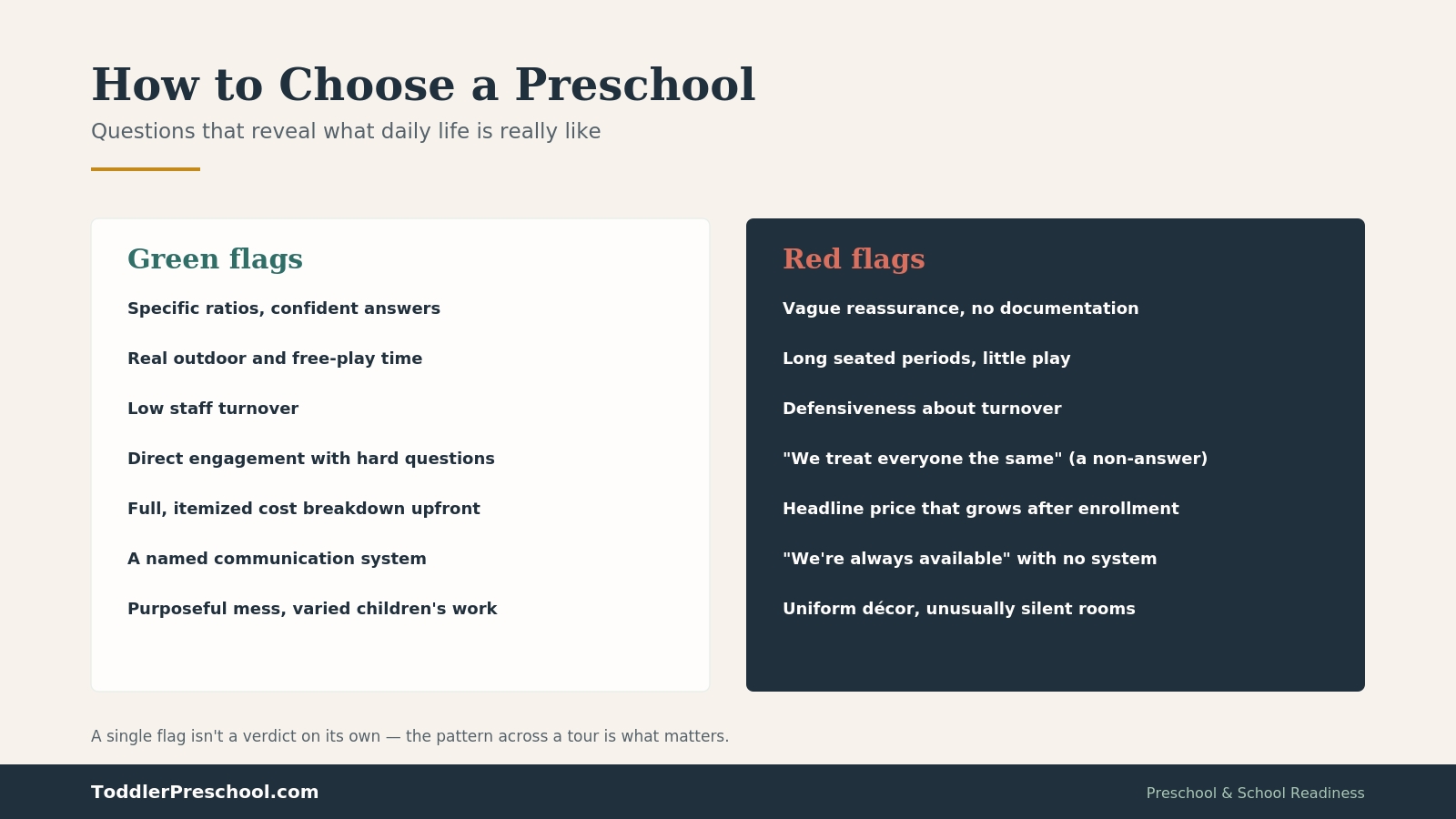
None of these signals are individually disqualifying or guaranteeing on their own — a single red flag is worth a direct follow-up question, not an automatic rejection, and a single green flag doesn’t mean you can skip asking about everything else. Used together, though, this is a quick-reference pattern for the kind of thing you’re watching for, category by category:
| Category | Green Flag | Red Flag |
|---|---|---|
| Safety | Specific ratios, confident staff answers, visible licensing | Vague reassurance, hesitation to show documentation |
| Daily structure | Varied schedule, real outdoor and free-play time | Long seated periods, academic acceleration as the main pitch |
| Staff | Low turnover, specific training examples | Defensiveness about turnover, no concrete training answer |
| Inclusion | Direct, thoughtful engagement with the question | Deflection, “we treat everyone the same” as a non-answer |
| Toileting | Clear policy stated without judgment, some flexibility discussed | Rigid cutoff with no willingness to discuss a close-but-not-there child |
| Cost | Full itemized answer upfront | Headline number that grows once you enroll |
| Communication | Named system, real response-time expectation | “We’re always available” with no actual system |
| Classroom feel | Purposeful mess, varied children’s work on walls | Uniform, adult-made décor; unusually silent rooms during active hours |
What Quality Preschool Programs Tend to Have in Common
Across all the specific questions above, a few broader patterns show up repeatedly in programs families end up genuinely happy with, worth watching for as a kind of composite picture rather than a separate checklist:
Specificity over polish. A program confident in its actual daily practice tends to answer questions with concrete detail — real examples, real numbers, a specific story — rather than smooth, generic reassurance. Polish in a brochure or a scripted tour doesn’t predict this; direct conversation does.
Consistency between what leadership says and what you observe. If the director describes a play-based philosophy but the classroom you actually walk through is dominated by seated worksheet time, that gap matters more than either data point alone. Programs where the tour and the pitch match each other closely tend to be more trustworthy sources of information generally.
Comfort with hard questions. How a program responds to a pointed question — about turnover, about a past incident, about cost surprises other families have mentioned online — often reveals more than the answer itself. Defensiveness is a different signal than a thoughtful, direct response, even when the underlying facts are similar.
Evidence of an actual relationship with current families. Ask if you can speak briefly with a current parent, or look for signs of an active parent community (a bulletin board, a newsletter, visible family photos or contributions in the space). Programs with genuine family engagement tend to have more channels for a concern to surface and get addressed before it becomes a real problem.
A specific plan for imperfection. No program handles every day flawlessly, and a program that can describe what happens when something goes wrong — a staffing gap, an incident, a miscommunication — rather than insisting nothing ever goes wrong, is generally more trustworthy about the other claims it makes too.
Warmth that’s visible, not just described. The programs families describe as genuinely good fits tend to have a specific, observable warmth — a teacher who remembers a small detail about a child, a calm redirect during a conflict, a genuine smile that isn’t performed for the tour — rather than warmth as a marketing adjective in a mission statement. This is exactly why an in-person visit, even a brief one, tends to reveal more than any written material a program sends you.
Common Obstacles When Choosing a Preschool
“We toured five places and I genuinely can’t decide.”
This is common, and it’s usually a sign that several options are each good in different ways rather than a sign you’re missing something. Go back to the comparison table above and ask which trade-offs matter most to your specific family this year — cost, commute, and communication style are often the deciding factors once safety and basic quality are confirmed across the board, more than any single “best” feature. If you’re still stuck after that, it’s reasonable to set a decision deadline for yourself — a week from now — and commit to choosing from your current top two by that date rather than continuing to gather information indefinitely.
“Our top choice has a waitlist.”
Ask directly how the waitlist works — ranked by application date, priority category, or another system — and how often spots actually open. It’s reasonable to enroll elsewhere for the interim while staying on a waitlist; most programs don’t penalize this, but confirm the specific policy rather than assuming. If the wait could plausibly extend beyond a semester, ask directly whether it’s realistic to expect a spot this program year at all, since some waitlists are genuinely more aspirational than actionable, and that’s useful to know before you decline other options while waiting.
“We found a program we love, but it’s not accredited the way I expected.”
Accreditation (commonly through NAEYC, the field’s most widely recognized program) is a genuine quality signal when present, but plenty of excellent programs — especially smaller, community-based, or religious-affiliated ones — are licensed but not formally accredited, sometimes for cost or administrative reasons unrelated to quality. Licensing (which is legally required) and accreditation (which is voluntary) are different things worth asking about separately; a licensed-but-not-accredited program isn’t automatically a lesser choice.
“My partner and I disagree about which program is right.”
Go through the comparison and red/green flag tables together and identify specifically where you diverge — often it’s not actually a disagreement about quality, but about which trade-off (cost versus commute, philosophy versus convenience) matters more to each of you. Naming the specific trade-off usually unlocks a decision faster than repeating general impressions back and forth.
“I have a bad feeling about a program that looked good on paper.”
Trust it enough to investigate further, even if you can’t immediately articulate why — ask a more specific follow-up question about whatever felt off, or schedule a second visit at a different time of day. A vague unease that persists after a second look is worth acting on; a program that checks every box on paper still has to feel right when you’re standing in the room.
“We can’t get a tour scheduled — the program isn’t responding, or says tours aren’t currently offered.”
A program that’s slow to respond to a straightforward enrollment inquiry, or unwilling to offer any kind of visit before you commit, is itself useful information, even before you’ve seen the classroom. It’s reasonable to give a program one clear follow-up attempt and then move down your list if there’s still no real response — a program that’s a good fit generally wants to make the process of choosing them easy, not difficult.
“Everything checks out on paper, but the cost is more than we budgeted for.”
Before ruling the program out entirely, ask directly and specifically about every financial assistance option covered above — CCDF subsidy eligibility, a sliding scale, a payment plan, a part-time schedule that lowers the total cost — since a program’s advertised full-time rate isn’t always the only real option available. If it genuinely isn’t workable after that conversation, it’s fine to say so plainly and move to the next program on your list rather than stretching a budget in a way that creates ongoing stress.
After You’ve Chosen: What Actually Happens Next
Enrollment typically involves paperwork (emergency contacts, immunization records, any relevant medical or educational plans), and many programs offer — or will arrange if you ask — a shorter visit or trial period before the official start date. If your child has an IEP, IFSP, or other documented plan, this is the point to schedule a specific meeting with the program’s point person, well before the first day, rather than assuming it will be handled automatically during general onboarding.
A few practical steps worth taking in the weeks between choosing and starting:
- Confirm the exact paperwork deadline and gather documents early — immunization records in particular sometimes take longer to obtain than families expect, especially if a well-child visit needs to happen first to complete them.
- Ask directly what the first day or first week typically looks like, so you can set realistic expectations at home rather than guessing.
- Share anything the program should know in writing, not just in conversation — allergies, comfort strategies, family language, a recent big change at home — since a written note is less likely to get lost than a passing comment at drop-off on a busy morning.
- Revisit your own routine at home — sleep schedule, morning timing — in the weeks leading up to the start date, since the logistics of the transition matter as much as which program you picked.
- Save your notes from the comparison process, even after you’ve decided — if a sibling starts a search of their own in a year or two, or if you ever do need to revisit the choice, you’ll have a real record instead of a fading memory of what mattered and why.
It’s also worth knowing that choosing a program isn’t necessarily a one-time, permanent decision. If something isn’t working after a genuine adjustment period — several weeks, not several days — it’s reasonable to revisit the choice, raise the specific concern directly with the program first, and consider a change if the concern doesn’t resolve. Choosing well the first time reduces how often this happens, but it doesn’t eliminate the possibility, and that’s a normal part of the process rather than a sign the original choice was a mistake.
Choosing for More Than One Child at Once
If you’re enrolling siblings or twins at the same time, ask specifically whether a program offers a sibling discount, whether siblings are placed in the same or different classrooms (policies and preferences vary), and how drop-off and pickup logistics work if children are in different rooms or different programs entirely. It’s also worth deciding explicitly whether you want siblings at the same program for logistical simplicity or are open to different programs if each child’s individual fit points a different direction — there’s no rule that siblings need to attend the same place, and sometimes the honest answer is that they don’t need the same environment to thrive.
Adapting How You Choose a Preschool to Every Family’s Situation
Multilingual families. Ask directly about a program’s experience and approach with multilingual learners, and whether any staff share your home language — this can meaningfully ease the first weeks, and strong programs treat a child’s home language as a foundation to build on, not an obstacle. If materials, enrollment paperwork, or family communication aren’t available in your preferred language, ask whether the program can provide translation or an interpreter — this is a reasonable request, not an imposition.
Disability and developmental variation. The “how to choose” process above applies fully to a child with a disability or developmental difference — the inclusion questions aren’t a separate track, they’re a core part of evaluating fit for any child, alongside input from your child’s Early Intervention team, therapists, or pediatrician. If your child is currently receiving Early Intervention services under an IFSP, factor the timeline for transitioning toward a preschool IEP into your overall search timeline, since that process has its own steps and deadlines separate from general enrollment.
Different family structures. Whoever handles day-to-day decisions for your child — a parent, grandparent, foster parent, or another primary caregiver — is the right person to lead this process and ask these questions, regardless of family structure; in shared-custody situations, confirm directly how a program handles communication and pickup authorization across two households, since assumptions here vary by program and are worth settling before enrollment rather than discovering mid-year.
Budget. Cost assistance exists at federal, state, and local levels (Head Start, state pre-K, CCDF subsidies, sliding-scale nonprofit and co-op programs), and it’s worth actively researching eligibility rather than assuming your family doesn’t qualify — rules and thresholds shift from year to year, and a “no” from one program’s specific funding source doesn’t mean no assistance exists anywhere.
Schedule and access to care. A program’s fit with your actual work hours, transportation, and caregiving situation is as much a “choosing well” factor as anything else in this guide — the theoretically best program is the wrong choice if your family can’t reliably get to and from it. If your schedule is irregular or unpredictable, ask directly how a program handles that before assuming a rigid-looking policy is actually rigid in practice.
Frequently Asked Questions About Choosing a Preschool
How far in advance should we start this process? Popular programs, especially ones with waitlists or state pre-K with enrollment windows, often benefit from starting six months to a year ahead where possible, but plenty of families successfully find a good fit on a much shorter timeline — start now with whatever runway you actually have rather than assuming you’ve missed the window.
Is it bad to switch preschools if we choose wrong? No — a switch, while disruptive for a few weeks, is a completely reasonable correction if a program genuinely isn’t working, and most children adapt to a new setting faster than parents expect, especially with some warning and a calm explanation of what’s changing.
Should I trust online reviews when researching how to choose a preschool? Treat them as one data point, not the deciding factor — a handful of extreme reviews (very positive or very negative) often reflect an unusual individual experience more than the program’s typical daily reality. A tour and direct questions tell you far more than a star rating.
What if the “right” answer to a question above isn’t available anywhere near us? Prioritize the factors that matter most for your specific child and circumstances rather than expecting every green flag at once — a program that’s strong on safety and communication but weaker on extras is a reasonable choice; no real-world program will be perfect on every dimension in this guide.
Should both parents or caregivers attend every tour? It’s not required, but it genuinely helps for at least the top one or two choices, since two people often notice different things and a shared firsthand impression tends to resolve disagreements faster than one person relaying secondhand notes. If a joint visit isn’t logistically possible, a phone call afterward to walk through specific impressions together, rather than just a summary verdict, captures more of the same value.
Is it worth paying more for a “prestigious” or highly sought-after program? Not automatically — as covered throughout this guide, program quality is mostly about the concrete, checkable factors above (safety, communication, inclusion, teacher stability, genuine play-based practice), not reputation or exclusivity. A sought-after program is sometimes genuinely excellent and sometimes simply well-marketed; the questions in this guide work the same way regardless of a program’s reputation, and it’s worth asking them even of a program everyone says is “the best one.”
How much should a single bad tour experience weigh in the decision? Consider the context — a single off day (an unusually chaotic morning, a substitute staff member filling in) is less meaningful than a pattern, and it’s reasonable to ask for a second visit if your first impression felt like it might not represent the program’s normal reality. A program’s willingness to offer that second look, without pushback, is itself a small positive signal.
Do I need to choose a program with a specific educational philosophy (Montessori, Reggio, play-based) to make a good choice? No — a named philosophy can be a helpful shorthand for what to expect, but the concrete questions throughout this guide (safety, communication, genuine play-based daily structure, staff stability) matter more than which branded approach a program markets itself under. A program without a specific named philosophy that scores well on the practical questions above is a completely reasonable choice.
Your One Next Step
Pick one question from the “Questions That Reveal What Daily Life Is Really Like” section above that you haven’t actually asked yet, and call or email one program on your list this week to ask it directly. If you’re not yet at the tour stage, your one next step is simpler still: write down your family’s non-negotiable logistics — commute radius, budget ceiling, schedule — before you look at a single program website, so nothing you fall for on paper can quietly override a constraint that actually matters.
Sources consulted: Office of Head Start — Head Start Early Learning Outcomes Framework and the Head Start Approach to School Readiness; general preschool-evaluation guidance compiled from multiple parenting, pediatric, and early-childhood program resources current as of the research date.