

Your child was fine at drop-off back in May — a quick hug, maybe a wave, and off they went. Now preschool drop off after summer is about to start back up, and the thought of it is already making you brace for tears, or the actual first morning back has already happened and it went worse than you expected. Either way, you’re not imagining it, and you didn’t do anything wrong.
Here’s the direct answer: preschool drop off after summer is genuinely harder for a lot of children, even ones who were completely comfortable with it before break, and it typically takes about two weeks of a consistent, low-key routine to get back to where things were. This isn’t a sign of a new problem or a step backward in your child’s development — it’s a predictable, well-documented pattern tied to how trust and daily habit work, and this guide gives you both the lead-up plan for the weeks before your child goes back and a concrete, day-by-day two-week plan for the return itself.
If you’re reading this a week before drop-off resumes, use the final-stretch checklist and the two-week plan directly. If you have more runway, the 60-day lead-in below gives you a gentler on-ramp — either way, nothing here requires elaborate preparation, just consistency applied at the right moments.
Why Drop-Off Gets Hard Again After Summer
The Habit of “You Always Come Back” Gets Interrupted
A child’s comfort with separation isn’t a fixed trait — it’s closer to a habit built through repetition. Across a school year, a child experiences “goodbye, then reunion” enough times that it becomes background knowledge: the leaving part stops feeling scary because the coming-back part has happened reliably, over and over. A summer break — even a short one, and even one spent happily with family — interrupts that repetition. By the time preschool drop off after summer rolls back around, the daily proof that “leaving means coming back” hasn’t happened in weeks, and for a lot of children, the old worry resurfaces right along with it.
It’s Not Just About Missing You
Summer also changes the practical shape of a child’s days — different wake times, different company, often more one-on-one adult attention than a classroom of peers provides. Preschool drop off after summer isn’t only a reunion with separation anxiety; it’s also a reunion with sharing attention, following a group schedule, and being somewhere that isn’t home. Several adjustments are happening at once, which is part of why the first week or two can feel more intense than a family expects from “just” a drop-off issue.
This Can Happen Even to Kids Who Seemed Fully Past It
One of the more surprising patterns parents run into: a child who hadn’t cried at drop-off in months, and seemed to have separation anxiety fully behind them, cries again after a break — sometimes just as hard as their very first week of preschool. According to guidance from the American Academy of Child and Adolescent Psychiatry, typical separation distress can resurface during transitions well past the age it first appeared, and returning after a break is exactly the kind of transition that tends to bring it back. This is common enough that it shouldn’t be read as a sign anything is wrong with your child or your relationship — it’s a predictable response to an interrupted routine, not a regression in character.
The First Time Is Usually the Hardest, But Not Always the Only Time
If this is your child’s first-ever experience with a break-and-return cycle, the intensity can feel alarming precisely because you have nothing to compare it to. It’s worth knowing that many families find each subsequent break-and-return gets a little easier as the pattern itself becomes familiar — not because the separation feeling disappears, but because your child (and you) build a track record with the reset process itself, the same way the daily “goodbye, then reunion” pattern builds trust within a school year. That said, some children have a harder reset after every break regardless of how many they’ve been through, and that’s also within the range of normal — temperament plays as much of a role here as experience does.
What This Isn’t
Not every difficult morning after a break is “just” the summer reset effect, and it’s worth naming what else could be going on so you’re not stretching one explanation to cover everything: a genuine illness, a stressful change at home, a new fear unrelated to school, or (far less commonly) a persistent anxiety pattern that goes beyond typical separation distress. If drop-off distress doesn’t meaningfully ease over the two-week window this guide describes, or comes with other signs described later in this guide, that’s worth a closer look rather than more of the same wait-and-see approach.
The 60-Day Lead-In Before Preschool Drop-Off After Summer
A two-week reset plan works better when it’s not starting completely cold. Here’s what to do in the roughly two months before your child heads back.
60 to 30 Days Out: Observe and Plan
This window is mostly quiet. Notice your child’s current summer rhythm — sleep schedule, general mood, how they’ve been handling any separations over the summer (a sitter, a grandparent’s house, a camp) — without changing anything yet. Pay particular attention to how your child has handled any brief separations that did happen over the summer; a child who cried hard at a single sitter drop-off in July is giving you a reasonable preview of what the first day back might look like, which is useful information, not something to feel discouraged by this far out.
This is also the time to confirm any paperwork your program needs refreshed after a long break: updated emergency contacts, current immunization records, and any medical or allergy information that may have changed over the summer. If your child had any kind of evaluation, new diagnosis, or change in support needs over the summer, this window is also the right time to start that conversation with the program directly, well before the logistics of the first day are competing for everyone’s attention.
30 to 14 Days Out: Start Talking About It, Lightly
Begin mentioning preschool again in simple, positive terms — not constantly, which can build anticipatory worry, but naturally, woven into conversation. “In a few weeks you’ll see Ms. Rivera and your friends again” works better than a big, dramatic countdown. If your child attended a genuinely different program or is moving to a new classroom or teacher within the same program, this is also the window for a preview visit if the program offers one.
14 to 1 Days Out: Rehearse the Actual Morning
In the final two weeks before drop-off starts again, begin shifting bedtime and wake time gradually back toward the school-year schedule, and start running the real morning sequence — same wake-up window, same breakfast routine, same clothes-on process — even on days with nowhere to go. This single step does more to make the first actual morning back feel familiar than almost anything else on this list.
In the Final Week: What to Double-Check Closer to the Actual Return Date
A few things are worth reconfirming specifically in the last several days, since they’re the kind of detail that changes over a long break or gets communicated once, over the summer, and easily forgotten:
- Re-read any start-of-year communication your program sent over the summer — schedule changes, a new teacher assignment, updated drop-off procedures, or a revised supply list are all common enough to have been announced months in advance and then forgotten by the actual first day.
- Check the weather-appropriate clothing situation. A summer wardrobe may not match what a program’s outdoor time or air-conditioning level actually requires; a light layer in the bag solves most of this without much effort.
- Confirm your own work schedule or coverage plan for the first week or two specifically, since this is the stretch most likely to include a harder-than-usual morning, and having a small buffer of flexibility (even ten extra minutes) makes those mornings meaningfully easier to handle calmly.
- Reconnect with your child’s teacher briefly before day one if possible — a short email or a message through whatever system your program uses, mentioning that you’re aware drop-off might be rough this week, opens the door for the partnership described later in this guide before you even need it.
The Two-Week Reset Plan for Preschool Drop-Off After Summer
This is the core of the plan: what to actually do across the first two weeks back, day by day, once preschool drop off after summer has actually started.
The Night Before Day One
Lay out clothes, pack whatever the program needs, and keep the evening calm and predictable rather than making a big deal out of “tomorrow’s the big day,” which can build more anxiety than it resolves. A short, simple mention of the plan — “tomorrow you’ll go back to see Ms. Rivera, and I’ll pick you up after lunch” — said once, calmly, is enough.
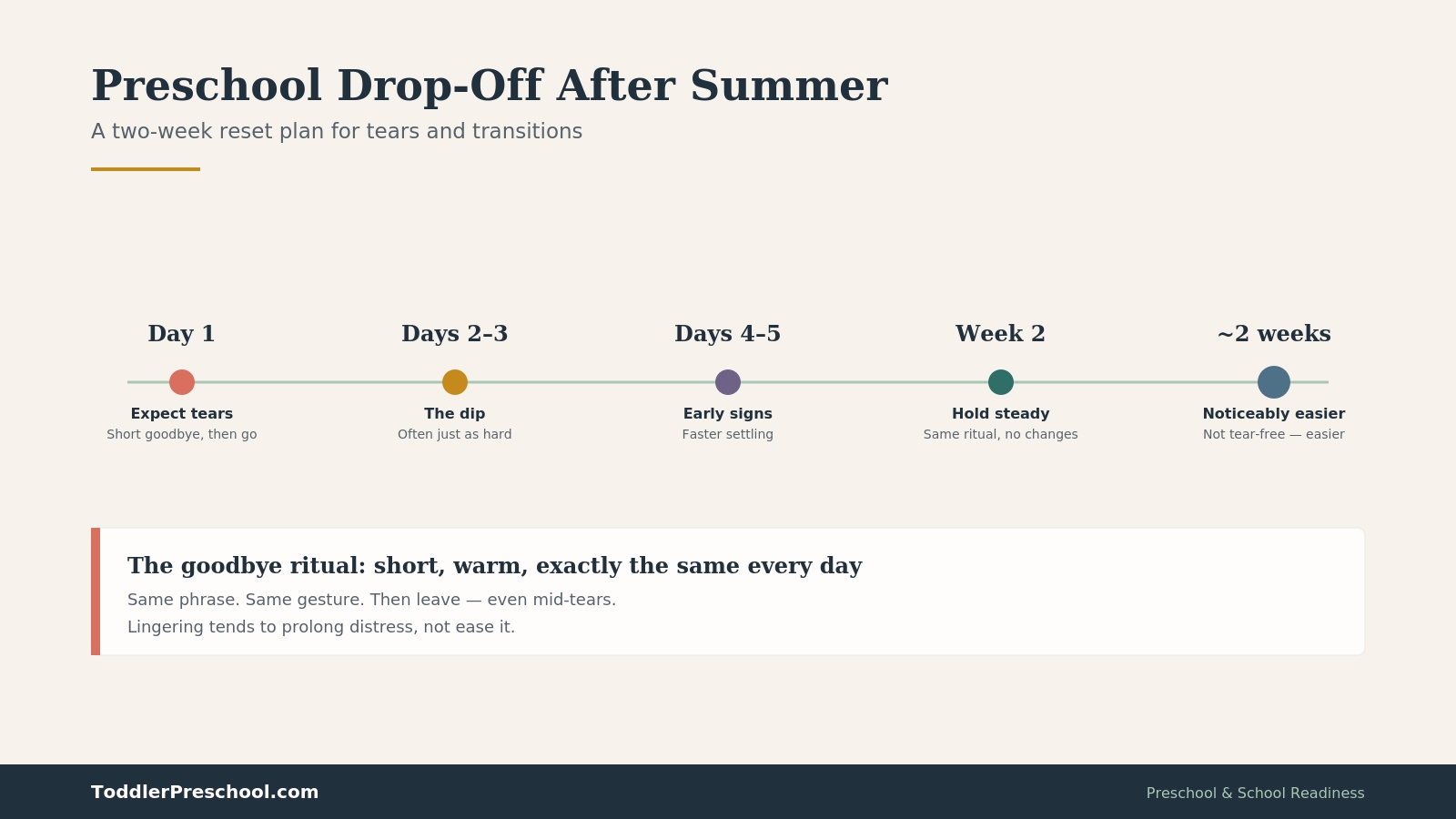
Day 1: Expect It to Be Hard, and Keep the Goodbye Short
Go in expecting some tears, even from a child who was previously completely fine with drop-off — this is the single most useful thing to mentally prepare for, since a parent who expects smooth sailing and gets tears instead tends to linger, which usually makes things harder, not easier. Use the short, consistent goodbye ritual described below, say it once, and leave — even if your child is crying behind you. It is common for children to stop crying within a few minutes of a parent leaving, even when the goodbye itself was rough. Build in a few extra minutes on this particular morning so a hard goodbye doesn’t turn into a rushed, stressed one on top of everything else.
Days 2 to 3: The Predictable Dip
It’s common for day two or three to be just as hard as day one, or even a little harder, before things start easing — the routine hasn’t built back up yet, and a child who cried but “survived” day one hasn’t necessarily connected that experience to feeling more confident yet. Keep the exact same goodbye ritual and morning routine both days; consistency, not variety, is what builds the habit back. This is also a common point where a parent starts to worry the plan isn’t working — it usually is, it just hasn’t accumulated enough repetitions yet to show results.
A note on where the two-week figure comes from: it’s not an exact, individually guaranteed number for every child, but it reflects a pattern widely observed by early-childhood educators and reported across pediatric and parenting resources — most children who experience separation distress at the start of a school year, or after a break, show meaningful improvement within roughly two weeks of a consistent routine. Some children settle faster; a smaller number take a bit longer. Treat two weeks as a reasonable planning horizon and a checkpoint for taking stock, not a deadline your child needs to hit.
Days 4 to 5 (End of Week One): Watching for the Turn
By the end of the first week, many children start showing early signs of easing — settling faster after you leave, a shorter cry, or less resistance getting in the door, even if the goodbye itself is still difficult. This isn’t universal on this exact timeline, and that’s fine; the point of noticing it isn’t to grade your child’s progress, it’s to give you a realistic sense of whether the pattern is moving in the right direction at all, which is the actual thing worth tracking. If Friday of the first week still looks identical to Monday, that’s not yet a red flag on its own — the two-week window is the meaningful benchmark, not the one-week mark.
Week Two, Days 6 to 8: Holding the Routine Steady
Keep everything the same — same wake time, same goodbye phrase, same morning sequence — even if the previous few days felt discouraging. This is the stretch where consistency pays off most, and it’s also a common point for a parent to want to change something (a new bribe, a longer goodbye, a different tactic) out of frustration; resist that urge unless something is clearly not working at all, since switching strategies mid-reset often resets the clock rather than speeding things up.
Week Two, Days 9 to 10: Taking Stock
By the end of the second week, most children have noticeably eased, even if drop-off isn’t perfectly smooth yet — “noticeably easier” is a realistic goal here, not “completely tear-free.” This is a reasonable point to check in with your child’s teacher about what they’re observing once you’ve left (often more reassuring than what you see in the doorway), and to honestly assess whether you’re seeing real, if gradual, improvement or a pattern that genuinely isn’t shifting at all.
The Two-Week Plan at a Glance
| Day | Focus | What to Expect |
|---|---|---|
| Night before | Calm, predictable evening | Lay out clothes, one simple mention of the plan, no big buildup |
| Day 1 | The first goodbye | Expect tears even from a previously easy child; short ritual, then leave |
| Days 2–3 | The predictable dip | Often just as hard, or harder, than Day 1 — stay consistent |
| Days 4–5 | Early signs of easing | Watch for faster settling, not necessarily a tear-free morning |
| Days 6–8 | Hold steady | Resist the urge to change the approach out of frustration |
| Days 9–10 | Take stock | Check in with the teacher; assess real, gradual progress |
| Ongoing | Maintenance | Keep the same ritual even after things feel easier — it’s still doing the work |
The Drop-Off Ritual After Summer: Short, Warm, and Exactly the Same Every Day
A short, predictable goodbye is one of the most consistently effective tools for easing preschool drop off after summer, and it works precisely because it’s boring and repeatable, not because it’s elaborate. A useful structure: a specific phrase (“hugs, then I’ll see you after snack”), a specific physical gesture (a particular hug or a hand signal), and then a calm, confident exit — every single day, in that order, without variation. Lingering for extra reassurance, sneaking out without saying goodbye, or changing the ritual day to day all tend to prolong distress rather than ease it, since each of those signals — in a different way — that leaving is something to be uncertain about.
What to Say to Your Child, Before and During the Reset
A few days ahead, explaining the return: “In a few days, you’re going back to see Ms. Rivera and your friends. We had a fun summer, and now it’s time for preschool again. I’ll always come back to get you.”
The morning of, before you leave the house: “Today’s a preschool day. After I drop you off, I’ll come back after lunch, just like always.”
At the actual goodbye: Keep it to your established short phrase — “Hugs, then I’ll see you after snack. Have a good day.” Said the same way, every day.
If your child asks why they have to go back: A brief, honest answer beats a long justification: “This is where you learn and play with your friends. I always come back.” Repetition builds trust here more than explanation does.
If your child cries and you have to leave anyway: “I see you’re sad. I’ll be back after lunch. I love you.” Then go — validating the feeling without staying to fix it in the moment is more helpful than it feels in the moment.
For a younger or less verbal preschooler, keep every script above shorter and more concrete — clock times and abstract explanations mean less than a familiar reference point (“after snack,” “after nap”) and a simple, repeated phrase. A younger child generally needs fewer words and more repetition of the exact same short phrase, not a more detailed explanation.
For an older, more verbal preschooler who wants to understand more, a bit more explanation is fine to offer once, without over-explaining daily: “Summer was different because we were together more. Now it’s a school routine again, and that can feel like a big change even when nothing’s wrong.” Following that with the same short goodbye phrase each day still matters more than the explanation itself.
A Comfort Item, If Your Program Allows One
A small transitional object — a family photo tucked in a pocket, a tiny stuffed animal, a parent’s item your child can hold — can genuinely help some children bridge the gap between home and the classroom during a hard reset, giving them something concrete to hold onto (literally) when the reassurance of your presence isn’t there. This isn’t necessary for every child, and plenty of children do fine without one. Check with your program first, since policies on outside comfort items vary — some allow a small item kept in a cubby or backpack rather than carried around the classroom, which is often a workable middle ground. If your child doesn’t take to a comfort item or loses interest in it quickly, that’s not a sign anything went wrong; it’s simply not every child’s preferred coping tool, and the consistent goodbye ritual described below does most of the actual work regardless.
Working With the Teacher: What to Share and What to Ask
Your child’s teacher is a genuine partner in this reset, not just someone managing the morning handoff. Before or during the first week back, it’s worth sharing specifically what your child’s summer was like (a lot of one-on-one time, a change in household, travel, a new sibling, anything that might color the adjustment), and asking directly how drop-off tends to go once you’ve left — most children settle faster than the doorway goodbye would suggest, and hearing that from staff is often more reassuring than what you personally witness. It’s also reasonable to ask whether the teacher noticed this pattern with other returning children this week, since a shared, expected pattern across the classroom is useful context, not just information about your child specifically.
Programs that follow frameworks like Head Start’s Early Learning Outcomes Framework are generally trained to expect and support exactly this kind of transition as a normal part of social-emotional development, not as a disruption to manage around — a good teacher has seen this pattern many times before and typically has their own calm, practiced approach to the first couple of weeks, which is worth asking about directly rather than assuming you’re the only family dealing with it.
Safety and Practical Refreshers Before Day One
A break of several weeks or months is a reasonable prompt to refresh a few practical details rather than assume everything from last year still applies:
- Confirm pickup authorization is current — anyone newly authorized (or no longer authorized) to pick up your child should be updated with the program directly, not assumed to carry over.
- Update emergency contacts and any medical information, including allergy details or medication needs that may have changed over the summer.
- Check that any car seat or booster your program’s carpool or transportation uses still fits — car seat needs can change faster than parents expect over a summer growth spurt.
- Reconfirm the specific drop-off and pickup procedure, especially if staff, entrances, or sign-in systems changed over the break.
- Check that labeled belongings are actually re-labeled if your child grew out of last year’s water bottle, jacket, or backpack over the summer — a fresh set of unlabeled items is an easy thing to send in without thinking on a rushed first morning.
- If your child takes any medication at the program, confirm the current supply and paperwork are up to date, since a summer without a school-day dosing routine is a common point for this to lapse without anyone noticing until it’s needed.
Resetting the Physical Side Too: Sleep, Toileting, and Meals
Drop-off tears are often worse when a child is also tired, hungry, or dealing with a toileting regression — all three are common after a summer with a looser schedule, and all three make an already-emotional morning harder than it needs to be.
Sleep. If bedtime drifted later over the summer, shift it back gradually — 10 to 15 minutes earlier every few days — rather than all at once the night before drop-off resumes; an overtired child has less capacity to handle the emotional part of the morning.
Toileting. It’s common, and not a sign of failure, for a previously reliable toileting routine to include more accidents during a stressful transition like this one — the stress of the change, not a loss of the underlying skill, is usually the driver, and it typically resolves within a couple of weeks as the routine settles, same as the drop-off tears themselves.
Meals. A rushed or skipped breakfast makes for a harder goodbye. If mornings are tight during the reset window, a simple, repeatable breakfast your child reliably eats — even a portable option eaten in the car — is worth prioritizing over a more elaborate breakfast that adds stress to an already emotional morning. It’s also common for appetite to dip during an emotionally taxing stretch; a smaller-than-usual breakfast for a few days isn’t cause for concern on its own.
Illness exposure. It’s also worth a heads-up that many children get sick more often in the first several weeks back after any break in group care, simply from renewed exposure to viruses circulating in a classroom after time away — this is a normal, if inconvenient, part of returning to a group setting and isn’t related to the emotional reset, though a genuinely under-the-weather child will understandably have a harder drop-off on top of everything else. Keeping basic sick-day supplies on hand during this window saves a scramble later.
What About Pickup and the Rest of the Day?
Drop-off gets most of the attention, but “tears and transitions” often shows up at the other end of the day too. Many parents are caught off guard by how hard the after-pickup hour can be during this same reset window — a child who was reportedly fine at school falls apart within minutes of seeing you again, with more whining, more clinginess, or a meltdown over something minor. This is a common pattern during any big adjustment, not a sign the day actually went badly; many children hold themselves together through a structured day and release the accumulated effort once they’re back with the person they trust most. A predictable, low-demand transition right after pickup — a snack, a few minutes of quiet connection before asking anything of your child, narrating the plan out loud — tends to soften this considerably during the reset window, the same way the goodbye ritual softens the morning.
Does the Reset Restart Every Weekend?
A reasonable and common worry: does taking a weekend off reset the whole two-week clock? Generally, no — a typical two-day weekend doesn’t function like the longer summer break that triggered the original reset, and most children don’t lose the ground gained during the school week over a single weekend. That said, it’s worth keeping weekend mornings roughly consistent with the school-week wake time during the reset specifically (within an hour or so), since a wildly different weekend rhythm can make Monday’s return feel like starting over in a way that a closer-to-consistent weekend doesn’t.
When Preschool Drop-Off After Summer Is More Than a Normal Reset
Most preschool drop off after summer distress eases meaningfully within the two-week window described above. It’s worth a conversation with your child’s teacher or pediatrician — not urgently, but genuinely — if:
- Distress isn’t easing at all after two to three full weeks of a consistent routine.
- Your child shows new physical symptoms alongside the distress (stomachaches, sleep disruption, appetite changes) that persist on non-school days too.
- Your child seems fearful of a specific person or situation, rather than generally anxious about separation.
- The distress is paired with a lost skill your child previously had — not just occasional accidents, but a broader pattern of losing several previously solid skills at once.
None of this necessarily means something is wrong. It means a further conversation is a reasonable next step, not an overreaction — and your pediatrician can help distinguish typical, transition-related separation distress from something that would benefit from additional support. According to guidance from the American Academy of Child and Adolescent Psychiatry, a genuine separation anxiety disorder is relatively uncommon and involves persistent, excessive distress well beyond what a normal transition produces — most preschool drop off after summer distress, even when it feels intense in the moment, falls well short of that threshold and resolves with time and consistency alone.
Common Obstacles With Preschool Drop-Off After Summer
“My child is fine at pickup and at home, but drop-off itself never gets easier.”
This is one of the more common and, in context, reassuring patterns — many children settle quickly once out of sight while the goodbye moment itself stays hard for longer. Trust your teacher’s report about what happens after you leave more than your own read of the doorway moment, while still watching for the drop-off itself to gradually ease over the two-week window described above.
“We’re not just returning — my child also has a new teacher or classroom this year.”
A double transition (returning after a break and adjusting to a new teacher or room) reasonably takes a bit longer to settle than a straightforward return to the exact same setup. The same two-week plan still applies; just hold your expectations a little looser about the timeline, and mention the double transition directly to the new teacher so they have context for what they’re seeing.
“My work schedule makes it hard to stay calm and unhurried at drop-off.”
A rushed morning genuinely makes drop-off harder for both of you, and it’s worth being honest with yourself about whether the actual bottleneck is time or emotional bandwidth. If mornings are tight, the single highest-value change is protecting extra time specifically around the goodbye itself — even if that means everything else about the morning stays rushed, a calm, unhurried final two minutes tends to matter more than a calm hour before it.
“My other child (a sibling) is having a hard time too, and I can’t be fully present for both.”
Whoever is available narrates and reassures briefly for each child in turn rather than trying to manage a joint, simultaneous goodbye — a short, individual moment with each child, even 30 seconds, tends to work better than a rushed group goodbye where neither child gets a clear, calm ending. If two caregivers are available some mornings, splitting up (one per child) removes this bottleneck entirely.
“It’s been more than two weeks and nothing has changed.”
This is exactly the situation described in the “When It’s More Than a Normal Reset” section below — a pattern that genuinely isn’t shifting after a full two to three weeks of real consistency is worth a conversation with your child’s teacher or pediatrician, not more of the same approach indefinitely.
Adapting This to Every Family’s Situation
Multilingual families. The goodbye phrase and daily conversation described above work in any language your family speaks at home — there’s no need to switch to English for this ritual to work, and consistency in your child’s most comfortable language may help more than translating it. If your child is also navigating a program where a different language is spoken, mention to the teacher which words your child uses at home for common needs (bathroom, hungry, tired, hurt), since that small bit of shared vocabulary can meaningfully ease the reset on top of the goodbye ritual itself.
Disability and developmental variation. For a child with a disability or sensory sensitivities, the same reset structure applies, adapted with input from your child’s therapists or IEP/IFSP team — a longer or more gradual reset timeline, or a different specific ritual, is a reasonable individualized adjustment, not a sign the general approach doesn’t apply. If sensory factors make a hug-based goodbye overwhelming rather than comforting, a different consistent physical gesture (a specific handshake, a fist bump, a wave through the window) can serve the same function.
Different family structures. Whoever handles drop-off — a parent, grandparent, or another caregiver — should use the same consistent goodbye ritual and phrase, and it’s worth briefly aligning on the exact wording across multiple caregivers if drop-off duty rotates, since a child benefits from the ritual staying the same regardless of who’s doing it that day. In shared-custody situations specifically, it’s worth a brief, low-drama conversation with a co-parent about using the same phrase and approach across both households during the reset window, since consistency across households tends to matter as much as consistency within one.
Siblings on different timelines. If you have more than one child returning after summer — at the same program or different ones — expect each child’s reset to potentially look completely different from the other’s, even with the same parents and the same general approach; one child’s easy return doesn’t predict the other’s, and that’s not a sign you’re doing anything differently right or wrong between them.
Budget and schedule. Nothing in this reset plan requires spending money or a schedule change — the entire approach is built from consistency and a repeatable few-word phrase, which costs nothing and fits into whatever morning routine your family already has.
Frequently Asked Questions
Our break was only a week or two — is this reset plan really necessary? A shorter break is genuinely less likely to trigger a full reset, and plenty of children sail through a short break with no drop-off disruption at all. If you don’t see any distress, there’s no need to apply this plan preemptively — use it if and when tears actually show up, not as a precaution for a child who’s clearly fine.
My child didn’t have separation anxiety before, so why now? This is one of the most common and confusing patterns for parents — a child can be genuinely past drop-off distress and still have it resurface after a break, for the reasons explained above. It’s a response to the interrupted routine, not a step backward in your child’s overall development or a sign the original progress wasn’t real.
Is it better to ease back in with a shorter first week, or go straight to the full schedule? Both approaches work, and it depends on what your program allows and your family’s flexibility — a gradually lengthening first week can soften the adjustment for some children, while others do just as well jumping straight into the normal schedule, since the routine itself (not just the hours) is part of what rebuilds comfort. If your program offers a phased return, it’s a reasonable option to consider, not a requirement.
What if the teacher says my child is fine within minutes, but drop-off itself never gets easier? This is actually one of the more common and, in context, reassuring patterns — many children settle quickly once you’re out of sight even while the goodbye moment itself stays hard for a while longer. Trust the teacher’s report about what happens after you leave more than your own read of the doorway moment, while still watching for the drop-off itself to gradually ease over the two-week window.
Should I stay a few extra minutes on the hard mornings to help my child calm down first? It’s tempting, but a short, consistent goodbye generally works better than a longer one, even on the hardest mornings — lingering tends to signal that leaving is something worth being uncertain about, which can prolong the distress rather than ease it. If a longer goodbye feels necessary on a specific rough day, that’s a reasonable one-time call, but returning to the short ritual the next day matters more than any single morning’s approach.
Does it matter whether the same parent does drop-off every day during the reset, or can it rotate between caregivers? The consistency that matters most is the ritual itself — the same phrase, the same gesture — not necessarily the same person delivering it. If drop-off rotates between caregivers, aligning on the exact same short goodbye phrase and approach across everyone involved matters more than having one dedicated person do it every day.
Your One Next Step
Pick your exact goodbye phrase and gesture now, before the first morning back, and commit to using precisely the same one every single day for the next two weeks — the consistency matters more than the specific words you choose. If drop-off has already started and this week has already been rough, that’s fine too: start the exact-same-phrase habit today rather than waiting for a cleaner starting point that doesn’t need to exist.
Sources consulted: Office of Head Start — Head Start Early Learning Outcomes Framework; American Academy of Child and Adolescent Psychiatry guidance on typical separation distress versus separation anxiety disorder, as cited across multiple current parenting and pediatric resources.