
The leaves haven’t even turned yet, and you’re already seeing pumpkin patch signs and orchard reservation links everywhere. You’re searching for fall preschool activities because you want the season to feel fun, not like one long scramble to catch up.
Here’s the direct answer. Fall preschool activities work best with a little lead time. A rough plan by early September. Specific outings booked before they sell out. A small set of easy at-home activities ready for the days you don’t have anything planned. This guide gives you a real 60-day timeline, honest outing logistics, and a core set of activities you can actually pull off.
You don’t need a themed unit or a packed weekend schedule to make this season feel full. A little planning now buys you a much more relaxed October later.
The Direct Answer: A Simple Fall Preschool Activities Plan
Pick a small handful of outings worth planning ahead, like an orchard trip or a pumpkin patch visit. Keep a few easy at-home activities in your back pocket for ordinary days. Build in room for a bad-weather day or a day your preschooler just isn’t up for it.
None of this requires a full themed unit or a packed weekend schedule. A realistic plan beats an ambitious one that falls apart by week two.
Why Planning Ahead Helps With Fall Preschool Activities
Young children can be sensitive to changes in sleep, food, travel, noise, and unfamiliar routines. Fall brings a lot of these changes at once. Earlier darkness, a new school routine settling in, and often several new experiences packed into a short window.
A little preparation ahead of time reduces how many of these changes hit all at once. This isn’t about elaborate planning. It’s about deciding the big pieces early enough that the season doesn’t feel rushed.
This matters more for fall specifically than for many other seasons, simply because so much happens in a compressed six to eight week window between Labor Day and Halloween. Spring and summer stretch out over months; fall, by contrast, packs its biggest moments into a short, busy stretch.
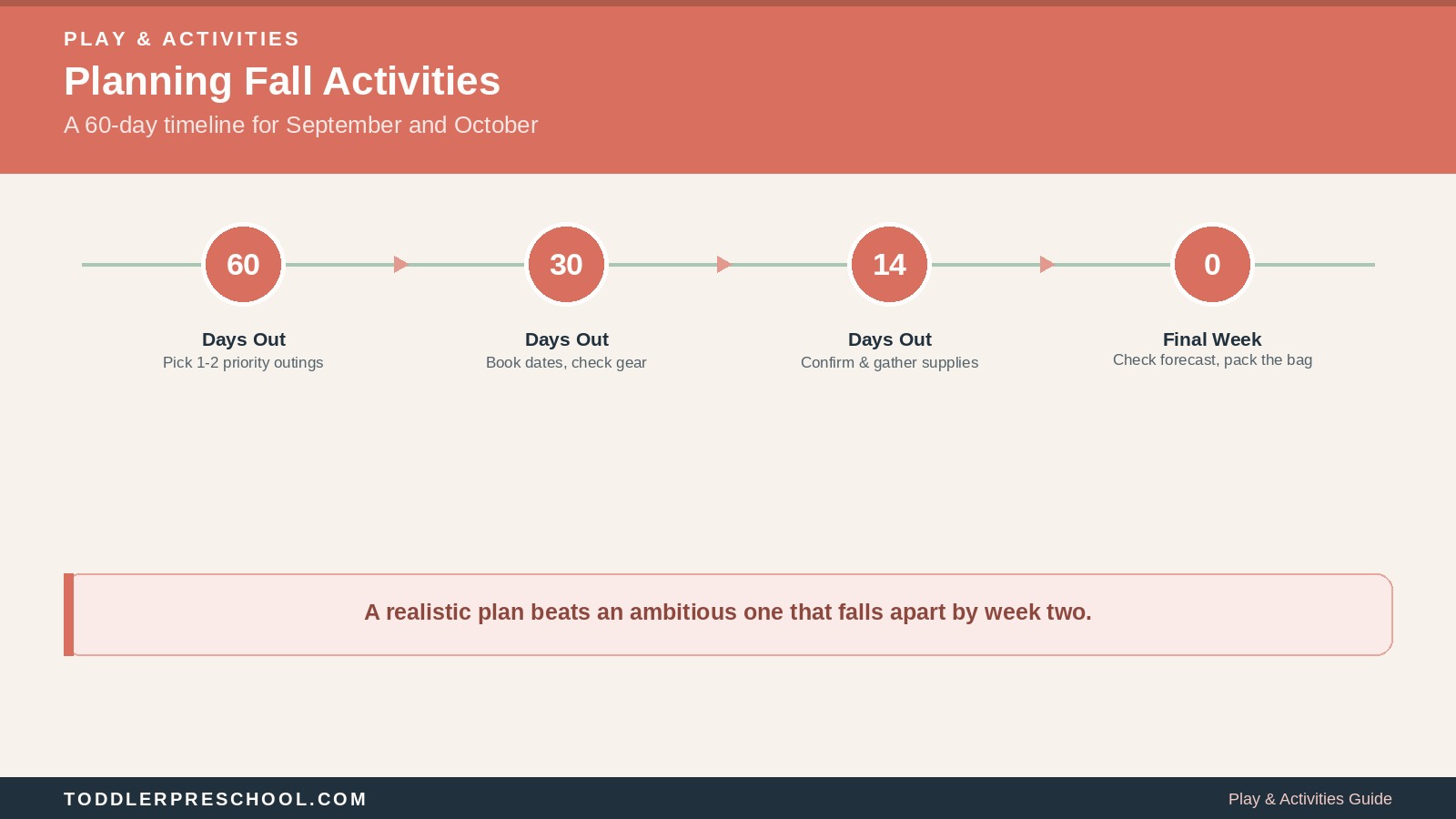
The 60-Day Lead Timeline for Fall Preschool Activities
Working backward from the heart of fall, roughly mid-to-late October, gives you a realistic planning window.
60 Days Out: The Big Picture Decisions
About 60 days before the peak of fall, decide which outings actually matter to your family this year. Not everything needs to happen. Pick one or two genuine priorities, like an orchard visit or a pumpkin patch trip, rather than trying to fit in every possible fall activity.
This is also the point to check whether a specific outing needs a reservation. Many popular orchards and pumpkin patches now require advance booking, especially for weekend slots.
This early window is also a good time to have a brief family conversation about expectations. If one adult is picturing an elaborate weekend and another is picturing something low key, sorting that out now avoids friction later.
30 Days Out: Locking In Specifics
About a month out, book the actual date and time for your priority outings. Weekday mornings are almost always less crowded than weekend afternoons, worth considering if your schedule allows any flexibility.
This is also a reasonable point to check your preschooler’s fall wardrobe needs, covered in more detail later in this guide. That way, you’re not scrambling for a jacket the morning of an outing.
This is roughly the halfway mark of your planning window. It’s a natural point to check that the one or two priorities you picked at 60 days are still actually right for your family this year.
14 Days Out: Logistics and Gear
About two weeks before an outing, confirm the actual reservation or plan details. Check the specific weather pattern for your region around that date, and adjust clothing plans accordingly.
This is also a good time to gather any at-home activity supplies you’ll want on hand, covered later in this guide. A rainy day won’t catch you without materials this way.
If your outing includes food, like apple picking followed by baking, plan the specific recipe now. Figuring it out the same day, when you’re tired from the outing itself, rarely works as well.
Final Week: Last-Minute Checks
In the final week before a planned outing, check the actual forecast rather than the general seasonal pattern. Confirm hours, since some farms and orchards adjust their schedule based on how the harvest is going that specific year.
Pack a simple bag the night before. Water, a snack, layers, and anything specific to your child’s needs, so the morning feels calm rather than rushed.
A quick check of your own energy level matters here too. If the week has been genuinely exhausting, consider a simpler version of the plan. Pushing through an ambitious outing on empty rarely goes well.
The Week Of: Staying Flexible
Hold your plan loosely in the final days. If your preschooler is having an off week, a planned outing can move to a different day. Or it can become a simpler at-home activity instead, without the whole season feeling derailed.
Flexibility here isn’t a failure of planning. It’s exactly what the earlier planning was for, giving you enough structure to adjust calmly rather than scrambling entirely from scratch. A plan that bends easily is more useful than a rigid one that breaks at the first sign of trouble.
Core Fall Activities for Preschoolers to Have Ready
These nine activities cover the essentials: something for a nature walk, something for the kitchen, something messy, and something active. For a fuller list of 20 fall activities across leaves, apples, pumpkins, and movement, see our companion guide.
Leaf Collecting Walk
A simple walk to gather leaves in different colors and shapes.
Best fit: 2 to 5 years. Time: No setup, 15 to 30 minutes. Mess: None. Supervision: Same room, arm’s reach near any street.
Materials and substitutions: A bag or basket for collecting. No materials needed at all for a shorter, simpler version.
Steps: Walk together and point out different leaves. Let your child choose which ones to collect. Sort or display the finds once home.
Skills it may support: visual scanning, color recognition, sustained attention during a walk.
Easier version: Skip the collecting and simply walk and point together. Extension: Sort collected leaves by color or size once home. Stopping point: A short walk with a handful of leaves is a complete activity.
Pumpkin Seed Sensory Scoop
Scooping and exploring real pumpkin seeds and pulp.
Best fit: 2.5 to 5 years. Time: 5 minutes setup, 15 to 20 minutes play. Mess: Medium. Supervision: Arm’s reach, since pumpkin seeds are a choking risk for a child who still mouths objects.
Materials and substitutions: A real pumpkin with the top cut off by an adult, a bowl, and a spoon.
Steps: Let your child scoop seeds and pulp into a bowl. Offer a spoon for anyone hesitant about the texture. Separate seeds from pulp together afterward.
Skills it may support: sensory tolerance, fine motor scooping, cause and effect exploration.
Easier version: Offer a spoon from the start. Extension: Rinse and roast the seeds together afterward. Stopping point: Once the pumpkin is scooped, the activity has a natural end.
Apple Taste Test
Tasting a few apple varieties side by side.
Best fit: 2 to 5 years. Time: 5 minutes setup, 10 to 15 minutes play. Mess: Low. Supervision: Arm’s reach, since raw apple pieces are a choking risk at this age.
Materials and substitutions: Two or three apple varieties, cut into small pieces by an adult.
Steps: Cut each variety into small pieces. Taste and compare together. Talk about which tastes sweeter or tarter.
Skills it may support: descriptive vocabulary, sensory comparison, trying new foods in a low pressure way.
Easier version: Offer just two varieties. Extension: Graph or vote on a favorite. Stopping point: A few tasted pieces is a complete activity.
Fall Leaf Rubbing Art
A simple crayon rubbing over a real leaf.
Best fit: 2.5 to 5 years. Time: 3 minutes setup, 10 to 15 minutes play. Mess: Low. Supervision: Same room.
Materials and substitutions: A collected leaf, thin paper, and a crayon with the wrapper removed.
Steps: Place the leaf under the paper. Rub the crayon sideways over the leaf’s shape. Reveal the pattern together.
Skills it may support: grip strength, cause and effect, a satisfying visual result.
Easier version: Use a large, flat leaf for an easy first result. Extension: Collect several rubbings on one page. Stopping point: A few rubbings is a complete session.
Mini Pumpkin Painting
Painting small, real pumpkins instead of carving them.
Best fit: 2 to 5 years. Time: 3 minutes setup, 15 to 20 minutes play. Mess: Medium. Supervision: Same room.
Materials and substitutions: A few mini pumpkins or gourds, washable paint, and a brush.
Steps: Set pumpkins on a covered surface. Offer paint and a brush. Let your child paint freely.
Skills it may support: brush control, creative expression, color exploration.
Easier version: Offer one or two colors instead of a full palette. Extension: Let painted pumpkins dry for a fall display. Stopping point: One or two painted pumpkins is complete.
Fall Obstacle Course
A simple movement course using whatever’s on hand.
Best fit: 2 to 5 years. Time: 10 minutes setup, 15 to 20 minutes play. Mess: None. Supervision: Same room.
Materials and substitutions: A taped line to step over, a low branch or noodle, a chair to crawl under, a circle of leaves to jump into.
Steps: Set up three or four simple stations. Demonstrate once. Let your child move through it repeatedly.
Skills it may support: gross motor planning, balance, following a sequence.
Easier version: Use two stations instead of four. Extension: Add a second lap or a timer for an older child. Stopping point: A few laps is complete.
Cinnamon Scented Playdough
A simple, fall-scented playdough.
Best fit: 2.5 to 5 years. Time: 10 minutes setup, 15 to 20 minutes play. Mess: Low. Supervision: Arm’s reach if mixing, same room during play.
Materials and substitutions: Flour, salt, oil, water, and cinnamon, mixed briefly, or store-bought dough with cinnamon added.
Steps: Prepare the dough, or make it together. Let your child knead and shape freely. Store in an airtight container.
Skills it may support: hand strength, sensory exploration, open ended play.
Easier version: Skip making the dough and simply add cinnamon to store-bought dough. Extension: Add rolling pins or cutters. Stopping point: A full play session is complete.
Acorn and Pinecone Toss
Tossing collected acorns or pinecones into a bucket.
Best fit: 3 to 5 years. Time: 3 minutes setup, 10 to 15 minutes play. Mess: None. Supervision: Arm’s reach, since small natural items are a choking risk for a child who still mouths objects.
Materials and substitutions: A handful of acorns or pinecones, and a bucket or basket.
Steps: Set the bucket a short distance away. Toss items in together. Adjust distance for difficulty.
Skills it may support: hand eye coordination, gross motor throwing, simple counting.
Easier version: Move the bucket very close. Extension: Add distance markers for an older child. Stopping point: When the bucket empties for the last time, that’s a natural end.
Fall Nature Scavenger Walk
A short walk with a simple list of fall items to find.
Best fit: 2 to 5 years. Time: No setup, 15 to 30 minutes. Mess: None. Supervision: Same room, arm’s reach near any street.
Materials and substitutions: A simple list or verbal prompts, and a bag for finds.
Steps: Show the list before heading out. Walk together, pointing out and collecting items. Check off finds along the way.
Skills it may support: visual scanning, sustained attention, early categorization.
Easier version: Shorten the list to two or three items. Extension: Sort finds by category once home. Stopping point: Finding a handful of items is a complete walk.
Planning Real Fall Preschool Activities and Outings
Outings are where most of the actual planning effort goes, and a little logistics knowledge makes a real difference.
Orchards and Pumpkin Patches: When to Book
Many popular orchards and pumpkin patches now require an advance reservation, especially for weekend time slots during peak season. Booking around the 30-day mark gives you a wider choice of dates and times than waiting until the week before.
Some Farms Sell Out Specific Activities
Some farms sell out specific popular activities, like a hayride or a corn maze slot, separately from general admission. Checking the specific booking structure ahead of time avoids arriving to find your child’s favorite part already full. That’s a genuinely disappointing surprise to discover only after you’ve already made the drive.
Timing Around Crowds
Weekday mornings are consistently less crowded than weekend afternoons at most family-oriented farms. If your schedule allows any flexibility, this timing difference alone helps. It can make an outing meaningfully more enjoyable for a preschooler who doesn’t do well in long lines.
Early in the season is often quieter too, even on a weekend. This is before the first cool weekend draws everyone out at once, since fewer families have started their fall outings yet.
Weather and Ground Conditions
Fall weather shifts quickly, and orchards and patches are often on uneven, sometimes muddy ground. Check the actual forecast in the final week, rather than assuming general fall weather. This helps you dress appropriately and decide whether closed-toe boots are worth bringing.
A recent rain can turn a pleasant orchard visit into a muddy, frustrating one for a preschooler in the wrong shoes. This is worth checking specifically, not just assuming the weather will be fine because it’s fall.
Nature Walks Closer to Home
Not every fall outing needs to be a planned event. A regular neighborhood walk works well too. So does a local park, or even a single tree with dropping leaves nearby, supporting several activities in this guide without any advance planning at all.
These lower effort options are worth keeping in your back pocket. They’re useful specifically for weeks when a bigger outing doesn’t fit, whether due to budget, weather, or simply everyone being too tired.
Setting Realistic Expectations for the Outing Itself
A preschooler’s attention span for a farm visit is often shorter than the full experience offered. Plan for the specific parts your child will likely enjoy most, rather than trying to do everything available. This tends to produce a better outing for everyone.
Building in a planned early exit point, rather than assuming you’ll stay for the full visit, also helps. Leaving while things are still going well beats pushing until a meltdown forces an abrupt end. This approach also tends to leave your child with a genuinely positive memory of the outing, rather than associating it with an exhausted, difficult ending.
Fall Preschool Activities: Wardrobe and Gear Planning
A few practical gear decisions are worth making before the season is in full swing.
Layering for Unpredictable Weather
Fall mornings and afternoons can differ by 20 degrees or more in many parts of the U.S. Dressing in layers that a preschooler can manage removing themselves, rather than a single heavy layer, handles this swing better.
A simple system works well: a t-shirt, a light long sleeve layer, and a jacket that comes off easily. This gives your child real control over their own comfort throughout a changing day.
What to Buy Now vs Later
A properly fitting fall jacket and closed-toe shoes are worth sorting out early, ideally around the 30-day mark, before sizes sell out in popular options. Heavier winter gear can typically wait until closer to when it’s actually needed.
Rain boots are worth having on hand specifically for orchard and patch visits. That ground turns muddy often, even if your region doesn’t get much actual rain.
Checking What Already Fits
Before buying anything new, a quick try-on of last year’s fall gear saves both money and an unnecessary shopping trip. Many preschoolers grow enough over a single year that this check is genuinely worth doing early.
Do this check at the 30-day mark, rather than the morning of your first outing. That gives you enough time to actually replace anything that no longer fits, whether through a store trip, a hand-me-down, or a quick online order.
Building In an Indoor Backup Plan
A rainy or genuinely cold day doesn’t need to cancel fall preschool activities entirely.
Moving Activities Indoors
Most of the core activities in this guide, apple tasting, leaf rubbing, cinnamon playdough, work just as well on a covered table indoors as outside. Keeping the specific materials on hand, rather than only when weather permits an outdoor version, means a rainy day doesn’t derail the plan. A small bin of go-to supplies, stored somewhere easy to grab, makes this switch genuinely quick rather than another thing to plan for.
A Short Window Still Counts
If weather clears briefly, even a 15-minute window outside is enough for a short nature walk or leaf collecting trip. You don’t need a full clear day to fit in an outdoor moment. Preschoolers often don’t need much time to find real enjoyment in a brief outdoor break.
When to Simply Skip a Day
Some days, neither an outdoor nor indoor activity is realistic, and that’s a completely reasonable outcome too. Fall preschool activities don’t need to happen every single day to make the season feel full. A day with nothing planned isn’t a day wasted.
Managing Expectations Against Idealized Fall Images
Social media and pin-worthy fall photos can quietly raise the bar for what a “good” fall season looks like, and it’s worth naming that directly.
The Gap Between the Image and the Real Moment
A perfectly styled photo of a toddler in a pumpkin patch rarely tells the whole story. It doesn’t show the fifteen minutes of resistance, the dropped snack, or the early meltdown that came before or after. Comparing your actual fall to someone else’s curated highlight reel sets an unfair bar. Every family’s real version includes moments that never make it into a photo. That’s genuinely normal, not a sign your own fall is falling short. Remembering this specifically in the moment, rather than only in hindsight, can ease a lot of unnecessary pressure.
What Actually Makes a Fall Memorable for a Preschooler
Preschoolers generally remember the feeling of an experience, being outside, doing something with you, more than they remember whether the photos looked a certain way. A genuinely fun, low pressure outing beats a stressful, perfectly documented one, both in the moment and in what your child actually carries forward from it.
Giving Yourself Permission to Skip the Production Value
Fall preschool activities don’t need elaborate setups, matching outfits, or a fully styled photo moment to count as meaningful. A simple, genuine activity, done without any pressure to make it look a certain way, is enough. Your preschooler won’t remember, or care, whether the leaf pile photo was perfectly lit.
Regional Variation in Fall Timing
Fall looks and feels different depending on where in the U.S. your family lives, and this genuinely affects planning.
Northern and Mountain Regions
Cooler climates often see earlier leaf color and a shorter, more intense fall window, sometimes wrapping up by mid-to-late October. Planning outings slightly earlier in the season makes sense in these regions. Waiting until the traditional peak-fall dates other regions use can mean missing the best window entirely.
Southern and Warmer Regions
Warmer climates often see a later, more gradual shift, with comfortable outdoor temperatures extending well into what other regions would call late fall. Orchard and patch seasons in these areas sometimes run later into November as a result. This gives families in these regions a wider planning window than the national timeline suggests.
Checking Local Timing Rather Than a National Average
A national fall guide, this one included, can only give general timing. Check your specific region’s typical harvest and foliage timing, easily found through a quick regional search. This gives a more accurate picture than assuming a one-size-fits-all calendar. Local agricultural extension offices and state tourism sites are often surprisingly reliable, specific sources for this exact question.
Pacing the Season So It Doesn’t Feel Rushed
Fall compresses a lot into a short window, and pacing matters as much as planning.
Spreading Activities Across Weeks
Rather than clustering every fall activity into one or two intense weekends, spread them across September and October. This gives each one room to actually be enjoyed, rather than rushed through as one item on a checklist. A single well-enjoyed activity per week tends to leave a stronger impression than five rushed ones crammed into a single Saturday.
Recognizing When the Season Feels Like Too Much
If fall preschool activities start feeling like an obligation rather than something to look forward to, that’s worth noticing. Scaling back to just the highest priority items, rather than pushing through a packed plan, keeps the season feeling like play rather than a project. Your own enjoyment of the season matters too, and a burned out parent rarely makes for a genuinely fun outing.
Leaving Room for Unplanned Moments
Some of the best fall moments happen outside any planned activity entirely. A spontaneous puddle jump. An interesting bug found on a walk. A pile of leaves that wasn’t part of the plan. Leaving genuine open, unscheduled time makes room for these, rather than filling every available moment with a structured activity.
Coordinating With Preschool or Daycare
If your child’s program is also doing fall activities, a little coordination adds value on both sides.
Asking What They’re Covering
A quick question to your child’s teacher about their current fall theme can help. You can choose complementary activities at home, rather than repeating exactly what they’re already doing at school. This kind of quick coordination also gives your child a chance to feel like the expert, showing you something they already learned in class.
Extending a School Activity at Home
If your child comes home excited about something specific from school, a similar activity from this guide can extend that interest. You won’t need to guess what might work. Asking your child directly what they enjoyed most is often the simplest way to pick the right follow-up activity.
Budget Friendly Fall Preschool Activities
Not every family has room in the budget for paid outings this year, and that’s completely fine.
What Costs Nothing
A neighborhood leaf walk, a scavenger hunt, and an obstacle course all use materials most families already have, at no cost at all. These can carry a genuinely full fall on their own.
Lower Cost Alternatives to a Full Outing
A few purchased apples and a single mini pumpkin from a regular grocery store go a long way. Rather than a paid farm visit, they still support the taste test, painting, and seed scooping activities for a fraction of the cost.
Free Local Options Worth Checking
Some public libraries, community centers, and local parks host free fall events during this season. A quick check of your local library or parks department calendar sometimes turns up a free alternative to a paid farm visit. This can include similar activities like pumpkin decorating or a staff-led nature walk.
Daylight Saving Time and the Fall Schedule Shift
Fall brings a schedule change worth knowing about ahead of time, though this guide focuses on activities rather than the full routine adjustment.
The Basic Timing
Clocks fall back in early November, which can temporarily shift a preschooler’s natural wake and sleep timing. This is a separate planning consideration from the activities in this guide.
Where to Find the Full Routine Guidance
For a complete walkthrough of adjusting your child’s schedule around this time change, see our companion guide on the fall routine reset. It covers a gradual adjustment approach many families find easier than a sudden switch.
Involving Grandparents and Extended Family
Fall outings are often a natural fit for extended family involvement, worth planning for specifically if this matters to your family.
Coordinating Schedules Early
If grandparents or other extended family want to join a planned outing, loop them in around the 30-day mark, alongside your own booking. This avoids a last-minute scramble to coordinate multiple schedules. This lead time also gives out-of-town family a real chance to plan travel around the visit, if that’s part of your family’s tradition.
A Different Pace With Extended Family
An outing with grandparents sometimes moves at a different pace than a parent-led one, often slower and more focused on connection than efficiently covering every activity. Planning for this different rhythm, rather than expecting the usual pace, helps everyone enjoy the day more. Building in extra time, rather than a tight schedule, tends to work better for these specific outings.
Involving Siblings of Different Ages
Many families planning fall preschool activities have more than one child to consider.
Older Siblings as Helpers
An older sibling can take the lead on more complex steps, like reading a scavenger hunt list aloud or managing a camera. This turns a solo activity into a shared one that includes everyone. This kind of shared role also gives an older child a genuine sense of responsibility during the outing.
Adjusting Outings for a Range of Ages
A single outing rarely fits every age equally well. Plan for the youngest child’s realistic stamina, rather than the oldest child’s ideal pace. This tends to produce a smoother outing overall, since older children are generally more able to adapt. Bring along something to occupy an older, more patient sibling during a moment focused on the younger child. This helps the outing run smoothly for everyone.
When Interests Genuinely Diverge
If siblings want meaningfully different things from an outing, consider splitting into two smaller groups, if you have the adults available. This sometimes works better than forcing a single shared itinerary that satisfies no one. This isn’t always possible, but it’s worth considering when the age gap between siblings is significant.
Capturing the Season Without Overdoing It
A few families find value in documenting fall activities, and a light touch works best here.
A Simple Approach to Photos
A few genuine photos throughout an outing capture the season without turning the whole activity into a staged photo shoot. Preschoolers often sense and resist an overly posed moment, while a candid shot during actual play tends to come out better anyway. Letting your child simply do the activity, rather than pausing repeatedly to pose, usually produces both a better photo and a better experience.
Keeping a Simple Record
A single sentence written down after a meaningful activity is often enough. This works better than an elaborate journal, without adding pressure to document everything perfectly. Even a quick voice memo on your phone works just as well as a written note, if that’s easier to keep up with.
Safety Notes for Fall Preschool Activities
A few fall-specific safety points are worth keeping in mind across the activities in this guide.
Small Natural Items
Acorns, small pinecones, and pumpkin seeds are a choking risk for a child who still mouths objects. A rough guide: anything smaller than an empty toilet paper tube, about 1.25 inches across. These activities need arm’s reach supervision or should wait for an older child.
This general guideline is worth keeping in mind for any small natural item your preschooler picks up during an outdoor activity. It applies beyond just the ones specifically listed in this guide.
Raw Apple Pieces
Raw apple pieces are a separate, specific choking risk at any preschool age, since firm raw fruit needs real chewing ability to break down safely. Cutting pieces small and supervising closely handles this.
This applies at farm visits too. A whole apple handed out as a sample is worth cutting down before your child eats it, even if that means bringing a small knife along or asking staff for pre-cut pieces.
Outdoor Terrain
Orchards, patches, and nature walks often involve uneven ground, exposed roots, or slippery leaves. A quick visual check of the specific area, rather than assuming it’s automatically safe, is a reasonable habit.
Wet, fallen leaves specifically can be genuinely slippery underfoot, worth a mention to your preschooler before they take off running across a leaf-covered path. This is easy to overlook since leaves look soft and harmless. A wet leaf pile over a hard surface behaves more like ice than most parents expect.
Farm Animal Contact
Many pumpkin patches and orchards include a small petting area or farm animals nearby. Handwashing immediately after any animal contact, before eating anything, is a reasonable standard practice at these venues. Hand sanitizer or wipes are worth packing if a handwashing station isn’t readily available.
Common Obstacles With Fall Preschool Activities
A few specific situations come up often enough to address directly.
“We waited too long and our favorite orchard is fully booked.”
Many areas have more than one option within a reasonable drive, even if it’s not the usual favorite. A quick search for alternatives, or simply shifting to an at-home activity this year, both work fine.
“The weather ruined our planned outing.”
Rescheduling for a later date, or swapping to one of the at-home activities in this guide, keeps the day from feeling like a loss. Fall weather is unpredictable enough that a backup plan genuinely helps.
“My preschooler had a meltdown halfway through our outing.”
This is common, especially with crowds, walking, and new sensory input all at once. Ending the outing early, rather than pushing through, respects your child’s actual capacity that day.
“We don’t have the budget for orchard admission or pumpkin patch tickets this year.”
Every activity in this guide’s core list works entirely at home, at little to no cost. A neighborhood walk and a few at-home activities can capture the season just as meaningfully as a paid outing.
“We’re new to this area and don’t know which local farms are actually good for preschoolers.”
Checking recent reviews specifically mentioning young children, rather than general reviews, gives a better sense of whether a specific location suits your preschooler. Local parenting groups or community forums often have more current, honest recommendations than a farm’s own website.
“My preschooler is scared of costumed characters or loud farm sounds we didn’t expect.”
This is common and worth taking seriously rather than pushing through. Scout ahead via the farm’s own photos or recent visitor posts. This can help you anticipate, and either avoid or prepare your child for, anything specifically startling.
Adapting This to Every Family’s Situation
These fall preschool activities are meant to flex, not to be followed exactly as written. The National Association for the Education of Young Children frames developmentally appropriate practice a specific way. It’s responsive to the specific child and family in front of you, not a fixed script.
Family and Developmental Variation
Multilingual families. Every activity and conversation in this guide works in any language your family speaks at home.
Disability and developmental variation. Crowded, loud outings like a busy pumpkin patch aren’t the right fit for every child. A quieter version, like a neighborhood walk or an off-peak visit, works just as well for a child who finds crowds overwhelming.
Many farms and attractions now offer designated sensory-friendly hours specifically, worth checking for directly if your child benefits from a lower stimulation environment.
Different family structures and caregivers. Nothing in this guide requires two adults or a specific relationship to the child. Any consistent caregiver can lead any part of this plan.
Budget, Access, and Schedule
Budget. The core activity list uses materials most families already have or would buy anyway this season. Paid outings are optional, not required, to have a genuinely enjoyable fall.
Access to outdoor space. If your family doesn’t have easy access to an orchard or a yard, other options work too. A local park, a single tree on your block, or even a few purchased apples and a mini pumpkin can support most of what’s in this guide.
Time and schedule. If a big outing genuinely doesn’t fit this year, the at-home activities alone can carry the season. A missed outing isn’t a missed fall.
Working parents with limited planning time. The 60-day timeline in this guide is a framework, not a requirement to check every box. Even doing just the 30-day and final-week steps, skipping the earlier planning stages, still meaningfully reduces last-minute stress.
Families managing food allergies. For activities involving apples specifically, a couple of options work well. Checking ingredient sourcing at a farm before a taste-focused activity, or simply substituting a different fruit at home, both preserve the core sensory value.
Frequently Asked Questions
Questions About Outings and Timing
Is it worth paying for a pumpkin patch with extra attractions, like a corn maze or hayride, for a preschooler? This depends on your specific child’s interests and stamina. Many preschoolers get just as much enjoyment from a simple pumpkin selection and a short walk as from a full attraction lineup. It’s reasonable to skip the extras without feeling like you’re missing out.
How far in advance should we plan if we want to visit during peak leaf color? Peak color timing varies by region and specific year, so exact advance planning is hard. Check a regional foliage tracker in the two weeks before a planned trip. This gives a more accurate picture than planning months ahead around an assumed date.
Is it worth traveling further for a “better” pumpkin patch, or should we stick with the closest option? For most preschoolers, the specific farm matters far less than the general experience: being outside, picking a pumpkin, maybe a short hayride. A closer, simpler option often produces just as much genuine enjoyment as a longer drive to a bigger, more elaborate destination.
Questions About Planning and Coordination
Should we do a themed fall week at home, or spread activities out? Either works well. A single activity on an ordinary Tuesday is just as valid as a themed week. This guide is built so you can pick whatever fits your family’s actual rhythm.
What if our preschool or daycare already does extensive fall activities? Coordinating rather than duplicating tends to work best. A quick question to your child’s teacher about what they’re covering can help. You can choose complementary activities at home, rather than repeating what they’re already doing at school.
How do we handle fall preschool activities with a mixed age group, like a toddler and a preschooler together? Most activities in this guide can flex for a younger sibling with small adjustments. Skip anything involving small seeds or natural items for the toddler specifically. Let the preschooler take the lead on more complex steps like counting or graphing.
Should we start planning Halloween activities during this same window? This guide focuses specifically on general fall activities and outings. Halloween itself, including costumes and trick-or-treating logistics, is covered in more depth in our dedicated Halloween planning guides, worth starting closer to late September.
Your One Next Step
Pick one outing, if any, that genuinely matters to your family this fall, and check today whether it needs a reservation. That single check, done now rather than in three weeks, is the highest value planning step in this entire guide.
If no outing feels like a priority this year, pick one activity from the core list instead. Gather its materials this week, so it’s ready whenever the right afternoon comes along.
Sources consulted: National Association for the Education of Young Children, Defining Developmentally Appropriate Practice; U.S. Consumer Product Safety Commission public guidance on choking hazards and small parts sizing for children under 5.