
Halloween decorations are already showing up in stores, and you’re picturing your toddler in a tiny costume. Halloween with toddlers also means figuring out how to pull off the evening without a meltdown, a safety scare, or both.
This guide about Halloween with toddlers is general information, not individualized medical or safety advice for your specific child. For any urgent symptom or reaction, call 911 or your local emergency number, or contact Poison Control at 1-800-222-1222.
Here’s the direct answer. Halloween with toddlers goes best when you handle the genuine safety essentials first, most of it early and low effort. Then build the evening around your child’s normal routine instead of against it. This guide puts the most urgent safety facts first. It then walks through a 60-day timeline, so none of it has to happen in a last-minute scramble.
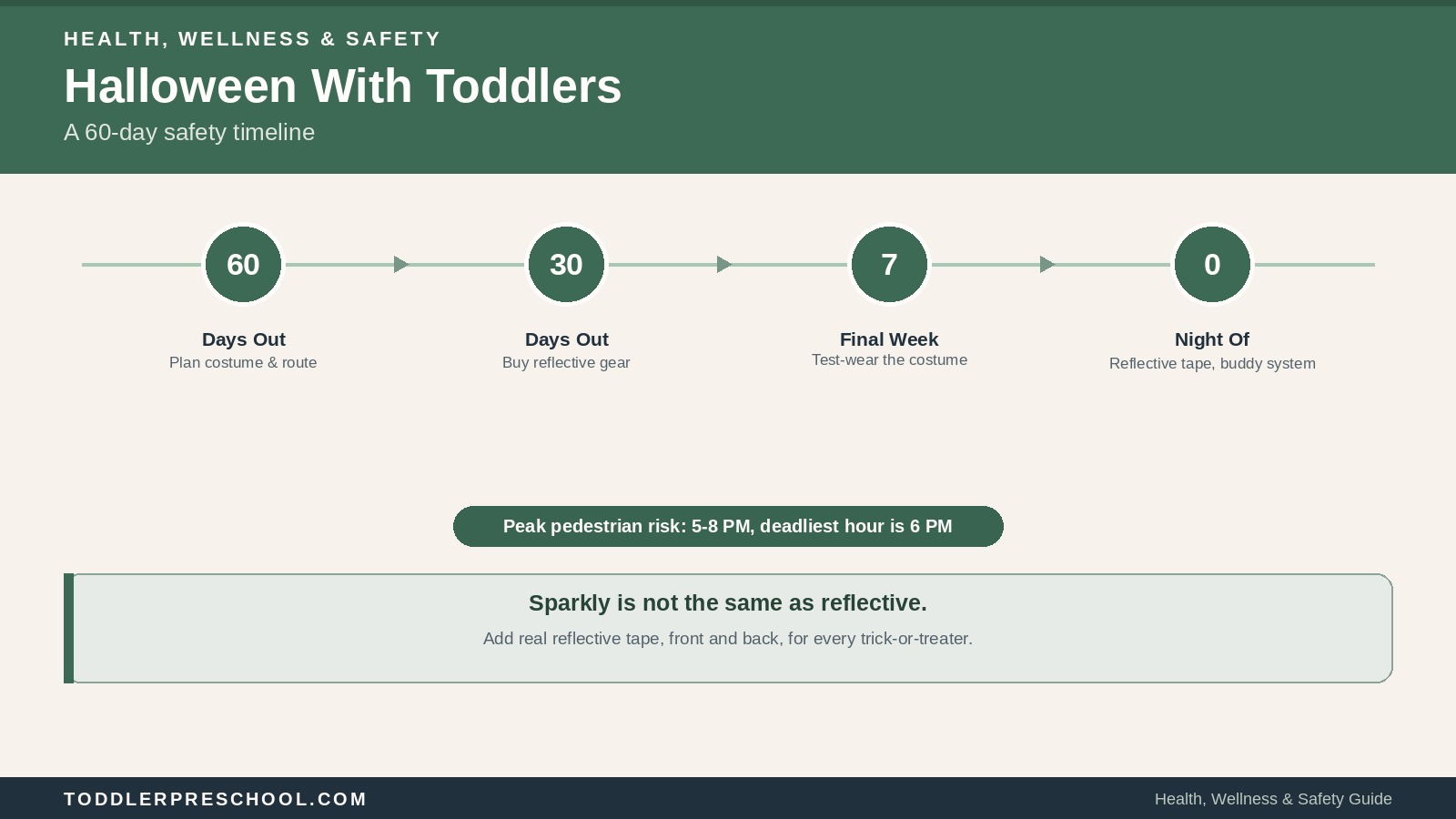
Halloween With Toddlers: The Most Urgent Safety Facts First
A few facts matter enough to cover before anything else in this guide.
Halloween Is the Most Dangerous Night of the Year for Child Pedestrians
According to a CDC analysis of national crash data, child pedestrian deaths increase roughly fourfold on Halloween evening compared to other evenings. A separate peer-reviewed study in JAMA Pediatrics found children ages 4 to 8 face a dramatically higher risk specifically on Halloween night.
This isn’t a reason to skip the holiday. It’s a reason to treat traffic safety as the top priority, not an afterthought.
The Most Dangerous Hours
Research consistently points to the hours between 5 p.m. and 8 p.m. as the highest-risk window, with risk peaking around 6 p.m. This is exactly when most trick-or-treating happens, in low light, with more pedestrians and more distracted drivers on residential streets.
What This Means for Your Specific Family
A toddler is usually held, carried, or pushed in a stroller rather than walking independently, which reduces some risk directly. But if older siblings are trick-or-treating too, your whole family is likely out during this exact high-risk window. The safety steps below apply to everyone in your group, not just the toddler.
Traffic and Pedestrian Safety Steps for Halloween With Toddlers
These steps come directly from current guidance from NHTSA, CDC, and AAA.
Consider the Timing of Your Outing
Trick-or-treating earlier, right at dusk before the 6 p.m. peak, or choosing a daytime alternative event, genuinely reduces exposure to the highest-risk window. This is worth real consideration for a family with a toddler in tow.
Visibility Rules That Actually Work
Add reflective tape to your toddler’s costume, stroller, and candy bag. Carry a flashlight or glow stick even if you’re not planning to stay out late. Bright, light-colored costumes are easier for drivers to see than dark ones.
Where to Walk and How to Cross
Stay on sidewalks. Cross only at corners or crosswalks, looking both directions before crossing, every single time. Avoid cutting between parked cars, where a driver has the least chance of seeing a small child in time.
Supervision Stays Constant
An adult should stay within arm’s reach of a toddler the entire time you’re near any street or driveway. This sounds obvious, but distraction (a costume adjustment, a conversation, a ringing phone) is exactly when a quick step into a street happens.
If You’re Driving That Evening Too
If your family also drives anywhere during the 5 to 8 p.m. window, slow down well below the posted limit in residential areas. Children in costumes may not see or hear an approaching vehicle the way an adult would expect. Masks limiting their own peripheral vision make this worse.
A Note on Alcohol and Driving
National data consistently shows a higher share of impaired drivers on the road on Halloween night compared to an average evening. If any adult in your group will be driving later that night, plan a sober driver in advance. This removes one more real risk factor from the evening.
Halloween Costume Safety Requirements for Toddlers
Current guidance from the U.S. Consumer Product Safety Commission covers costumes specifically, and it’s worth following closely.
Flame Resistance
Look for costumes, wigs, and beards labeled flame resistant. This labeling doesn’t mean an item can’t catch fire. It means the material resists burning and should extinguish quickly once removed from an ignition source, such as a candle or jack-o’-lantern flame.
Fit and Fabric
Avoid costumes with big, baggy sleeves, billowing skirts, or fabric that drags on the ground. Loose fabric increases both fire risk near open flames and tripping risk on stairs or uneven sidewalks.
Choose sturdy, well-fitting shoes rather than oversized shoes or costume footwear that doesn’t fit securely. A toddler in an ill-fitting costume shoe is a genuine fall risk.
Masks Versus Face Paint
Masks can block a young child’s peripheral vision, which matters a great deal near streets and stairs. Face paint or makeup is a safer choice for visibility, as long as the product is nontoxic and meets FDA cosmetic safety standards.
If a mask is part of the costume, check that it fits securely and has openings large enough for full vision and breathing.
Accessories
Any sword, wand, or prop accessory should be short, soft, and flexible rather than rigid or sharp. For a toddler specifically, it’s worth skipping small detachable accessories entirely, given the separate choking risk covered below.
Candy and Choking Hazard Safety for Toddlers
This section applies general choking-hazard guidance specifically to Halloween candy, and it deserves direct attention for this age group.
Why Most Halloween Candy Isn’t Appropriate for a Toddler
Hard candy, whole gumballs, and gummy candies are common choking hazards for children under 4, according to general pediatric choking-prevention guidance. A rough rule of thumb applies here. Anything small enough to pass through an empty toilet-paper tube, about 1.25 inches across, is a genuine risk. This applies to a child who still explores food quickly or doesn’t chew thoroughly.
This doesn’t mean a toddler can’t participate in trick-or-treating. It means an adult should sort and manage the actual candy your toddler eats that night. Keep it separate from whatever ends up in the bag.
Checking Treats Before Any Child Eats Them
Examine all treats before any child eats them, checking for damaged or unsealed wrapping. This is longstanding CPSC guidance, and it applies to every child in your group, not just the youngest.
A Safer Toddler Treat Swap
Many families let an older sibling collect candy. A toddler gets a small, age-appropriate treat instead, like a soft cookie or a favorite snack from home. This avoids the choking risk entirely while still letting a toddler feel included in the evening.
Food Allergy Safety and the Teal Pumpkin Project
If your toddler has a diagnosed food allergy, this section is directly relevant.
What the Teal Pumpkin Project Is
The Teal Pumpkin Project is run by Food Allergy Research & Education (FARE). It encourages households to offer non-food treats, marked with a teal pumpkin, alongside or instead of candy. According to FARE, roughly 1 in 13 children in the U.S. has a food allergy, and many popular Halloween candies contain common allergens like peanuts, tree nuts, milk, egg, soy, or wheat.
Checking Labels Carefully
Read labels on every item before your child eats it. This includes fun-size versions, which sometimes contain different ingredients than the full-size version of the same product. When in doubt, set the item aside rather than guessing.
If Your Child Has a Prescribed Emergency Plan
If your toddler has a diagnosed allergy with a prescribed action plan or an epinephrine auto-injector, carry it with you. Make sure every accompanying adult knows how and when to use it, following your child’s specific plan from their allergist or pediatrician. This guide does not provide individualized dosing guidance; follow your child’s actual prescribed plan.
Pumpkin Carving and Jack-o’-Lantern Safety
If pumpkin carving is part of your family’s tradition, a few safety points apply directly to a toddler in the house.
Carving Tools Stay With Adults
Pumpkin carving knives are genuinely sharp, and a toddler should never handle one, even with supervision. Let a toddler help with the messy, safe parts, like scooping seeds with a spoon, while an adult handles all cutting.
Battery Lights Instead of Open Flames
Battery-operated tea lights avoid the burn and fire risk of a real candle entirely. Current CPSC guidance recommends them specifically for households with young children. If you do use a real candle, keep it well away from where a toddler could reach or where a costume could brush against it.
Placement Away from Foot Traffic
Keep lit jack-o’-lanterns away from doorsteps, stairs, and walkways where a child in a costume might brush against them or trip nearby.
Home Decoration Safety With a Toddler in the House
Halloween decorations bring their own small hazards worth a quick check.
Small Decorative Pieces
Spider rings, small skeletons, and similar decorations are often exactly the size that presents a choking risk for a toddler. Keep these out of reach, or skip them entirely until your child is older.
Cords and Trip Hazards
Extension cords for outdoor lights or animatronics should be secured against tripping. This protects your own toddler and any smaller trick-or-treaters visiting your home.
The 60-Day Halloween With Toddlers Preparation Timeline
Most of this preparation is quick, spread out, and low effort when it isn’t left until the last week.
60 to 30 Days Out
Decide on your general plan: full trick-or-treating, a daytime alternative, or staying home. Start looking at costume options with the safety criteria above in mind, rather than appearance alone.
This is also a reasonable window to check whether your child’s preschool or daycare has a Halloween event planned. Many programs hold their own daytime celebration, which may cover part of what your family wants out of the holiday.
30 to 14 Days Out
Purchase or assemble the costume, checking fit and flame-resistance labeling. If your neighborhood does a group event or trunk-or-treat, confirm the date and time now, while it’s still easy to plan around.
If your child has a food allergy, this is a good window to prepare a small stash of safe treats. Swap these in for anything questionable that comes home, rather than sorting through unfamiliar candy on the night itself.
Final 2 Weeks
Let your toddler try the full costume on at home, including any shoes, at least once before the actual night. This surfaces comfort or fit problems while there’s still time to adjust or swap something out.
Talk through the plan with every adult who’ll be supervising, so everyone knows the route, the timing, and who’s responsible for what.
Closer to the Event: A Final-Week Update Checklist
A few things are worth reconfirming specifically in the days right before Halloween, since conditions change.
- Check the weather forecast and plan a layering option if it’s cold, since a bulky coat over a costume changes the fit and flame-resistance picture.
- Reconfirm sunset time for your specific location, and adjust your planned outing window accordingly.
- Refresh reflective tape or glow sticks if older ones have gone missing since you bought them.
- Re-examine the costume for any tears, loose trim, or tripping-length fabric that appeared during a test wear.
- Confirm any allergy action plan is current and accompanying you, if relevant to your child.
Building a Halloween Evening Around Your Toddler’s Routine
Safety comes first, but a smoother evening also depends on working with your toddler’s normal rhythm, not against it.
Managing an Earlier Bedtime Collision
Halloween evening often runs later than a toddler’s usual bedtime. A short, planned outing, rather than an all-evening event, keeps the disruption smaller and easier to recover from the next day.
Sugar and Food Timing
A regular dinner before heading out works better than starting the evening on an empty stomach. This tends to make everything smoother, including how your child handles the excitement and any candy that comes home.
Overstimulation and a Shorter Route
Costumes, crowds, decorations, and doorbells add up fast for a young child. A short route, just a handful of houses, is a completely reasonable choice for a toddler’s first few Halloweens.
Costume Comfort for a Toddler
For Halloween with toddlers specifically, a costume that looks great in a photo isn’t worth much if your toddler refuses to wear it.
A Sample Toddler-Friendly Evening
This is a loose template built around an earlier, shorter outing that avoids the highest-risk traffic window where possible.
| Time | What’s Happening |
|---|---|
| Late afternoon | Regular dinner, before heading out |
| Dusk, before 6 p.m. if possible | Short outing to a handful of nearby houses |
| Right after | Head home, check candy together |
| Evening | Regular wind-down and bedtime routine |
Shift this earlier or later to match your own family’s actual schedule and your area’s sunset time.
Sensory Considerations
Watch for scratchy tags, tight elastic, or unfamiliar textures that might bother a sensory-sensitive toddler. A soft, familiar layer worn underneath a scratchier costume piece often solves this without needing a different costume entirely.
Trying the Costume Before the Big Night
A full trial run at home catches most comfort problems early enough to fix them. Include a short walk around the house, as mentioned in the timeline above.
Weather Considerations for Halloween With Toddlers
Late October evenings are often cold in much of the U.S., which affects both comfort and costume safety.
Layering Without Losing the Costume
A thin layer worn underneath a costume works better than a bulky coat over it. A heavy coat can obscure flame-resistant material and change how the costume fits and moves.
A Backup Plan for Bad Weather
Rain or unusually cold temperatures are a reasonable reason to adjust plans. Shorten the outing, move to an indoor alternative, or reschedule to a community event on a different day.
Alternatives to Full Trick-or-Treating With Toddlers
Traditional door-to-door trick-or-treating isn’t the only reasonable way to mark the holiday with a toddler.
Trunk-or-Treat and Daytime Events
Many communities, schools, and faith organizations host trunk-or-treat events or daytime Halloween gatherings. These often happen in daylight, in a contained space, which sidesteps much of the traffic risk covered earlier in this guide.
Staying Home and Handing Out Candy
Staying home and handing out candy to other trick-or-treaters is a genuine option. A toddler still enjoys costumes and doorbells, without the traffic exposure of walking a neighborhood route.
A Few Houses Instead of a Whole Neighborhood
Visiting a handful of familiar, close neighbors is a reasonable middle ground for a family not ready for a full route. There’s no requirement to do more than what fits your specific toddler’s stamina and your family’s comfort level.
Halloween With a Toddler and Older Siblings
Managing different ages at once adds its own planning layer.
Different Paces, Different Needs
An older sibling may want a full, long route, while a toddler is ready to head home after twenty minutes. One adult can head home early with the toddler, if two adults are available. This avoids cutting the older child’s evening short too.
One Route That Works for Everyone
If splitting up isn’t possible, choosing a shorter, slower route than an older sibling might want alone is a reasonable compromise. Most older kids adjust well once they understand the plan ahead of time.
Preschool and Daycare Halloween Parties
Many programs hold their own celebration, which is worth factoring into your overall plan.
Ask About the Program’s Specific Plan
Confirm costume rules, timing, and any food or allergy policies directly with your child’s program. Some centers have specific restrictions, like no masks or no weapon-style props, worth knowing before you buy a costume.
This Can Replace or Supplement Evening Plans
A daytime program celebration genuinely covers much of what families want from the holiday. Treating it as enough, rather than adding a full evening event on top, is a reasonable choice for a young toddler’s schedule.
Common Obstacles for Halloween With Toddlers
A few specific situations come up often enough to address directly.
“My toddler refuses to wear the costume at all.”
This is common enough to not derail the whole plan. A simple costume element, like a themed shirt or a single accessory, still lets your child participate without a fight over a full costume.
“We’re not sure our toddler can handle the excitement of a whole evening out.”
Trust that instinct. A shorter outing, or one of the daytime alternatives above, is a completely reasonable scaled-down version of the holiday.
“Our neighborhood doesn’t feel safe for trick-or-treating.”
A trunk-or-treat event, a mall or business-district trick-or-treat program, or simply staying home and handing out candy are all reasonable, safety-conscious alternatives.
“My toddler is scared of decorations, masks, or other costumed kids.”
This is extremely common at this age. Fear of unfamiliar, exaggerated imagery isn’t a sign anything is wrong. Sticking to friendly, non-scary decorations at home, and skipping houses with elaborate scary displays, is a reasonable accommodation.
“My toddler wants to eat candy the moment it goes in the bag.”
Setting the expectation before you leave the house, rather than mid-outing, tends to work better. A simple, repeated phrase like “candy comes home first, then we check it together” gives a toddler a predictable rule to hold onto.
Talking to Your Toddler About Halloween Beforehand
A little preparation talk goes a long way for a young child facing an unfamiliar evening.
Reading a Simple Book About Halloween
A picture book about trick-or-treating gives your toddler a low-pressure preview. A friendly Halloween story works too, covering everything from costumes to doorbells.
Practicing the Costume and the Routine at Home
Practice “trick or treat” at your own front door. Then walk to the next room for a pretend treat. This turns an unfamiliar routine into a familiar game before the actual night.
Keeping Expectations Simple and Honest
A brief, calm explanation works best. Try “we’re going to a few houses, then we go home” rather than an elaborate description of the whole evening’s plan.
Medical Boundaries: When to Seek Care Right Away
A few situations need immediate action, not a wait-and-see approach.
Call 911 or go to the nearest emergency room if your child shows:
- Signs of a severe allergic reaction, including difficulty breathing, swelling of the face or throat, or widespread hives after eating a treat
- Choking that isn’t resolving, including an inability to cry, cough, or breathe
- Any loss of consciousness after a fall during trick-or-treating
Call Poison Control at 1-800-222-1222 if your child eats something you believe may not be food, including a glow stick, a small decoration, or an unknown substance found while trick-or-treating.
None of this is meant to increase anxiety about the holiday. It’s meant to make sure you’re not searching for a phone number in an actual emergency.
Non-Urgent Concerns Still Worth a Call
A mild rash, a stomachache after too much candy, or general overtiredness the next day don’t need an emergency visit. They’re still reasonable to mention at your child’s next regular appointment if they persist or worry you.
Save These Numbers Before the Event
Program Poison Control and your pediatrician’s after-hours line into your phone before Halloween evening, not during. A saved contact is faster to find than a search in a stressful moment.
The Wide Range of Normal
A few sources of real variation are worth naming directly.
Multilingual families. Every safety phrase and routine in this guide works in any language your family speaks at home.
Disability and sensory differences. For a toddler with sensory sensitivities or a disability, several options work well. A modified costume, a shorter or quieter alternative event, or skipping trick-or-treating entirely this year are all reasonable, valid choices.
Different family structures. Whoever is supervising your toddler that evening should know the safety points in this guide. One or two parents, a grandparent, another caregiver, not just one household member.
Budget. A costume doesn’t need to be purchased new or elaborate to meet the safety criteria in this guide. A simple, homemade option that fits well and avoids loose fabric meets every safety point covered here.
Cultural and religious differences. Not every family celebrates Halloween, and that’s a completely reasonable choice. Every safety principle in this guide still applies. Pedestrian awareness, choking hazard sizing, allergy caution work for any fall evening activity your family chooses, Halloween-specific or not.
First Halloween versus a toddler who remembers last year. A first Halloween often means more unpredictability, since your child has no prior context for any of it. A second or third Halloween usually goes more smoothly simply from familiarity, not because anything was done differently.
Adapting This to Every Family’s Situation
Access to care. If you don’t have a regular pediatrician or allergist, community health centers can help. They can typically answer basic questions about a known allergy or sensitivity before the holiday.
Schedule constraints. If a full 60-day timeline isn’t realistic, focus on two things. The costume’s flame-resistance and fit, and a plan for the 5 to 8 p.m. traffic window. Everything else in this guide is a genuine bonus, not a requirement.
Working parents. A quick weekday evening costume trial works fine, rather than a dedicated weekend event. It still catches most fit and comfort problems with just a few minutes of effort.
Disability and mobility considerations. For a toddler using mobility equipment, scout a route in advance. Checking curb cuts, ramps, and sidewalk surfaces makes the actual evening far less stressful. Some neighborhoods and organized events specifically plan accessible routes, worth asking about directly.
Families new to the U.S. or new to this specific holiday tradition. Asking a neighbor, a program teacher, or a community group directly about local norms helps. What time trick-or-treating typically starts, whether a costume is expected at daycare. These unwritten expectations aren’t obvious from the outside.
Photos and Sharing Online
Many families want to capture and share Halloween photos, and a couple of practical points are worth a quick thought.
A Quick Privacy Consideration
If you plan to share costume photos publicly, think about what the image reveals. A home address, school, or specific neighborhood detail is worth blurring, particularly if posted before the evening itself.
Capturing the Moment Without Missing It
A quick photo at the door before heading out often captures the excitement best. Photographing mid-walk pulls adult attention away from active traffic supervision.
Briefing Every Adult in Your Group
If more than one adult will be present, a quick shared plan helps the evening run smoothly.
A Two-Minute Conversation Before You Leave
Confirm who’s watching which child, the planned route, and the return time before stepping out the door. This small step prevents the common gap where each adult assumes someone else is watching a specific child near a street.
Grandparents or Occasional Caregivers
If someone less familiar with your usual routine is joining, walk them through the key safety points directly. Don’t assume shared knowledge of current guidance.
Frequently Asked Questions
Questions About Candy and Costumes
Is it safe to let a toddler eat any Halloween candy at all? Many toddlers can safely have a small piece of soft, age-appropriate candy, with direct supervision. Check first that it isn’t a choking risk and doesn’t contain a known allergen. Hard candy, gum, and whole nuts are worth avoiding entirely for this age group.
What if our costume choice doesn’t meet the flame-resistant labeling guidance? Keep the child away from any open flame sources, including candles in jack-o’-lanterns. Consider a battery-operated light instead. Checking the label before buying is the more reliable fix going forward.
How much candy is actually okay for a toddler to eat that night? There’s no official specific limit. This is a reasonable family judgment call rather than a strict rule. A small amount of age-appropriate, checked candy, alongside a regular dinner, works for most toddlers without a specific medical restriction.
Should we worry about tampered candy, or is that mostly an old myth? Deliberate candy tampering by strangers is exceedingly rare in verified cases. The standard advice to examine treats before eating them remains reasonable practice anyway, catching genuine issues like damaged packaging.
Questions About Planning the Evening
Should we skip trick-or-treating altogether if we have a toddler and no older kids? Not necessarily, but it’s a completely reasonable choice if a daytime alternative or staying home feels like a better fit for your family this year. There’s no requirement to do a full evening route with a toddler.
Is a stroller safer than carrying a toddler during trick-or-treating? Both can work well. A stroller keeps a toddler contained and visible with reflective additions. Carrying keeps a child close and off uneven sidewalks. Either choice is reasonable as long as visibility and supervision stay consistent.
What if our toddler’s preschool doesn’t celebrate Halloween at all? That’s a program’s reasonable choice, often tied to specific community or family preferences. Your family’s own celebration, however large or small, doesn’t need to match what happens at school.
Your One Next Step
Pick one item from the urgent safety section above. Most likely, that’s checking your planned costume for flame-resistant labeling and fit. Handle it this week, well before the last-minute rush.
Sources consulted: Centers for Disease Control and Prevention, historical pedestrian injury surveillance data; National Highway Traffic Safety Administration Halloween pedestrian safety guidance; U.S. Consumer Product Safety Commission costume and candy safety guidance; Food Allergy Research & Education (FARE), the Teal Pumpkin Project. This article is general information and does not replace individualized guidance from your child’s pediatrician, allergist, or emergency services.