
You’re in the checkout line, your toddler wanted the candy you said no to, and now they’re on the floor screaming while a small audience of strangers watches you decide what to do next. Or maybe it’s happening at home, over a cracker that broke in half, and you’re standing there wondering how something this small turned into something this loud — and whether toddler tantrums like this one are actually normal or a sign something needs to change.
Here’s the direct answer: during a toddler tantrum, your job is to keep everyone safe, let the feeling happen without trying to talk your child out of it, hold firm on any behavior limit that matters, and reconnect once the storm passes — not to stop the tantrum itself, which usually has to run its course. Toddler tantrums are a normal, expected part of development, not a sign of bad parenting or a bad kid, and there’s a genuinely practical, repeatable plan for handling them that doesn’t require perfect calm or a psychology degree. This guide walks through exactly what that plan looks like in the moment, what to actually say, how to keep things safe when a tantrum gets physical, how to reduce how often they happen, and when a pattern is worth a closer look from a professional.
This guide is organized so you can use whichever part actually helps right now: skip straight to the in-the-moment plan and scripts if you need something today, or read through the developmental logic first if understanding the “why” helps you stay calmer in the moment. Either way, nothing here requires you to have handled a toddler tantrum perfectly before to get real value out of what follows.
The Direct Answer: What Actually Helps During a Toddler Tantrum
Everything in this guide builds on one core idea, drawn directly from CDC’s own parenting guidance for this age group: all feelings are acceptable, but not all behaviors are. A toddler tantrum itself — the crying, the screaming, the collapsing to the floor — is your child’s feeling showing up in the only form they currently have the tools to express it in. That part doesn’t need to be stopped or punished. What does need a clear, calm limit is any behavior that’s unsafe: hitting, biting, throwing something dangerous, or running into traffic.
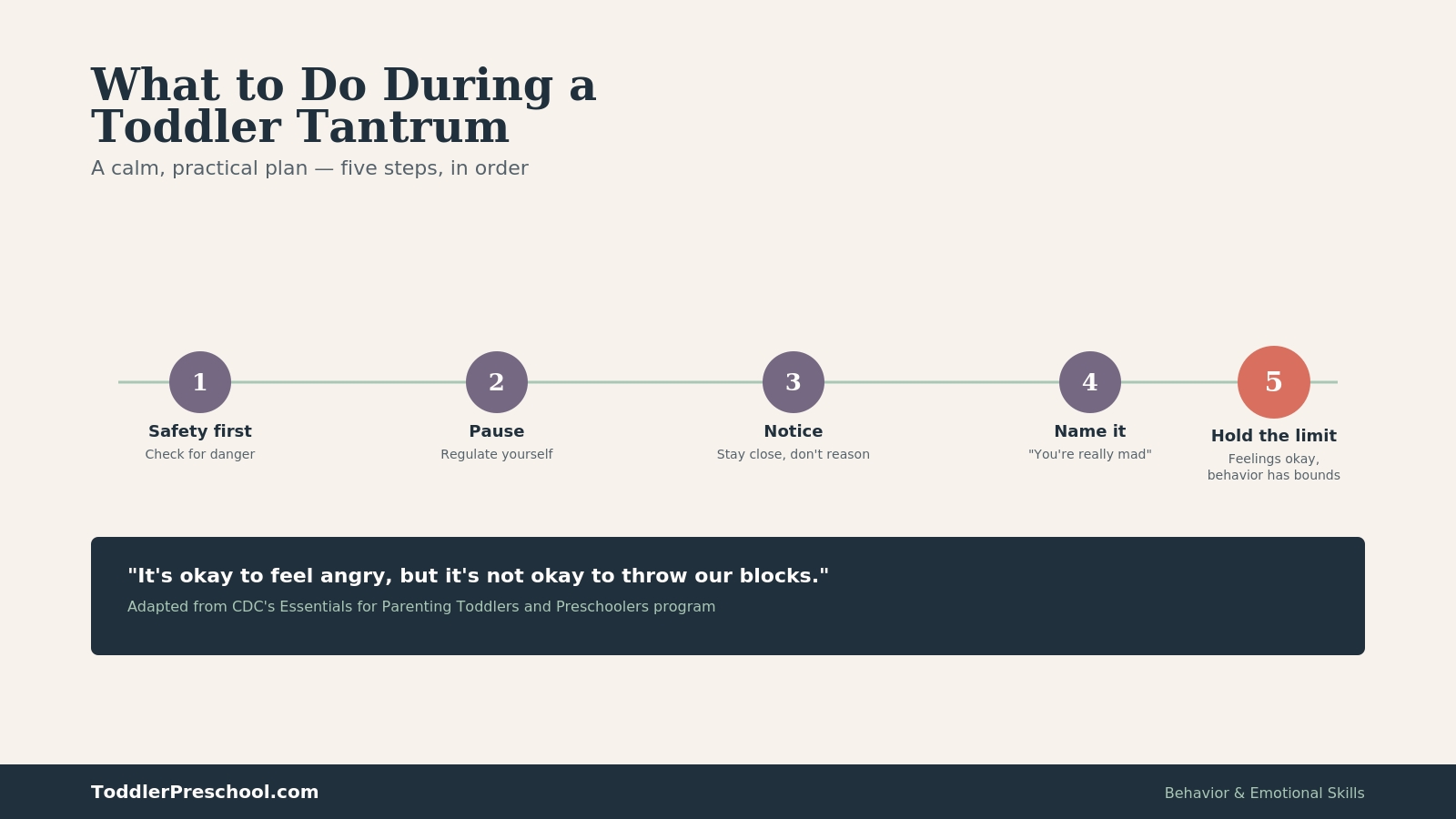
In practice, that breaks down into five things worth doing, roughly in order: make sure everyone is physically safe, pause long enough to keep your own reaction calm, stay nearby without trying to reason your child out of the feeling while it’s at its peak, name what you think they’re feeling once they can hear you, and hold whatever limit actually matters without arguing about it. None of this requires the tantrum to end quickly — most toddler tantrums run their own course over a few minutes regardless of what you do, and the goal is to get through them safely and consistently, not to make them disappear on command.
What a Toddler Tantrum Actually Looks Like
A toddler tantrum — the term this guide uses throughout for this common behavior — can include crying, screaming, dropping to the floor, stiffening the body, kicking, throwing nearby objects, hitting, or — in some children — holding their breath. Duration and intensity vary enormously: some tantrums last less than a minute and resolve almost as fast as they started; others stretch to ten or fifteen minutes, especially when a child is already overtired or overstimulated before the trigger even happens.
A tantrum often moves through a rough arc, even though it can look chaotic in the moment: an initial trigger (a “no,” a transition, a frustration), a rapid escalation as the feeling overwhelms the toddler’s limited coping tools, a peak where reasoning genuinely isn’t accessible to your child, and then a gradual de-escalation as the emotional energy discharges. Recognizing which part of that arc you’re in changes what’s actually useful — trying to reason during the peak rarely works, while the same conversation often lands fine once the de-escalation phase has started.
Toddler tantrums are most common and most intense roughly between 18 months and 3 years, though plenty of 3- and 4-year-olds still have them regularly, and some younger toddlers show early versions before 18 months. Frequency varies just as widely — daily tantrums are common for some children and families during this stretch, while others see them more like a few times a week. Both patterns, and everything between them, fall within the range of typical toddler behavior at this age.
It’s worth naming plainly that a tantrum is not the same thing as a “meltdown” in the specific sense some professionals use that word (a response to sensory or emotional overload that isn’t really aimed at getting an outcome), and this guide isn’t attempting to diagnose which one you’re seeing — that’s a conversation for a pediatrician if you’re genuinely unsure. What follows applies to the ordinary, expectable toddler tantrums the vast majority of families deal with regularly during these years.
Why Toddler Tantrums Happen: The Developmental Logic
Toddlers experience big emotions — anger, frustration, disappointment — every bit as intensely as adults do, but without the vocabulary, impulse control, or emotional regulation skills to manage those feelings the way an older child or adult can. A tantrum is what happens when that gap gets crossed: a feeling arrives that’s bigger than the tools currently available to handle it. According to CDC’s own guidance for parents of toddlers and preschoolers, this is a normal behavior and a healthy way for young children to release emotional energy and return to a calmer state — not a character flaw or a parenting failure.
A few common triggers show up again and again:
- Hunger or fatigue. A toddler who’s hungry or overtired has fewer emotional resources available for anything else, and a minor frustration can trigger a full response that would barely register on a well-rested, well-fed day.
- Overstimulation. Too much noise, too many new people, or too long in a stimulating environment (a birthday party, a crowded store) can push a toddler past their capacity before anything specific even goes “wrong.”
- Transitions. Being asked to stop one activity and start another — leaving the park, turning off a show, getting into the car seat — is genuinely hard for toddlers, who don’t yet have a strong internal sense of time or the flexibility to shift gears easily.
- Wanting autonomy. Toddlers are in the thick of learning they’re a separate person with their own preferences, and a “no” to something they want to do or control can trigger real frustration, independent of how reasonable the “no” is.
- Communication frustration. A toddler who can’t yet say what they want or need, or isn’t being understood, may express that frustration physically because the words aren’t available yet.
- A change in routine or environment. A new caregiver, a different room layout, travel, or even a different order to a familiar routine can be enough to tip a toddler who’s already running low on flexibility for the day.
- Sensory discomfort. An itchy tag, a wet diaper, being too hot or cold, or an uncomfortable texture can all contribute to a toddler tantrum without the trigger ever being obvious to an adult, since a toddler often can’t yet identify or name a physical discomfort directly.
Two Broad Patterns Worth Recognizing, Without Diagnosing Either
Many toddler tantrums have at least some goal-directed element — your child wants something specific (an item, an activity, your attention) and the tantrum is, in part, an attempt to get it, even if it’s not a conscious strategy. Other times, a tantrum looks more like genuine overwhelm with no clear “ask” behind it — the sensory or emotional load has simply become too much, and the tantrum is a release rather than a request. In practice, most real toddler tantrums are some mix of both, and you don’t need to correctly sort which one you’re seeing for the response in this guide to work — the core plan (safety, validate the feeling, hold behavior limits, reconnect after) applies either way.
Feelings Are Always Okay, Behavior Sometimes Isn’t
This distinction is the single most useful thing to internalize before your next toddler tantrum happens, because it changes what you’re actually trying to do in the moment. You are not trying to stop your child from being angry, sad, or frustrated — those feelings are legitimate and don’t need permission. You’re only setting a limit on specific behaviors that are unsafe or genuinely not okay, like hitting or throwing something that could hurt someone.
CDC’s own parenting guidance frames this exact idea with a simple example: “It’s okay to feel angry, but it’s not okay to throw our blocks.” Said plainly and calmly, a sentence like that does two things at once — it validates the feeling completely, and it draws a clear, specific line around the behavior, without shaming your child for having the feeling in the first place. This is different from a blanket “stop crying” or “calm down” message, which tells a toddler their feeling itself is the problem — a much harder message for a young child to make sense of, and one that tends to prolong distress rather than ease it.
The In-the-Moment Plan: Five Steps for a Toddler Tantrum
This sequence is adapted from CDC’s own “emotion coaching” framework for parents of toddlers and preschoolers, built specifically for exactly this kind of moment.
Step 1: Make Sure Everyone Is Safe First
Before anything else, check whether your child, other children, or anyone nearby is in any physical danger — from hitting, from an unsafe location (near stairs, in a parking lot, near a hot stove), or from the child themselves (head-banging, in some children). If there’s a safety issue, address that first, calmly and without extensive explanation in the moment; the emotional conversation can wait until everyone is physically secure. This might mean physically moving your child away from a hazard, removing a dangerous object from reach, or simply repositioning yourself between your child and something they could get hurt on.
Step 2: Pause and Regulate Yourself Before Responding
Your own calm matters more than almost anything else you do during a toddler tantrum. If you’re feeling frustrated, embarrassed, or overwhelmed yourself, take a breath — literally three deep breaths, if that’s what you need — before engaging further. CDC’s guidance calls this “self-regulating,” and it explicitly notes that if you try to address your child’s emotions before managing your own, you risk unintentionally dismissing what your child is feeling rather than actually helping. A short pause, even a few seconds, tends to produce a calmer, more effective response than reacting instantly.
If you find yourself genuinely too activated to respond calmly — which happens to every parent occasionally — it’s completely reasonable to take a slightly longer pause, as long as your child remains safe: step a few feet away, get a sip of water, or simply stand quietly for a moment before re-engaging. This isn’t avoidance; it’s the same self-regulation you’re eventually hoping to model for your child, and toddlers do learn from watching how you handle your own big feelings, even when you don’t realize you’re being watched.
Step 3: Notice and Stay Close, Without Trying to Reason It Away
During the peak of a toddler tantrum, your child usually can’t process reasoning, negotiation, or a long explanation — the part of the brain that handles that kind of thinking is essentially offline while the emotional response is running at full intensity. Rather than talking extensively, stay physically close (unless your child needs space, which some do), keep your hands free, and give your full attention. You don’t need to fix anything yet; you’re just letting your child know you’re there.
This step is often the hardest for parents, since standing quietly nearby while your toddler screams can feel like doing nothing. It isn’t nothing — your calm, consistent presence is actively communicating safety and stability, even though your child can’t yet tell you that’s what they’re absorbing from it. Some toddlers want to be held during this phase; others pull away and need physical space while staying in the same room. Following your specific child’s preference, rather than a one-size-fits-all approach, tends to work better here.
Step 4: Name the Feeling, Once Your Child Can Hear You
Once the most intense part has started to ease even slightly, name what you think your child is feeling, in simple words: “You’re really angry that we have to leave the park.” You don’t need to get it exactly right — if your child corrects you, that’s useful information, not a failure on your part. Naming the feeling helps a toddler start to build the vocabulary to eventually name it themselves, which is a skill that develops gradually over years, not in a single tantrum.
Step 5: Hold the Limit and Offer a Path Forward
Once the feeling has been acknowledged, this is the moment to restate any behavior limit that matters (“It’s okay to be mad, but we can’t throw toys”) and, if appropriate, offer a simple next step or choice: “Do you want to walk to the car, or should I carry you?” Rushing to this step too early — before the feeling itself has been allowed to happen — tends to escalate things rather than resolve them, which is exactly why it comes last, not first.
The Five Steps at a Glance
| Step | What You’re Doing |
|---|---|
| 1. Safety first | Check for danger to your child or others; address it immediately, without a long explanation yet |
| 2. Pause and regulate | Take a breath (or several) before responding; manage your own reaction first |
| 3. Notice and stay close | Give full attention without trying to reason during the peak intensity |
| 4. Name the feeling | Once it starts to ease, name what your child seems to be feeling, in simple words |
| 5. Hold the limit | Restate any behavior limit calmly, and offer a simple choice or next step forward |
Scripts: What to Actually Say During a Toddler Tantrum
Having a few ready-made phrases matters more than it might seem, since it’s hard to find the right words in the actual moment. A few real scenarios:
The classic “no” to something at the store: “You really want that candy. It’s hard to hear no. We’re not getting it today, and I’m going to stay right here with you.” Repeat calmly as needed, without escalating your own volume or over-explaining.
A sibling conflict over a toy: “You both want the truck. That’s frustrating. The truck is going on the shelf for a minute, and then we’ll figure out turns.” (This mirrors CDC’s own example of removing a contested item as a logical consequence, rather than trying to mediate a full negotiation mid-tantrum.)
Leaving somewhere fun: “It’s hard to leave the park when you’re having fun. We’re leaving now. Do you want to walk like a bunny or like a bear to the car?” Offering a small, genuine choice about how to comply, rather than whether to comply, often helps more than a flat command.
When your child hits or throws something: “I won’t let you hit. Hitting hurts. You can be mad, but I’m going to keep everyone safe.” Said firmly and calmly, this holds the safety limit without shaming the underlying feeling.
If you genuinely don’t know what’s wrong: “Something is really bothering you. I’m here.” You don’t need to correctly diagnose the trigger in the moment for this to be helpful — simply being present and naming that you notice something is real support.
Getting dressed or ready when your toddler refuses: “You don’t want to put on shoes right now. I get it. We need shoes to go outside — do you want to pick which ones, or should I pick?” This keeps the non-negotiable (shoes are happening) while offering a small area of genuine control.
Bedtime or nap resistance: “You wish you could stay up and play. It’s hard to stop. It’s sleep time now. Do you want one more book or one more song before lights out?” Naming the wish directly, rather than arguing about whether it’s actually bedtime, tends to shorten the standoff.
Safety Steps When a Toddler Tantrum Involves Danger
Most toddler tantrums don’t involve any real safety risk, but a few specific situations are worth knowing how to handle in advance.
Hitting, Biting, or Throwing
Physically block the unsafe action without restraining your child harshly — a hand gently but firmly held, or simply moving out of range, usually works better than a tight physical hold, which can sometimes escalate distress further. State the limit simply (“I won’t let you hit me” or “I’m moving the toy so no one gets hurt”) and follow through consistently every time, since consistency is what makes the limit meaningful over repeated tantrums.
Head-Banging
Some toddlers bang their heads against a wall, floor, or crib rail during intense frustration. This is a known, if unsettling, pattern in some young children and is usually not a sign of a deeper problem on its own, especially if it happens specifically during tantrums and not at other times. If it’s happening, move your child (or move soft padding) so the surface being hit is softer, rather than trying to physically stop the motion itself, which can be difficult and sometimes escalates the behavior. If head-banging is frequent, happens outside of tantrums too, or seems to be causing real injury, that’s worth raising with your pediatrician.
Breath-Holding Spells
Some toddlers, especially between about 1 and 3 years old, hold their breath during intense crying to the point of briefly turning pale or bluish around the lips and, in some cases, fainting for a few seconds. This looks alarming, but breath-holding spells are involuntary — your child isn’t doing this deliberately or manipulatively — and they’re generally not dangerous. If your child faints during a spell, lay them on their side to protect their airway, don’t put anything in their mouth, and don’t attempt CPR or rescue breathing, since breathing restarts on its own within seconds. Once your child recovers, treat the moment matter-of-factly rather than with an extra-big reaction, extra comfort, or punishment — either response can unintentionally reinforce the pattern. Call your pediatrician after a first-ever spell to confirm what happened, and see them again if spells become frequent (more than occasional) or if your child seems unusually drowsy or doesn’t return to normal within about half an hour afterward.
Running Away or Bolting
A toddler who bolts during a tantrum — in a parking lot, near a street, in a store — needs an immediate, calm physical intervention (picking them up, blocking the path) rather than a verbal negotiation first; safety comes before the emotional conversation every time, and you can revisit the feelings once everyone is physically secure.
Safety Situations at a Glance
| If This Happens | Do This |
|---|---|
| Hitting, biting, or throwing | Block the action gently but firmly; state the limit simply and follow through consistently |
| Head-banging | Move your child or add soft padding rather than forcibly stopping the motion; mention to your pediatrician if frequent or happening outside tantrums |
| Breath-holding spell | Lay your child on their side if they faint; don’t put anything in their mouth; stay calm and matter-of-fact once they recover |
| Running or bolting | Physically intervene immediately (pick up, block path); save the conversation for once everyone is safe |
What Tends to Make Tantrums Worse
None of the patterns below during toddler tantrums make you a bad parent — they’re common instincts, and most parents have done some version of all of them. They’re worth naming honestly because they tend to backfire, not because doing them occasionally is a problem.
Giving in to stop the tantrum. If a toddler tantrum ends because you gave them what they were asking for, they’ve learned — accurately, from their perspective — that a big enough tantrum works. CDC’s own guidance is direct about this: giving in after a tantrum rewards the tantrum and makes future ones more likely. This doesn’t mean every “no” needs to be permanent forever, but changing your answer specifically because of the tantrum, rather than for an independent reason, reinforces the pattern.
Long explanations mid-tantrum. Toddlers generally can’t process detailed reasoning while they’re at the peak of an emotional response — save the explanation for after things have calmed, or keep it to one short sentence during the tantrum itself.
Matching their volume and intensity. Raising your own voice to be heard over a tantrum tends to escalate rather than de-escalate the situation. A lower, calmer volume — even if it means your child can’t hear every word — communicates steadiness more effectively than volume does.
Shaming or comparing. Phrases like “big kids don’t cry like this” or “you’re embarrassing me” attach shame to the feeling itself, which tends to make emotional regulation harder to learn over time, not easier, and doesn’t reflect the brand’s — or CDC’s — evidence-based approach to this age group.
Ignoring a genuine safety issue to avoid a scene. In public specifically, it can be tempting to let an unsafe behavior slide to avoid drawing more attention — but the safety limit matters more than the audience, and a brief, calm intervention is worth the extra few seconds of visibility.
Bargaining or introducing a new offer mid-tantrum. Offering a treat, a screen, or a new incentive specifically to stop a tantrum in progress teaches the same lesson as giving in outright — that escalating gets results — even when the specific thing offered wasn’t the original request. It’s different from the planned, small choices covered in the prevention section below, which are offered proactively rather than as a reaction to escalating distress.
Inconsistency between caregivers or between days. A limit that’s firm on Tuesday and negotiable on Wednesday, or enforced by one parent but not the other, tends to extend how long it takes a toddler to learn where a boundary actually is, simply because the boundary itself keeps moving.
Setting Limits Once the Storm Has Passed
Not every toddler tantrum needs a formal consequence — many resolve on their own once the feeling has passed, and reconnecting afterward is enough. But for a behavior that keeps happening (repeatedly throwing toys, repeatedly hitting), CDC’s guidance offers a clear, repeatable structure worth having in your back pocket:
- Identify the specific behavior, stated plainly: “We can’t throw toys. It’s not safe.”
- Give one calm warning, using a simple if-then statement: “If you throw it again, I’m going to put it away.” Only give a warning you’re actually willing to follow through on.
- Follow through with a consequence if the behavior repeats — removing the item, a brief loss of a privilege, or a short time-out are all reasonable options for this age, chosen to logically connect to the behavior where possible.
- Briefly explain why, once the consequence is in place: “Because you threw it again, it’s going away for now.”
- Return to positive interaction once the consequence has been applied — this isn’t about holding a grudge or extending the conflict, it’s about closing the loop and moving forward together.
Expect an emotional reaction to the consequence itself — crying, protesting, even saying something like “I hate you” in the moment. CDC’s guidance is direct that this reaction shouldn’t change your decision to follow through, since inconsistency teaches a toddler that warnings (and, by extension, future limits) aren’t reliable.
A Note on Punishing the Tantrum Itself
It’s worth being explicit about something this guide has implied throughout: the tantrum — the crying, the screaming, the collapse — isn’t the thing being addressed with a consequence in the framework above. A specific unsafe or repeated behavior during the tantrum (throwing, hitting) can reasonably carry a consequence; the emotional release itself generally shouldn’t, since punishing a feeling teaches a toddler to suppress or hide emotions rather than learn to manage them, which tends to create more difficulty with emotional regulation later, not less.
Preventing Toddler Tantrums: A Proactive Plan
You can’t eliminate toddler tantrums entirely — they’re a normal part of this developmental stage — but several genuinely effective strategies reduce how often and how intensely toddler tantrums happen.
Watch for Hunger, Tiredness, and Overstimulation
A surprising number of toddler tantrums trace back to one of these three physical states rather than the specific trigger that seemed to set it off. Keeping a simple snack on hand, protecting nap and bedtime schedules as much as realistically possible, and limiting how much stimulating activity gets packed into a single day are unglamorous but genuinely effective prevention tools. Some families find it useful to informally track when tantrums happen for a week or two — many parents notice a clear pattern (late afternoon, right before a meal, after a long outing) once they’re actually looking for it, which makes prevention far more targeted than a general “be more careful” approach.
Build In Predictable Routines and Transition Warnings
Toddlers do better with predictability, since it reduces the number of surprises they have to emotionally process in a day. A consistent daily rhythm, plus a simple warning before a transition (“two more minutes, then we’re leaving the park”) gives a toddler’s slower-to-shift attention a chance to catch up, rather than being asked to stop instantly. A visual timer, a countdown said aloud, or a consistent transition phrase (“one more time down the slide, then we go”) all work by the same principle — turning an abrupt stop into a predictable process with a clear ending your child can see coming.
Offer Real, Limited Choices
Toddlers are working hard on autonomy, and a genuine (if small) choice — “red cup or blue cup,” “walk or be carried” — gives them a real sense of control within limits you’ve already set, which reduces the number of moments that turn into a fight over control itself. The key word is genuine: both options need to be ones you’re actually fine with, since offering a fake choice (“do you want to get in the car seat, or not?”) when there isn’t really a second option tends to backfire once a toddler realizes the “choice” wasn’t real.
Give Positive Attention Proactively, Not Just Reactively
CDC’s guidance notes that attention — positive or negative — reinforces whatever behavior it follows, and that any attention given immediately after a behavior makes that behavior more likely to happen again. Proactively noticing and praising calm, cooperative moments (“thank you for waiting so patiently”) builds up a reserve of positive attention that reduces how much a toddler needs to escalate to get noticed at all. This works best as a steady background habit rather than an occasional effort — a few genuine, specific moments of positive attention scattered through an ordinary day tend to do more than a single big praise session.
Simplify Language and Expectations
Toddlers process shorter, more concrete instructions better than long ones. “Shoes on, then we go” lands better than a multi-step explanation of the whole morning plan, and fewer words in the moment leaves more room for your child to actually process and comply. This applies to limits too — “we don’t hit” is easier for a toddler to hold onto than a longer explanation of why hitting is wrong, even though the longer version might feel more thorough to say.
Build In Recovery Time After Known Triggers
If you know a specific activity or setting reliably taxes your toddler — a long errand, a busy event, a skipped nap — building in some quiet, low-demand time afterward, rather than moving straight into the next demanding thing, gives your child a chance to reset before their reserves are tested again. This is less about avoiding hard situations altogether and more about not stacking several of them back to back without any recovery space between.
Toddler Tantrums in Public: A Realistic Plan
Public toddler tantrums carry an extra layer of stress — the audience — but the underlying plan doesn’t actually change. A few adjustments that help specifically in public:
- Decide in advance how much you’ll explain to onlookers, and let that be enough. You don’t owe strangers a full account of your parenting; a brief, calm “we’re having a hard moment” (or nothing at all) is completely sufficient.
- Have an exit plan for genuinely overwhelming situations — leaving a cart, stepping outside, moving to the car — rather than trying to push through a full grocery trip during a major meltdown.
- Expect judgment from some strangers, and let it roll off. Most other parents recognize exactly what’s happening and aren’t judging nearly as much as it feels like in the moment; the ones who are judging don’t have information about your child or your parenting that matters more than what you already know.
- Keep a small “tantrum kit” for predictable trigger locations, if that’s useful for your family — a snack, a small comfort item, anything that addresses a common trigger (hunger, boredom during a long wait) before it escalates.
- Consider timing errands around your child’s known good windows, when that’s realistically possible — running an errand right before a nap or a meal predictably stacks the odds against everyone, while the same errand an hour earlier or later might go smoothly.
After the Storm: Repair and Reconnection
Once a toddler tantrum has fully passed — and most toddler tantrums do fully pass within several minutes — a brief, warm reconnection — a hug, a return to normal conversation, moving on to the next activity together — helps close the emotional loop for both of you. This isn’t about pretending nothing happened or over-processing what occurred; a simple “that was a hard moment, and I’m glad we’re okay now” is usually enough for a toddler, who doesn’t need or benefit from an extended post-mortem discussion at this age.
If a consequence was applied, this is also the moment CDC’s guidance points to for reminding your child of the behavior you do want to see going forward — “you can play with the blocks again if we stack them instead of throwing” — paired with genuine praise the next time you see that better behavior show up.
This reconnection step matters for you too, not just your child. A toddler tantrum can leave a parent feeling drained, frustrated, or even guilty, especially after a particularly hard one or one that happened in public. It’s reasonable to give yourself the same brief reset you’d offer your child — a breath, a moment, an acknowledgment that that was genuinely hard — before moving on to whatever comes next in your day. Parenting through repeated toddler tantrums is real, sustained emotional labor, and treating your own recovery as optional tends to make the next one harder to handle calmly, not easier.
The Wide Range of Normal for Toddler Tantrums
Frequency, intensity, and duration of toddler tantrums all vary enormously among typically developing toddlers, and several sources of that variation are worth naming directly:
Temperament. Some toddlers are naturally more intense in their emotional expression across the board — happy moments and hard moments alike — while others are more even-keeled by nature. Neither pattern predicts anything meaningful about long-term emotional regulation on its own.
Multilingual and multicultural households. Families and cultures vary in how much emotional expression is encouraged or expected, and a toddler’s visible intensity partly reflects what’s modeled at home, not solely an internal trait. The core emotion-coaching approach in this guide works in any language your family speaks.
Recent life changes. A new sibling, a move, starting child care, an illness, or a disrupted sleep stretch can all temporarily increase tantrum frequency or intensity, even in a toddler whose baseline is usually calmer — worth factoring in before assuming a pattern is a lasting one.
Disability and sensory differences. For a toddler with a sensory processing difference, a communication delay, or another diagnosed or developing difference, tantrums may be more frequent or intense, or triggered by different things (specific textures, sounds, or transitions) than what’s typical — this doesn’t mean the core approach in this guide doesn’t apply, but an individualized plan developed with your child’s specific care team is a better fit than general guidance alone.
Comparing to siblings or peers. A toddler’s tantrum pattern doesn’t reliably predict or match a sibling’s at the same age, and a classroom or playgroup is too small a sample to draw real conclusions from — comparison rarely provides useful information here.
Birth order and household dynamics. A toddler with older siblings sometimes has more practice watching emotional regulation modeled (or, at times, more triggers from sibling conflict); an only child may have more consistent one-on-one adult attention but less practice navigating shared resources. Neither setup produces reliably more or fewer tantrums on its own.
Time of year and schedule disruption. Holidays, travel, daylight saving time changes, and shifts in child care schedules all commonly bring a temporary uptick in tantrums for otherwise steady toddlers, simply from the accumulated disruption to routine — this tends to settle back down once the new rhythm becomes familiar.
When Toddler Tantrums Need Professional Support
Most toddler tantrums, even frequent or intense ones, are a normal part of this developmental stage and don’t require professional intervention beyond the strategies already covered in this toddler tantrums guide. It’s reasonable to raise the pattern with your pediatrician, without needing to wait for a scheduled visit, if:
- Tantrums are frequent, severe, and not gradually easing with a consistent approach applied over several weeks.
- Your child hurts themselves or others significantly during tantrums, beyond typical hitting or throwing.
- Tantrums continue well past age 4 with the same frequency and intensity as earlier, rather than gradually becoming less frequent.
- Your child can’t calm down at all, even with your support, for an unusually long time (well beyond the typical few minutes).
- Tantrums are paired with other concerns — a language delay, significant difficulty with transitions across many settings, or a loss of previously solid skills.
- You’re finding it hard to stay safe or calm yourself, or the pattern is significantly affecting your family’s daily functioning or your own well-being.
None of this necessarily means something is wrong with your child. It means a further conversation with your pediatrician is a reasonable, low-stakes next step — they can help distinguish typical toddler intensity from a pattern that would benefit from additional support, and can refer you to a behavioral specialist or early intervention services if that turns out to be useful.
If you do raise a concern, it helps to bring specifics rather than a general impression: roughly how often tantrums happen, how long they typically last, what tends to trigger them, and what you’ve already tried. A few days of informal notes — even just a rough tally on your phone — gives your pediatrician something concrete to work with, rather than asking them to assess a pattern from a single description in a 15-minute visit.
Managing a Tantrum When Other Children Are Also There
A common, genuinely hard scenario: one child is mid-tantrum while a sibling (or a whole classroom, for caregivers outside the immediate family) still needs supervision and attention. A few practical adjustments:
Briefly narrate the plan to other children present. Even a simple “your brother is having a hard time, I’m going to help him, and then I’ll come back to you” gives an older sibling a concrete expectation rather than feeling ignored while you focus elsewhere.
Prioritize safety over full attention to every child equally in the moment. If one child is at genuine risk of harm, it’s reasonable for a sibling to briefly entertain themselves or wait, even if that feels imperfect — safety comes first, and a short wait doesn’t cause lasting harm to the waiting child.
Avoid asking an older sibling to “help” manage a younger one’s tantrum. It’s tempting to enlist an older child as a helper, but this can create pressure or resentment that isn’t fair to place on another child, even one who seems willing in the moment.
If two children are tantruming at once, triage based on safety first (address whichever situation has a real safety risk) and otherwise it’s fine to stay physically near both, even without giving either your full verbal attention every second — physical presence alone communicates support, even when you can’t fully engage with both simultaneously.
Adapting This to Every Family’s Situation
Multilingual families. Every script and the entire emotion-coaching approach in this guide works in whatever language your family speaks at home — naming feelings and holding behavior limits doesn’t require English specifically, and consistency in your child’s most comfortable language likely helps more than switching languages for this particular purpose. If your toddler is actively building vocabulary in more than one language, feeling words may lag slightly behind other vocabulary in each individual language — this is typical and not a barrier to using this approach.
Disability and developmental variation. For a toddler with a diagnosed or developing difference affecting communication, sensory processing, or emotional regulation, this guide’s core principles (safety first, feelings are valid, behavior limits are separate) still apply, but the specific strategies may need real adaptation from a therapist or specialist working with your family — that’s a better source for individualized modification than a general guide. A toddler with a sensory processing difference, for instance, may need a very different environmental adjustment (noise-reducing headphones, a specific quiet space) alongside the emotional approach covered here.
Different family structures and caregivers. Consistency across whoever cares for your toddler — parents, grandparents, child care providers — matters more than which specific adult is present during any one tantrum. It’s worth a direct, low-drama conversation with any co-parent or regular caregiver about using a similar approach, since inconsistent responses to the same behavior across different adults tend to prolong the learning curve. In shared-custody households specifically, a brief shared note about what triggered a tantrum and what helped can keep both households working from similar information, even without needing to align on every parenting detail.
Budget and access to care. Nothing in this guide’s core approach requires spending money — it’s built on attention, consistency, and language, all of which are free. If professional support does become useful, community health centers, your child’s pediatrician, and (for children under 3 with a broader developmental concern) your state’s Early Intervention program are all worth exploring regardless of insurance status.
Time and schedule constraints. A full five-step response isn’t always realistic in every moment — a rushed morning or a public setting may only allow for the safety step and a brief, calm limit. That’s a completely reasonable, scaled-down version of this plan, not a failure to do it “right.” Working parents managing tantrums around tight morning or evening windows aren’t at a disadvantage here — consistency in the small moments you do have matters more than executing every step perfectly every time.
Frequently Asked Questions About Toddler Tantrums
Is it okay to just walk away during a toddler tantrum? It depends on the situation and your child’s specific needs — some toddlers do better with a caregiver staying close throughout, while others calm down faster with a little space, as long as they’re still safe and supervised. If you do step back, staying within sight and returning as soon as the intensity eases is a reasonable middle ground; a full walkout with no supervision isn’t appropriate at this age.
Should I use time-out during a toddler tantrum, or only afterward? Time-out generally works better as a consequence for a specific repeated misbehavior (like the framework covered above) once things have calmed slightly, rather than as a tool to stop a tantrum already in full swing, since a toddler at the peak of a tantrum usually isn’t in a state to process what a time-out means yet.
My toddler seems to tantrum more around one parent than the other — does that mean something’s wrong? Not necessarily — toddlers sometimes save their biggest emotional releases for whoever they feel safest and most securely attached to, which can mean the parent who sees more tantrums is actually the one their child trusts most to handle big feelings. It’s still worth comparing notes between caregivers to check for real differences in routine, consistency, or approach that might also be playing a role.
How long should I expect toddler tantrums to last as a phase, overall? Most families see tantrums become gradually less frequent and less intense between ages 3 and 4, as language and emotional regulation skills continue developing, though the exact timeline varies by child. Occasional tantrums into the preschool years, especially when overtired or overwhelmed, are still within the range of typical.
Is it normal for my toddler to have a tantrum over something that seems tiny, like a cracker breaking? Yes — the size of the trigger rarely matches the size of the reaction at this age, because the tantrum is really about the gap between a big feeling and limited coping tools, not a rational assessment of how serious the problem actually is. A broken cracker can represent a loss of control that feels genuinely significant to a toddler, even though it looks disproportionate from the outside.
Should I talk to my toddler about the tantrum after everyone has calmed down, or just move on? A brief, simple acknowledgment tends to help more than either extreme — a short “that was hard, I’m glad we’re okay” closes the loop without turning into a lengthy post-mortem your toddler can’t really engage with productively yet. Extended discussion or repeated re-litigating of what happened generally isn’t useful for a child this age and can sometimes reopen distress that had already settled.
My toddler seems to have tantrums specifically to get out of things they don’t want to do, like leaving somewhere or putting on clothes — does the same approach still apply? Yes — the same core plan applies regardless of whether a tantrum leans more toward genuine overwhelm or more toward an attempt to avoid or get something, since you likely can’t fully separate the two in the moment anyway. The key adjustment is making sure you don’t change the actual requirement (shoes still go on, you still leave) because of the tantrum, even while validating the feeling behind the resistance.
Your One Next Step
Before your next toddler tantrum happens, pick just one piece of this plan to focus on — a specific phrase from the scripts section, or simply the pause-before-responding step — and practice using it once, deliberately, the next time a tantrum starts. You don’t need the whole five-step plan perfectly executed to make a real difference; one consistent piece, repeated, is enough to start.
Sources consulted: Centers for Disease Control and Prevention — Essentials for Parenting Toddlers and Preschoolers, specifically the emotion coaching and responding to behavior guidance; pediatric hospital and health system resources on breath-holding spells, cross-checked across multiple current sources for consistency.