
Your toddler just bit you, a sibling, or a friend, and there’s a visible mark to prove it. Maybe daycare called too. Toddler biting catches most parents off guard the first few times, and you’re standing there wondering what to actually do right now.
Here’s the direct answer. Toddler biting is extremely common, often tied to teething, sensory seeking, or the same skill gaps behind other physical behavior. It responds best to a few things done well. Calm first aid for whoever was bitten. A short firm script for your toddler. A genuine prevention plan for the space between incidents. This guide covers all of it, including the daycare biting policy questions most articles skip entirely.
None of what follows requires you to have handled every past incident perfectly. It’s a practical guide for what to do starting today, whether this is your first bite mark or your fiftieth.
The Direct Answer: What to Do When Your Toddler Bites
Check the bite first. Clean it, and watch for broken skin. Give your toddler a short, firm limit without a lecture. Reconnect once everyone is calm.
None of this needs to be perfect every time. It needs to be consistent enough that your child starts to predict it.
This guide also covers something specific to toddler biting that a general toddler biting article often misses. What a bite wound actually needs, and how most childcare programs handle these incidents behind the scenes.
You’re not alone in dealing with this today. Biting is one of the most common toddler behaviors, and it genuinely does pass for the vast majority of children with time and a consistent approach.
Why Toddlers Bite: The Developmental Logic
Understanding why toddler biting happens doesn’t excuse it. It does change how you respond to it.
Teething and Oral Discomfort
A teething toddler sometimes bites simply because pressure on sore gums feels better than no pressure at all. This cause is specific to biting. It doesn’t apply to hitting or other physical behaviors in the same way.
Teething related biting often shows up in clusters, tied to a specific tooth coming in, rather than as a steady daily pattern.
Molars in particular tend to come in later than front teeth. They often bring a fresh wave of teething related biting well into the toddler years, not just in infancy.
Oral Sensory Seeking
Some toddlers are still in a genuine mouthing stage. They explore texture and pressure with their mouths the way they might with their hands. A bite in this context is closer to curiosity than aggression.
This kind of biting often targets objects as much as people. That’s a useful clue that sensory seeking, not frustration, is the driver.
A toddler who chews on sleeves, toys, and furniture edges, alongside occasionally biting people, is showing a consistent sensory pattern. This is worth addressing with appropriate chew items, covered later in this guide.
Language Outpaced by Feelings
Like many toddler behaviors, biting sometimes happens when a feeling arrives faster than the words to express it. The body reacts before the brain catches up.
This gap closes gradually over the toddler and early preschool years, not overnight. Patience during this specific stretch genuinely matters.
Testing Cause and Effect
A toddler may bite simply to see what happens next. This is the same experimental curiosity behind dropping food repeatedly from a high chair.
Experimental biting often looks calmer than angry biting. It’s sometimes paired with watching your reaction closely afterward, almost studying the response.
Feeling Crowded or Threatened
A toddler who feels physically crowded, especially in a busy group setting, may bite as a fast, unfiltered way to create space. This isn’t calculated aggression. It’s an immediate reaction.
A toddler being hugged too tightly by an enthusiastic sibling, or squeezed in a crowded play space, is a common, specific version of this trigger.
Excitement, Not Just Frustration
Some toddlers bite during genuinely happy, overstimulated moments, not just frustrated ones. A big hug that turns into a bite is a common, confusing version of this pattern.
This version often catches parents off guard the most. It doesn’t fit the usual picture of an angry, frustrated toddler lashing out.
Toddler Biting: Separating Feelings From Behavior Limits
This distinction sits at the center of every calm, effective response.
All Feelings Are Allowed, Not All Behaviors
Excitement, frustration, and overwhelm are all legitimate toddler feelings. Biting is simply not an acceptable way to act on any of them.
Holding both truths, the feeling is fine and the behavior isn’t, is the core of a response that actually teaches something.
Naming the Feeling Without Excusing the Bite
“You were so excited” names the feeling. “And biting still isn’t okay” holds the limit. Neither sentence cancels out the other.
What to Do in the Moment: A Step by Step Script
This sequence works whether your toddler bit a sibling, a peer, or you directly.
Step 1: Check the Bite First
Before anything else, look at the bitten skin. This matters more with biting than with most other physical behaviors, since biting can genuinely break skin.
A quick visual check takes just a few seconds. It tells you immediately whether you’re dealing with a minor mark or something needing more careful first aid.
Step 2: Comfort Whoever Was Bitten
Offer comfort and basic first aid before addressing your toddler at length. This isn’t about ignoring the child who bit. It’s about attending to pain first.
If the bitten child is upset and crying, a brief, calm presence matters more in this moment than any words directed at either child.
Step 3: A Short, Firm Limit
Use very few words. “No biting. Biting hurts.” Your tone carries as much weight as the words themselves.
A calm, firm tone lands better than a loud or panicked one. Toddlers read emotional intensity closely, and matching their intensity tends to escalate rather than calm things down.
Step 4: Name the Impact Briefly
Once things are calmer, name what happened plainly. “You bit him, and it hurt.” Keep this short. A dysregulated toddler can’t absorb a long explanation yet.
Step 5: Reconnect Once Everyone Is Calm
A hug and a return to normal tone matter after the moment passes. Discipline at this age works best as teaching, not prolonged distance.
Extended coldness after an incident tends to confuse a young child more than it teaches. The link between the specific behavior and the response fades over time.
A Sample Script You Can Use
“I won’t let you bite. Biting hurts. Show me your teeth are for food, not for people.” Said calmly and consistently, this covers the limit and a concrete redirect in one breath.
Repeating this exact phrasing every time, rather than varying the wording, helps your toddler recognize the pattern faster. Predictability matters more than creativity here.
A Shorter Script for a Younger Toddler
For a toddler under about 2 with very little language, an even shorter version works better. “No bite. Hurts.” Paired with a gentle physical block of the next attempt, this matches what a very young child can actually process.
What Not to Do
Don’t bite your child back to “show them how it feels.” This old idea doesn’t teach the lesson it claims to. It also models the exact behavior you’re trying to stop. Don’t lecture at length in the heated moment. Don’t shame or label your child as “a biter” in front of others.
First Aid for a Bite Wound
This is worth covering directly, since biting causes a specific physical injury that other toddler behaviors usually don’t.
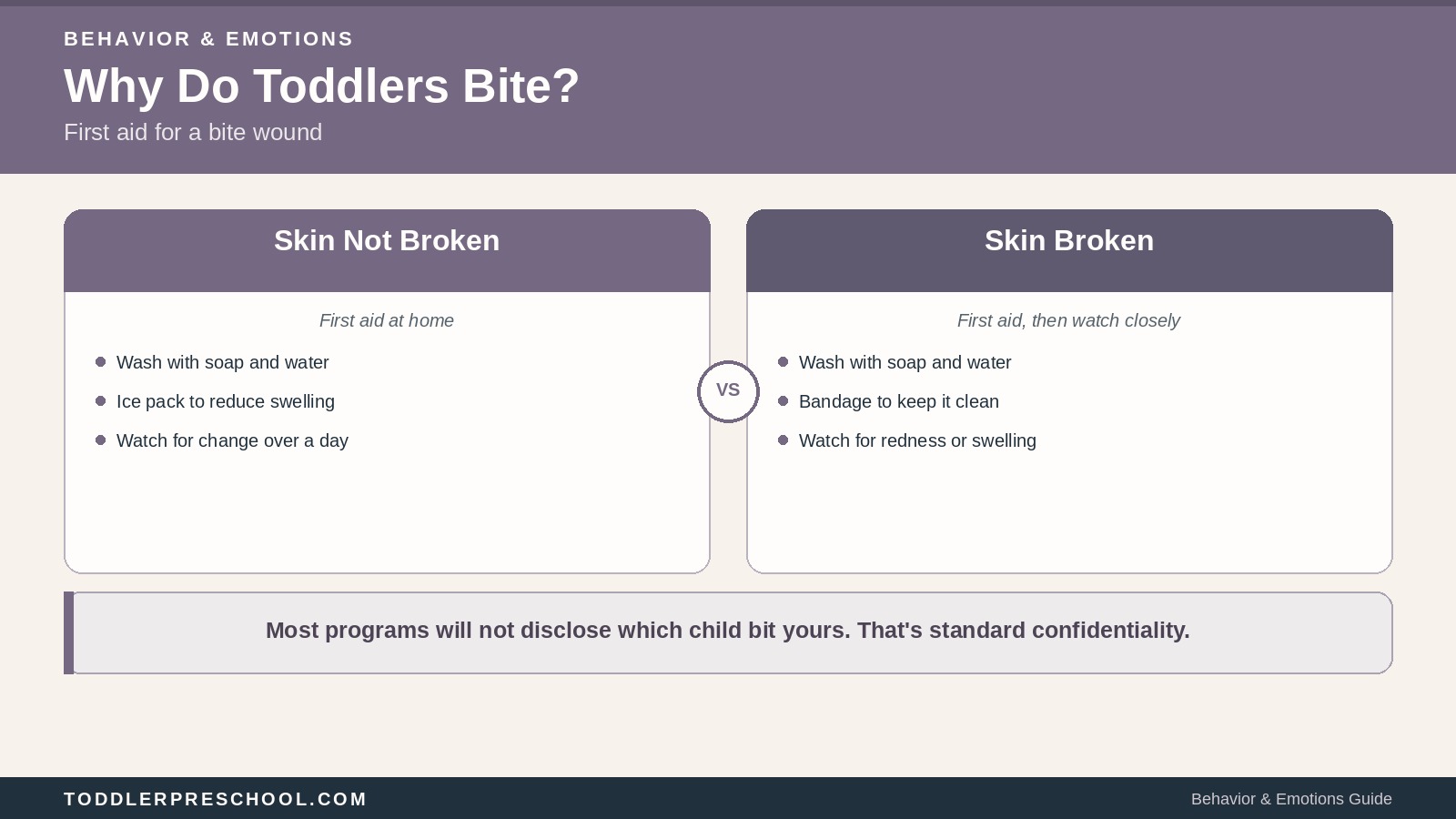
If the Skin Isn’t Broken
Wash the area gently with soap and water. Apply an ice pack or cool cloth to reduce swelling and ease pain. Watch the area over the next day for any change.
Many bites that don’t break skin still leave a visible bruise or ring mark for several days. This is a normal healing pattern, not a sign of a more serious injury.
If the Skin Is Broken
Wash the wound with soap and water. Many childcare programs apply a bandage to keep the area clean. Watch closely for redness, swelling, or warmth over the following days, which can signal infection.
Keep the area clean and covered during the first day or two. Then allow it to air out once any bleeding has stopped. This is a reasonable general approach many programs follow.
When to Seek Medical Care
Contact your pediatrician or seek care in a few specific cases. If the bite breaks skin significantly. If it doesn’t stop bleeding with gentle pressure. Or if it shows signs of infection in the days after. When in doubt about a broken skin bite, a quick call to your pediatrician’s office is a reasonable, low pressure step.
A bite anywhere near the eyes is worth a direct call. So is one that seems unusually deep for a toddler’s bite, rather than waiting to see how it looks the next day.
This Guide Is General Information
The first aid notes above are general information, not a substitute for direct medical guidance for a specific injury. For any bite that seems severe or worrying, contact your pediatrician or seek care directly rather than relying on a general article.
Caring for Your Own Toddler’s Mouth Too
If your toddler bit hard enough to potentially hurt their own teeth or gums, a quick check of their mouth is worth doing too. This is rarely a concern with typical toddler bite strength.
Teaching the Bitten Child to Respond Too
If biting involves a sibling or peer, the other child benefits from coaching too.
A Clear, Simple Response
Teaching a hurt child to say “You hurt me” or “Stop” builds a real self advocacy skill that matters beyond this one incident.
This works even for a very young bitten child. The words themselves matter less than the pattern of learning to speak up, rather than simply absorbing the bite silently.
Involving the Child Who Bit in Repair
Once everyone is calm, encourage the child who bit to help. Getting an ice pack, checking in, can turn the moment into genuine repair rather than only a consequence.
This step should stay optional and age appropriate. A toddler who’s still dysregulated isn’t ready for this yet, and it works better once things have settled. Forcing this step too early, while emotions are still high, tends to backfire and can make the whole interaction feel more like punishment than genuine repair.
When Both Children Are Toddlers
If both children involved are toddlers themselves, expecting a full understanding from either one is unrealistic. The goal is modeling the pattern repeatedly, not achieving complete resolution in any single moment.
Building a Toddler Biting Prevention Plan
The space between incidents is where lasting change tends to happen.
Offer Safe Things to Chew
A chew necklace, a firm teething toy, or even a cold washcloth gives a toddler a genuine, appropriate outlet for oral sensory needs. This is a biting-specific prevention tool with no real equivalent for other physical behaviors.
Offering this proactively, not just after a bite, builds the habit of reaching for an appropriate object first.
Keep a chew item within easy reach during known high-risk times, like right before a meal when hunger and impatience both peak. This makes the idea genuinely usable, not just good in theory.
Watch for Teething Windows
If biting clusters around a specific stretch, check for a new tooth coming in. Teething related biting often eases once that specific tooth has fully emerged.
A quick look at your toddler’s gums can help. Feel gently along the gum line, and you can sometimes confirm a new tooth is on its way even before it’s visible. A slightly swollen or reddened patch of gum is a common sign worth checking for during a biting-heavy stretch.
Common Triggers Beyond Teething
Hunger, overtiredness, and overstimulation contribute to biting just as they do to other toddler behaviors. A quick check, has my child eaten, is nap time close, has today been unusually busy, often explains more than expected.
Keep a loose mental note of when biting tends to happen. Even just noticing a pattern over a week can reveal a specific time of day worth adjusting proactively.
Give Words and Alternative Outlets
Teaching phrases like “no” or “mine” gives a toddler something to reach for besides teeth. Physical outlets like squeezing a soft toy can redirect similar energy safely.
For a toddler with limited spoken language, a simple sign for “mad” or “help” can serve the same function. It gives a nonverbal or early verbal child a real alternative to reach for.
Discourage Pretend Biting in Play
Play biting, even gentle and affectionate, can blur the line for a toddler still learning the actual rule. Redirecting this kind of play toward a toy or a pretend animal keeps the “no biting people” rule consistent.
This includes affectionate “nibbling” games some families play during snuggle time. However sweet the intent, these can genuinely confuse a toddler still building this specific boundary.
Praise Early Communication
Specific praise for using words instead of teeth reinforces what you want to see more of. “You told me you were mad instead of biting. Great choice” does real work over time.
Catching and praising these small moments, even imperfect ones, tends to matter more over time than any single consequence delivered after a bite.
Coordinate With Every Caregiver
If more than one adult is involved in your child’s care, aim for a shared, consistent response. The same approach across every setting helps a toddler learn the pattern faster.
Biting During Breastfeeding or Nursing
For families still nursing a toddler, biting during feeding is a specific, common version of this behavior worth addressing separately.
Why This Happens
Teething discomfort, distraction, or simply testing a reaction are all common reasons behind nursing related biting. This is rarely about anything wrong with the nursing relationship itself.
A Direct, Consistent Response
Calmly end the nursing session for a brief moment after a bite. Pair this with a short verbal limit. This tends to reduce the pattern over time for most toddlers. Reacting with a loud yelp, however understandable, sometimes has the opposite effect by turning it into an interesting game.
This Doesn’t Mean Weaning Is Required
Biting during nursing doesn’t need to mean the end of a nursing relationship your family wants to continue. Most families find this specific pattern eases with a consistent response, similar to biting in any other context.
Understanding Daycare and Preschool Biting Policies
This section covers something most general biting articles skip, and it’s often exactly what a parent searching this topic actually needs.
Why Programs Take Biting So Seriously
Group care settings see biting more often than most homes do, simply from the sheer number of toddlers in close contact. Most licensed programs have a specific, written biting policy for this reason.
Ask your program directly for a copy of their written policy before an incident happens, if they have one. Knowing what to expect ahead of time makes an actual incident far less stressful to navigate for you and for your child’s teacher alike.
Confidentiality: Why You Won’t Get a Name
Most programs will not tell you which child bit yours. The reverse is also true if your child is the one who bit. This is standard confidentiality practice, not a program withholding information unfairly.
This policy protects every family’s privacy equally, including yours on the days your own toddler is the one who bit. It’s worth remembering that frustration from the other side of this exact situation.
Incident Reports and What to Expect
Expect a written incident report after a biting event, whether your child bit or was bitten. This typically documents what happened and any first aid given. It’s often signed by a parent at pickup.
Reading this report calmly, even when it’s upsetting, gives you real information. Time of day, what led up to it, and how staff responded, all useful for building your own prevention plan at home. Keep copies of these reports over time. This can help you and your program spot a pattern that’s hard to see from any single incident alone.
When a Program Asks a Child to Leave
Some programs have specific thresholds, like multiple bites in one day, that trigger a call home or an early pickup. This is a program policy decision, not a judgment about your parenting or your child’s overall character.
A small number of programs have stricter policies still, sometimes involving a formal warning process after a set number of incidents within a short period. Reviewing your specific program’s written policy ahead of time avoids an unpleasant surprise.
Working With Your Program as a Partner
Ask your child’s teacher directly what pattern they’re seeing. Share what you’re trying at home too. This tends to speed up progress more than either side working in isolation.
Many programs are genuinely glad to align their approach with what you’re doing at home, rather than running a separate, uncoordinated response.
If You’re the Parent of the Bitten Child
Receiving a call or report that your child was bitten is understandably upsetting. Most programs are actively managing the situation on their end, even without sharing every detail with you directly. A direct, calm question to staff about what’s being done generally gets a more useful answer than frustration directed at the situation itself. Most programs genuinely want to reassure you that it’s being handled.
Toddler Biting During Specific Daily Moments
Certain moments in an ordinary day tend to produce more biting than others.
Mealtime and Snack Time
Hunger itself, combined with waiting for food, is a common trigger window. Keeping a small, ready snack on hand during meal prep can ease this specific stretch for a toddler who struggles with the wait.
Group Play and Shared Toys
Crowded play spaces with limited toys create frequent, predictable friction. Having duplicate favorite toys available, when realistic, reduces one common source of conflict directly.
Transitions Between Activities
Being asked to stop one activity and move to another, especially abruptly, is a well documented trigger for toddler frustration generally. A brief warning before a transition gives a toddler’s brain a moment to adjust.
End of Day Fatigue
Many toddlers show more biting in the late afternoon or early evening, simply from accumulated fatigue across a long day. Building in a calmer, lower stimulation wind down during this specific window can genuinely help.
Managing Your Own Reaction
Being bitten, or watching your child bite someone else, tests adult patience in a genuinely specific way.
It’s Normal to Feel a Strong Reaction
Being physically bitten by your own child, even briefly, can trigger a surprisingly intense response. Feeling frustrated, embarrassed, or briefly angry doesn’t make you a bad parent.
A Quick Reset Before Responding
If you notice your own frustration spiking, a few deep breaths before responding tends to produce a calmer, more effective reaction than responding instantly.
Give Yourself the Same Grace You’re Teaching
A single sharp reaction on a hard day doesn’t undo weeks of calm, consistent effort. Noticing it and returning to your usual approach matters more than a flawless response every time.
Safety Steps
A few specific safety points are worth stating directly.
Standard Precautions With Blood
If a bite draws blood, basic hygiene precautions, like washing hands after providing first aid, are a reasonable standard practice. Treat it similarly to handling any minor injury.
When Hitting or Biting Escalates Together
If biting happens alongside hitting, scratching, or other physical behavior, the same core response and prevention plan generally applies to all of them together. They aren’t separate problems needing separate scripts.
Coordinating With Every Caregiver
A shared, consistent response across home, daycare, and any other regular caregiver helps a toddler learn the pattern faster than inconsistent expectations.
Supervision During Known High-Risk Play
Stay close enough to intervene quickly during unsupervised play, especially with a significant age or size gap between children. This is a reasonable precaution during a period of frequent biting.
Toddler Biting: Different Settings, Different Patterns
Biting doesn’t always show up the same way everywhere, and that pattern is useful information.
Biting at Daycare but Not at Home
This is extremely common. It often reflects the specific demands of a group setting. More crowding, more waiting, more shared toys, none of which home has in the same way.
Biting at Home but Not at Daycare
The reverse happens too. This sometimes reflects a toddler saving their hardest, most dysregulated moments for the people they feel safest with.
Toddler Biting With Siblings and Multiples
Two children close in age often trigger each other’s frustration simply through constant proximity and shared toys. This is genuinely common and doesn’t reflect a deeper problem between them.
A younger sibling arriving in the home sometimes triggers a temporary increase in biting from an older toddler. This specific, well documented pattern is tied to the adjustment itself, not anything else changing.
Toddler Biting and New Siblings
A new baby in the house is one of the most common, specific triggers for a temporary rise in biting.
Why This Happens So Often
An older toddler suddenly sharing attention, space, and routines with a new baby experiences a genuine, significant change. Biting sometimes emerges as one way of expressing that disruption physically, since the words for it often aren’t there yet.
This is one of the most consistently documented triggers in early childhood behavior. Recognizing it for what it is, a normal adjustment reaction rather than a character shift, helps most parents respond with more patience.
What Tends to Help
Extra one-on-one time with your toddler, even in small five minute windows, can ease this specific trigger meaningfully. Name the change directly: “it’s a big change having a new baby here.” This helps even a toddler who can’t fully respond in words yet.
Involve your toddler in small, genuine ways with the new baby. Handing a diaper, choosing an outfit, singing a song together, can channel that displaced energy into connection rather than competition.
This Usually Eases With Time
Most toddlers settle into the new family rhythm within weeks to a few months. Biting tied specifically to this adjustment tends to ease along with it. If it persists well beyond this general window, treat it the same as any other lingering pattern. The consistent script and prevention steps covered throughout this guide remain the right approach.
The Wide Range of Normal for Toddler Biting
A few sources of genuine variation are worth naming clearly.
Age and Developmental Timing
Biting often peaks somewhat earlier than hitting, frequently in the 12 to 24 month range. It can appear later or persist longer for individual children. A wider range than this is still within normal variation.
Many families see biting ease noticeably once verbal skills catch up. This often happens in the later toddler or early preschool years, though the exact timeline varies widely.
Disability and Developmental Differences
For a child with a diagnosed disability or developmental delay, biting may follow a different timeline or persist longer than general guidance suggests. Your child’s care team is a better guide here than a general article.
For a child with limited communication ability specifically, biting sometimes functions as the clearest tool currently available to them. This makes building alternative communication a genuinely high value part of any plan.
A child working with an occupational therapist may already have specific strategies for oral sensory needs. Those strategies should generally take priority over general suggestions like the ones in this guide.
Temperament
A more intense, sensory seeking temperament genuinely predicts more biting, independent of parenting approach. This is a real individual difference, not a sign anything is being done wrong.
A more easygoing sibling who rarely bites, raised in the exact same household, is a common and expected contrast. It’s not evidence that something different happened with one child.
Multilingual and Multicultural Families
Every script and strategy in this guide works in any language your family speaks at home. Consistency in your child’s most comfortable language matters more than which specific language you use.
When Professional Support Is Warranted
This is the question many families searching for toddler biting guidance actually want answered.
What Typical Toddler Biting Looks Like
Occasional biting tied to a specific trigger, like teething or a toy dispute, is a typical, expected part of toddler development. A single incident, or a pattern that responds to a consistent approach, generally falls into this category.
This pattern is well within the range of expected toddler experience, even when it’s hard to watch. It doesn’t need a specialist evaluation on its own.
Signs Worth a Closer Look
A few signs suggest a pattern worth discussing with a professional:
- Biting that’s frequent and doesn’t ease despite weeks of consistent response
- Biting paired with other significant behavior or developmental concerns
- Bites that are unusually severe or cause repeated injury
- A pattern that escalates over time rather than improving
- Biting that continues well past the toddler years without easing
None of these signs alone means something is seriously wrong. They’re worth a focused conversation with someone who can look at your specific child directly, rather than something to diagnose yourself from a checklist.
Talking to Your Pediatrician
Bring specifics. How often it happens, what settings, what you’ve tried, and how your child responds afterward. This gives your pediatrician real information to work with.
A brief written log kept over even just one or two weeks often reveals a pattern that’s hard to see day to day. Note the time of day and apparent trigger. Bring this log to the appointment, rather than trying to recall details from memory.
When a Specialist Evaluation Makes Sense
Sometimes biting is severe, or doesn’t improve over a reasonable trial period. Sometimes it comes with other concerns. In these cases, an evaluation from a child development specialist is a reasonable, non-alarming next step. This isn’t a last resort. It’s a way to get more targeted help.
None of This Means You Did Anything Wrong
A referral or evaluation isn’t a verdict on your parenting. It’s a way to get more specific, targeted help when a general approach genuinely isn’t moving the needle.
Tracking Progress Without Adding Pressure
Some families find it useful to notice patterns over time.
A Private Log Works Better Than a Visible One
Keep your own private notes, rather than something your toddler sees. This gives you the same useful information without adding performance pressure to an already hard skill.
What to Actually Track
A simple note of when biting happens, what seemed to trigger it, and how your child responded afterward is genuinely useful. Elaborate tracking systems rarely add much beyond this.
Looking for the Trend, Not the Daily Score
A single hard day doesn’t undo weeks of real progress. Looking back over two or three weeks at a time, rather than judging each individual day, usually reveals a clearer picture.
Common Obstacles
A few specific situations come up often enough to address directly.
“My toddler only bites at daycare, never at home.”
This is common and usually reflects the group setting itself, not something wrong at home or at school. Coordinating a shared approach between both settings tends to help more than assuming one setting is failing.
“We’ve tried everything and biting hasn’t improved.”
If a genuinely consistent approach hasn’t produced real change after several weeks, that’s worth raising with your pediatrician. Don’t keep trying new tactics alone indefinitely.
“My child bit once and I overreacted.”
A single overreaction doesn’t undo an otherwise calm pattern. Acknowledging it briefly, even to a young child, models repair without making it a bigger event than needed.
“Daycare wants to meet about my child’s biting, and I feel judged.”
Most programs approach these meetings as problem solving, not blame. Bringing your own observations from home gives the conversation more useful information to work with together.
“My toddler bites when excited, and I don’t know how to prevent that.”
Excitement based biting is trickier to predict than frustration based biting, since it happens during genuinely happy moments. Watch for early physical signs, like a toddler getting increasingly wound up during play. Offering a chew item or a brief pause before things peak can help.
“Other parents seem to judge me when my toddler bites in public.”
A brief, calm response works the same in public as at home. You don’t owe onlookers an explanation, and most parents watching have faced a similar moment themselves or will soon.
Adapting This to Every Family’s Situation
Different family structures. Whoever spends the most time with your child benefits from using the same consistent script and limits. Co-parenting households especially benefit from a quick, direct conversation about the exact words each household will use.
Budget. A basic chew necklace or teething toy costs very little. Everything else in this guide requires no spending at all.
Schedule constraints. If a full prevention routine feels like too much, the single highest value habit is the calm, consistent script used every time.
Access to care. If you don’t have a regular pediatrician yet, community health centers can typically help assess whether a referral makes sense.
Working parents with limited time. A brief, consistent response matters more than an elaborate plan you can’t sustain. Consistency in small moments outweighs an ambitious plan that falls apart after a busy week.
Families new to U.S. childcare norms. If your family is new to navigating a U.S. daycare or preschool setting, asking directly about their specific biting policy, rather than assuming it matches what you may have experienced elsewhere, avoids confusion later.
Cultural and Family Differences in Approach
Families approach this challenge differently, and that’s worth naming directly.
Different Traditions, Same Underlying Goal
Some families lean toward a more structured, consequence driven approach. Others focus more heavily on connection and modeling first. Both traditions can effectively teach a toddler that biting isn’t acceptable, as long as the approach stays calm and consistent.
What Matters Across Every Approach
Regardless of your family’s broader discipline philosophy, avoiding biting your child back, even playfully, matters consistently. Modeling the exact behavior you don’t want to see tends to work against your own goals.
There’s No Single Required Method
What matters most is that your family’s approach is calm, consistent, and paired with genuine teaching rather than punishment alone.
What About Biting Aimed at Pets?
Some toddlers direct biting toward a family pet, which raises its own specific safety consideration.
Why This Happens
The same sensory seeking, excitement, or frustration driving biting toward people can extend to a pet, especially a calm, tolerant one that doesn’t immediately react.
A Genuine Safety Concern in Both Directions
Beyond teaching your toddler that pets aren’t for biting, supervise closely to protect your toddler too. Even a generally gentle pet may eventually react defensively to repeated rough handling. Close supervision during any toddler-pet interaction is a reasonable standard regardless of biting specifically.
A pet that seems tolerant of rough handling today isn’t guaranteed to stay that way indefinitely, especially as a toddler’s own strength increases with age. Building in this supervision habit early protects everyone involved.
Frequently Asked Questions
Questions About the Bite and the Response
Should there be a consequence every time my toddler bites? A consistent response matters more than an elaborate consequence system. A brief pause from play and the clear verbal limit are often enough, especially for a younger toddler.
Is it normal for my toddler to bite again minutes after we talked about it? Yes. Learning a new behavior pattern takes many repetitions over weeks, not one successful conversation.
Does teething explain all toddler biting? No. Teething explains some biting, especially in younger toddlers. Frustration, sensory seeking, and testing cause and effect all remain common causes well beyond the teething years.
Questions About Daycare and Patterns
Should I ask daycare who bit my child? Most programs won’t share this. That’s standard confidentiality practice rather than a program withholding information unfairly. Asking about the general pattern and prevention plan is usually more productive than asking for a specific name.
My toddler bit a sibling but has never bitten anyone else. Is that different? Targeting a sibling specifically is common. It often reflects proximity and shared attention more than anything deeper. Watch for genuine escalation rather than assuming the worst from this pattern alone.
How long does a typical biting phase last? There’s no fixed timeline, but many toddlers show real improvement within a few months of a consistent approach. Biting typically becomes much less common through the preschool years.
A Few More Common Questions
Should I use a chew necklace even if my toddler isn’t teething right now? Yes, a chew necklace or similar item can help regardless of the specific cause. It offers a safe outlet for oral sensory needs, whether the trigger is teething, excitement, or general sensory seeking.
Is it true that some toddlers bite because they’re copying a sibling or classmate? Yes, toddlers are close observers, and biting they’ve witnessed from another child can genuinely become something they try themselves. This isn’t cause for alarm; it’s simply one more common driver alongside the others covered in this guide.
My toddler seems to bite specifically when I’m on the phone or distracted. Is that intentional attention seeking? This pattern is common and often reflects a toddler’s bid for connection in a specific moment, more than a calculated strategy. Building in a little more proactive, undivided attention during predictable busy moments, like a phone call, can genuinely help.
Is there a genetic or family component to biting, or is it purely situational? Temperament, which does have some genetic component, plays a real role in how intensely a toddler expresses frustration physically. That said, situational factors like teething, tiredness, and environment still matter enormously, regardless of temperament.
Noticing Real Progress, Even When It’s Slow
Progress with toddler biting rarely moves in a straight line.
Fewer Incidents Over Time Still Counts
A drop from frequent biting to occasional biting, even with harder days mixed in, is real progress. It’s easy to focus only on the hard days and miss the overall trend improving underneath them.
Faster Recovery Is Also Progress
A toddler who calms down more quickly after biting is building real skill. So is a toddler who reaches for words some of the time, even before biting itself has fully stopped.
Setbacks During Stressful Periods Are Expected
A return of more frequent biting during a stressful stretch, illness, a new sibling, a move, doesn’t erase progress already made. Most toddlers return to their improved baseline once the stressor passes.
Your One Next Step
Write down the exact short script you’ll use next time, something like “I won’t let you bite. Biting hurts. Show me your teeth are for food,” and keep a chew necklace or teething toy within reach so you have a redirect ready too.
The next time biting happens, you won’t be improvising. You’ll already have a calm, practiced response ready, which is often the single biggest factor in staying steady when it actually counts. Most families look back on this specific stage as a genuinely temporary one, however intense it feels right now.
Sources consulted: Centers for Disease Control and Prevention, Essentials for Parenting Toddlers and Preschoolers; UCSF and Office of Head Start biting fact sheet for families; multiple current published childcare center biting policies reviewed for consistency on first aid, confidentiality, and incident reporting practices.