
Your toddler just hit you, or a sibling, or a friend at the park. You’re standing there in front of other people, wondering what to actually do right now. Toddler hitting catches most parents off guard the first few times. Then you’re wondering something bigger. Is this normal, and what do you do about it between incidents, not just in the moment?
Here’s the direct answer. Toddler hitting is extremely common, and it usually reflects a skill gap rather than a character problem. It responds best to a short, calm, consistent script in the moment, paired with a genuine prevention plan between incidents. This guide covers both halves. Exactly what to do when it happens, and what to build into your everyday routine so it happens less over time.
You’re not the only parent dealing with this today. This specific stage genuinely does pass for the vast majority of toddlers, however hard it feels right now. Time and a consistent approach make the difference.
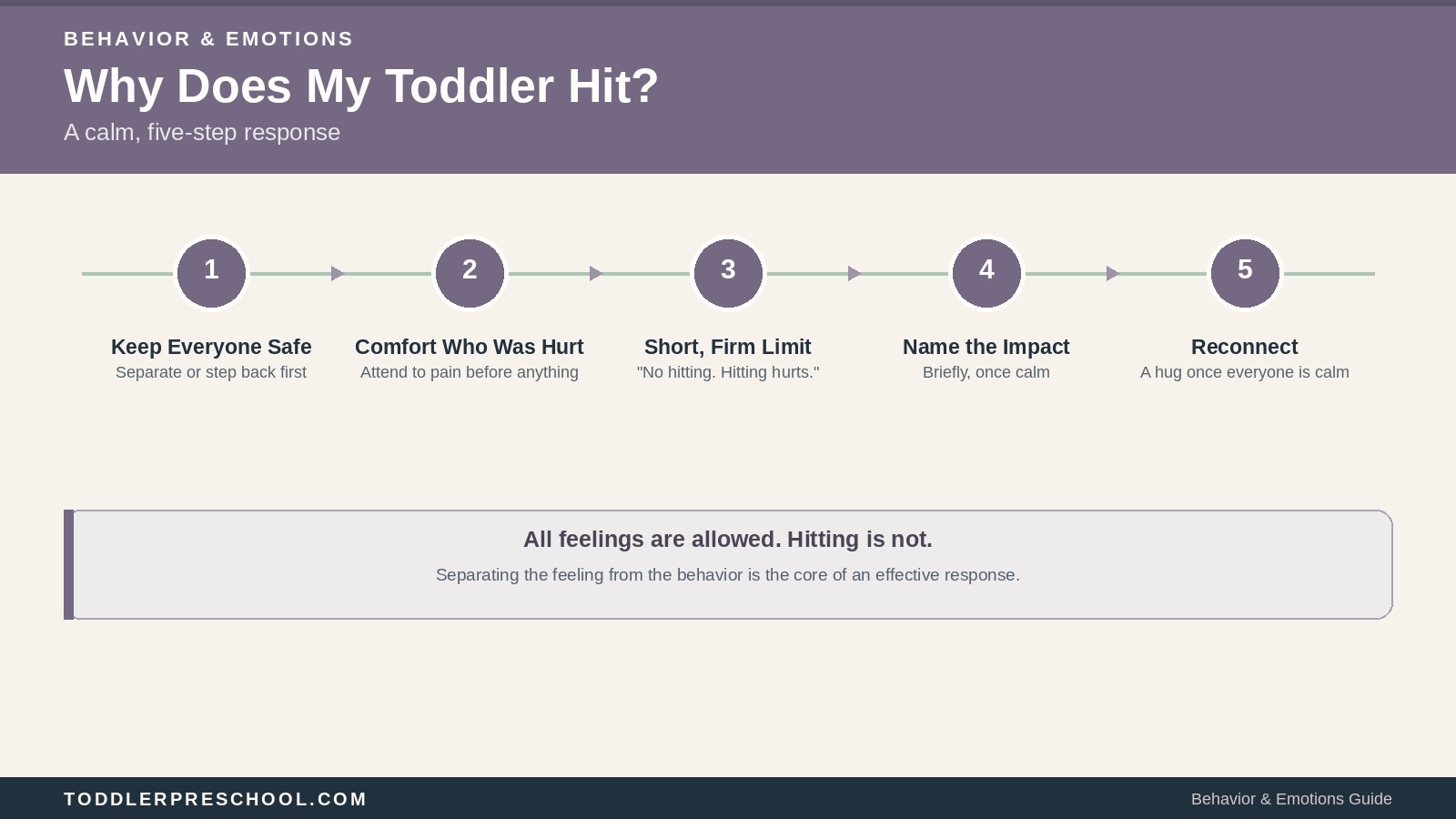
The Direct Answer: What to Do When Your Toddler Hits
Keep everyone physically safe first. Attend briefly to whoever was hurt. Give your child a short, firm limit, without a lecture, and reconnect once things are calm.
None of this requires a perfect response every single time. It requires a consistent pattern your child can start to predict and learn from.
This guide covers the full picture behind toddler hitting. Why it happens, exactly what to do in the moment, how to build a prevention plan for the space between incidents. And how to tell typical toddler behavior from a pattern worth discussing with a professional.
Why Toddler Hitting Happens: The Developmental Logic
Understanding the “why” doesn’t excuse hitting, but it does change how you respond to it.
Language Outpaced by Feelings
A toddler’s feelings often arrive faster and bigger than their words can keep up with. When frustration spikes and the right words aren’t there yet, the body sometimes acts before the brain catches up.
This gap between feeling and language narrows gradually over the preschool years, not overnight. That’s exactly why patience during this specific stretch genuinely matters.
Impulse Control Is Still Under Construction
The brain skill that lets an older child pause between feeling something and acting on it takes years to build. It’s still developing throughout the toddler and early preschool years. This isn’t a character flaw. It’s a timeline every child moves through at their own pace.
Adults sometimes expect a toddler to have adult level self control simply because they can walk, talk, and follow some directions. Impulse control develops on its own separate timeline, well past the toddler years for most of these specific skills.
Testing Cause and Effect
Some hitting has nothing to do with big feelings at all. A toddler may hit simply to see what happens next. It’s the same curiosity that drives dropping food off a high chair repeatedly to watch it fall.
This experimental hitting often looks different from angry hitting: calmer, more curious, sometimes even accompanied by watching your face closely for a reaction.
Self Defense
A toddler who’s been hit, scared, or startled by someone else may hit back as a direct, unfiltered response. This includes situations where an adult has physically disciplined a child, which research has linked to more aggressive behavior, not less.
A toddler in this moment isn’t calculating right and wrong. They’re reacting to a perceived threat the same fast, unfiltered way any young child would.
Copying What They’ve Seen
Toddlers are constant observers. That includes observing aggression, whether from a sibling, a show, or an adult’s own physical response to frustration. What a child sees modeled shapes what they try themselves.
This isn’t about assigning blame to any specific household. It’s simply a reminder that toddlers absorb far more from what they watch than from what they’re told. A household that’s generally calm can still have a toddler going through a hitting phase. Siblings, peers, media, and simple developmental timing all play a role too, not parenting alone.
Seeking Attention, Even Negative Attention
For a toddler starved for connection in a specific moment, negative attention can feel better than none at all. A hit that reliably gets an adult’s full, immediate focus can become a pattern, even when that attention comes with a consequence.
Recognizing this pattern matters because the fix often isn’t a bigger consequence. It’s more proactive, positive attention during the calm stretches between incidents.
Toddler Hitting: Separating Feelings From Behavior Limits
This distinction sits at the center of every effective response to toddler hitting.
All Feelings Are Allowed, Not All Behaviors
Anger, frustration, and jealousy are all completely legitimate feelings for a toddler to have. Hitting is simply not an acceptable way to act on any of them. Holding both truths at once is the core of a calm, effective response.
A parent who only addresses the behavior, without ever acknowledging the feeling underneath it, misses a real chance to teach. A parent who only validates the feeling, without holding the behavior limit, misses the other half of the lesson.
Naming the Feeling Without Excusing the Hit
“You’re really mad that he took your truck” names the feeling accurately. “And hitting isn’t okay, even when you’re mad” holds the limit just as clearly. Neither sentence needs to apologize for the other.
Over time, hearing both halves paired together, feeling named and limit held, teaches a toddler that emotions themselves are never the problem. The specific choice of action is what needs to change.
Why This Framing Actually Works Better Than Punishment Alone
A purely punishment focused response teaches a child what not to do, but rarely teaches what to do instead. Naming the feeling and offering a next step gives a toddler an actual alternative to reach for. It’s not just a behavior to suppress.
What to Do in the Moment: A Step by Step Script
This sequence works whether your toddler hit a sibling, a peer, or you directly.
Step 1: Keep Everyone Safe First
Physically separate the children, or step back yourself, before anything else happens. Safety comes before any conversation, explanation, or consequence.
If a hit happened during active play, physically moving between the two children often works best. Simply redirecting verbally from a distance usually isn’t enough.
Step 2: Attend to Whoever Was Hurt
Check on the hurt child or person first, briefly and calmly. This isn’t about punishing the child who hit by ignoring them. It’s about making sure anyone in pain gets attention before anything else happens.
A brief check, “are you okay, let me see,” models care and also gives everyone a moment to settle before the next step.
Step 3: A Short, Firm Limit
Use very few words, especially for a child with limited language: “No hitting. Hitting hurts.” Your tone and expression communicate as much as the words themselves.
A firm, calm tone lands better than a loud or panicked one. Toddlers read emotional intensity closely, and matching their intensity with your own often escalates rather than calms the moment.
Step 4: Name What Happened, Briefly
Once things are calmer, name the impact plainly: “You hurt him, and he’s crying.” This isn’t a lecture. It’s a short, factual bridge between the behavior and its real effect on another person.
Keep this step genuinely brief. A long explanation asks more processing than most toddlers can manage in an already dysregulated moment.
Step 5: Reconnect Once Everyone Is Calm
After the moment has passed, a hug, a return to normal tone, and moving forward together matters. Discipline in these years works best as teaching, not as prolonged distance or shame.
Extended silent treatment or ongoing coldness after an incident tends to confuse a young child more than it teaches. The connection between the specific behavior and the consequence gets lost over time.
A Sample Script You Can Actually Use
“I won’t let you hit. You’re really mad that Sam took the truck. Hitting hurts, and I need you to use words instead.” Said calmly, in that order, this covers the limit, the feeling, and the redirect in one breath.
A Second Script for a Younger Toddler With Very Little Language
For a toddler under about 2, an even shorter version works better: “No hit. Hurts.” Paired with a firm, gentle physical block of the next attempt, this matches what a very young child can actually process in the moment.
What Not to Do
Don’t hit or spank back, even as a quick reflexive response. Don’t get in your child’s face or raise your voice to match their intensity. Don’t deliver a long lecture in the heated moment itself; save teaching for when everyone is calm. And don’t try to teach an alternative behavior while your child is still upset. A dysregulated brain isn’t in a state to absorb a new lesson yet.
Teaching the Other Child to Respond Too
If hitting involves a sibling or peer, the other child benefits from coaching just as much as the one who hit.
Encouraging a Clear, Simple Response
Teach the hurt child to say “You hurt me” or “I don’t like that.” This builds a real, useful self advocacy skill, one that matters well beyond this specific incident.
This works even for a very young hurt child. The words themselves matter less than the pattern of learning to speak up, rather than simply absorbing the hit silently.
It’s Okay to Set a Boundary Together
“If you keep hitting, she can’t play with you right now” is a reasonable, calm boundary to state aloud. It models for both children that hurtful behavior has a real, immediate consequence within play itself.
This kind of natural, logical consequence tends to land better than an unrelated punishment. The connection between the behavior and the outcome is immediate and obvious to both children.
Helping the Hit Child Feel Involved in Repair
Encourage the child who hit to help care for the hurt child. Getting an ice pack, offering a tissue, checking in, all can turn the moment into a genuine repair rather than only a punishment.
This step should stay optional and age appropriate. A toddler who’s still dysregulated isn’t ready for this step yet, and it works better once everyone has calmed down.
When Both Children Are Toddlers
If both children involved are toddlers themselves, expecting either one to fully understand the exchange is unrealistic. The goal at this age is modeling the pattern repeatedly, not achieving a full resolution in any single moment.
Building a Toddler Hitting Prevention Plan Between Incidents
The in-the-moment response matters, but the space between incidents is where real, lasting change tends to happen.
Watch for the Common Triggers
Hunger, overtiredness, and overstimulation are behind a large share of toddler hitting. A quick mental check often explains more than it seems like it should. Has my child eaten recently? Is nap time close? Has today been unusually loud or busy?
Keep a loose mental log of when hitting tends to happen. Even just noticing a pattern over a week can reveal a specific time of day or situation worth adjusting proactively.
Practice Gentle Touch at Neutral Times
Practice a gentle high five, a soft pat, or a hug during a calm moment, completely separate from any incident. This builds the physical habit your child can draw on later. This works far better taught proactively than mid conflict.
Narrate the difference out loud during calm practice: “this is gentle, see how soft that felt.” This gives a toddler a concrete physical reference point to compare against later.
Give Words and Alternative Outlets
Teaching specific phrases, “I’m mad,” “my turn,” “stop,” gives a toddler something to reach for instead of a hit. Physical outlets like stomping, squeezing a soft toy, or a big body movement can also redirect the same energy safely.
For a toddler with limited spoken language, simple signs for “mad,” “stop,” or “help” can serve the exact same function. They give a nonverbal or early verbal child a real alternative to reach for.
Praise Early, Calm Communication
Specific praise for using words instead of hands, even imperfectly, reinforces the behavior you actually want to see more of. “You told me you were mad instead of hitting. That was a great choice” does real work over time.
Catching and praising these moments, even small ones, tends to matter more over time than any single consequence delivered after a hit.
Read About Feelings Together
Simple picture books about anger, frustration, or sharing give a toddler real language. They also become a shared reference point to draw on outside the heat of an actual moment.
Revisit the same book repeatedly, rather than moving through many different ones. This often helps a toddler internalize the specific language and examples more deeply.
Coordinate With Every Caregiver
If more than one adult is involved in your child’s care, aim for a shared, consistent response. The same approach across every setting helps. Home, daycare, grandparent’s house, all teach the pattern faster than inconsistent expectations across different people.
A short written note helps. So does a quick conversation about your specific script and approach, so a new or occasional caregiver can respond the same way you would.
Cultural and Family Differences in Discipline Approach
Families approach discipline very differently, and it’s worth naming that directly rather than assuming one universal method.
Different Traditions, Same Underlying Goal
Some families use a more structured, consequence driven approach from an early age. Others lean more heavily on connection and modeling before introducing formal consequences. Both traditions can effectively teach a toddler that hitting isn’t acceptable, as long as the approach stays calm and consistent.
What Matters Most Across Approaches
Avoiding physical punishment in response to hitting matters consistently across the research on this topic. This holds regardless of the specific discipline philosophy your family follows. Modeling the exact behavior you don’t want to see tends to work against your own goals. This holds true whatever else your broader approach looks like.
There’s No Single Required Method
What matters most is that your family’s specific approach is calm, consistent, and paired with genuine teaching rather than punishment alone. The exact method matters less than that underlying foundation.
Toddler Hitting During Specific Daily Transitions
Certain moments in an ordinary day tend to produce more hitting than others, and knowing your child’s specific pattern helps target prevention.
Mealtime Frustration
Hunger itself, combined with waiting for food or being told to stay seated, is a common trigger window. Having a small, ready snack available during meal prep can ease this specific stretch for a toddler who struggles with the wait.
Bedtime and Naptime Resistance
Overtiredness paradoxically often peaks right at the moments a toddler most needs to wind down. This makes bedtime and naptime transitions a common hitting window. A predictable, calm wind down routine, started before your child is already overtired, tends to reduce this specific pattern over time.
Drop-off and Separation Moments
The stress of separation at daycare or preschool drop-off can spill into physical behavior, sometimes directed at the parent who’s leaving. This isn’t defiance; it’s often an overwhelmed toddler’s most immediate way of expressing a big, hard feeling in a rushed moment.
A short, consistent goodbye routine tends to reduce this specific hitting pattern too. It’s the same one many families already use to ease general separation anxiety, and it lowers the overall stress of the moment rather than addressing hitting in isolation.
Transitions Between Activities
Being asked to stop one activity and move to another, especially abruptly, is a well documented trigger for toddler frustration. Hitting is no exception. A brief warning before a transition helps: “two more minutes, then we clean up.” It gives a toddler’s brain a moment to adjust before the actual change happens.
Managing Your Own Reaction
Being hit, or watching your child hit someone else, tests adult patience in a genuinely specific way, and that’s worth naming honestly.
It’s Normal to Feel a Strong Reaction
Being physically hit by your own child, even by a small toddler with limited force, can trigger a surprisingly intense emotional response. Feeling frustrated, embarrassed, or even briefly angry doesn’t make you a bad parent.
A Quick Reset Before Responding
If you notice your own frustration spiking, take a few deep breaths before responding. This tends to produce a calmer, more effective reaction than responding instantly in the heat of the moment.
Give Yourself the Same Grace You’re Teaching
A single sharp reaction on a hard day doesn’t undo weeks of calm, consistent effort. Noticing it and returning to your usual calm approach matters more than achieving a flawless response every single time.
Handling Toddler Hitting in Public
An audience adds a layer most parents don’t expect to think about in the moment.
You Don’t Owe Anyone an Explanation
A brief, calm response works exactly the same in public as it does at home. You don’t need to apologize extensively or explain your child’s behavior to onlookers.
Other Parents Have Been There Too
Most parents watching have experienced a similar moment themselves, or will soon enough. The judgment you imagine is usually far less than what’s actually happening around you.
Leaving Early Is a Reasonable Choice
If a specific outing has become genuinely overwhelming and hitting keeps recurring, ending it early isn’t a failure. It’s a reasonable response to a toddler who’s clearly signaling they’ve reached their limit for the day.
Safety Steps
A few specific safety considerations are worth naming directly.
When Hitting Involves a Sibling
Stay close enough to intervene quickly during unsupervised sibling play, especially with a significant age or size gap. A younger sibling is sometimes genuinely unable to defend themselves physically.
Set up play in a shared, visible space rather than a closed bedroom, at least during a period of frequent hitting. This makes quick intervention realistically possible.
When Hitting Involves a Parent or Caregiver
An adult who feels their own anger rising in response to being hit should signal a partner or another caregiver. A brief break helps, if at all possible. Stepping away for a moment to regulate yourself is a reasonable, responsible choice, not a failure.
If you’re parenting alone in the moment with no one to tag in, try a brief physical step back. Even just standing up and moving a few feet away, while staying in the room, can help. It creates enough space to respond calmly rather than reactively.
When Hitting Involves a Peer at Daycare or Preschool
Ask your child’s program directly how they handle these moments and whether a specific pattern has emerged there. Consistency between home and program response genuinely speeds up progress.
Most programs have their own established protocol for this exact situation. Aligning your home approach with theirs, rather than working at cross purposes, tends to help more than either approach alone.
When an Object Is Involved
If hitting escalates to include throwing an object or using something as a weapon, treat this as a more serious safety moment. It requires immediate physical intervention, separate from the standard verbal script. Remove the object and the child from the situation together.
Toddler Hitting: Different Settings, Different Patterns
Hitting doesn’t always show up the same way in every environment, and that pattern itself is useful information.
Hitting at Home but Not at School
A toddler who hits only at home, and not in a more structured group setting, often understands the specific expectations at school clearly. This is frequently a reassuring sign. It shows your child can and does regulate their behavior, at least with the right supports in place.
This pattern sometimes reflects a toddler saving their hardest, most dysregulated moments for the people they feel safest and most attached to. That’s a genuinely different interpretation than simply “worse behavior” at home.
Hitting at School but Not at Home
The reverse pattern is common too. It often reflects the specific demands of a group setting. More waiting, more sharing, more transitions, none of which home requires in the same way. This isn’t a sign that home discipline has failed.
A program with a higher child to adult ratio, more frequent transitions, or a louder overall environment simply presents more triggers over the course of a day. A typical home setting doesn’t compare.
When the Pattern Is Genuinely Inconsistent
Some toddlers show no clear pattern at all, hitting occasionally in various settings without an obvious trigger. This is common too, and doesn’t necessarily point to anything beyond normal individual variation in how a specific child is currently regulating.
Toddler Hitting With Siblings and Multiples
Households with more than one young child face their own specific version of this challenge.
Twins and Close-in-Age Siblings
Two children close in age often trigger each other’s frustration simply through constant proximity and shared toys. This has more to do with proximity than anything specific about either child’s temperament. This pattern is genuinely common and doesn’t reflect a deeper problem between them.
An Older Sibling’s Role
An older sibling, even one just a year or two ahead developmentally, sometimes follows the “no hitting” limit more consistently. A younger toddler is often still building that same skill. Expecting identical behavior from children at different developmental stages sets everyone up for frustration.
Avoiding the Referee Trap
Constantly intervening in every single sibling conflict can prevent children from building their own conflict resolution skills over time. Stepping in specifically when hitting happens, rather than at every disagreement, strikes a more sustainable balance for most families.
The Wide Range of Normal for Toddler Hitting
A few sources of genuine variation are worth naming clearly.
Age and Developmental Timing
Hitting is most common in the roughly 18 month to 3 year range. It can appear earlier or persist somewhat longer for individual children. A wider range than this is still well within normal variation.
Many families see a genuine peak somewhere in the middle of this range. It often coincides with a period of rapid independence seeking and still limited verbal skill, before gradually easing as language catches up.
Disability and Developmental Differences
For a child with a diagnosed disability or developmental delay, this specific behavior may follow a different timeline. It may also persist longer than general guidance suggests. Your child’s care team is a better guide here than a general article.
A child working with an occupational therapist or behavioral specialist may already have an individualized plan for this exact behavior. That plan should generally take priority over general strategies like the ones in this guide. For a child with limited or emerging communication ability specifically, hitting sometimes functions as the clearest form of communication. It may be the only tool currently available to them. This makes building alternative communication tools, like picture cards or simple sign language, a particularly high value part of any plan.
Temperament
A more intense, reactive temperament genuinely predicts more visible physical responses to frustration, independent of parenting approach. This is a real individual difference, not a reflection of anything being done wrong.
A more easygoing sibling who rarely hits, raised in the exact same household with the exact same approach, is a common and completely expected contrast. It’s not evidence that something different happened with one child.
Multilingual and Multicultural Families
Every script and strategy in this guide works in any language your family speaks at home. Consistency in your child’s most comfortable language matters more than which specific language you use. Switching between languages during an emotional moment is completely fine.
First-Time Parents Versus Experienced Ones
A first-time parent sometimes finds toddler hitting more alarming, simply from lack of prior experience. This isn’t because anything about the behavior itself is more serious. A parent who’s already raised a hitting toddler once often approaches the second time with more built-in calm. That calm comes purely from familiarity with how common and temporary this stage typically is.
When Professional Support Is Warranted
This is the question many families searching for toddler hitting guidance actually want answered, and it deserves a direct response.
What Typical Toddler Hitting Looks Like
According to pediatric guidance, occasional hitting tied to a specific frustration, like a toy dispute, is typical. It’s an expected part of toddler development, not something to treat as aggression in a clinical sense. A single incident, or an occasional pattern that responds to a consistent approach, generally falls into this category.
Pediatric psychologists specifically note that an isolated instance, like pushing a peer during a moment of frustration, isn’t automatically concerning. It only becomes worth watching once it’s part of a genuine, ongoing pattern.
Signs Worth a Closer Look
A few signs suggest a pattern worth discussing with a professional:
- Hitting that’s frequent and doesn’t ease despite weeks of a consistent, calm response
- Hitting paired with other significant behavior or developmental concerns
- Hitting that causes real, repeated injury to another child or an adult
- A pattern that escalates over time rather than staying flat or improving
- Hitting that seems to happen without any identifiable trigger, repeatedly
None of these signs, on their own, means something is seriously wrong. They’re simply worth a more focused conversation with someone who can look at your specific child directly.
Talking to Your Pediatrician
Bring specifics: how often it happens, what settings it happens in, what you’ve already tried, and how your child responds afterward. This gives your pediatrician real information to work with, rather than a general impression.
A brief written log kept over even just one or two weeks often reveals a pattern that’s hard to see day to day. Note the time of day, apparent trigger, and what happened afterward.
When a Specialist Evaluation Makes Sense
Sometimes hitting is severe, or doesn’t improve with a consistent approach over a genuinely reasonable trial period. Sometimes it comes alongside other concerns. In these cases, an evaluation from a child development specialist or behavioral health professional is a reasonable, non-alarming next step. This isn’t a last resort. It’s a way to get more targeted support.
None of This Means You Did Anything Wrong
A referral or evaluation isn’t a verdict on your parenting. It’s a way to get more specific, targeted help when a general approach genuinely isn’t moving the needle. Plenty of families who eventually sought this kind of support look back on it simply as one more resource. It wasn’t a sign anything had gone seriously wrong along the way, and most describe the process itself as far less intimidating than they’d expected going in.
Tracking Progress Without Adding Pressure
Some families find it useful to notice patterns over time. Done thoughtfully, this can genuinely help.
A Private Log Works Better Than a Visible Chart
Keep your own private notes, rather than a chart your toddler sees and might feel judged by. This gives you the same useful information without adding performance pressure to an already hard skill.
What to Actually Track
A simple note of when hitting happens, what seemed to trigger it, and how your child responded afterward is genuinely useful. Elaborate tracking systems rarely add much beyond this basic information.
Looking for the Trend, Not the Daily Score
A single hard day doesn’t undo weeks of real progress, and a single good day doesn’t mean the work is finished. Look back over two or three weeks at a time, rather than judging each individual day. This usually reveals a clearer picture of whether your approach is working.
When to Stop Tracking Altogether
Once hitting feels reasonably infrequent and manageable, tracking usually stops being useful. Continuing to log every single incident well past the point of real improvement can start to feel like surveillance rather than support. That’s true both for you and eventually for your child.
Common Obstacles With Toddler Hitting
A few specific situations come up often enough to address directly.
“My toddler hits, then laughs, which makes it feel worse.”
Laughing after hitting is common and doesn’t necessarily mean your child finds it funny in the way it looks. It’s sometimes a nervous or overstimulated response rather than genuine amusement. Responding with the same calm limit regardless works just as well.
“We’ve tried everything and the hitting hasn’t improved at all.”
If a genuinely consistent approach hasn’t produced any real change after several weeks, raise it with your pediatrician. That’s a better path than continuing to try new tactics indefinitely on your own.
“My toddler only hits me, never anyone else.”
This is common and often reflects how safe your child feels expressing big emotions with you specifically. It’s not a sign you’re doing something wrong. If anything, it often reflects a secure relationship where your child trusts you’ll stay present even through difficult behavior.
“My child hit once and I overreacted. How do I undo that?”
A single overreaction doesn’t undo an otherwise calm, consistent pattern. Acknowledge it briefly, even to a very young child: “I got too loud, I’m sorry, let’s try again.” This models repair without turning it into a bigger event than it needs to be.
“My toddler hits when I say no, even to something small.”
This is a common, specific pattern, often reflecting low frustration tolerance around limits generally, not just physical aggression specifically. The same core approach applies here. Hold the limit calmly, name the frustration, and don’t cave to the hit by reversing the original no.
“My child hits other kids but never hits family members.”
This split is common and doesn’t necessarily mean anything concerning on its own. Some toddlers genuinely find peer interactions, with their unpredictable sharing and turn taking demands, more frustrating than familiar family dynamics.
Adapting This to Every Family’s Situation
Different family structures. Whoever spends the most time with your child benefits from using the same consistent script and limits. This holds regardless of the specific relationship to the child. Co-parenting households especially benefit from a quick, direct conversation about the exact words and approach each household will use.
Budget. Nothing in this guide requires spending money. A consistent response and some proactive practice at calm moments cost nothing and fit into any family’s existing routine.
Schedule constraints. If a full prevention routine feels like too much some weeks, the single highest value habit is the calm, consistent in-the-moment script. Everything else in this guide is a genuine bonus on top of that.
Access to care. If you don’t have a regular pediatrician yet, community health centers can help. They can typically assess whether a referral makes sense for a pattern that’s genuinely concerning you.
Working parents with limited time. A brief, consistent script used every single time genuinely matters more than an elaborate, time consuming prevention plan you can’t realistically sustain. Consistency in the small moments outweighs an ambitious plan that falls apart after a busy week.
Noticing Real Progress, Even When It’s Slow
Progress with toddler hitting rarely moves in a straight line. Recognizing what genuine improvement actually looks like helps you stay the course.
Fewer Incidents Over Time Still Counts
A drop from daily hitting to a few times a week, even with occasional harder days mixed in, is real progress. It’s easy to focus only on the hard days and miss the overall trend improving underneath them.
Faster Recovery Is Also Progress
A toddler who calms down more quickly after hitting is building real skill. The same goes for a toddler who starts using words some of the time. This counts even if it’s not consistent yet, even before hitting itself has fully stopped.
Setbacks During Stressful Periods Are Expected
A return of more frequent hitting during a stressful stretch, illness, travel, a new sibling, doesn’t erase the progress already made. Most toddlers return to their improved baseline once the specific stressor passes.
Frequently Asked Questions
Questions About the In-the-Moment Response
Should there be a consequence every single time my toddler hits? A consistent response matters more than an elaborate consequence system. A brief pause from play is often enough. A short time near you to calm down, or simply the clear verbal limit itself, works especially well for a younger toddler.
What if my toddler hits again five minutes after we talked about it? This is extremely common and doesn’t mean the conversation failed. Learning a new behavior pattern takes many repetitions over weeks or months, not a single successful talk.
Is it okay to remove privileges, like a favorite toy, after hitting? This is a personal family choice rather than a strict requirement. For most toddlers, a clear verbal limit and brief separation from play work just as well as removing a specific item. Neither approach adds an extra layer to manage.
Questions About Patterns and Support
My toddler seems to target one specific sibling. Is that concerning? Targeting a specific sibling, especially one close in age, is common and often reflects proximity and shared toys more than anything deeper. Watching for genuine escalation, rather than assuming the worst from a pattern alone, is a reasonable approach.
How long does a typical hitting phase last? There’s no fixed timeline. Many toddlers show real improvement over a few months of consistent response, with hitting becoming less frequent through the preschool years as language and impulse control both develop further.
More Questions About Hitting Patterns
Does biting follow the same guidance as hitting? Largely yes. The same core approach applies to biting as well. Calm intervention, attention to whoever was hurt, a short firm limit, and prevention through addressing triggers all matter here. They rest on the same developmental logic.
Should I make my toddler apologize after hitting? A forced apology from a very young child often means little to them. It can turn into an empty ritual rather than genuine understanding. Model an apology yourself, or gently suggest one once your child is calm and willing. This tends to teach more than requiring one in the heated moment.
My toddler hits stuffed animals or toys, not people. Is that different? This is generally a lower concern pattern. It’s sometimes even a healthy outlet for big feelings, similar to the physical redirect strategies mentioned earlier in this guide. Watch for whether it stays contained to objects or starts extending to people or animals.
Different Family Structures and Traditions
Is there a difference between hitting and rough, physical play that looks similar? Yes, and it’s worth distinguishing. Rough play both children are enjoying looks different from a real conflict. Mutual laughter and willing participation are the key signs, versus one child clearly upset or trying to get away. Watching the reaction of the other child, not just the physical action itself, usually clarifies which situation you’re looking at.
My toddler hits when excited, not just when frustrated. Is that the same thing? Excitement based hitting stems from a similar impulse control gap as frustration based hitting. It’s sometimes just a big, uncontrolled physical release during genuinely happy moments. The same core response, a calm limit paired with a safe physical outlet, works for both versions.
Does it matter whether one or both parents use the exact same script? Close alignment helps more than word-for-word identical phrasing. What matters most is that no adult undermines another’s consistency, especially around the core limit itself and how calmly it gets delivered.
Your One Next Step
Write down the exact short script you’ll use next time your toddler hits, something like “I won’t let you hit. Hitting hurts. Use your words,” and practice saying it out loud once today, so it’s ready before you need it.
The next time hitting happens, you won’t be improvising in the moment. You’ll already have a calm, practiced response ready to go. That’s often the single biggest factor in staying steady when it actually counts.
Sources consulted: Centers for Disease Control and Prevention, Essentials for Parenting Toddlers and Preschoolers; Office of Head Start biting fact sheet for families; Children’s Mercy Hospital pediatric guidance on hitting and biting; Cleveland Clinic pediatric psychology commentary on toddler aggression.