
You’re standing in front of a shelf, or scrolling a search results page at 11 p.m., trying to pick one book about starting preschool before the first day arrives. There are dozens of options, most of them rated 4.5 stars, and no real way to tell from a thumbnail which one will actually land with your particular kid. Books about starting preschool.
Here’s the direct answer: the “best” book about starting preschool isn’t the same for every child, and the loudest bestseller badge doesn’t tell you what you actually need to know. Fit depends on your child’s age, their specific worry (or lack of one), how much text they can sit through, whether they need a ritual, a laugh, or a straight preview of what the day will look like, and what your budget and library access actually allow. This guide compares 12 real, currently available titles against those factors, tells you plainly who should skip each one, and gives you a free or low-cost alternative for every pick — so you can make a decision in minutes instead of reading fifty reviews.
How We Chose and Reviewed These 12 Books
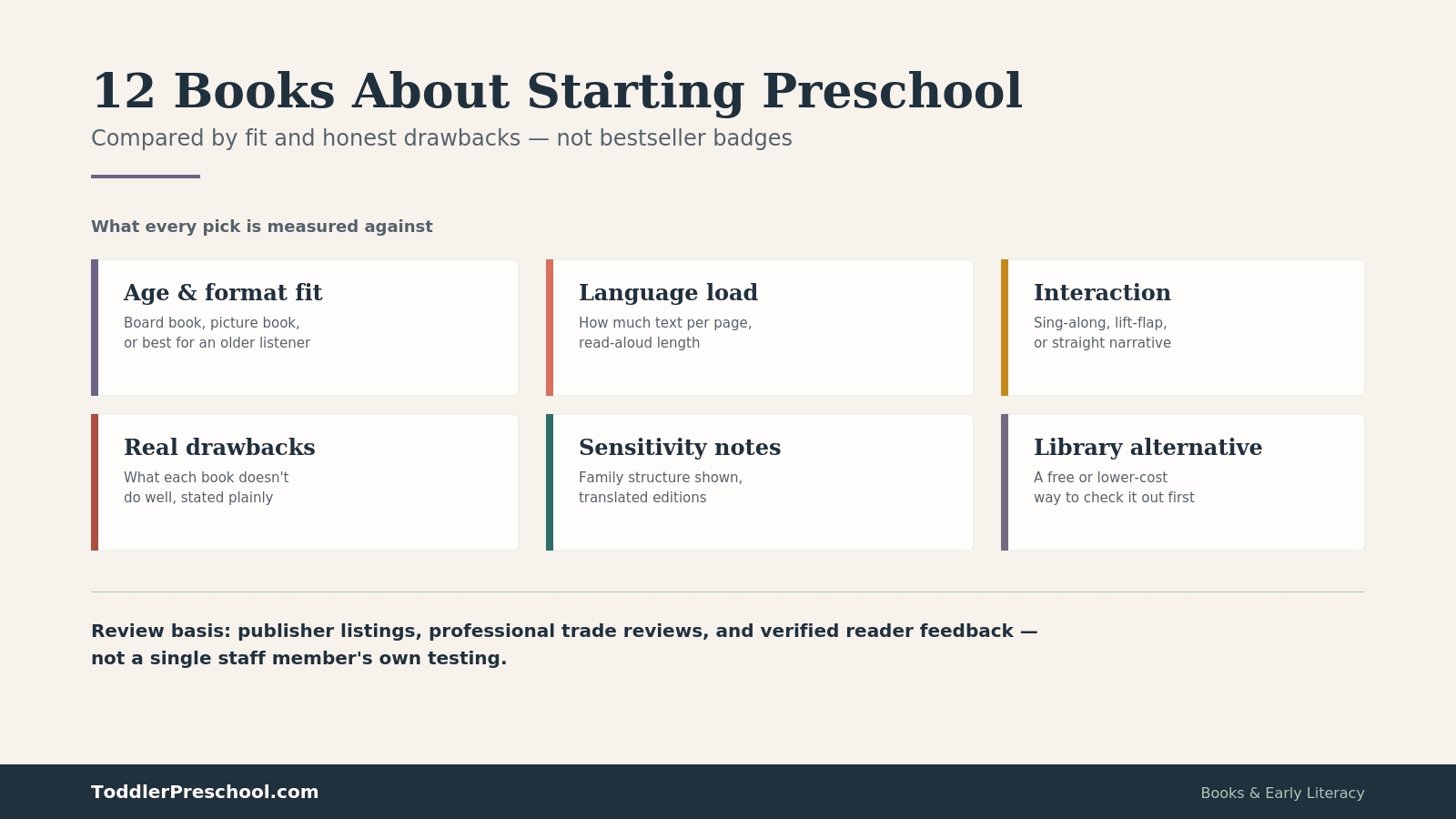
Selection criteria. To make this list, a book had to be currently in print and available in the U.S., directly address starting preschool, daycare, or a first day of separation (not school in general years later), and be readable to a child somewhere in the 2-to-5-year range. From there, we deliberately picked a spread rather than 12 versions of the same book: board books for the youngest toddlers, longer picture books for confident 4- and 5-year-olds, anxious-kid stories, humor-first stories, and a couple of plain, low-drama previews for kids who don’t want a “worry” narrative at all.
Review basis — read this before you trust any “best of” list. Every fact below (author, illustrator, publisher, page count, price, age range, and format) was checked directly against current publisher and bookseller listings, and we ran a Consumer Product Safety Commission recall search on all 12 titles and found none affecting them. The qualitative notes — what a book is like to actually read aloud, its drawbacks, and who tends to skip it — are compiled from professional trade reviews (School Library Journal, Kirkus Reviews, Publishers Weekly, The Horn Book) and consistent patterns in librarian, teacher, and reader feedback, not from a ToddlerPreschool.com staffer’s own read-aloud sessions with this specific batch of books. We’re telling you that directly because a site that implies hands-on testing it didn’t do is exactly the kind of “trust us” claim this guide is trying to help you see past. If a detail changes — a new edition, a price shift, a reprint — treat the publisher’s own product page as the final word over any single article, including this one.
Which Book Fits Your Situation
Before the full breakdown, here’s a fast way to narrow 12 options down to two or three worth a closer look.
| Your Situation | Books Worth a Closer Look |
|---|---|
| Child gets visibly anxious or cries about the idea of separating | The Kissing Hand, Wemberly Worried, Llama Llama Misses Mama |
| Youngest toddler (18 months–2.5 years), needs a board book | Llama Llama Misses Mama (board edition), How Do Dinosaurs Go to School? (board edition), My Preschool (board edition) |
| Confident kid who wants a laugh, not reassurance | Chu’s First Day of School, The Pigeon HAS to Go to School!, Pete the Cat: Rocking in My School Shoes |
| Wants a plain preview with no “worry” plot at all | My Preschool, Maisy Goes to Preschool |
| Older/more verbal preschooler (4–5), can sit through a longer story | School’s First Day of School, If You Take a Mouse to School, Wemberly Worried |
| Tight budget, want something under $8 | The Night Before Preschool, Maisy Goes to Preschool |
| Want a rhyming, sing-song read-aloud | Llama Llama Misses Mama, How Do Dinosaurs Go to School?, Pete the Cat: Rocking in My School Shoes |
| Want a Spanish-language edition confirmed available | How Do Dinosaurs Go to School? (“¿Cómo van a la escuela los dinosaurios?”), The Kissing Hand (“Un beso en mi mano”) |
Quick-Pick Summary
| Book | Best For | Age Range | Format | Approx. Price |
|---|---|---|---|---|
| The Kissing Hand | A concrete goodbye ritual | 3–7 | Paperback / hardcover | $12.99 / $18.99 |
| Llama Llama Misses Mama | Rhyming reassurance, classic separation-anxiety arc | 3–6 (board edition younger) | Hardcover / board book | $16.99–18.99 / $9.99 |
| Wemberly Worried | Kids who worry about everything, not just school | 4–8 | Paperback / hardcover | $9.99 / $17.99+ |
| Chu’s First Day of School | Humor over reassurance | 4–8 (board edition 0–4) | Hardcover / board book | $17.99–19.99 / $8.99 |
| The Pigeon HAS to Go to School! | Kids who make excuses to avoid new things | 3–5 | Hardcover | $16.99–18.99 |
| Pete the Cat: Rocking in My School Shoes | Confident, upbeat, musical read-aloud | 3–7 | Hardcover | $16.99–19.99 |
| School’s First Day of School | A fresh angle (the school itself is nervous) | 4–8 | Hardcover | $17.99–18.99 |
| How Do Dinosaurs Go to School? | Modeling classroom behavior, playfully | 3–5 (board edition 2–4) | Hardcover / board book | $19.99 / $7.99 |
| My Preschool | A realistic, low-drama preview | 2–5 | Hardcover / board book | $18.99 / $7.99 |
| If You Take a Mouse to School | Older preschoolers, imaginative humor | 4–8 | Hardcover | $19.99 |
| The Night Before Preschool | Budget pick, bedtime-adjacent countdown | 3–5 | Paperback | $5.99 |
| Maisy Goes to Preschool | A calm, confident preview with no anxiety plot | 2–5 | Paperback | $6.99–8.99 |
The 12 Books, Compared
1. The Kissing Hand — Audrey Penn
Chester Raccoon doesn’t want to start school, so his mother teaches him a private ritual: a kiss pressed into his palm that he can press to his own cheek whenever he misses her. It’s a genuinely tender idea, and it’s the reason this 1993 book is still a staple for teachers on the first day of school more than 30 years later.
| Detail | Notes |
|---|---|
| Best for | A child who wants a concrete, repeatable ritual to hold onto during the goodbye |
| Skip if | Your child tends to fixate on objects or routines — a “kissing hand” ritual can become a source of distress if it’s ever forgotten or feels incomplete |
| Age & format fit | Ages 3–7; picture book, paperback ($12.99) or hardcover ($18.99), 32 pages |
| Language load | Moderate — a full narrative arc, best for a sit-down read rather than a quick bedtime skim |
| Interaction | Low; some editions include stickers in the back for the child to keep |
| Drawback | The ritual is sweet but doesn’t teach a coping skill your child can use on their own later — some kids come to need the exact ritual repeated rather than internalizing “Mom always comes back” |
| Sensitivity notes | Centers a mother figure; swap in the name of whoever is actually doing drop-off. A Spanish-language edition, “Un beso en mi mano,” exists |
| Review basis | Long publishing history (Child Welfare League of America, 1993; now Tanglewood), widely cited by parenting and teacher resources as a first-day classic |
| Library or budget alternative | Check WorldCat for a copy near you — this is one of the most commonly stocked titles in U.S. public libraries |
2. Llama Llama Misses Mama — Anna Dewdney
Llama Llama’s first day of preschool starts fine — new teacher, new toys — until Mama leaves, and suddenly nothing feels fun anymore. Dewdney’s signature bouncy rhyme carries the story from panic to “he loves Mama… and school too,” and it’s part of a New York Times bestselling series many toddlers already know.
| Detail | Notes |
|---|---|
| Best for | Kids already attached to the Llama Llama series, and families who want the classic separation-anxiety arc in rhyme |
| Skip if | Your child needs new content — this beat (missing Mama, then discovering school is fun) is the plot of several Llama Llama books, so if you already own others in the series this may feel repetitive |
| Age & format fit | Hardcover picture book, ages 3–6, 40 pages, $16.99–18.99; also available as a shorter board book for younger toddlers, around $9.99 |
| Language load | Light — short rhyming lines, easy for a squirmy toddler to sit through |
| Interaction | Read-aloud rhythm invites kids to finish rhyming lines once they know it |
| Drawback | Trade reviewers have noted it adds little beyond earlier books in the series structurally — charming, but not a huge leap in depth |
| Sensitivity notes | “Mama” is named specifically throughout; easy to substitute verbally for another caregiver’s name during read-aloud. A Spanish hardcover edition, “Llama Llama extraña a Mamá,” is available |
| Review basis | Starred/positive trade coverage from Publishers Weekly and School Library Journal; multi-week New York Times bestseller |
| Library or budget alternative | Check WorldCat for a copy near you — the whole Llama Llama series is a near-universal library holding |
3. Wemberly Worried — Kevin Henkes
Wemberly, a small anxious mouse, worries about absolutely everything — the swings, the bathtub, and most of all, her first day of school. Then she meets another worrier in her class and realizes she isn’t alone. Kevin Henkes writes genuinely worried kids without ever making Wemberly the butt of the joke, which is part of why this is a #1 New York Times bestseller and ALA Notable Book.
| Detail | Notes |
|---|---|
| Best for | A child whose anxiety isn’t limited to school — Wemberly worries about everything, which can feel more honestly representative to a generally anxious kid than a story about one specific fear |
| Skip if | Your child isn’t a worrier and finds Wemberly’s constant fretting confusing or contagious rather than relatable |
| Age & format fit | Ages 4–8; picture book, paperback ($9.99) or hardcover ($17.99+), 32 pages — text-heavier than most on this list, so less suited to a 2- or young-3-year-old |
| Language load | Higher than most entries here — full sentences with hand-lettered emotional asides throughout |
| Interaction | Low; it’s a straightforward read-aloud narrative rather than a participatory one |
| Drawback | Some younger or less verbal toddlers may find the density of “worry” language (spelled out again and again) more agitating than soothing; better suited to a child who can already talk about feelings a little |
| Sensitivity notes | Depicts both parents and a grandmother as active support figures — one of the more multi-caregiver-inclusive options on this list without any edits needed |
| Review basis | Starred reviews from both School Library Journal and Publishers Weekly; ALA Notable Children’s Book; #1 New York Times bestseller |
| Library or budget alternative | Check WorldCat for a copy near you |
4. Chu’s First Day of School — Neil Gaiman, illustrated by Adam Rex
Chu the panda is nervous about his first day — will the other kids like him? — until the story pays off with his signature, room-clearing sneeze. It’s the humor-forward entry on this list: less about processing worry and more about defusing it with a laugh.
| Detail | Notes |
|---|---|
| Best for | A child who responds better to humor and distraction than to a story that names their worry directly |
| Skip if | Your child needs a book that validates anxiety in words — this one resolves through comedy, not through naming or normalizing the feeling |
| Age & format fit | Picture book, ages 4–8, 32 pages, $17.99–19.99; board book edition for ages 0–4, 36 pages, around $8.99–9.99 |
| Language load | Light to moderate; short, punchy lines built for read-aloud timing |
| Interaction | High — the sneeze payoff is built for a big group reaction and works well read aloud with sound effects |
| Drawback | The emotional arc is thinner than titles like Wemberly Worried or The Kissing Hand — it’s a fun read, not a deep one, so pair it with a more direct conversation if your child needs to actually talk through the worry |
| Sensitivity notes | Panda-family context with no strongly gendered parent figure emphasized in the text, making it easy to read as-is regardless of who’s doing drop-off |
| Review basis | Positive Publishers Weekly review; School Library Journal review of the board book edition; bestseller status from an established Gaiman/Rex series |
| Library or budget alternative | Check WorldCat for a copy near you |
5. The Pigeon HAS to Go to School! — Mo Willems
Mo Willems’s Pigeon does what Pigeon always does: argues, stalls, and lists every possible reason not to go — he already knows everything, what if the teacher doesn’t like him, what if he learns TOO MUCH? Kirkus called it a book that filters every typical kid excuse about school through Pigeon’s comic bluster.
| Detail | Notes |
|---|---|
| Best for | A child who copes with new things by making excuses or arguing — seeing Pigeon do the exact same thing, out loud, tends to land as funny rather than shaming |
| Skip if | Your child needs to see an actual first-day scene play out — Pigeon’s book is entirely pre-school jitters and excuse-making; it doesn’t show the school day itself |
| Age & format fit | Ages 3–5 (some editions list 4–6); hardcover picture book, 40 pages, $16.99–18.99 |
| Language load | Light — Willems’s signature short, expressive, speech-bubble-style text |
| Interaction | Very high; the Pigeon series is built for kids to talk back to the book (“NO, Pigeon!”) |
| Drawback | No parent or caregiver appears in the book at all, and no resolution scene at school itself — it’s purely about the anticipatory anxiety, not the actual experience |
| Sensitivity notes | No family structure depicted at all, which sidesteps representation questions entirely but also means it won’t model a goodbye scene for a child who needs to see one |
| Review basis | Positive Kirkus and Publishers Weekly reviews; part of a long-running, heavily awarded series (three Caldecott Honors for earlier Pigeon and Knuffle Bunny titles) |
| Library or budget alternative | Check WorldCat for a copy near you |
6. Pete the Cat: Rocking in My School Shoes — Eric Litwin, illustrated by James Dean
Pete discovers the library, the lunchroom, and the playground, and — true to form — never stops singing his song, because “it’s all good.” This is the confidence-first entry: Pete doesn’t worry, he just grooves through the day.
| Detail | Notes |
|---|---|
| Best for | A child who isn’t especially anxious and responds well to music, repetition, and an upbeat, nothing-fazes-me character |
| Skip if | Your child is genuinely nervous about school — Publishers Weekly’s own review flags that Pete’s blasé “it’s all good” attitude may not actually reach a truly anxious reader, since the book never engages with worry at all |
| Age & format fit | Ages 3–7; hardcover picture book, 40 pages, $16.99–19.99 |
| Language load | Very light — short, songlike, repetitive lines |
| Interaction | High — the book is built around a downloadable singalong track and a repeated refrain kids pick up fast |
| Drawback | Same plot shape as other Pete the Cat books (something changes, Pete stays unbothered) — if your child owns other titles in the series, the structure will feel familiar rather than fresh |
| Sensitivity notes | No specific parent or drop-off scene shown; focus stays entirely on the school day itself |
| Review basis | Publishers Weekly review (noting the drawback above directly); long-running bestselling series with a large existing fan base among toddlers and preschoolers |
| Library or budget alternative | Check WorldCat for a copy near you |
7. School’s First Day of School — Adam Rex, illustrated by Christian Robinson
A clever reversal: the school building itself is nervous on the first day, unsure whether the children will like it. As the day goes on — through a spilled lunch and an “accident” during a fire drill — the school realizes this chaos is exactly what it was built for.
| Detail | Notes |
|---|---|
| Best for | An older, more verbal preschooler who’ll appreciate the unusual point-of-view, and any child comforted by the idea that everyone (even the building) gets nervous about new things |
| Skip if | You want a story your child can map directly onto their own preschool morning — the setting reads as a larger elementary school (named “Frederick Douglass Elementary”), not a preschool classroom specifically |
| Age & format fit | Ages 4–8; hardcover, 40 pages, $17.99–18.99 |
| Language load | Moderate; a genuine narrative with some dry humor that lands better with a slightly older listener |
| Interaction | Low; a read-aloud narrative, not a participatory one |
| Drawback | The elementary-school setting and slightly older recommended age make it a better fit for kindergarten-adjacent preschoolers than for a 2- or 3-year-old just starting daycare |
| Sensitivity notes | Illustrations depict a racially and culturally diverse group of children throughout, without centering any single family structure |
| Review basis | Starred reviews from School Library Journal, Kirkus, and The Horn Book; illustrator is a Caldecott Honoree |
| Library or budget alternative | Check WorldCat for a copy near you |
8. How Do Dinosaurs Go to School? — Jane Yolen, illustrated by Mark Teague
Part of the long-running “How Do Dinosaurs…” series, this one puts ten brightly colored dinosaurs through a school day and asks, playfully, whether they’d stomp on the bus, roughhouse in class, or actually behave. It’s less about separation anxiety and more about modeling classroom expectations.
| Detail | Notes |
|---|---|
| Best for | A child who benefits from seeing “the wrong way, then the right way” modeled through humor — a format familiar from earlier books in the series |
| Skip if | Your child is anxious about missing you specifically — this book is about classroom behavior, not about the goodbye or the missing-mom-or-dad feeling |
| Age & format fit | Picture book, ages 3–5 (some listings extend to 8), 40 pages, $19.99; board book edition, ages 2–4, 34 pages, $7.99 |
| Language load | Light; rhyming, rhythmic text consistent with the series’ established formula |
| Interaction | Moderate; each dinosaur’s name is hidden in the illustrations, giving kids something to search for on repeat reads |
| Drawback | If your child has read other “How Do Dinosaurs” titles, the structure (a string of “would they misbehave” questions, then a well-behaved resolution) will feel very familiar |
| Sensitivity notes | Multiple dinosaur/parent pairs shown without strong gendering; a Spanish-language edition, “¿Cómo van a la escuela los dinosaurios?,” is available |
| Review basis | Positive School Library Journal review; long-established bestselling series (this is the eighth entry, counting board books) |
| Library or budget alternative | Check WorldCat for a copy near you |
9. My Preschool — written and illustrated by Anne Rockwell
A little boy moves through an ordinary preschool day — circle time, painting, the water table, snack, goodbye — with no anxiety plot at all. Reviewers have specifically called out its realism: this is what preschool actually looks like, told plainly.
| Detail | Notes |
|---|---|
| Best for | A child who doesn’t need a “worry” story, and would rather just see, concretely, what a preschool day involves |
| Skip if | Your child wants a story with tension, character, or humor — this one is closer to a gentle documentary of a school day than a narrative arc |
| Age & format fit | Ages 2–5; hardcover, 32 pages, $18.99; board book edition, ages 2–4, 30 pages, $7.99 |
| Language load | Light; simple, sequential sentences describing one activity at a time |
| Interaction | Low; a calm, observational read rather than a participatory one |
| Drawback | The lack of plot tension means a child looking for excitement or reassurance-through-story may find it a little flat compared to the more narrative-driven picks on this list |
| Sensitivity notes | Parent/caregiver drop-off is implied rather than shown or gendered, making it easy to read as-is for any family structure |
| Review basis | Positive coverage from School Library Journal, Kirkus, Booklist, and The New York Times Book Review |
| Library or budget alternative | Check WorldCat for a copy near you |
10. If You Take a Mouse to School — Laura Numeroff, illustrated by Felicia Bond
The famous circular-logic mouse from the “If You Give…” series heads to school, working a math problem, spelling a word, running a science experiment, and building a block house along the way. It leans academic and imaginative rather than emotional.
| Detail | Notes |
|---|---|
| Best for | An older, school-curious preschooler (closer to pre-K or kindergarten-adjacent) who enjoys the cause-and-effect humor of the “If You Give…” series |
| Skip if | Your child needs emotional reassurance about separation specifically — this book is about the academic and imaginative side of school, not the goodbye |
| Age & format fit | Ages 4–8; hardcover, 32 pages, $19.99; a board book edition also exists for younger fans of the series |
| Language load | Moderate; the circular “if you give him X, he’ll want Y” structure requires some ability to follow a chain of cause and effect |
| Interaction | Moderate; kids familiar with the series often predict the next domino before you turn the page |
| Drawback | References math problems and spelling words, which reads more like an elementary classroom than a typical preschool one — worth knowing if your child’s actual program is play-based |
| Sensitivity notes | No specific family structure or drop-off scene is depicted; focus stays on the school day and the mouse’s antics |
| Review basis | Coverage in Kirkus, Publishers Weekly, School Library Journal, and The Bulletin of the Center for Children’s Books; long-running, well-established series |
| Library or budget alternative | Check WorldCat for a copy near you |
11. The Night Before Preschool — Natasha Wing, illustrated by Amy Wummer
Billy can’t sleep the night before preschool because he’s nervous — and then can’t sleep the night after, because he’s too excited to go back. It’s part of Wing’s long-running “Night Before” rhyming series, and its bedtime framing pairs naturally with a family’s evening routine.
| Detail | Notes |
|---|---|
| Best for | Reading the night before the first day, specifically — the format is built for that exact moment, and it’s the lowest-cost book on this list |
| Skip if | You want a book to read repeatedly over weeks of preparation — the “night before” framing is a little odd to revisit on a random Tuesday two weeks out |
| Age & format fit | Ages 3–5; paperback, 32 pages, around $5.99 |
| Language load | Light; simple rhyming couplets meant for a quick bedtime read |
| Interaction | Low; a straightforward rhyming narrative |
| Drawback | Thin on plot and detail compared to longer picture books on this list — a confident 5-year-old may find it a little young |
| Sensitivity notes | Caregiver role is not strongly gendered in the text, making it easy to read as-is |
| Review basis | Long-running, well-established “Night Before” series from Grosset & Dunlap (Penguin); consistently positive reader and bookseller reception |
| Library or budget alternative | Check WorldCat for a copy near you — at under $6 new, this is already one of the more budget-friendly options if buying |
12. Maisy Goes to Preschool — Lucy Cousins
Maisy, already a fixture of toddler bookshelves everywhere, spends a full day at preschool: painting, snack time, story time, nap time, instruments, and outdoor play. School Library Journal specifically noted that Maisy “clearly has no separation issues” — this is a preview book, not a worry book.
| Detail | Notes |
|---|---|
| Best for | A toddler who isn’t anxious and just wants a friendly, familiar character to preview what preschool involves |
| Skip if | Your child is nervous about separating from you — Maisy’s confident, breezy tone may not connect with a genuinely worried kid the way The Kissing Hand or Wemberly Worried would |
| Age & format fit | Ages 2–5; paperback, 32 pages, $6.99–8.99 |
| Language load | Very light; simple, short sentences in Cousins’s signature bright, bold style |
| Interaction | Low to moderate; young Maisy fans often narrate along from familiarity with the character |
| Drawback | No goodbye or drop-off scene is shown at all — the book picks up once Maisy is already there, so it doesn’t model that specific moment |
| Sensitivity notes | No parent figure shown in the text; sidesteps family-structure questions by omission |
| Review basis | Positive School Library Journal review; part of the widely held, long-running Maisy franchise |
| Library or budget alternative | Check WorldCat for a copy near you — Maisy titles are near-universally stocked in children’s library sections |
What Books Can Do (and What They Can’t)
Reading together does real, well-documented work beyond just filling time before bed. The American Academy of Pediatrics updated its formal policy on shared reading in 2024, and it’s worth knowing what that update actually says before you treat any single book as a fix. The AAP’s position is that reading aloud with young children — from infancy through at least kindergarten — supports brain development, strengthens the parent-child bond, and lays groundwork for social-emotional skills, language, and school readiness, and the organization specifically recommends print books over screens for this purpose, since screen-based reading doesn’t offer the same back-and-forth interaction.
None of that means a book will resolve real separation anxiety on its own, and no book on this list is a substitute for the practical, in-the-moment strategies — a short goodbye ritual, previewing the physical space, working with your child’s teacher — that actually ease a hard drop-off. Treat these books as one supportive layer in a broader routine, not as the whole plan, and don’t read too much into how your child reacts to any single title on a single night; a flat reaction one evening doesn’t predict how the first day will actually go.
Respecting Every Family’s Situation
Multilingual families. Two titles on this list — The Kissing Hand and How Do Dinosaurs Go to School? — have confirmed Spanish-language editions available in the U.S. For other titles, check your library’s catalog or a Spanish-language children’s bookstore before assuming a translation doesn’t exist; publishing details shift, and this list reflects a point-in-time check, not a permanent record.
Budget and access. The AAP’s own policy update specifically calls out prioritizing book access for families who may not have it, and that’s a genuinely practical starting point here too: your public library almost certainly carries several of these titles for free, and a library card costs nothing. If buying, The Night Before Preschool and Maisy Goes to Preschool are the lowest-cost new options on this list, both under $9.
Different family structures. Several of these books — Chu’s First Day of School, The Pigeon HAS to Go to School!, Pete the Cat: Rocking in My School Shoes, My Preschool, If You Take a Mouse to School, The Night Before Preschool, and Maisy Goes to Preschool — don’t center a specific gendered parent figure in the text, which makes them easy to read as-is regardless of who’s actually doing drop-off in your family. For the titles that do name “Mama” or “Mom” specifically (Llama Llama Misses Mama, The Kissing Hand), it’s simple to swap in the name of whichever caregiver — a dad, a grandparent, two moms, two dads — actually handles that part of the morning.
Disability and developmental variation. None of these books were written with a specific diagnosis in mind, and this article isn’t making any claims about which book suits a particular developmental profile — that’s a conversation for your child’s teacher, therapist, or pediatrician if you have one. What’s worth noting generally: books with heavier text (Wemberly Worried, If You Take a Mouse to School, School’s First Day of School) ask more of a child’s sitting and listening stamina than the lighter, more rhythmic options (Llama Llama Misses Mama, Pete the Cat, How Do Dinosaurs Go to School?), which is worth factoring in regardless of the reason a longer book might not hold your child’s attention yet.
Frequently Asked Questions
Do I need to buy all 12 of these? No — pick one, maybe two, based on the “Which Book Fits Your Situation” table above. Buying a stack of books your child never asks to reread is a common trap in this category; one book that actually gets requested again and again is worth more than five that don’t.
My child gets more anxious after we talk about big changes — should we skip books like this altogether? Some kids do better with less advance discussion, not more, and that’s a reasonable pattern to notice and work with rather than push against. If a specific book seems to be adding worry rather than easing it, it’s fine to set it aside — try a lower-key, no-anxiety-plot option like My Preschool or Maisy Goes to Preschool instead, or skip books on this topic for now and focus on the routine itself.
Is it better to read one of these before enrollment starts, or wait until closer to the first day? Both can work, and it depends on your child. A book read weeks ahead gives more time for questions to surface gradually; a book read the night before (The Night Before Preschool is built for exactly this) works well for a child who does better with less lead time to worry. There’s no single right window — watch how your child responds and adjust.
What if we don’t want to spend any money on this? Every entry above includes a library-check link, and most of these titles are commonly held in U.S. public library systems. Many libraries also offer free read-aloud videos or story-time sessions built around back-to-school titles — ask your local branch or check its events calendar.
Your One Next Step
Pick one book from the “Which Book Fits Your Situation” table above — just one — and check whether your library has it before buying anything. That’s the whole first step.