
It’s 11 PM and you’re scrolling through forums, comparing your toddler to every other kid at the park today. Toddler not talking is what you typed into the search bar. You need an actual answer, not another vague reassurance to “just wait.”
Here’s the direct answer. A toddler not talking yet is usually a late talker. This is a real, well-studied pattern where expressive vocabulary lags behind while everything else, understanding, gestures, social connection, stays on track. About half of late talkers catch up on their own by school age. This guide explains how to tell a late talker apart from something that needs more support. It covers what to actually notice this week, and exactly what to do next.
You’re not the only parent doing this exact search tonight. Toddler not talking is one of the most common developmental worries parents bring to a pediatrician. Most of the time, there’s a real, specific pattern behind it, not a mystery. Understanding that pattern is exactly what the rest of this guide walks through.
The Direct Answer: What to Do Right Now
Watch what your toddler understands and how they communicate without words, not just their spoken word count. Give it focused attention for two to four weeks using the specific steps in this guide. If concern remains after that, talk to your pediatrician and consider a free evaluation.
None of this requires panic tonight. A toddler not talking yet requires a clear, specific next step, which this guide gives you.
This guide also covers something many general milestone articles skip. That’s the real, clinical difference between a late talker and a broader language concern, since that distinction changes what actually helps.
What Counts as “Not Talking Yet”? Defining the Actual Concern
“Not talking” means different things to different families, and getting specific helps.
No Words at All
A toddler past 18 months with zero spoken words, not even approximate ones like “ba” for ball, is a genuinely different situation. It’s not the same as a toddler with a few words who just isn’t combining them yet.
This distinction matters because the two situations often call for a different level of urgency, even though both can feel equally worrying in the moment.
A Few Words, But Fewer Than Expected
Many toddlers searched about here have some words, just fewer than what a general age chart suggests. This is the most common version of “toddler not talking” and often falls within the late talker pattern described below.
Words But No Combinations
A toddler who has individual words but isn’t yet putting two together by around 24 months is worth watching specifically. This alone isn’t automatically concerning, though.
A toddler in this specific situation often benefits most from the everyday language strategies covered later in this guide. The building blocks are already there.
Toddler Not Talking: Late Talker Versus Language Delay
This is the single most useful thing to understand if your toddler isn’t talking yet.
What “Late Talker” Actually Means
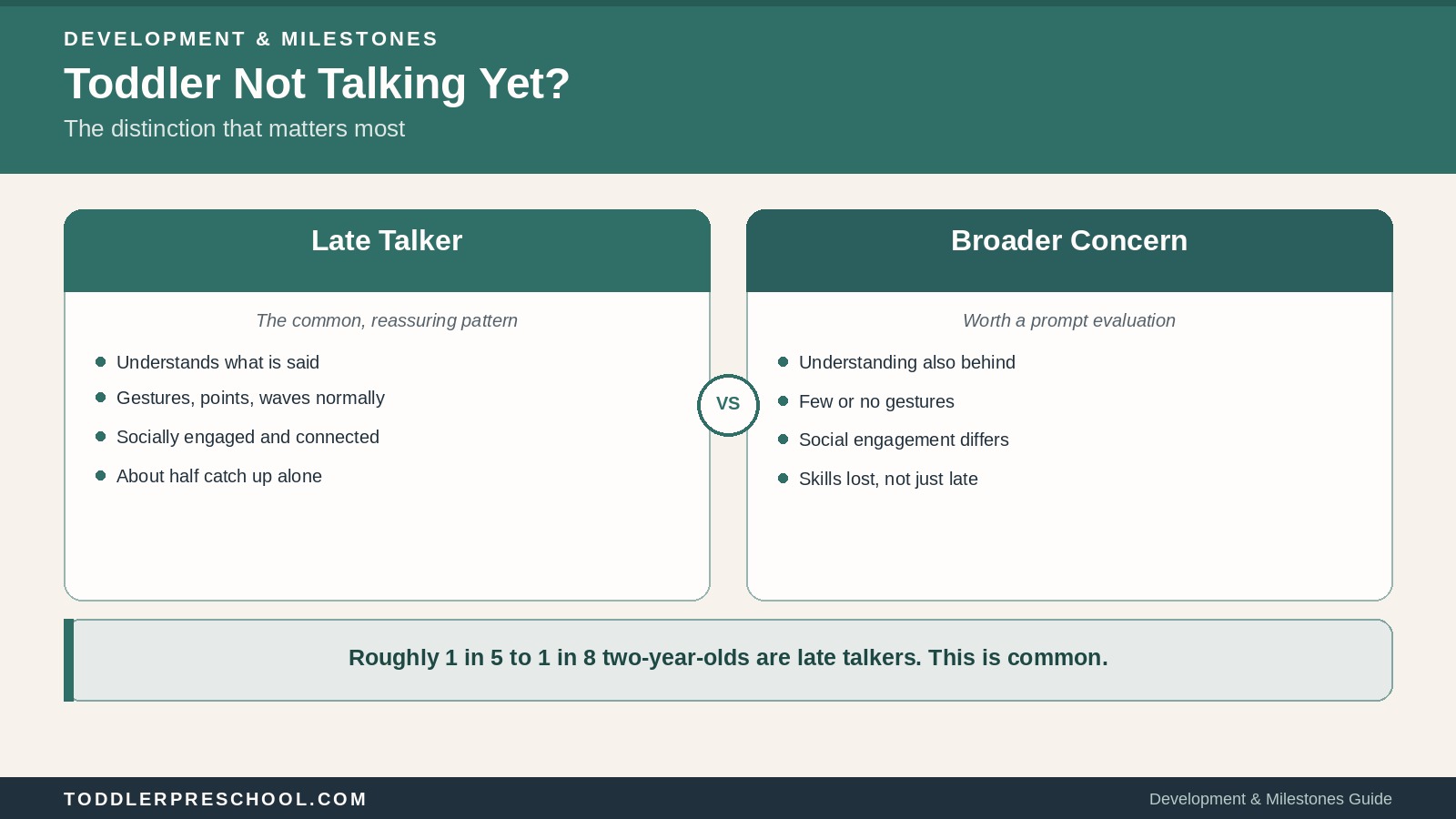
A late talker is a toddler, usually between 18 and 30 months, whose expressive vocabulary lags behind expectations. Everything else about their development stays on track. They understand what’s said to them. They gesture, point, and engage socially in age-typical ways. Speech is simply the one piece that’s behind.
Researchers sometimes call this late language emergence, or LLE. The name matters less than the pattern. What matters is a genuinely isolated delay, not a broader difference.
This distinction, isolated versus broader, is the single piece of information that changes everything. It shapes exactly how worried to be when a toddler is not talking yet.
How Common This Actually Is
Roughly 1 in 5 to 1 in 8 two-year-olds fit this pattern. The exact number varies by study. This is common enough that pediatricians see it regularly. It’s not a rare or alarming finding on its own.
Knowing this number doesn’t erase the worry. It does put your specific situation into real, honest context. A lot of other families are going through the exact same thing right now, often at this exact same hour.
The Genuinely Reassuring Statistic
About half of late talkers catch up entirely by school entry, without any formal intervention at all. This doesn’t mean doing nothing is always the right call, covered later in this guide. It does mean a late diagnosis of “late talker” alone isn’t a prediction of ongoing difficulty.
The other half, worth naming honestly, benefit from more targeted support. This is exactly why the observation and action steps in this guide matter, rather than simply waiting passively either way. Knowing which group your child is likely in matters. The observation checklist and the two-to-four-week plan later in this guide are designed to help clarify exactly that.
What Separates a Late Talker From a Broader Concern
The key distinguishing features are worth naming specifically:
- Receptive language is intact. Your toddler follows directions and understands far more than they say.
- Gestures are present and varied. Pointing, waving, nodding, and reaching all show up normally.
- Social engagement is typical. Eye contact, shared attention, and interest in people are all present.
- No hearing loss or neurological explanation. The delay isn’t better explained by something else.
If all four hold true, the isolated late talker pattern is the most likely explanation. If one or more doesn’t hold, raise it with your pediatrician sooner rather than later.
Work through this list honestly, ideally over a few days of real observation rather than a single moment. This gives you far more useful information than the general worry alone. A single hard morning doesn’t determine the answer either way.
When Late Talking Points to Something Broader
If receptive language is also behind, if gestures are limited or absent, or if social engagement seems different, this points toward something broader. It’s less likely to be an isolated speech delay alone. This isn’t a diagnosis you can make yourself from a checklist. It’s still a genuine signal worth raising directly and promptly.
A flat trajectory means little to no progress over several months, rather than slow but steady progress. This is also a more specific signal worth mentioning at your next visit.
Why This Distinction Actually Changes What Helps
A toddler with an isolated expressive delay often responds well to increased everyday language exposure, covered later in this guide. A toddler with a broader pattern typically benefits more from a fuller evaluation and targeted professional support sooner. Knowing which situation you’re likely in shapes a genuinely different, more useful next step. A single generic piece of advice can’t cover every possibility at once.
Toddler Not Talking: What to Notice This Week
Rather than a full age chart, here’s a focused, practical observation list for the next several days.
Count Actual Words, Loosely
A “word” at this age includes consistent approximations, “wa” for water used the same way every time counts. Write down what you actually hear over a few days, rather than relying on memory alone.
Many parents underestimate their toddler’s actual word count simply because individual words don’t feel worth tracking in the moment. A running list, even a rough one, often reveals more than expected. It sometimes surprises a worried parent with a higher count than they assumed going in.
Watch for Understanding Without Words
Does your toddler get their coat when you say it’s time to go outside? Point to the right animal when you name it in a book? This receptive understanding is often the clearest sign that language is developing, even before speech catches up.
Test this a few different ways across a few days. A single moment of not responding could simply reflect distraction, rather than a genuine understanding gap. A toddler deep in play might ignore a request they’d easily follow at a calmer moment.
Notice Gestures Specifically
Pointing to share interest, not just to request something, is a particularly meaningful sign. A toddler who points at a dog and looks back at you to check you saw it too is demonstrating real, early communication.
This specific gesture is sometimes called joint attention, and it’s worth watching for directly. It reflects a social communication skill that goes beyond simply wanting an object. It shows a toddler actively including you in their experience of the world, a genuinely meaningful early skill.
Pay Attention to Social Connection
Genuine interest in people, enjoyment of back-and-forth games like peekaboo, and responding to their name are all worth noting alongside the speech itself.
A toddler who seeks you out, shows you things, and enjoys shared play is demonstrating a real foundation. Speech typically builds on top of this, even when the words themselves are still developing. This foundation itself is real, meaningful progress, even before it shows up as actual talking.
Log It Somewhere, Even Roughly
A simple note on your phone, updated every few days, reveals a trend far more clearly. Trying to remember weeks of observations from memory alone rarely works as well.
This log also becomes genuinely useful later, whether for your own reassurance or as real information to bring to a pediatrician if concern remains. Many parents find the act of writing it down itself brings a small sense of relief. It turns a vague worry into something concrete and trackable.
Common Reasons a Toddler Might Not Be Talking Yet
Several genuine, common explanations exist beyond the late talker pattern itself.
Simple Developmental Variation
Some toddlers are simply on the later end of a wide normal range, with no specific explanation needed beyond individual timing.
This is worth stating plainly: not every late-emerging pattern has an identifiable cause, and that’s genuinely fine. Development doesn’t always come with a tidy explanation attached.
Multilingual and Bilingual Homes
A toddler learning two languages may show a smaller vocabulary in each individual language while their combined vocabulary across both is on track. This is well documented and not a cause of delay on its own.
Code switching is a normal part of bilingual development, not a sign of confusion. This means mixing words from two languages in the same sentence. A toddler saying “quiero leche please” is demonstrating real skill with both languages at once, not struggling with either one.
An Older Sibling Talking for Them
A toddler with an older sibling who anticipates and speaks for them sometimes has less practical need to talk. This is a real, if mild, contributing pattern worth noticing.
Simply pause before an older sibling jumps in to translate or answer for a younger one. Giving the toddler a real chance to attempt it first can meaningfully shift this dynamic over time. A brief, gentle “let’s let your brother try first” said consistently tends to work better than a single one-time request.
Hearing
Even a mild, intermittent hearing loss, like one caused by frequent ear infections, can meaningfully affect language development during this specific window. A hearing check is often one of the first steps in any formal evaluation, precisely because it’s common and treatable. Ruling this out early tends to simplify everything that follows, whether the result confirms typical hearing or reveals something worth addressing directly.
Signs worth noticing include not responding to their name, needing the TV unusually loud, or not startling at sudden loud sounds. Any of these specifically are worth mentioning to your pediatrician directly, separate from the general speech concern itself.
Prematurity
For a toddler born significantly early, use corrected age rather than calendar age. This is a reasonable way to think about expected timing, at least through the first couple of years.
A toddler born two months early, for instance, might reasonably be expected to reach a given milestone two months later than the standard chart suggests. This applies at least in these early years. This adjustment matters less as your child gets older, typically becoming less relevant by age 2 or 3.
Limited Practice Opportunity
A toddler with fewer everyday opportunities to hear and use language sometimes shows a delay. This is through no fault of any specific caregiver. It often responds well to simply increasing that exposure.
This isn’t about blame. Busy schedules, multiple caregivers, and ordinary life all genuinely limit language-rich interaction sometimes, and naming that honestly is more useful than guilt. Most families can meaningfully increase this exposure without a complete schedule overhaul.
A Broader Developmental Difference
For some toddlers, the language delay is one part of a wider developmental picture. This isn’t something to self-diagnose. It’s exactly what an evaluation is designed to sort out clearly.
An evaluation exists precisely for this uncertainty. You don’t need to figure it out alone first.
What Toddler Not Talking Doesn’t Automatically Mean
A few reassuring clarifications are worth stating directly.
It Doesn’t Mean Low Intelligence
Expressive language and general cognitive ability are genuinely separate skills. Many late talkers show completely typical, even advanced, understanding and problem solving.
Some children who talk late go on to have strong language skills once speech does emerge. The underlying thinking and understanding were developing all along, just not yet visible through speech.
It Doesn’t Automatically Mean Autism
Language delay can be one early sign among several for autism. But an isolated speech delay with typical social engagement, gestures, and receptive language is far more often simply a late talker pattern. A screening tool, not a parent’s own worry alone, is the right way to sort this out. It weighs the whole picture, not just one piece.
Autism screening specifically looks at a broader pattern, social communication, interests, and behavior alongside speech, not language delay in isolation. This is exactly why a formal screening tool matters more than a parent trying to draw this conclusion from speech alone. A trained professional weighs many factors together, not just word count.
It’s Rarely Caused by One Single Thing You Did
Screen time, not talking enough, or any other single parenting factor is almost never the sole explanation. Genuine biological and developmental variation plays the larger role in most cases.
If you’re replaying every parenting decision from the last year searching for a cause, that instinct is understandable but rarely productive. Redirecting that energy toward the practical steps in this guide tends to help more than the search for blame. This holds true both for your own peace of mind and for your toddler’s actual progress.
It Doesn’t Mean You Missed Something
Many parents feel a wave of guilt the moment they start actively noticing a delay. It can feel like noticing it now means they should have caught it sooner. Development doesn’t work on a schedule that makes early awareness a failure. It simply means you’re paying attention now, which is exactly the right moment to act, whenever that moment happens to arrive.
Toddler Not Talking: Monitoring Versus Screening
These terms get used interchangeably, but they mean genuinely different things.
Monitoring Is Ongoing and Informal
Monitoring is the everyday, informal tracking of your child’s development, happening at every well visit and every time you notice something at home. This guide’s observation checklist above is a form of monitoring.
Monitoring doesn’t require a special tool or appointment. It’s simply the habit of paying attention to your child’s development as an ongoing process, exactly what you’re already doing by reading this guide.
Screening Is Formal and Scheduled
Screening uses a validated tool at specific ages. This typically happens around 9, 18, and 30 months for general development, plus autism-specific screening at 18 and 24 months. A screening result flagging a concern isn’t a diagnosis; it’s a prompt for a closer look.
A screening tool usually involves a short questionnaire filled out either in the waiting room or ahead of time. It covers several developmental areas at once, not just speech specifically.
Why Both Matter Here
Monitoring, what you’re doing right now by watching closely, catches gradual changes over time. Screening catches things a single office visit conversation might miss. For a toddler not talking yet, both genuinely matter, and neither replaces the other.
What to Do This Week: A Practical Starting Plan
A few specific, doable steps for the coming days, not a lifelong program.
Narrate More Than Feels Natural
Describe what you’re doing out loud during ordinary routines. This costs nothing and requires no special materials. Just more talking during tasks you’re already doing.
This works especially well during tasks you’re already doing anyway, like driving, cooking, or getting dressed. It requires no extra time carved out of an already busy day, which matters most on the hardest, most exhausted days.
Get Down to Their Level and Wait
After naming something or asking a simple question, pause for several full seconds before filling the silence yourself. This gives your toddler real space to attempt a response.
This pause feels uncomfortably long to most adults at first. Counting silently to five before speaking again is a simple, concrete way to actually hold that space, rather than rushing to fill it. It gets more natural with a little practice.
Respond to Every Communication Attempt
A point, a grunt, or an approximate word all deserve a warm, immediate response. This teaches that communication works, regardless of how clear the attempt was.
A toddler who points and grunts toward a cup, and gets a warm, immediate response, learns something valuable. Communication is effective and worth repeating, regardless of how clear the actual attempt was. That lesson matters more than perfect pronunciation right now.
Read the Same Few Books Repeatedly
Repetitive, predictable books build real language recall faster than a large rotating collection. Let your toddler choose the same favorite as many times as they want.
Books with a repeated refrain or pattern are especially useful here. They give your toddler a genuine, low pressure chance to anticipate and eventually join in on their own timeline.
Reduce, Don’t Necessarily Eliminate, Screen Time
Passive screen time before age 2 is associated with somewhat slower language development in some research. This largely happens because it replaces the back-and-forth interaction that builds speech most effectively. A modest reduction, not necessarily zero, is a reasonable starting adjustment.
If screen time is a genuine, necessary part of your family’s daily routine right now, pair it with narration. Talk about what’s happening on screen together to preserve some of the interactive benefit.
Offer Choices Instead of Yes-or-No Questions
Ask “do you want the red cup or the blue cup” rather than “do you want a cup.” This gives your toddler a natural opening to use a word, even a single one, rather than simply nodding or pointing.
Toddler Not Talking: When to Move to Action
A genuine, specific answer to “how worried should I actually be.”
Give a Focused Effort Two to Four Weeks
Applying the steps above consistently for two to four weeks, then reassessing using the same observation checklist, gives you real, specific information rather than a vague ongoing worry.
Write down where things stand today, then compare it directly to your notes in a few weeks. A concrete before and after comparison is far more useful than a general sense of whether things feel better.
Signs Worth Acting on Sooner
A few patterns are worth a prompt conversation with your pediatrician, rather than waiting out the full monitoring window:
- No babbling by 12 months, not even consonant sounds
- No gestures at all by 12 months, not even pointing or waving
- No words by 16 months, not even approximate ones
- No two-word combinations by 24 months, alongside a limited overall vocabulary
- Loss of any previously acquired word or skill, at any age
None of these alone is a diagnosis. Each is a clear, specific reason to move from watching to acting.
Trust Your Own Observation
You see your toddler far more than any single appointment allows. If something feels off despite a screening or a pediatrician’s reassurance, a second opinion or a direct evaluation is a completely reasonable choice.
Parents are frequently the first to notice a genuine pattern, well before any formal screening tool catches it. You’re observing your child across far more moments than any single visit could capture. That accumulated, everyday observation is genuinely valuable.
Toddler Not Talking: The Referral Pathway
If concern remains, a clear path exists for getting real support.
Start With Your Pediatrician
Bring your specific observations: word count, what you’ve tried, and how your toddler responds. A pediatrician sharing your concern will typically refer you for a full evaluation.
Bring your written log from this guide, rather than trying to summarize weeks of observation from memory. This makes the conversation genuinely more productive for everyone involved.
Early Intervention Is Free and Direct
Every U.S. state offers a free early intervention program for children under 3. You can request an evaluation directly, without a doctor’s referral, in most states.
This program is federally mandated, meaning every state must offer it, though the specific name and exact process varies somewhat by location, state to state.
A Hearing Check Is a Common First Step
Hearing plays a role often enough that a hearing check is frequently one of the first parts of a fuller evaluation. It’s common and treatable.
An Evaluation Isn’t Stressful for Your Toddler
Most evaluations look like play, using familiar toys and simple questions directed mostly at you. It’s information gathering, not a test your toddler can fail.
Most evaluations take place in a comfortable, low pressure setting. They often look more like a supervised play session than any kind of formal testing your toddler would notice as unusual.
Toddler Not Talking: Everyday Examples of Language Developing Quietly
A few concrete moments show how language sometimes progresses before speech itself catches up.
At the Dinner Table
A toddler who points at their cup and grunts, then looks at you expectantly, is communicating clearly, even without a word. Responding warmly, “you want your cup, here you go,” models the word while honoring the attempt.
During Play
A toddler who hands you a toy and makes eye contact is engaging in genuine back-and-forth interaction, a real communication skill, independent of spoken vocabulary.
At Drop-Off or Goodbye
A toddler who waves consistently, even without saying “bye,” is demonstrating real, meaningful gesture based communication.
During Bath Time
A toddler who points to their own body parts when you ask, “where’s your nose,” even silently, is showing something real. Genuine receptive language and body awareness are both real building blocks for speech.
When Something Goes Wrong
A toddler who brings you a broken toy, or leads you by the hand to show you a problem, is communicating a specific need clearly. They’re using actions in place of words that haven’t arrived yet.
The Wide Range of Normal for a Toddler Not Talking
A toddler not talking yet has a few sources of genuine variation worth naming directly.
Individual Variation Within “Typical”
Two toddlers can differ by many months in when talking really takes off, both within a completely normal range. General guidelines describe a pattern, not a deadline for any specific child.
Many families see a genuine, sudden jump in words right around the point speech does take off. This is sometimes called a vocabulary spurt, even after months of relatively few words.
Temperament
A more cautious, observant toddler sometimes talks less in general, including in unfamiliar settings like a pediatrician’s office, without that reflecting lower actual skill.
A quieter toddler who watches closely before trying something new often applies that same cautious approach to speech. They may take longer to attempt a word out loud, even once they clearly understand it.
Family History
A family history of late talking in a parent or sibling is a real, documented risk factor. It doesn’t guarantee the same pattern will repeat, though.
Asking family members directly about their own early talking timeline sometimes reveals a genuinely useful, reassuring pattern worth knowing about.
Disability and Developmental Differences
For a toddler with a diagnosed disability, language may follow an entirely different timeline. Your child’s care team is a better guide here than any general article.
Birth Order
Later born children sometimes talk somewhat later than firstborns. Older siblings may interpret and speak for them, reducing the younger child’s own practical need to talk. This is a mild, population level pattern, not a rule for any individual child.
First-Time Parents Versus Experienced Ones
A first-time parent sometimes finds a talking delay more alarming, simply from lack of prior experience. This isn’t because anything about the situation itself is more serious. A parent who’s already navigated this with an older child often approaches it with more built-in calm. That calm comes purely from familiarity with how common this specific worry actually is.
What to Do If a Skill Was There, Then Lost
Losing a previously used word or gesture is a different situation from a skill simply arriving late.
This Deserves a Prompt Call, Not a Wait-and-See Approach
Regression is worth mentioning to your pediatrician promptly, rather than waiting for your next scheduled visit. Call directly and describe specifically what you’ve noticed.
Note when you first noticed the change, whether it happened gradually or suddenly, and whether any other skills seem affected alongside speech. Having these specific answers ready helps the conversation move efficiently.
It Doesn’t Automatically Mean Something Serious
Illness, a major transition, or simple variation can sometimes explain a temporary dip. Still, this specific pattern deserves a direct conversation rather than continued at-home monitoring alone.
A pediatrician can help sort out which explanation actually fits your specific situation. This is exactly the kind of judgment call worth getting a professional opinion on, rather than guessing alone.
Coordinating With Daycare or Other Caregivers
If your toddler spends significant time with another caregiver, their observations add real value to your own.
Asking Directly What They’re Seeing
A teacher or regular caregiver often has useful comparative context, having observed many toddlers over time. This can help you understand whether a pattern is worth flagging more urgently.
Sharing Your Own Observations Too
Two way sharing works better than only asking questions. Telling a caregiver specifically what you’re seeing at home helps build a fuller, more accurate combined picture than either setting alone.
When Settings Show Different Pictures
A toddler who communicates more at home than in a group setting, or the reverse, isn’t unusual. Different settings genuinely produce different comfort levels, and this difference alone isn’t cause for alarm, though it’s worth mentioning either way.
Managing the Worry Itself
Watching for a specific developmental concern brings a particular kind of anxiety worth naming directly.
The 2 AM Spiral Is Real
Searching symptoms late at night, comparing your toddler to every child at the park, and imagining worst case scenarios are all extremely common. This is a normal response to this exact worry. You’re not overreacting by feeling this; most parents in this situation feel it too.
What Comparison Actually Misses
You don’t see another family’s full picture, their own private worries, their own delays in other areas. You’re comparing your complete, close-up view of your own child to a brief, curated glimpse of someone else’s.
A More Useful Comparison
Compare your toddler to your toddler a few weeks ago, using the observation log from earlier in this guide. Is there more communication now than last month, in words or otherwise? That comparison actually tells you something useful, unlike comparing across different children entirely.
Common Obstacles When a Toddler Is Not Talking Yet
A few specific situations come up often enough to address directly.
“My pediatrician says to wait and see, but I’m still worried.”
Trust your own instinct here. You can request an early intervention evaluation directly, without a doctor’s referral, in most states, and a second opinion is always a reasonable option.
“We’re bilingual, and I can’t tell if this is normal or a real delay.”
Count your toddler’s combined vocabulary across every language spoken at home, not just one language in isolation. A bilingual toddler’s total vocabulary is the accurate comparison point. This combined count is often noticeably higher than either single language would suggest on its own.
“My toddler understands everything but says almost nothing.”
This specific pattern, strong receptive language paired with limited expressive language, is the classic late talker profile. It’s common and often resolves with focused attention and time, and it’s genuinely one of the more reassuring patterns to recognize in your own child.
“I’ve read that late talkers usually catch up, so why would I bother with an evaluation at all?”
The “usually catches up” statistic describes the group average, not a guarantee for your specific child. An evaluation simply gives you more certain, individualized information than a general statistic can.
“Everyone around us keeps saying ‘he’ll talk when he’s ready,’ and it’s not helping.”
Well-meaning reassurance from family and friends often comes from genuine care, even when it doesn’t match what you actually need right now. It’s completely reasonable to thank them for the thought. You can still pursue the specific steps in this guide without needing their full agreement.
“My toddler talks fine at home but won’t talk at daycare or around other people.”
This is a distinct pattern worth noting specifically, sometimes related to comfort in unfamiliar settings rather than an overall language delay. If it persists strongly past the toddler years, mention it at a visit as its own specific concern. Keep it separate from the general talking timeline covered throughout this guide.
Adapting This Toddler Not Talking Guide to Every Family
Different family structures. Whoever spends the most time with your toddler is often best positioned to notice real changes over time. This holds regardless of the specific relationship to the child.
Budget. Monitoring and the practical steps in this guide cost nothing. Early intervention evaluations are free by federal law for children under 3, regardless of your family’s income or insurance situation.
Schedule constraints. If a formal evaluation feels like too much right now, start smaller. Simply mentioning your specific concern at your next pediatric visit is a reasonable, low effort first step.
Access to care. If you don’t have a regular pediatrician, community health centers can typically help connect you with your state’s early intervention program directly.
Multilingual and immigrant families. Early intervention evaluations are required to accommodate your family’s home language, including providing an interpreter when needed. Language differences at home are never a barrier to getting evaluated.
Working parents with limited time. The practical steps in this guide fit into routines you’re already doing: driving, cooking, getting dressed. They don’t require dedicated extra time you may not have.
Families with more than one child. If you’re also caring for other children, even five focused minutes of one-on-one language interaction helps. Protected from interruption, this can meaningfully add up over the course of a week.
Frequently Asked Questions
Questions About the Late Talker Pattern
Is there a specific word count that separates a late talker from a bigger concern? Roughly fewer than 50 words, or no two-word combinations, by 24 months is a commonly used general marker. Individual variation is real, though, and the broader pattern, receptive language, gestures, social connection, matters more than any single number.
Does being a late talker predict future learning difficulties? Research is genuinely mixed here. Most late talkers, especially those with strong receptive language and gestures, show typical outcomes by school age, though ongoing monitoring is reasonable regardless.
My toddler was talking, then seemed to plateau. Is that the same as regression? A plateau, meaning steady but unchanging vocabulary over a few months, is different from losing words the child already had. Both are worth mentioning at a visit, but true loss of previously used words deserves more prompt attention.
Questions About Getting Support
Will requesting an evaluation feel like an overreaction if it turns out to be nothing? Not really. Many evaluations conclude that a toddler is developing typically, simply confirming what a parent hoped to hear. That’s a genuinely useful, reassuring outcome, not a wasted effort.
How long does it typically take to get evaluated once we reach out? This varies by state, but early intervention programs are generally required to complete an evaluation within a set timeframe after referral, often around 45 days. Contacting your specific state program gives the most accurate local timeline.
Can speech actually improve just from us talking more at home, without formal therapy? For many late talkers, yes, increased everyday language exposure and interaction genuinely helps. For a broader language delay, professional support usually adds real value beyond what home strategies alone can provide.
Is there a genetic component to being a late talker? A family history of late talking in a parent or sibling is a real, documented risk factor. This doesn’t mean the pattern will definitely repeat, but it’s a reasonable piece of context to mention if you do pursue an evaluation.
Does gender play a role in typical talking timelines? Some research shows a modest average difference, with girls sometimes reaching certain language milestones slightly earlier on average. Individual variation within each sex is far larger than this average difference, so it shouldn’t be used to predict any specific child’s timeline.
My toddler uses a lot of gestures and sounds but very few actual words. Is that still a late talker pattern? Yes, this is a common version of the pattern. Strong gesture use alongside limited spoken words often reflects genuine communication skill that simply hasn’t yet translated into speech, and it’s generally a reassuring combination.
Comparing Siblings Fairly
Comparing one toddler’s talking timeline to an older sibling’s is one of the most common, and least useful, comparisons parents make.
Why This Comparison Rarely Helps
Each child has their own temperament, birth order position, and individual timeline. A younger sibling talking later than an older one doesn’t predict much about either child’s long term development.
A More Useful Frame
Try a different question instead. Rather than asking “is this child behind their sibling,” ask “is this child making steady progress along their own timeline.” This gives you a more accurate, less anxiety-inducing way to think about it. This shift in framing tends to reduce unnecessary worry without ignoring genuine concerns when they do arise.
Tracking Progress Without Adding Pressure
A few practical notes on keeping the observation habit itself sustainable.
A Private Log Works Better Than a Visible One
Keep your own private notes, rather than a chart your toddler might sense pressure from. This gives you the same useful information without adding stress for either of you.
Looking at the Trend, Not a Single Day
A single quiet day doesn’t undo real progress made over several weeks. Looking back over your full log, rather than judging any one day in isolation, usually gives a clearer, more accurate picture.
When to Loosen the Tracking
Once you feel genuinely confident your toddler’s communication is progressing, whether through natural catch-up or with professional support, formal tracking usually isn’t necessary anymore. Ongoing, relaxed awareness is enough for most families at that point, and stepping back from close tracking is itself a sign of real, earned confidence.
Your One Next Step
Spend the next three days simply counting: how many actual words, including approximations, does your toddler use, and how do they communicate without words? Write it down. That specific, honest count is more useful tonight than another hour of comparison scrolling.
Whatever the count turns out to be, you’ll have real information instead of a vague worry. Real information is what actually moves you toward the right next step, whether that’s continued monitoring or reaching out for support.
Sources consulted: Centers for Disease Control and Prevention, Learn the Signs. Act Early.; American Speech-Language-Hearing Association, late language emergence and developmental milestones guidance; peer-reviewed research on late talker outcomes and language development, including work by Rescorla and colleagues on long-term outcomes in late-talking toddlers.