
Dinner is half eaten. Your toddler is pointing at something across the room. You’re wondering if there’s a better way to handle this exact moment than just guessing what they want. You’re searching for how to encourage toddler speech because you want real techniques. A vague reminder to “just talk more” doesn’t help much.
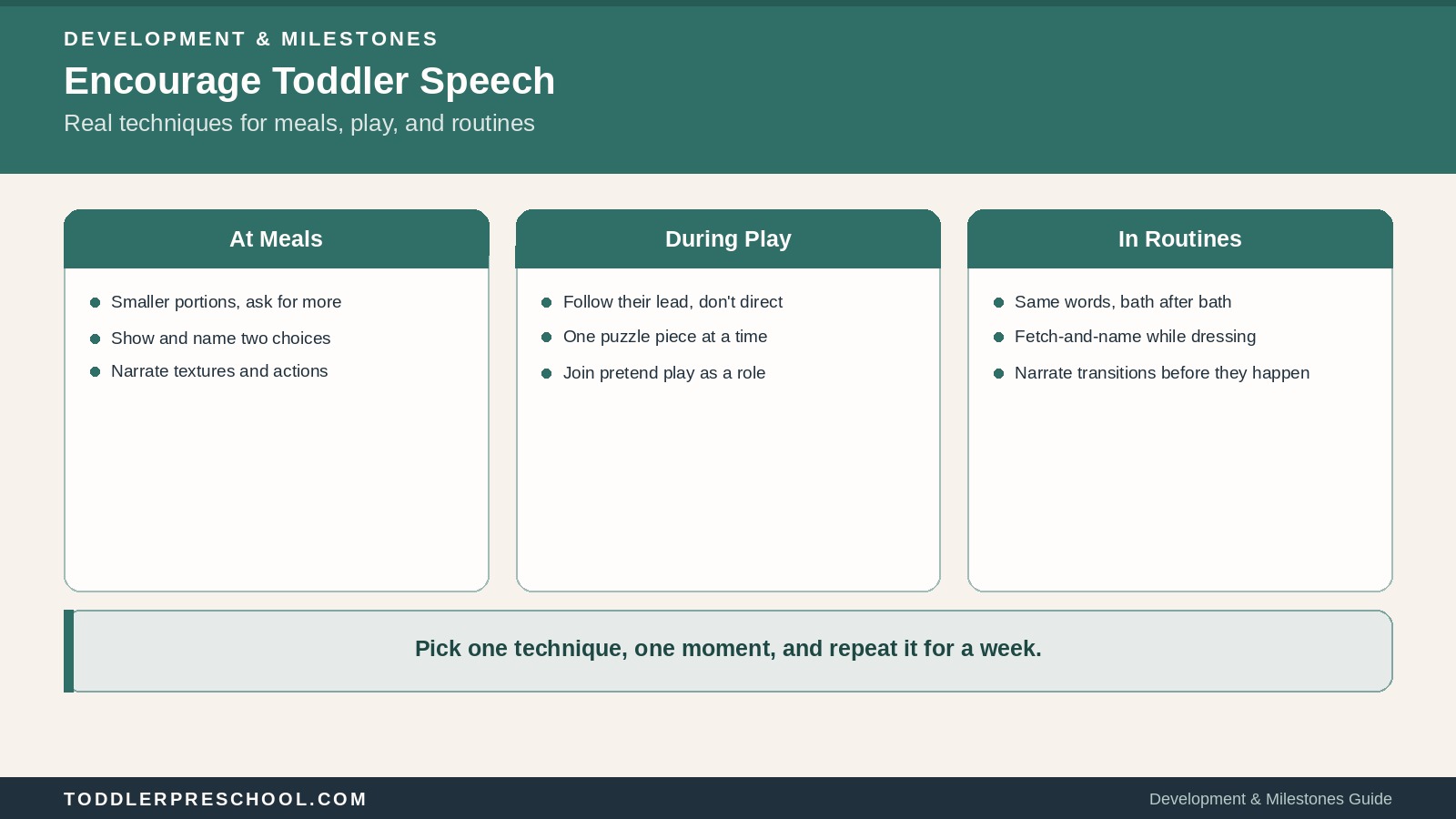
Here’s the direct answer. How to encourage toddler speech comes down to a small set of proven techniques. Apply them consistently during the moments you’re already living through: meals, play, and daily routines. You don’t need dedicated lesson time or special materials. This guide walks through real, specific strategies for each of these three contexts, plus the core techniques that work everywhere.
You don’t need to become a different kind of parent to make this work. Most of these techniques take the moments you’re already spending with your toddler. They add a small, specific language layer on top, without requiring extra time carved out of an already full day.
How to Encourage Toddler Speech: Core Techniques That Work Everywhere
Before getting into specific moments, a few foundational techniques apply across every context in this guide. Learning these first makes the rest of the guide easier to apply consistently.
Narrate More Than Feels Natural
Describe what you’re doing out loud, even during ordinary tasks. This exposes your toddler to a steady stream of real language tied directly to what they’re seeing and experiencing right now.
This feels repetitive to most adults at first. Your toddler doesn’t experience it that way; repetition is exactly how new words get learned and remembered. Saying “we’re putting on your shoes” every single morning, in nearly the same words, is doing real work. It feels mundane to you by the tenth repetition, but it’s still working.
Use Real Words Alongside Any Nicknames
A warmer, higher-pitched, more melodic tone, sometimes called parentese, genuinely helps hold a toddler’s attention. Pairing it with real vocabulary, not just cute nicknames, matters just as much.
If you call dinner “num-nums,” follow it with the real word too. Try “time for dinner, we’re having pasta.” This way your toddler gets both warmth and real language. A cute substitute word alone won’t transfer to other settings.
Wait Before Filling the Silence
After naming something or asking a simple question, pause for several full seconds before jumping in yourself. This gives your toddler genuine space to attempt a response.
Counting silently to five is a simple, concrete way to actually hold that pause. It stops you from rushing to answer for them out of habit. This specific habit, waiting a beat longer than feels natural, is one of the single most effective, low-effort changes a parent can make.
Respond to Every Communication Attempt
A point, a grunt, or an approximate word all deserve a warm, immediate response. This teaches that communication works, regardless of how clear the attempt was.
A toddler who reaches toward a cup and makes a sound gets an immediate, warm response. Try “you want your cup, here you go.” That teaches something important. Reaching out and communicating gets results. That lesson matters more in these early stages than the clarity of any single attempt.
Offer Real Choices, Shown and Named
Rather than open-ended questions, hold up two real options, name each one clearly, and let your toddler point, reach, or attempt a word. “Do you want crackers, or a banana?” works better than “what do you want to eat.” It gives a toddler something concrete to answer.
An open-ended question asks a toddler to generate language from nothing. A shown, named choice gives them a much smaller, achievable task: recognizing and selecting from two real options already in front of them.
Expand, Don’t Just Repeat
When your toddler says one word, add one more onto it in your response. If they say “ball,” you say “yes, big ball” or “red ball.” This models the next step up. No correcting, no demanding a repeat.
This technique is sometimes called expansion. It’s one of the most consistently recommended strategies across speech-language literature. It meets a toddler exactly where they are, and gently extends just one step further.
Create Small Communication Temptations
Occasionally hold something just out of reach, or pause a favorite activity, to give your toddler a genuine reason to ask for more. This isn’t about withholding; it’s about creating a real, low-pressure moment where words become useful.
This specific technique has a name in speech-language practice: a communication temptation. Pausing a tickle game right before the best part uses this same idea. So does handing over toy pieces one at a time instead of all at once.
Encouraging Language During Meals
Mealtime happens multiple times a day, which makes it one of the highest-value windows for real language practice. Unlike a dedicated activity you have to set up, meals happen whether or not you plan for them. That makes any language added here essentially free.
Narrating Before and During the Meal
Describing what you’re preparing, “I’m cutting the apple into slices,” gives your toddler language tied directly to something they’re watching happen. This works even before they’re old enough to respond verbally, since receptive language, understanding, develops well before expressive language, speaking, catches up.
Continue this narration once food is on the table. Name colors, textures, and temperatures. This keeps the language flowing throughout the meal, not just during setup. “This soup is warm. These carrots are orange and crunchy.” Each small comment adds a piece of real, concrete vocabulary, tied to something your toddler is experiencing right now.
The Power of Smaller Portions
Serving a smaller portion than usual, then waiting for your toddler to ask for more, creates a genuine, low-pressure reason to communicate. This is sometimes called a communication temptation. It’s one of the most consistently recommended techniques in speech-language literature. It works with a toddler’s own motivation, rather than asking them to perform on command.
When your toddler does ask, even with a gesture or a grunt, respond immediately and warmly: “more, you want more! Here you go.” This confirms that the attempt worked. Over time, many toddlers begin adding an approximate word, then a clearer one, to this exact same request. It’s been reinforced so consistently, at exactly the right moment.
This technique works particularly well with a favorite food. A toddler who loves a specific snack has real motivation to ask for it again. That motivation does a lot of the work for you.
Offering Real Choices at the Table
Show two food options side by side rather than asking an open-ended question. Say each name clearly as you show it: “crackers, or banana?” Let your toddler point, reach, or attempt a word first.
If your toddler points without a word, model it back briefly: “crackers? You want crackers.” This pairs the successful choice with the actual word, without demanding a repeat. Over repeated meals, many toddlers start attempting the word themselves, simply from hearing it modeled so consistently at exactly the right moment.
This same technique scales up as your toddler’s language grows. A toddler who once simply pointed between two options might eventually say “banana” clearly. Later, it might become “I want banana,” as expressive language catches up to what they’ve understood and practiced for months already.
Naming Food, Textures, and Actions
Describing what’s happening as your toddler eats, “that’s crunchy,” “you’re using your spoon,” builds vocabulary tied directly to a real, current sensory experience.
This works especially well with foods that have an obvious texture or temperature, since the sensory experience itself helps the word stick. A toddler biting into something genuinely crunchy, while hearing the word “crunchy” at that exact moment, tends to remember it far more easily. A word introduced in isolation, away from the actual sensation, sticks less well.
Action words matter here too, not just food descriptions. Narrate “you’re stirring,” “you’re pouring,” or “you’re wiping” as your toddler participates in these small tasks. This builds verb vocabulary, which often lags behind noun vocabulary at this age.
Family-Style Meals as a Language Opportunity
Passing dishes around the table, rather than pre-plating everything, creates natural moments for requesting, waiting, and simple exchange. “Can you pass the bread” becomes a real, meaningful request. Your toddler can eventually participate themselves, both as the one asking and the one being asked.
This format also naturally exposes your toddler to more back-and-forth conversation between other family members at the table, even talk not aimed at them directly. Overhearing this kind of natural talk contributes to language development too, not just language directed specifically at your toddler.
Snack Time Specifically
Snack time often has lower stakes and less time pressure than a full meal. This makes it a genuinely good window for trying a new technique, without the stress of a full dinner routine riding on it.
The same choice-offering and communication-temptation techniques from mealtime apply directly here, just in a shorter, lower-pressure format. A quick afternoon snack, offered as a choice between two options, takes only a minute or two. It adds up meaningfully across many repetitions over weeks.
A Sample Meal Script You Can Use
Putting several of these techniques together might sound like this: “I’m cutting your sandwich now. Do you want it cut in triangles, or squares?” Wait, then respond to whatever answer comes, even a point. “Triangles! Here you go. It’s soft, and it’s got cheese inside.” This single short exchange layers narration, choice, waiting, and description together in under a minute.
Common Obstacles to Encouraging Toddler Speech at Mealtime
A few situations come up often enough to address directly.
“My toddler gets frustrated instead of asking when I wait.” If waiting consistently leads to distress rather than an attempt, shorten the wait time. Offer a model word sooner. The technique should reduce frustration over time, not increase it in the moment. A few seconds of pause is usually enough; this isn’t about making your toddler wait uncomfortably long.
“Mealtimes are already chaotic, and I don’t have bandwidth for a new technique.” Pick just one small addition, like narrating a single food item. Don’t try to apply every strategy in this guide at once. One consistent habit beats five inconsistent ones, especially during an already demanding part of the day.
“My toddler eats the same three foods and mealtime feels boring to narrate.” Even a familiar meal offers real narration opportunities. The temperature. The specific way it’s cut today. Which cup it’s served in. Predictability in the food itself doesn’t mean the language around it has to feel repetitive too.
Encouraging Language During Play
Play is where a toddler’s genuine interest already lives, which makes it a naturally rich language environment. Unlike more structured moments, play follows your toddler’s own curiosity, which means the language that comes with it tends to stick especially well.
Following Your Child’s Lead
Talk about whatever your toddler is already focused on, rather than redirecting to a topic you’ve chosen. This builds far more engagement than steering the conversation yourself. If they’re stacking blocks, narrate the blocks, not a different activity you’d prefer.
This single shift, following rather than directing, is one of the most consistently recommended techniques across early language intervention approaches. It respects that your toddler is already engaged and motivated by whatever has their attention. Language layered onto an existing interest lands far more effectively than language introduced to redirect attention elsewhere.
Watching closely for a few seconds before jumping in also matters here. Simply observe what your toddler is actually doing, rather than assuming. This ensures your narration genuinely matches their real focus, rather than your guess at it.
Parallel Talk During Independent Play
Describing what your toddler is doing, in real time, while they play independently nearby, exposes them to language without requiring a response. “You’re pushing the truck. It’s going fast.”
This works well specifically because it doesn’t interrupt the play itself; it simply adds a language layer on top of what’s already happening. A toddler deep in solo play doesn’t need to stop and respond to benefit from this kind of narration running alongside them.
This technique is particularly useful on days when your toddler seems to want independence more than direct interaction. You can still be actively building language exposure without inserting yourself into the play itself.
The One-Piece-at-a-Time Technique
During a puzzle, building blocks, or any activity with multiple pieces, hand over just one piece at a time. Skip handing over the whole set. This creates a natural, repeated opportunity for your toddler to request the next one.
Pair this with a simple model word each time. Use “more,” or the specific item name, so the request has language attached to it consistently. Over many repetitions across many play sessions, this structured repetition tends to build real, reliable vocabulary. It works faster than a single large exposure would.
This technique also works well with snacks during play, like handing over crackers one at a time during a longer play session. It effectively combines a mealtime and a playtime technique into one natural moment.
Pretend Play as a Language Goldmine
Pretend play naturally generates rich, varied language. Think feeding a doll, driving a toy car somewhere specific, or having two stuffed animals talk to each other. Joining in, rather than just watching, multiplies the language exposure significantly. Your own added dialogue and narration doubles the amount of language happening during that same play session.
Take on a simple role yourself. Try “I’ll be the baby, can you feed me.” This gives your toddler a natural reason to direct language toward you specifically. Pretend play also introduces vocabulary and sentence structures that don’t come up as naturally elsewhere. Think narrating an imagined scenario, or describing what a character might be feeling.
As your toddler’s pretend play grows more complex, the language demands grow with it. A toddler moving from simply feeding a doll to narrating an entire pretend meal is doing genuinely sophisticated language work. This includes imagined foods and reactions. This holds true even if it looks like simple play from the outside.
Turn-Taking and Simple Games
Games with an obvious back-and-forth structure work well here: rolling a ball, a simple hiding game, or “I Spy” style prompts. These build genuine conversational turn-taking, a real skill independent of vocabulary size.
Even a very simple version builds this pattern early and repeatedly. Roll a ball back and forth while saying “my turn” and “your turn” each time. This turn-taking structure mirrors the back-and-forth nature of real conversation itself. That makes it a genuinely useful foundation, even before much actual vocabulary is involved.
Simple hiding games work well too. Try hiding a favorite toy under a blanket and asking “where’s the bear.” This builds receptive language and the anticipation that keeps a toddler interested.
Reading as Interactive Play, Not Passive Listening
Pause to ask “what’s that” while pointing at a picture, rather than reading straight through without stopping. This turns reading into an active, back-and-forth exchange, rather than passive listening.
Letting your toddler choose the same favorite book repeatedly matters here too, since predictable, familiar text builds genuine recall and eventual participation. A book read for the fifteenth time isn’t wasted repetition. It’s exactly the kind of consistency that helps a toddler eventually predict and join in on familiar lines.
Books with a simple, repeated refrain work particularly well for this specific technique. The predictable pattern gives your toddler a genuine, low-pressure opportunity to anticipate and eventually say the repeated line themselves.
Outdoor and Movement Play
Narrate what you see together outside: a dog, a truck, a bird. This gives your toddler exposure to vocabulary that simply doesn’t come up as often indoors. The outdoor environment offers a genuinely different, often richer vocabulary set than most indoor play spaces can match. The world outside your door changes constantly, in ways a living room rarely does.
Movement-based language, “up,” “down,” “fast,” “stop,” pairs naturally with physical play like swinging or climbing, giving abstract words a genuine physical anchor. A toddler who hears “up” while actually being lifted up on a swing connects that word to a real, felt sensation. This tends to build stronger recall than the same word introduced without any physical experience attached.
Common Obstacles to Encouraging Toddler Speech During Play
A few situations worth addressing directly.
“My toddler wants to play alone and doesn’t want me narrating.” Respect this some of the time. Parallel talk works even from a slight distance. Not every play session needs active narration to be valuable. A toddler playing happily alone is still building real skills, even without language added on top.
“I run out of things to say while narrating.” This is common. A simple, repeated formula, action plus object, “you’re pushing the car,” “you’re stacking the cup,” covers most moments without needing constant new material. You don’t need to narrate like a novelist; simple, repeated sentence patterns work just as well.
“My toddler gets frustrated when I join pretend play the ‘wrong’ way.” Follow your toddler’s specific version of the scenario. Don’t introduce your own idea of how it should go. This usually resolves it. Let them direct the play; your job is simply to add language on top of whatever they’ve already decided is happening.
Encouraging Language During Daily Routines
The routines that happen every single day, dressing, bathing, traveling, bedtime, offer some of the most consistent, repeatable language opportunities available. These moments repeat in nearly the same form day after day. That makes them uniquely well suited to the kind of consistent, repeated language modeling that actually builds recall.
Getting Dressed
Ask your toddler to fetch a specific item, like “can you get your socks.” This builds receptive language. Describing colors and textures builds expressive vocabulary too. Both happen naturally during a task you’re doing anyway.
Narrating the actual sequence, “shirt first, then the sweater,” also builds an early sense of order and sequencing alongside the vocabulary itself. Asking your toddler to help decide between two shirt options, held up and named clearly, adds a choice-based opportunity to this same routine.
As your toddler’s skills grow, this routine can shift from simple naming toward genuine categorizing. Sort clothes into “warm” and “cool weather” piles together, or group items by color. This builds more advanced language alongside the basic vocabulary of getting dressed.
Bath Time
Bath time offers a naturally contained, repeatable vocabulary set: water, bubbles, splash, wash, all done. Repeating these same words consistently, bath after bath, builds real recall faster than a large, varied vocabulary introduced only once.
The sensory richness of bath time, warm water, bubbles, different textures, also gives abstract words something concrete to attach to. A toddler feeling the actual sensation of “warm” water while hearing that word repeated connects the word to a real, physical experience. This works far more effectively than hearing the word in isolation.
Bath toys add another layer of opportunity here too. Narrate simple actions with bath toys, like “the boat is floating” or “the duck is sinking.” This pairs vocabulary with visible cause and effect, right in front of your toddler.
Diaper Changes and Bathroom Routines
Even a routine task like a diaper change offers a genuine, repeated window for simple, consistent language. Name body parts. Narrate the steps. Simply talk through what’s happening next.
For a toddler in the process of potty training, this routine becomes an especially rich language opportunity. It’s tied to a skill they’re actively motivated to build. Narrate the whole sequence consistently. Try “first we pull down, then we sit, then we wipe.” This builds both language and an early sense of procedure.
Car Rides and Errands
Narrate what you see out the window, or share a simple story from your own day. This exposes your toddler to language with a different rhythm and pace than instructional talk.
Ask open-ended questions, like “what did you see,” rather than yes-or-no questions. This invites more than a single-word response, once your toddler has enough language to attempt it. Even before your toddler can answer these questions fully, hearing them modeled consistently builds the underlying pattern for eventual response.
Errands specifically offer a wider vocabulary set than most home routines. A grocery store or a post office introduces genuinely different objects, people, and actions than what typically comes up at home.
Bedtime Routine
The wind-down pace of bedtime pairs naturally with a slower, more deliberate narration style. Reading the same favorite book, singing a familiar song, and using consistent, predictable phrases each night all build genuine language recall.
This repeated, predictable structure is also simply calming, which supports the routine’s other goal of helping your toddler settle for sleep. A consistent bedtime script helps here. Say nearly the same words every single night: “time for pajamas, then teeth, then two books.” This becomes genuinely familiar language. Your toddler comes to anticipate it and eventually joins in.
Talk briefly about the day just completed, even in very simple terms. Try “we went to the park, we saw a dog.” This introduces a small, low-pressure form of storytelling. It grows more elaborate as your toddler’s own language does.
Transitions Between Activities
Narrate an upcoming transition, like “two more minutes, then we clean up.” This gives your toddler a language model and a moment to process the change before it happens.
This same narration, repeated consistently across many transitions throughout a day, becomes a reliable language pattern. Your toddler comes to recognize and anticipate it. Over time, many toddlers begin using pieces of this same language themselves, announcing their own transitions using phrases they’ve heard modeled repeatedly.
Building a Simple Routine Vocabulary List
Picking a small, consistent set of words for each routine, rather than trying to introduce new vocabulary constantly, helps recall build faster. A few examples:
- Bath time: water, bubbles, splash, wash, all done
- Mealtime: more, all done, eat, drink, yummy
- Leaving the house: shoes, coat, ready, bye-bye, car
- Getting dressed: shirt, pants, socks, zip, button
- Bedtime: pajamas, book, night-night, sleepy, cozy
Use these same words consistently, routine after routine, day after day. This is more effective than introducing a large, varied vocabulary just once. Once these core words feel solid, gradually add one or two new words to each list. This keeps vocabulary growing without overwhelming the consistency that makes this approach work.
Common Obstacles to Encouraging Toddler Speech During Routines
A few specific situations worth naming directly.
“Routines happen so fast, there’s no time to add language.” Start with just one routine, like bath time, rather than trying to add narration everywhere at once. A single consistent habit is more sustainable than an ambitious, unsustainable overhaul that fizzles out within a week.
“My toddler resists routines entirely, so language feels like the last priority.” This is a real, separate challenge worth addressing on its own terms first. A calmer routine itself often creates more room for language once the resistance eases. Addressing the resistance isn’t a detour from this guide’s goal. It’s part of the same path.
“I feel silly narrating the same five words every single bath time.” This repetition, however monotonous it feels to you, is exactly the mechanism that builds real recall. The feeling of silliness fades with practice, and the consistency underneath it is doing genuine work the whole time.
Language Building With Siblings, for How to Encourage Toddler Speech
Many families applying these techniques also have more than one child, and a little specific guidance helps here.
When an Older Sibling Talks for the Toddler
A toddler with an older sibling who anticipates and speaks for them sometimes has less practical need to talk themselves. Gently pause before an older sibling jumps in. Give the toddler a genuine chance to attempt it first. This can meaningfully shift the pattern over time, with a little consistent, gentle redirection.
Involving Older Siblings as Language Models
Rather than only limiting an older sibling’s helpful instincts, involve them directly. Try “can you show your brother the word for this.” This turns their natural tendency to help into a genuine language-modeling opportunity.
One-on-One Moments Still Matter
Even five focused minutes of one-on-one interaction with your toddler, away from a sibling’s attention, helps. It protects space for your toddler’s own attempts, without any competing voice filling in for them. This doesn’t need to happen constantly to add real value across a week, even two or three short windows genuinely help.
Twins and Close-in-Age Siblings
Two children close in age sometimes develop their own shared communication shortcuts between themselves. This can occasionally reduce their individual motivation to use full, clear language with adults. Continue to model full words and phrases consistently, even when a shortcut between the two children works fine for them. This keeps broader language development on track for each child.
How to Encourage Toddler Speech: Choosing the Right Toys
The toys already in your home can either support or work against these techniques, worth a quick, honest look.
Open-Ended Toys Invite More Language
Blocks, simple figures, and toys without a single fixed way to play tend to generate more varied, ongoing language. This holds true compared to a toy with only one correct action, like pressing a single button for a single sound. An open-ended toy can be a car one day and a boat the next. It generates entirely different vocabulary each time it’s played with, since the toy’s meaning shifts along with your toddler’s own imagination.
Toys With Sound and Light Aren’t Inherently Bad
A toy that lights up or plays sounds on its own isn’t harmful. But it often generates less back-and-forth language than a simpler toy. A simpler toy depends on your toddler’s own imagination and your shared narration to come alive. The toy itself is already doing the talking, leaving less room for either of you.
You Don’t Need to Overhaul Your Toy Collection
This isn’t about replacing every toy your toddler owns. Simply choose open-ended play more often, when you do have a choice. Add narration to whatever toy is actually in use. This works well regardless of what’s already in your home. A battery-powered toy your toddler already loves doesn’t need to disappear; it simply benefits from your added narration layered on top of it.
How to Encourage Toddler Speech Around Screen Time
Screens are a genuine part of most families’ daily reality, and it’s worth addressing directly rather than ignoring.
Why Interactive Language Beats Passive Screen Time
Passive screen time, watching a show alone with no interaction, doesn’t offer the back-and-forth exchange that builds language most effectively. This isn’t about screens being inherently harmful. It’s about interactive, responsive conversation doing more of the actual language-building work, regardless of the specific source of the passive content.
If Screen Time Is Part of Your Routine
Watching together, and talking about what’s happening on screen, “look, the dog is running,” preserves some interactive value even during screen time itself. This isn’t the same as fully interactive play. Still, it’s a meaningfully better version of screen time than watching alone in silence, with no shared narration at all.
A Realistic, Non-Judgmental Approach
Most families use some screen time, and that’s a normal, reasonable part of modern parenting. The goal here isn’t eliminating screens entirely. It’s making sure they don’t crowd out the interactive, back-and-forth moments that these techniques rely on to build real language.
How to Encourage Toddler Speech With Songs and Music
Music offers a genuinely different, valuable path into language than spoken conversation alone.
Why Songs Work So Well for Language
Simple, repetitive songs pair language with melody and rhythm. Many toddlers find this easier to recall, and eventually join in on, than spoken words alone. The predictable structure of a familiar song gives a toddler a genuine, low-pressure opportunity to anticipate and fill in a word or line. This is similar to the predictable book technique covered earlier in this guide.
Action Songs Specifically
Songs paired with movement connect language to physical action. Think “The Wheels on the Bus” or a simple clapping rhyme. This is similar to how movement-based words work during outdoor play. This combination of movement and language tends to build especially strong recall. The physical action itself serves as a memory anchor for the accompanying words.
Making Up Your Own Simple Songs
A short, repeated phrase, set to a simple made-up tune, works just as well as a well-known song. Sing it consistently during a specific routine, like cleanup time. The tune itself doesn’t need to be sophisticated. Consistency and repetition matter more than musical quality. Your toddler won’t judge your singing the way an adult audience might.
Singing During Transitions
Pair a simple song with a transition: a cleanup song when toys need to go away, a specific tune for washing hands. This gives that transition a consistent, predictable cue your toddler comes to recognize and anticipate. It often eases resistance to the transition itself along the way.
How to Encourage Toddler Speech Without Overdoing It
None of this needs to happen everywhere, all day, to genuinely help. Knowing how to pace yourself matters just as much as knowing the techniques themselves, when learning how to encourage toddler speech sustainably.
Picking One or Two Contexts to Start
Choose just one meal, one play session, and one routine to focus on consistently. This is a far more sustainable starting point than trying to apply every technique across the entire day. Bath time and one meal, for instance, is a genuinely reasonable starting combination for most families.
Adding a Second Context Gradually
Add a second context only once the first feels genuinely automatic, rather than all at once. This tends to build habits that actually last. An ambitious plan trying to do everything at once often collapses within a few days.
Consistency Matters More Than Intensity
A single technique used consistently across many days tends to help more than every technique attempted once and abandoned. Pick something small enough to actually repeat. The repetition itself is doing much of the real work here, not the sophistication of any single technique.
It’s Fine to Have Off Days
A day where none of this happens, because you’re exhausted or the day got away from you, doesn’t undo progress. Other days still count. Language development happens across weeks and months, not any single day. Treating one missed day as a genuine setback tends to create unnecessary pressure that works against the whole approach.
Involving Every Caregiver
If more than one adult is involved in your toddler’s care, sharing which specific techniques you’re focusing on helps build consistency across settings. A brief, simple conversation is usually enough. Try “we’re working on offering choices at snack time.” That gets everyone genuinely on the same page, without needing a formal, written plan.
Tracking How to Encourage Toddler Speech Without Adding Pressure
A few practical notes on noticing real change over time, without turning this into a source of stress.
A Simple, Private Note
Jot down a new word or a specific moment where a technique clearly worked, even just a few words on your phone. This builds a genuine record over time. It’s far more reliable than trying to remember weeks of small moments from memory alone, especially on the busiest, most forgettable days.
Looking Back Every Few Weeks
Rather than judging progress day to day, look back over your notes every few weeks. This reveals a trend far more clearly than any single day could show on its own. A single hard day doesn’t reflect the broader trajectory, and this kind of longer view tends to be more accurate and more encouraging.
Celebrating Small Wins Along the Way
A new word. A longer pause held successfully. A clearer attempt at a familiar request. All of these are genuine progress worth noticing, even when the overall goal still feels far off. These small moments add up meaningfully over time, and noticing them consistently helps sustain your own motivation to keep applying these techniques.
Current Milestone Guidance, Briefly
This guide focuses on technique, not a full milestone reference. For real, age-by-age speech milestones from 12 to 36 months, see our companion guide, Toddler Speech Milestones by Age. It covers the complete picture in depth, including specific benchmarks for each stage.
In general terms, most toddlers move from single words and gestures around their first birthday. By age three, most reach short phrases and simple conversation. Individual timing varies widely, though. These techniques apply across this entire range, simply adjusted for where your specific toddler currently is.
For a toddler with a smaller current vocabulary, focus on single words and simple choices. For a toddler already combining words, focus shifts naturally toward expansion. Add one more word onto what they already say. Encourage longer responses to open-ended questions.
Monitoring Versus Screening
These two terms are worth understanding separately, since they serve genuinely different purposes in tracking your toddler’s development.
Monitoring Is Ongoing and Informal
Monitoring is the everyday, informal tracking of your child’s development, happening at every well visit and every time you notice something at home. Applying the techniques in this guide is itself a form of active monitoring. It puts you in close, regular contact with your toddler’s actual communication, far more than an occasional passing observation would.
This ongoing, hands-on engagement with your toddler’s language builds your own awareness of gradual changes over time. Simply using these techniques regularly does this, without needing a separate, dedicated tracking system layered on top.
Screening Is Formal and Scheduled
Screening uses a validated tool at specific ages. This typically happens around 9, 18, and 30 months for general development, plus autism-specific screening at 18 and 24 months. A screening flag isn’t a diagnosis. It’s a prompt for a closer look, using a structured, standardized approach rather than a parent’s general impression alone. This gives everyone more reliable, comparable information to work from.
Why This Works So Well
Both monitoring and screening matter, and neither replaces the other. The techniques in this guide support the monitoring side directly. Screening remains a separate, formal process your pediatrician leads, at specific scheduled points throughout the toddler years.
How to Encourage Toddler Speech: Coordinating With Daycare
If your toddler spends time in a group care setting, a little coordination extends these techniques beyond just your own home.
Asking What Language Techniques They Already Use
Many programs already use versions of these same techniques, narration, waiting, expansion, as part of their general approach. Ask directly what your child’s teacher does. This can help you use consistent, complementary language at home, rather than accidentally working at cross purposes with the classroom approach.
Sharing What’s Working at Home
Let your child’s teacher know which specific techniques you’ve found effective at home. This helps them reinforce the same approach during the day. It builds a more consistent experience for your toddler across both settings, rather than two disconnected approaches.
Different Settings, Different Language
A toddler communicating differently at daycare than at home isn’t unusual, and it doesn’t mean one setting is doing something wrong. Different environments genuinely produce different comfort levels and different opportunities for language. Both patterns are worth mentioning to each other, rather than assuming either setting alone has the full picture.
Everyday Examples of How to Encourage Toddler Speech
A few concrete moments show how this looks in practice, pulling several techniques from this guide together into real, everyday scenarios.
At Breakfast
Your toddler points at the cereal box. Rather than simply pouring it, you hold it up and say “cereal? You want cereal,” pausing briefly before handing it over. This turns an automatic moment into a small language opportunity, using the choice-and-wait technique from earlier in this guide in under ten seconds.
During Block Play
Your toddler is stacking blocks alone. You sit nearby and narrate quietly, “big blue block, now a red one,” without asking them to respond. This builds exposure without adding pressure, using parallel talk exactly as described in the play section above.
At Bedtime
You read the same board book for the fifth night in a row. Rather than feeling repetitive, this repetition is exactly what helps your toddler eventually predict and join in on familiar lines. This is the same principle behind the repeated reading technique covered earlier.
Getting Ready to Leave the House
Your toddler is putting on shoes. You narrate: “left shoe first, now the right one.” Then pause before handing over the second shoe. Let your toddler reach or ask for it. This combines routine narration with the wait-and-respond technique in one small, everyday moment.
During a Car Ride
You point out a garbage truck passing by and say “big truck, loud truck,” then wait. Your toddler might repeat “truck” or simply look with interest; either response is a genuine sign the narration landed.
The Wide Range of Normal for How to Encourage Toddler Speech
A few sources of genuine variation are worth naming directly. These techniques need to flex for real families, not just an idealized version of toddlerhood.
Multilingual Families
Every technique in this guide works in any language your family speaks at home, including switching between languages naturally. Consistency in your child’s most comfortable language matters more than which specific language you use. There’s no need to pick just one language to apply these techniques in.
Code switching is a normal part of bilingual development, not something to avoid while using these techniques. This means using words from more than one language within the same conversation.
Disability and Developmental Differences
For a toddler with a diagnosed disability, these general techniques may need adaptation from a specialist working directly with your family. Your child’s care team is a better guide here than a general article. Still, many of the core principles, following your child’s lead, waiting, responding to attempts, remain relevant even with specific adaptations layered on top.
Temperament
A quieter, more observant toddler may take in language just as effectively while showing less immediate verbal response. Not every technique needs an instant spoken result to be working. Receptive language, understanding, is building steadily, even when expressive output lags visibly behind it.
Family Structures and Available Time
Whoever spends time with your toddler, one or two parents, a grandparent, another caregiver, can apply any of these techniques. None require two adults or extensive dedicated time, and even a single consistent caregiver applying these techniques regularly can make a genuine difference.
Sensory Sensitivities
For a toddler who finds certain textures, sounds, or sensory experiences overwhelming, adapt the specific technique. Skip food-texture narration for a child with food sensitivities, for instance, while keeping the underlying approach. This still works well. The core structure of these techniques, waiting, responding, expanding, doesn’t depend on any single sensory detail to function.
What to Do If a Skill Is Missing, Lost, or Concern Remains
A few clear next steps for how to encourage toddler speech further, depending on your specific situation.
If a Skill Seems Missing
Give focused attention to the techniques in this guide for two to four weeks, then reassess. If a specific milestone still seems absent, mention it directly at your next pediatric visit. Bring specific observations, not just a general impression.
If a Skill Was There, Then Lost
Regression deserves a prompt call to your pediatrician, not a wait-and-see approach. This means a toddler who used to say a word or use a gesture, and now doesn’t. This is a genuinely different situation from a skill simply arriving later than expected, and it’s worth treating with more urgency.
If Concern Remains
Trust your own observation. Every U.S. state offers a free early intervention program for children under 3. You can request an evaluation directly, often without a doctor’s referral. Our companion guide, My Toddler Is Not Talking Yet, walks through this full pathway in depth. It includes the specific distinction between a late talker and a broader concern.
These Techniques Support, Not Replace, Professional Help
If your toddler is already receiving speech-language support, these techniques work well alongside that professional guidance, not instead of it. Mention to your speech-language pathologist which techniques you’re already using at home. This can help them build directly on what’s already working for your specific child.
Common Obstacles to Encouraging Toddler Speech
A few broader situations worth addressing directly.
“I feel like I’m performing instead of just being a parent.”
This feeling is common when first trying deliberate techniques. Most of these strategies become genuinely natural with repetition, fading into your normal parenting style rather than feeling like a performance indefinitely. Give it a few weeks before judging whether it still feels forced.
“My toddler seems to prefer gestures over even trying words.”
This is common and not a sign anything is wrong. Continue to model the word alongside accepting the gesture, rather than withholding a response until a word comes. This keeps communication working while still building toward speech. Gestures themselves are a genuine, valid form of early communication, not a failure to progress.
“I don’t see any difference after trying this for a week.”
Real change often takes several weeks of consistent practice to become visible. A single week is rarely enough to judge whether a technique is working, especially for a skill that develops as gradually as speech. Keeping a simple, brief log can help you notice gradual change you might otherwise miss day to day.
“My partner and I aren’t using the same techniques consistently.”
A brief conversation about which one or two techniques you’re both trying to use consistently helps align this without needing a formal plan. Even loose alignment between caregivers tends to work better than each person using a completely different, uncoordinated approach.
“I worry I’m doing this wrong.”
There’s no single perfect way to apply these techniques. Consistency and warmth matter more than precision, and a slightly imperfect version of any technique, applied regularly, still does real, meaningful work.
Adapting This to Every Family’s Situation
Budget. Every technique in this guide costs nothing and uses moments you’re already living through. None require special toys, apps, or purchased materials.
Schedule constraints. Picking just one routine or one meal to focus on, rather than an all-day overhaul, fits into even the busiest family’s actual schedule.
Access to care. If you don’t have a regular pediatrician, community health centers can typically help connect you with your state’s early intervention program directly.
Multilingual and immigrant families. These techniques translate directly into any home language. Early intervention evaluations are required to accommodate your family’s language too, including providing an interpreter when needed.
Working parents with limited time. These techniques don’t require dedicated extra time beyond what you’re already spending on meals, play, and routines each day.
Families with more than one child. If you’re also caring for other children, even a few minutes of focused, one-on-one language interaction help. During a single routine, protected from interruption, this adds up meaningfully over a week. You don’t need a large block of dedicated time every day.
Non-traditional schedules. For families with shift work or non-standard routines, these techniques adapt to whatever your actual daily structure looks like. They don’t require a conventional nine-to-five family schedule to work. They’re built around your actual meals, play, and routines, whenever those happen to fall.
Frequently Asked Questions
Questions About Technique and Timing
Is it okay to use baby talk with my toddler? A warmer, simplified tone is fine and even helpful for attention. Pairing it consistently with real words, rather than relying on baby talk alone, gives your toddler the actual vocabulary they’ll eventually need.
How long before I should expect to see a real difference? Most families notice gradual change over several weeks of consistent practice, not overnight. Progress in language development is rarely a single dramatic before-and-after moment.
Should I correct my toddler when they say a word wrong? Modeling the correct word back, rather than directly correcting, tends to work better. If your toddler says “wa-wa” for water, respond with “yes, water,” rather than pointing out the mispronunciation directly.
Questions About Specific Situations
Can too much talking overwhelm a toddler? Genuine back-and-forth interaction rarely overwhelms a toddler the way constant, one-directional talking might. Following your child’s cues and allowing real pauses keeps this naturally balanced.
Do these techniques work the same way for a toddler who already talks a lot? Yes, though the goal shifts slightly toward expanding sentence length and vocabulary variety, rather than encouraging first words. The same core techniques, expanding, following their lead, real conversation, still apply, just applied to longer, more complex language instead of single words.
Is it possible to overdo these techniques and make language feel like pressure to my toddler? Yes, if every single interaction turns into a structured language exercise. Balance these techniques with plenty of ordinary, pressure-free time together. This keeps the whole approach feeling natural, rather than constant and exhausting for both of you.
A Few More Practical Questions
Do I need to use the exact scripts and phrases in this guide word for word? No, these are examples, not required scripts. Adapt the underlying technique, waiting, expanding, offering choices, to your own natural way of speaking. This matters more than matching any specific wording exactly. Your own genuine voice will always land better than a memorized script.
Can grandparents or other occasional caregivers realistically pick up these techniques too? Yes, especially the simplest ones like waiting before filling silence and responding warmly to any attempt. A brief, friendly explanation of just one or two techniques is usually enough. An occasional caregiver can meaningfully contribute without needing to master this entire guide first.
Is there a risk of talking too much and overwhelming a toddler who needs more quiet time? For a toddler who seems genuinely overwhelmed by constant talk, dial back to simpler, shorter narration. Build in real quiet moments too. This respects that need while still applying these techniques in a lighter form.
Managing Your Own Energy Around This
A few honest notes about sustaining this approach over time, not just starting it.
This Is Genuinely Tiring Some Days
Deliberately narrating, waiting, and responding takes real mental energy, especially layered on top of an already demanding day. Acknowledge this honestly, rather than expecting yourself to apply these techniques perfectly every single day. This keeps the whole approach sustainable over the weeks and months this actually takes.
Falling Back Into Autopilot Sometimes Is Fine
Most parenting happens on some degree of autopilot, and that’s completely normal. These techniques don’t need to replace every single interaction. They simply need to show up consistently, in the specific moments you’ve chosen, to genuinely help over time.
Your Presence Matters More Than Perfect Execution
A toddler benefits enormously from a present, warm, engaged parent. This holds true even on days when the specific techniques here don’t get applied with precision. Connection itself is doing real language-building work, even without a formal technique attached to it. No single missed day, or imperfect application, undoes that broader, ongoing relationship.
Your One Next Step
Pick one single technique from this guide, and one specific moment in your day. Maybe smaller portions at snack time, or narrating during bath time. Use it consistently for the next week before adding anything else.
Whatever you choose when learning how to encourage toddler speech, the specific technique matters less than the consistency you bring to it. A single small habit, repeated daily, tends to outperform an ambitious plan applied once and abandoned. Give it real time before judging whether it’s working, and give yourself real grace on the days it doesn’t happen at all.
Sources consulted: Centers for Disease Control and Prevention, Learn the Signs. Act Early.; established speech-language pathology guidance on communication temptations and everyday language stimulation techniques for toddlers.