

You got the supply list from your child’s new program and one line simply says “nap mat,” maybe with a size range attached, maybe not. You open a shopping app and find dozens of options in every print imaginable, and no real way to tell which is the best nap mat for preschool use specifically, one that will actually fit the cubby, meet the program’s rule, and survive a full school year of weekly washing.
Here is the direct answer. The best nap mat for preschool is not the cutest one or the most popular one. It is the one that matches your program’s actual size and thickness rule, fits in the storage space you have at home between washes, and can be washed as often as your family and program both need without falling apart. This guide explains what those rules typically look like, then compares real, currently available options against them, with honest drawbacks and a lower cost alternative for every pick.
How We Chose the Best Nap Mat for Preschool Options and What We Checked
Selection criteria. To make this list, a nap mat had to be currently available from a real retailer in the U.S., meet or exceed the thickness rules commonly used in state child care licensing codes, and represent a genuinely different priority: classic simplicity, extra comfort, a smaller size for younger toddlers, or a lower price, rather than six near identical prints of the same product.
Review basis. Every listed spec (dimensions, price, materials, thickness) was checked against current brand and retailer listings. We ran a Consumer Product Safety Commission recall search on nap mats generally and found none affecting standard tri fold foam mats. The qualitative notes, drawbacks, and who tends to skip each option are compiled from verified customer reviews on brand and retailer sites and consistent patterns across multiple independent listings, not from a ToddlerPreschool.com staff member’s own hands on test of this specific batch. We are saying that directly because implying testing that did not happen is exactly the kind of unearned claim this guide is trying to help you see past. Treat your program’s own written policy, and the brand’s current product page, as the final word over any single article, including this one.
What Actually Matters in the Best Nap Mat for Preschool
Check Your Program’s Actual Rule First, Not the Product Listing
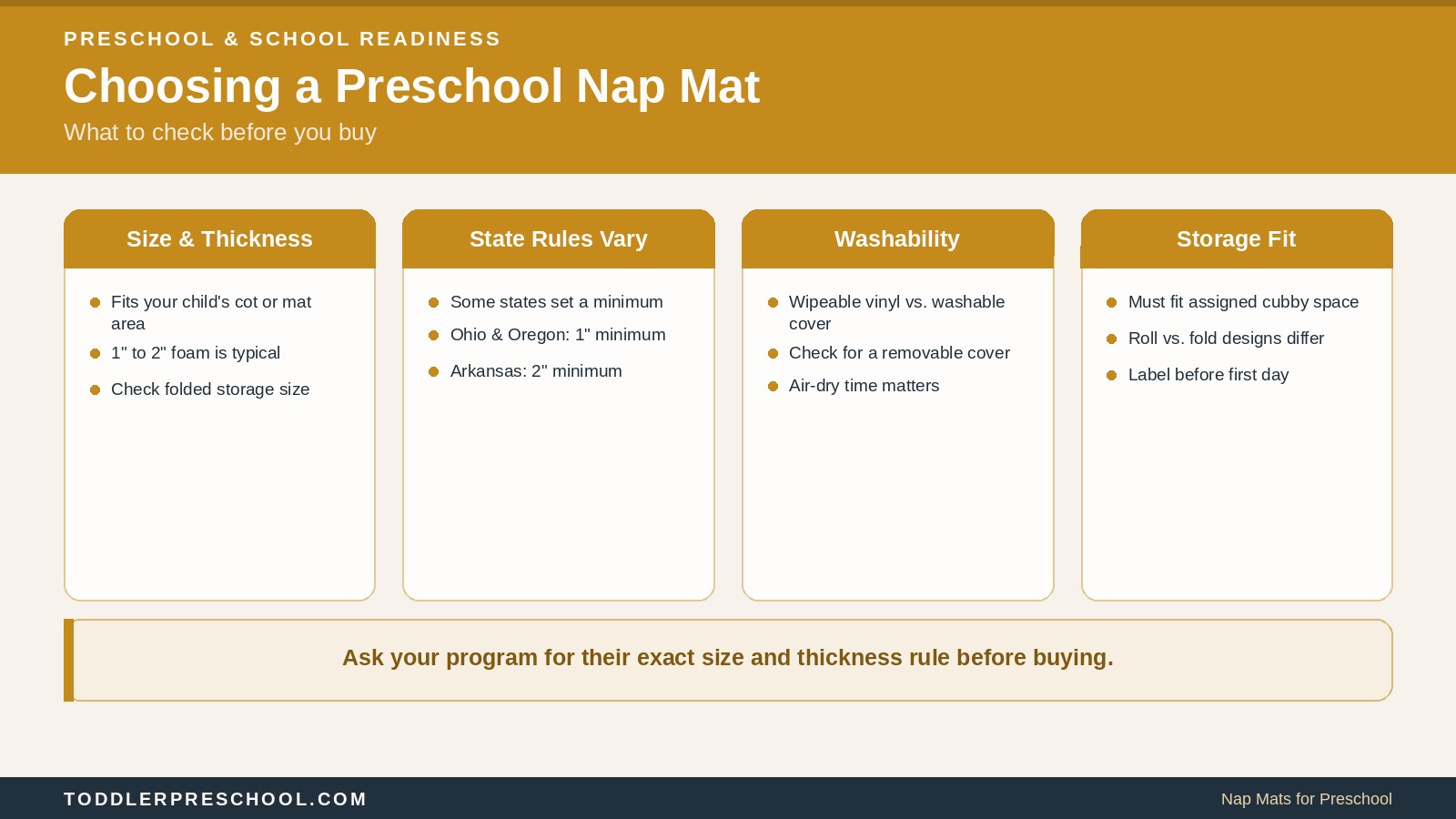
Before comparing a single product, get your specific program’s written nap mat policy: an exact size range, a thickness minimum, whether a cot is used instead, and whether the mat needs to fit in a specific cubby or bin. Many programs use a size close to the long standing classic dimension, about 19 by 45 inches, simply because it is the size cubbies were designed around decades ago and many still are. A mat that is a better product in the abstract is the wrong choice if it will not fit where your child’s program actually stores it.
Programs vary more than families expect on this point, and the search for the best nap mat for preschool really only makes sense once you know your own program’s specific answer. Some centers hand out a printed supply list with an exact brand and size named. Others simply say “nap mat, program approved” and leave the interpretation to families, which is exactly the situation this guide is built for.
Cot, Mat, or Something Else Entirely
Not every program actually uses a soft foam mat at all. Many licensed centers use stackable plastic cots instead, in which case a family buying a mat may only need a fitted sheet sized to the cot rather than a full mat purchase. It is worth confirming directly which category your program actually uses before you shop, since a beautifully reviewed nap mat is a wasted purchase if your child’s classroom uses cots and simply needs bedding.
Thickness Rules Vary Genuinely by State
This is one of the few places where state licensing rules create real, meaningful differences rather than a technicality. Ohio and Oregon both set a minimum mat thickness of one inch in their child care licensing codes. Arkansas sets a higher minimum of two inches for preschool sleeping equipment. Other states set their own specific minimums, and some simply require a mat that is “size appropriate” without a stated number. None of this is something a general guide can settle for your specific state, so checking your own state’s child care licensing rule, or simply asking your program directly what thickness they require, is worth the two minutes before you buy anything.
A Few State Examples
| State | Minimum Mat Thickness | Other Notes |
|---|---|---|
| Ohio | 1 inch | Mat must be as wide and long as the child; individually assigned and sanitized |
| Oregon | 1 inch | Waterproof cover required; mats spaced 2 to 3 feet apart |
| Arkansas | 2 inches | Must be washable, waterproof, and size appropriate |
Check your own state’s current rule directly rather than relying on this table alone, since licensing codes are updated periodically and this reflects a point in time check.
Waterproof or Wipeable Covering Is a Common Requirement, Not a Nice to Have
Multiple state licensing codes specifically require a mat covering that is washable and waterproof, not just a soft fabric surface. This matters practically too: a mat that only has a cloth surface, with no water resistant layer underneath, is far harder to keep genuinely clean after an inevitable spill or accident. Vinyl covered foam mats and mats with a water resistant liner both meet this need; a plain quilted fabric mat with no barrier layer generally does not.
Washing Realistically, Not Just in Theory
Most programs expect a nap mat to go home weekly for washing, and some require it more often. Before buying, check the actual care instructions rather than assuming: many all in one mats with an attached pillow and blanket require the pillow to be removed before washing, and some brands specifically call for a front loading washing machine on a gentle cycle, since a top loading machine with a center agitator can be rough on the internal padding over time. A mat you genuinely cannot wash on your real weekly schedule will end up smelling and looking worse than one that is slightly less plush but easier to actually clean.
A practical tip worth adopting regardless of which mat you choose: wash it the same night it comes home each week, rather than letting it sit, since foam padding that stays damp or soiled for several days is considerably harder to fully clean and dry than one washed promptly.
Storage Between Washes
Nap mats are bulky, and this is an easy detail to underestimate until one is sitting in your entryway for the fifth week in a row. A mat that rolls into a compact bundle with a carry handle or strap is meaningfully easier to store in a closet, a car trunk, or a small apartment entryway than a flat mat with no roll or fold mechanism, even if both meet your program’s size rule equally well. Families in smaller homes or apartments specifically benefit from checking a mat’s folded or rolled dimensions, not just its unrolled size, before buying.
Quick Pick Summary: The Best Nap Mat for Preschool Options
| Nap Mat | Best For | Thickness | Size | Approx Price |
|---|---|---|---|---|
| KinderMat Original Rest Mat | Programs with the classic size and thickness rule | 1 inch | 19 by 45 inches | $10 to $20 |
| KinderMat DayDreamer | Kids who need a bigger, plusher surface | 2 inches | 24 by 48 inches | $60 to $70 |
| Wildkin Original Nap Mat | Families who want a print, plus a built in pillow and blanket | About 1 inch | 20 by 50 inches | $45 to $55 |
| Wildkin Toddler Nap Mat | Younger toddlers new to a nap mat setup | Lighter padding | 21 by 43 inches | $35 to $45 |
| ProSource Four Fold Kids Rest Mat | Thicker padding on a genuine budget | 1.5 inches (varies by listing) | About 19 by 44 inches | $35 to $45 |
| Generic vinyl rest mat (any retailer) | The absolute lowest cost option that still meets most state rules | 1 inch | 19 by 45 inches | Often under $15 |
The Best Nap Mat for Preschool Options, Compared
1. KinderMat Original Rest Mat
The mat many U.S. preschool programs picture when they write “nap mat” on a supply list, largely unchanged since the brand’s founding in the 1950s and still made in Minnesota.
| Detail | Notes |
|---|---|
| Best for | Programs that use the classic size and a one inch thickness rule, and families who want the simplest, most widely recognized option |
| Skip if | Your child’s program specifically requires two inches of padding, or your child finds a thin mat uncomfortable on a hard floor |
| Age and size fit | Ages about 3 to 7 per the listing; 19 by 45 inches, tri fold design that folds down small |
| Thickness | 1 inch (a 2 inch version is sold separately under the same product line) |
| Materials | Vinyl covered, CertiPUR certified foam, heat sealed seams meant to resist liquid absorption |
| Drawback | At 1 inch thick, some kids and parents find it noticeably firm on a hard classroom floor compared to thicker options |
| Sensitivity notes | No character branding on the basic version, which some families prefer for a longer usable life across siblings or school years |
| Review basis | Long, well documented sales history and consistently positive verified buyer reviews across multiple major retailers |
| Library or budget alternative | This is already one of the lowest cost options reviewed here; watching for a seasonal sale brings it down further |
2. KinderMat DayDreamer
A larger, thicker version from the same brand, built to work for a wider age range without needing to be replaced as quickly.
| Detail | Notes |
|---|---|
| Best for | A family that wants one mat to comfortably last from toddler years through the early school years |
| Skip if | Your program’s cubby or storage bin is sized for the classic smaller dimension, since this one is noticeably bigger |
| Age and size fit | Marketed as one size fits toddlers through older kids; 24 by 48 inches, folds down to 12 by 24 inches |
| Thickness | 2 inches |
| Materials | Water resistant vinyl shell, wipeable surface, washable cover option available separately |
| Drawback | Its larger folded size is genuinely bulkier to carry and store than the classic mat, and more than one verified reviewer specifically mentioned feeling self conscious carrying an oversized mat next to smaller ones |
| Sensitivity notes | Solid colors rather than character prints, which wears well across multiple children in a family |
| Review basis | Strong verified buyer ratings on major retailer listings, with comfort and durability the most repeated themes |
| Library or budget alternative | The smaller, thinner KinderMat Original above meets most programs’ rules at roughly a third of the price |
3. Wildkin Original Nap Mat
A full nap time set in one purchase: mat, built in pillow, and an attached blanket, offered in dozens of character and pattern options from a Nashville based company already familiar from backpacks and lunch gear.
| Detail | Notes |
|---|---|
| Best for | A family that wants one coordinated purchase covering the mat, pillow, and blanket, with a print their child is excited about |
| Skip if | Your program requires a specifically waterproof vinyl surface rather than a soft cotton blend fabric, or requires the pillow and blanket to be separate, washable items |
| Age and size fit | Marketed for preschool through early elementary; 20 by 50 inches |
| Thickness | About 1 inch of padding |
| Materials | Soft cotton blend cover, attached blanket, removable pillow insert |
| Drawback | Multiple listings specifically note it should be washed in a front loading machine on a gentle cold cycle, which is not realistic for every household’s laundry setup |
| Sensitivity notes | Wide range of gender neutral and character specific prints, useful for coordinating with a sibling’s existing Wildkin gear |
| Review basis | Strong verified ratings across the brand’s full nap mat line on the brand’s own site and major retailers |
| Library or budget alternative | The classic KinderMat above covers the same basic function at roughly half the price, without the matching pillow and blanket |
4. Wildkin Toddler Nap Mat
A scaled down version of the brand’s nap mat, sized specifically for a younger child just starting a group care routine rather than an older preschooler.
| Detail | Notes |
|---|---|
| Best for | A younger toddler whose program allows a smaller mat, or a family wanting a first nap mat before a child is fully sized for the standard version |
| Skip if | Your child is already in the standard preschool age range, since this size will likely be outgrown quickly |
| Age and size fit | Marketed for younger toddlers; 21 by 43 inches with a smaller attached pillow |
| Thickness | Lighter padding than the brand’s standard version, built for shorter rest periods |
| Materials | Soft padded fabric, built in pillow, attached blanket |
| Drawback | The lighter padding and smaller size mean this is very likely a short term purchase rather than one that lasts multiple years |
| Sensitivity notes | Coordinates with the same print lines as the brand’s larger mats and backpacks |
| Review basis | Positive verified reviews specifically from parents of younger toddlers, noting the smaller size fits a younger child’s cubby better |
| Library or budget alternative | A basic 1 inch classic mat in a smaller size, or simply a folded blanket if your program allows it for the youngest toddlers, costs less for what is likely temporary use |
5. ProSource Four Fold Kids Rest Mat
A less character driven, more heavily padded option built around comfort and durability rather than a licensed print.
| Detail | Notes |
|---|---|
| Best for | A family prioritizing thicker cushioning and durability over a specific character or pattern |
| Skip if | You want the exact classic size some programs specifically name, since this one runs close but not identical |
| Age and size fit | General kids sizing, roughly 19 by 44 inches depending on the specific listing |
| Thickness | Around 1.5 inches, thicker than the basic classic mat |
| Materials | Dense foam core, wipeable outer covering |
| Drawback | Less brand recognition than KinderMat or Wildkin means it is less likely to be the exact product your program’s staff already recognizes on sight |
| Sensitivity notes | Solid colors and simple patterns, a reasonable neutral choice across siblings |
| Review basis | Positive verified ratings on major retailer listings, with thickness and value cited most often |
| Library or budget alternative | A basic 1 inch mat is thinner but meets most state minimums and costs somewhat less |
6. A Generic Vinyl Rest Mat, Any Retailer
Nearly every major retailer sells an unbranded or store brand version of the same basic tri fold vinyl mat, often at the lowest price point of any option on this list.
| Detail | Notes |
|---|---|
| Best for | A family who simply needs to meet a program’s size and thickness rule as affordably as possible |
| Skip if | You want a specific print your child is excited about, or a brand with a long public track record and easy to find replacement parts |
| Age and size fit | Typically matches the classic 19 by 45 inch size |
| Thickness | Usually 1 inch, occasionally listed as slightly more |
| Materials | Vinyl covered foam, similar construction to the branded classic option |
| Drawback | Quality control varies more between individual sellers than with an established brand, so checking recent verified reviews on the exact specific listing matters more here than with a name brand pick |
| Sensitivity notes | No character branding, a reasonable neutral pick |
| Review basis | Varies by specific seller; check the individual listing’s own verified review count and recent rating rather than assuming consistency across “generic” as a category |
| Library or budget alternative | This already is the budget alternative for most families; there is not a meaningfully cheaper option that still meets a typical one inch thickness rule |
What to Skip When Shopping for a Nap Mat for Preschool
Mats with no water resistant layer at all. A soft, all fabric mat with nothing underneath is genuinely harder to keep sanitary after a spill or an accident, and several state licensing codes specifically call for a waterproof covering for exactly this reason.
Mats that do not match your program’s actual size rule. A beautiful, well reviewed mat that is two inches too long for the cubby is not a good purchase regardless of how it performs on every other measure. Measure the actual cubby or storage bin at pickup time if you are genuinely unsure, rather than guessing from a supply list description.
Full bedding sets bought before checking the program’s linen policy. Some programs require their own specific sheet size, or do not allow a full pillow at all for safety reasons tied to a specific age group. Confirm this before buying an elaborate all in one set.
Extremely thin mats for a program with a higher thickness rule. A one inch mat bought for a program that specifically requires two inches will likely need to be returned or replaced, which costs more in the end than checking the rule first.
Roll style sleeping bag mats for a program that specifically wants a flat tri fold mat. Some retailers sell nap mats shaped more like a small sleeping bag, rolled rather than folded flat. These can work beautifully for travel or home use, but a program with a specific flat mat rule, or a specific cubby shape, may find a rolled sleeping bag style mat does not store the same way as the rest of the classroom’s mats.
Safety Notes
On CPSC recalls specifically. Our search found no recalls affecting standard tri fold foam preschool nap mats, the flat rest mats reviewed throughout this guide. It is worth knowing that a different, unrelated product called the Nap Nanny, a portable infant recliner rather than a flat floor mat, was the subject of a serious recall between 2010 and 2013 following multiple infant deaths from entrapment and fall hazards. That product and that recall have nothing to do with the flat nap mats used at preschool nap time, but the similar name is worth clarifying so a search does not leave you with the wrong impression about the product category covered in this guide.
On sanitizing between uses. Whatever mat you choose, most state licensing codes require it to be individually assigned to one child and sanitized before any reassignment to another child, not shared casually day to day. If your program provides communal mats rather than asking families to bring their own, it is reasonable to ask directly what their cleaning and assignment procedure looks like.
Adapting This to Every Family’s Situation
Disability and developmental variation. For a child with sensory sensitivities, mat firmness, fabric texture, and even the attached pillow itself can matter more than for a typically developing peer. A thicker or firmer option, or skipping the attached pillow entirely if your program allows a separate one, is a reasonable individualized adjustment worth discussing with your child’s occupational therapist if one is involved. If your child has a documented plan through their program, it is reasonable to ask directly whether a specific mat texture or firmness is already part of that plan before buying anything new.
Multilingual families. Choosing and using a nap mat does not depend on language spoken at home; the size and thickness guidance in this guide applies exactly the same regardless.
Different family structures. Whoever handles laundry and packing for your child, one or two parents, a grandparent, another regular caregiver, benefits from knowing the program’s specific washing schedule and size rule; it is worth writing this down somewhere shared if more than one adult rotates through this task. In households where a child moves between two homes, it is worth confirming whether each home needs its own mat or whether the same one travels with the child, since program policy sometimes has a say in this too.
Budget. As the comparison above shows, a basic mat meeting a typical one inch thickness rule is one of the least expensive items on most preschool supply lists, often under fifteen dollars. There is no need to spend more unless a specific comfort or durability need in your family calls for it. If cost is a genuine barrier even at that price point, it is reasonable to ask your program directly whether any loaner mats or community resources exist, since some centers keep a small supply on hand for exactly this situation.
Frequently Asked Questions
Does my child actually need a full nap mat, or would a folded blanket work? Check your program’s specific policy first. Many licensed programs require a true mat or cot rather than a blanket alone, specifically because state rules commonly set a minimum thickness that a folded blanket usually will not reliably meet on its own.
How long does a preschool nap mat typically last? A well made mat, washed as directed rather than in a rough cycle that breaks down the internal padding, often lasts a full school year or more. Vinyl covered foam options tend to hold up longer under repeated washing than soft fabric only versions without a protective layer.
Is it worth buying a nap mat with a matching pillow and blanket, or should I buy those separately? This mostly comes down to your program’s linen policy and your own laundry routine. An all in one set is convenient, but if your program has specific sheet or blanket size requirements, or if you would rather wash the mat and bedding on different schedules, buying separately gives you more control.
Can I use the same nap mat across more than one child in the family? Yes, as long as it still meets your current program’s size and thickness rule and is in good condition, reusing a mat across siblings is a completely reasonable, budget friendly choice. Just wash it thoroughly between uses and check that your current program does not have its own specific requirement your older child’s program did not have.
What if my child’s program does not send home a specific size or thickness requirement at all? Ask directly rather than guessing. If a program genuinely has no preference, a classic one inch mat around 19 by 45 inches is a safe, widely accepted default that fits most cubbies and meets most state minimums, and it is easy to size up later if your program turns out to need something different.
My child seems uncomfortable on a thin mat even though it meets the program’s rule. What should I do? A program’s minimum thickness rule is a safety and licensing floor, not a comfort guarantee, so it is completely reasonable to choose a thicker option than required if your specific child needs it. Confirm the thicker mat still fits the cubby or storage space before buying, since a program’s size rule usually matters more strictly than its thickness minimum.
Your One Next Step
Before you buy anything, get your program’s exact written size and thickness rule in hand, even if that just means a quick message to your child’s teacher, and measure any mat you are considering against that specific number rather than trusting a product listing’s general age range.
Sources consulted. Ohio Administrative Code, rules 5101:2 12 20 and 5101:2 13 20, on sleeping and napping requirements for licensed child care; Oregon Administrative Rule 414 300 0210 on child care furniture requirements; Arkansas child care licensing rule 1025 1102 on sleeping requirements for preschool; U.S. Consumer Product Safety Commission recall records.