

It’s probably 8:40 p.m., your toddler is still bouncing around the living room in pajamas, and somewhere in the back of your mind you’ve started doing math: school starts in three weeks, and this child has not been asleep before 9:30 since June. Or maybe your preschooler is starting a brand-new program next month, and you’re standing in the school-supply aisle wondering whether you should be doing something else right now — flashcards, a countdown chart, a perfectly labeled backpack — and you’re not sure what actually matters and what’s just noise.
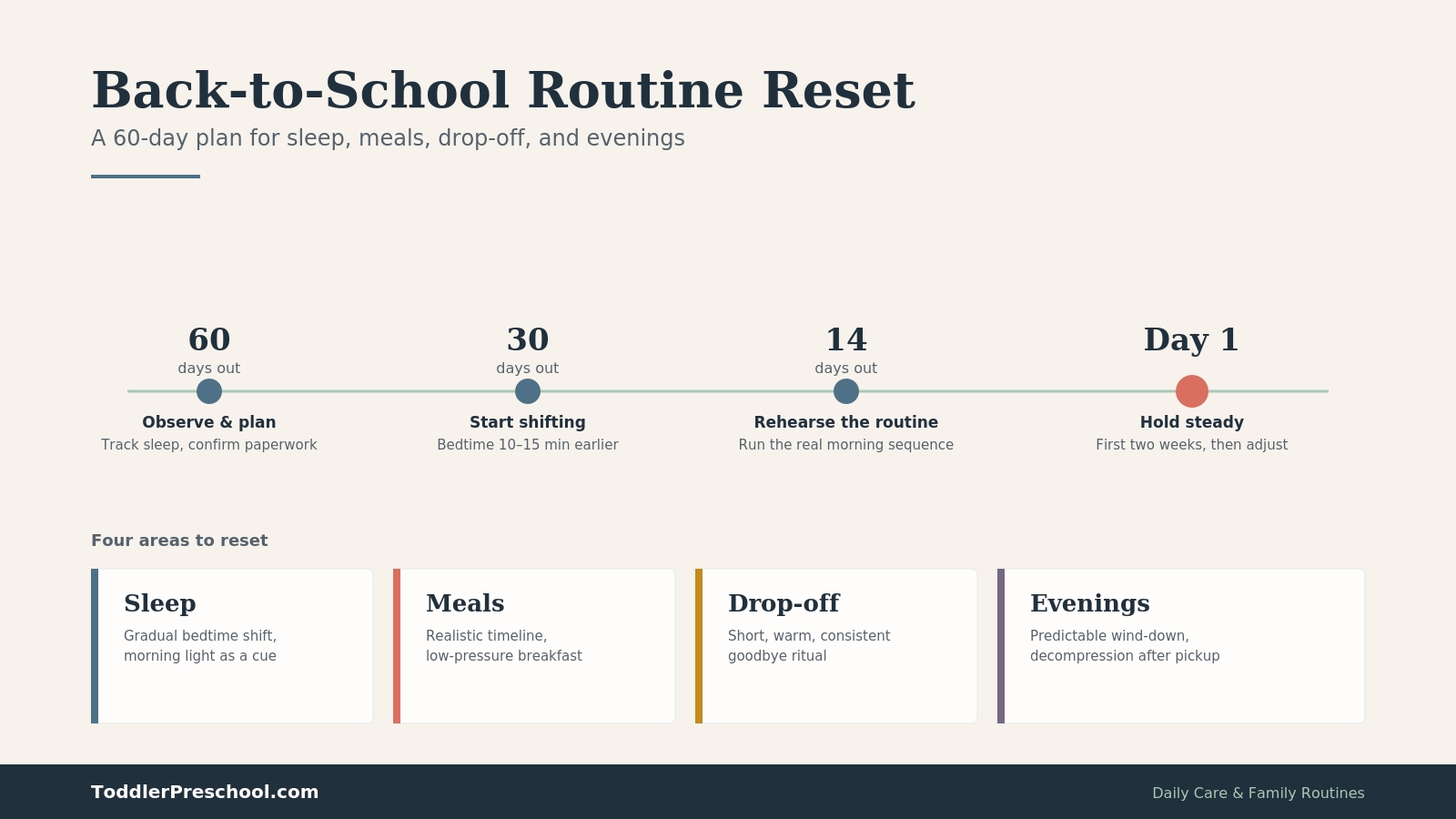
Here is the direct answer: a back to school routine preschool reset works best when it starts gradually, roughly 60 days before the first day, and focuses on four areas — sleep, mornings and meals, drop-off, and evenings. You do not need a perfect system. You need a plan that shifts your child’s body clock a little at a time, gives the day a predictable shape, and treats the emotional side of this transition — for both of you — as just as real as the logistical side.
That’s the point of this guide: to move you from I’m not sure what to actually do about any of this to I understand what’s changing, I know my realistic options, and I know exactly what to try tonight. Clear answers for real life with toddlers and preschoolers is the whole idea — not a perfect routine, just one that actually works for your household on an ordinary Tuesday. Below is the full plan — what to start now, what can wait, how to troubleshoot the parts that go sideways, and how to adjust the whole thing for your family’s real situation, whether that’s a two-parent household with flexible schedules, a single parent juggling drop-off and a commute, a multilingual home, a child with a disability or extra support needs, a family with more than one child starting at once, or a household working with a tight budget and very little spare time. None of the steps below are pass/fail, and your child doesn’t need to hit every one of them for the transition to go well.
The 60-Day Reset: A Timeline, Not a Countdown
Why Gradual Beats Sudden
The common instinct is to wait until the week before school starts and then try to fix everything at once — earlier bedtime, earlier wake-up, a new lunch routine, and a first-time drop-off, all inside five or six days. For a toddler or preschooler, that’s a lot of change to absorb at once, and it tends to produce exactly the meltdowns and battles you were hoping to avoid.
Young children regulate best with small, predictable shifts rather than sudden ones, because their internal clocks and their sense of security both respond to repetition, not to a single instruction. A 60-day window gives you room to move slowly — a few minutes of bedtime adjustment here, one new habit introduced there — with plenty of time to notice what’s working and quietly drop what isn’t. It also takes pressure off you. If you have 60 days, one rough week doesn’t derail the plan; you just pick back up the next day.
Sixty days is a helpful target, not a requirement. If you’re reading this with three weeks left, or even five days left, the same structure still applies — you’ll just compress the phases and prioritize sleep and the goodbye routine first, since those two areas have the biggest effect on how the whole transition feels.
The Four Phases at a Glance
Phase 1: 60 to 30 Days Out — Observe and Plan
This phase is mostly quiet, low-effort work. Before changing anything, spend a week or two simply noticing your child’s current rhythm: what time do they actually fall asleep, what time do they wake up on their own, how long do naps run, what does a relaxed breakfast look like, how do they handle new places and new faces right now. You’re gathering information, not judging it — summer schedules are supposed to be looser.
During this window, take care of anything with a long lead time: confirming enrollment paperwork, checking that immunization records are current, requesting the classroom’s daily schedule so you know which times matter, and putting any known needs — allergies, sensory preferences, a favorite comfort item, the family’s home language — in writing to the program so there’s a record on file, not just a conversation someone might forget.
Phase 2: 30 to 14 Days Out — Start Shifting
This is when small, consistent changes begin: nudging bedtime and wake-up time earlier in 10- to 15-minute increments every few days, introducing one or two new morning habits (a consistent breakfast spot, a “clothes on” sequence), and starting to talk about the upcoming change in simple, concrete, positive language. If your child is starting somewhere brand-new, this is also the window for a preview visit, a tour, or a short trial session if the program offers one.
Phase 3: 14 to 1 Days Out — Rehearse the Real Routine
In the final two weeks, start running the actual school-day sequence, even on days when there’s no school — the same wake-up time, the same breakfast window, the same getting-dressed routine, maybe even a practice drive or walk to the building. This is also when you finalize supplies, label belongings, and confirm logistics like carpool, drop-off procedures, and emergency contacts.
Phase 4: The First Two Weeks of School — Hold Steady and Adjust
The transition doesn’t end on day one. Expect the first two weeks to include some rough mornings, extra tiredness, more clinginess than usual, and possibly some regression in areas like toileting or sleep. This is common, and it isn’t a sign that anything has gone wrong. Your job during this phase is mostly to hold the routine steady, keep your expectations realistic, and give it time before deciding whether something actually needs to change.
A Sample 60-Day Calendar
Every family’s timeline will look different, but seeing the phases laid out against real weeks tends to make the plan feel more concrete. Here’s an example for a program that starts on a Monday in early September:
| Weeks Out | Focus | What to Actually Do |
|---|---|---|
| 8–7 weeks | Observe | Track current bedtime, wake time, and nap length for a week. Confirm enrollment paperwork and immunization records. |
| 6–5 weeks | Plan | Share allergies, home language, and comfort strategies with the program in writing. Schedule a preview visit if the setting is new. |
| 4–3 weeks | Shift sleep | Move bedtime and wake time 10–15 minutes earlier every 2–3 days. Start one new morning habit. |
| 2 weeks | Rehearse | Run the full school-morning sequence on non-school days, at the real time. Do a practice drive or walk. |
| 1 week | Finalize | Label belongings. Confirm drop-off logistics, carpool, and pickup authorization. Pack the “just in case” clothing bag. |
| Day before | Settle in | Lay out clothes, pack lunch, do a calm evening. Go to bed at the real school-night bedtime. |
| Week 1 of school | Hold steady | Keep the routine boringly consistent. Expect extra tiredness and some after-school big feelings. Don’t judge the whole year by day one. |
| Week 2 of school | Adjust | Note any pattern (not a one-off day) worth raising with the teacher or pediatrician. Otherwise, keep going — most families are through the roughest part by now. |
Sleep: Resetting Bedtime, Wake Time, and Naps
How Much Sleep Toddlers and Preschoolers Need, By Age
Sleep needs vary by child, but pediatric guidance gives a useful range to plan around. According to guidance from the American Academy of Pediatrics and the American Academy of Sleep Medicine, shared through HealthyChildren.org, toddlers between one and two years generally need about 11 to 14 hours of sleep in a 24-hour period, including naps, while preschoolers between three and five years typically need about 10 to 13 hours. These are ranges, not exact targets — a child who sleeps toward the lower end of the range and wakes up in a reasonably good mood is likely getting what they need, while a child who is foggy, weepy, or unusually wound-up by late afternoon may need more, regardless of what the number on the clock says.
It’s worth breaking this down a little further by age band, since a household with a one-year-old and a four-year-old is really managing two different sleep profiles at once:
- 1 to 2 years: Often still napping once or twice a day; total daily sleep toward the higher end of the range (12–14 hours) is common. Bedtime resistance at this age is frequently more about separation and routine than about not being tired.
- 2 to 3 years: Usually down to one nap; night sleep starts to consolidate, but this is also a common age for new fears (the dark, being alone) to appear and complicate bedtime.
- 3 to 5 years: Nap needs vary enormously — some children this age still need a daily rest, others have dropped it entirely, and many fall somewhere in between (quiet time instead of sleep). Total sleep needs are lower than for toddlers but still substantial.
The Gradual Shift Method (and Why “Cold Turkey” Usually Backfires)
Trying to move bedtime an hour earlier in a single night rarely works, because a child’s internal clock doesn’t reset that fast — they simply lie awake at the new bedtime, frustrated, which creates a bedtime battle instead of solving one. A gradual shift works with the body’s rhythm instead of against it.
The method: move bedtime — and wake-up time — earlier by about 10 to 15 minutes every two to three days until you reach the schedule school mornings require. Here’s what that looks like in practice for a child moving from a 9:00 p.m. summer bedtime to a 7:30 p.m. school-night bedtime:
| Day | Bedtime | Wake Time |
|---|---|---|
| Day 1 (start) | 9:00 p.m. | 8:00 a.m. |
| Day 4 | 8:45 p.m. | 7:45 a.m. |
| Day 7 | 8:30 p.m. | 7:30 a.m. |
| Day 10 | 8:15 p.m. | 7:15 a.m. |
| Day 13 | 8:00 p.m. | 7:00 a.m. |
| Day 16 | 7:45 p.m. | 6:45 a.m. |
| Day 19 (target) | 7:30 p.m. | 6:30 a.m. |
At that pace, the full shift takes about three weeks, which lines up with Phase 2 of the timeline above. If you’re short on time, larger 20- to 30-minute jumps can work, but expect more resistance along the way.
Anchoring the Morning Wake Time
Shifting bedtime alone is only half the job — the wake-up time has to move too, or the extra hour at night simply gets absorbed by sleeping in later. Letting light and a bit of noise into your child’s room 15 to 30 minutes earlier than their current wake-up helps nudge their internal clock forward and, over a few days, makes the earlier bedtime feel natural rather than forced. A consistent wake-up time, including on weekends, does more for smooth mornings than almost anything else in this guide.
Naps: There’s No Deadline
If your child currently naps and their new program includes one, the transition is usually straightforward — you’re mostly working around a different nap-time slot. If your child still naps but their new setting doesn’t offer one, or offers a shorter rest period than they’re used to, plan for extra sleep at night to cover the gap, and expect some cranky late afternoons for the first couple of weeks while their body adjusts. There is no fixed age at which naps are supposed to end — some children drop the nap around three, others still need one well into kindergarten, and both are typical. If a program requires quiet, non-napping children to lie still for a full rest period, ask directly what that looks like in practice; most experienced teachers have a workable routine (quiet books, a mat, soft music) for children who don’t actually fall asleep.
Troubleshooting Sleep Resistance Without Shame
If bedtime is a struggle right now, you’re far from the only family dealing with this, and needing help with sleep isn’t a reflection of anything you’re doing wrong. A few adjustments tend to help most:
- Keep the routine short and boringly predictable. The same three or four steps (bath, pajamas, book, lights out) in the same order, every night, works better than a long or varying sequence.
- Move screens out of the last hour before bed. Screen light and stimulating content can genuinely make it harder for a young child’s brain to wind down, regardless of how tired they seem.
- Expect some protest during the shift itself, especially in the first few days of an earlier bedtime — that’s a normal response to a schedule change, not a sign the plan isn’t working.
- If you’re using melatonin or another sleep aid, or considering it, talk with your child’s pediatrician first rather than starting on your own. Dosing and appropriateness vary by child, and a doctor can also rule out other causes of sleep trouble before you add anything.
When to Loop In Your Pediatrician
Occasional bedtime pushback is expected and not something to diagnose or worry over. It’s worth a conversation with your child’s doctor if sleep problems are severe, persist for several weeks despite a consistent routine, involve loud snoring or pauses in breathing, or if your child seems excessively tired during the day in a way that’s affecting mood or behavior. A pediatrician can screen for sleep disorders or other health conditions that a routine reset alone won’t fix — and there’s no downside to asking.
Mornings: Getting Dressed, Fed, and Out the Door
A Realistic Morning Timeline
Summer mornings tend to be elastic; school mornings aren’t. Most families do better budgeting more time than feels necessary at first, because a young child moving through breakfast, dressing, and leaving the house rarely runs on an adult’s internal clock. A workable shape looks something like this, adjusted up or down depending on your child’s age and independence:
| Step | 1–2 Years (More Hands-On) | 3–5 Years (More Independent) |
|---|---|---|
| Wake-up and connection | 10 minutes | 5–10 minutes |
| Breakfast | 20–25 minutes | 15–20 minutes |
| Getting dressed | 10–15 minutes (mostly you) | 10–15 minutes (mostly them, with prompts) |
| Teeth, hair, bathroom | 10 minutes | 5–10 minutes |
| Shoes, bag, out the door | 10 minutes | 5–10 minutes |
| Buffer for the unexpected | 15 minutes | 10–15 minutes |
Total: roughly 75–90 minutes from wake-up to walking out the door for most families — longer than it feels like it should take, and worth planning for rather than fighting.
Visual Routines and Picture Schedules
Many toddlers and preschoolers respond well to a simple visual sequence — a strip of pictures or icons showing “wake up → eat → get dressed → brush teeth → shoes → bag → go” that they can point to or move along as they complete each step. This isn’t necessary for every child, but for kids who resist verbal reminders, get overwhelmed by too many spoken instructions at once, or are working on independence, a visual routine can turn “hurry up” into something the child tracks themselves. A hand-drawn version on a piece of paper works exactly as well as a store-bought chart.
Breakfast Without a Battle
If mornings are already tight, breakfast doesn’t need to be elaborate — consistency matters more than variety. A short, repeatable rotation of two or three breakfasts your child reliably eats is more useful than trying out something new on a school morning. If your child is a slow eater, consider whether part of breakfast can happen in the car or stroller, or whether a portable option (a banana, a granola bar, a smoothie in a spill-proof cup) on rushed days is a reasonable trade-off rather than a failure.
Low-Cost, Low-Time Swaps
Not every family has the bandwidth for elaborate morning prep, and that’s a completely normal place to be. A few swaps that save real time without spending money:
- Choose clothes the night before, and let your child pick between two pre-approved outfits so mornings don’t turn into a negotiation.
- Keep a “launch pad” — one consistent spot by the door for the bag, shoes, and anything else that leaves the house — so nothing gets hunted for at the last minute.
- Pack lunches and snacks the night before, even if that just means pulling premade items from the fridge in the morning.
- Lower the bar on hair and outfit perfection. A program-ready toddler and a magazine-ready toddler are not the same goal, and only one of them matters here.

Meals and Lunches: Packing Food a Toddler Will Actually Eat
Working With, Not Against, Picky Eating
Selective eating is extremely common at this age and isn’t something to try to fix before school starts. Rather than introducing new foods in a lunchbox where you won’t be there to help, pack a few known, reliably eaten items alongside one small optional new food, without pressure to finish it. If your child eats better with company, ask the teacher whether kids eat together at a table — sometimes just watching peers try foods helps a picky eater take a bite they’d refuse at home.
Packing for Programs With Allergy Rules
Many programs now restrict or ban common allergens, especially peanuts and tree nuts, to protect classmates with allergies. Before shopping for lunch supplies, get your program’s specific food policy in writing rather than assuming — rules vary a lot between centers, family child care homes, and public pre-K programs. If your own child has a diagnosed allergy, make sure the program has a written action plan on file and that you’ve confirmed who is trained to use it. This is a conversation to have directly with staff, not something to leave to an intake form alone.
Budget-Friendly Lunch and Snack Ideas
A working lunch doesn’t need to be elaborate. Cost-conscious staples that travel well include whole fruit, cut vegetables with a small container of dip, whole-grain crackers, cheese, hard-boiled eggs, yogurt tubes, and simple sandwiches made from whatever bread and protein you already buy. Reusable containers cost more upfront but pay for themselves quickly compared to single-use packaging, and a basic insulated bag with one ice pack keeps food safe without needing anything fancy.
When Feeding Concerns Need a Professional
Picky eating that follows typical patterns — a narrow but adequate range of accepted foods, occasional new-food refusal, eating more some days than others — is developmentally common and not something this article, or any general guide, can assess for your individual child. It’s worth bringing to your pediatrician if your child is losing weight, gagging or choking frequently, eating an extremely limited range of textures or foods, or showing significant distress around meals. A doctor can determine whether a referral to a feeding specialist or occupational therapist makes sense.
Potty Training and Toileting During the Transition
Why Accidents Increase When Routines Change
If your child was reliably using the toilet over the summer and suddenly starts having accidents again once a new program begins, you are not imagining it, and you haven’t undone months of work. According to HealthyChildren.org, young children commonly regress in recently learned skills — including toileting — in response to a change in environment or a new source of stress in their life, and this is a normal, usually temporary response rather than a failure of the training itself.
Ruling Out Physical Causes First
Before assuming a regression is purely situational, it’s worth having your child seen by their pediatrician, since sudden or persistent accidents can sometimes signal a urinary tract infection, constipation, or another physical cause that needs treatment rather than a routine adjustment. Once a physical cause has been ruled out, a regression tied to a new routine is usually just your child’s way of processing change, and it tends to ease as the new setting becomes familiar.
Supporting Toileting Without Shame at Drop-Off
Clean up accidents matter-of-factly, without a lecture or a punishment — a calm “accidents happen, let’s get you changed” does more for a child’s confidence than a frustrated reaction, and shaming responses tend to make accidents more likely, not less, by adding pressure around a skill that’s already under stress. Keep the same calm, neutral tone you use for other new-skill wobbles. A sticker chart or small acknowledgment for successful bathroom trips can help some children, but it isn’t necessary, and it’s not a sign of a problem if it doesn’t move the needle much during the first few weeks.
What to Pack and What to Ask the Program
Send at least one full backup outfit — including socks and, if your child still has occasional accidents, extra underwear — in a labeled bag that stays at the program rather than coming home and back each day. Ask the program directly what their procedure is for accidents: whether staff change your child themselves, whether they call you, and at what age or stage they expect independence with wiping and handwashing. Knowing the actual procedure in advance removes one more unknown from your child’s first days.

Getting Sick More Often in the First Few Months
Why This Happens
If your child seems to catch every cold going around once a new program starts, you’re not imagining it, and nothing about the environment is unusually unclean. Pediatricians consistently point out that young children new to a group setting are exposed to a wider range of common viruses than they encountered at home, and that close quarters, shared toys, and still-developing hand-washing habits make it easy for illness to move through a classroom. It’s common for toddlers and preschoolers to have somewhere in the range of 8 to 12 viral illnesses in their first year of group care — noticeably more than school-age children or adults typically experience. Research on child care attendance has found that infection rates tend to even out by kindergarten and first grade, and children with earlier group-care experience sometimes get sick less often once they reach school age than peers who are encountering a classroom’s worth of germs for the first time.
What Helps Without Overreacting
- Build in slack for sick days, both in your own planning and in your expectations for the first few months — this is a normal cost of starting group care, not a sign that something is wrong.
- Reinforce handwashing after arriving home, before meals, and after bathroom use. It’s one of the few illness-prevention habits genuinely within a young child’s control, even in a basic form.
- Keep a simple home stock of a working thermometer, a children’s fever reducer appropriate for your child’s age and weight (confirmed with your pediatrician), tissues, and a few easy-to-eat foods for sick days, so an early-morning fever doesn’t turn into a scramble.
- Know your program’s illness policy in advance — most have specific fever thresholds and symptom rules for when a child needs to stay home, and knowing them ahead of time avoids a stressful phone call mid-morning.
- Call your pediatrician if illnesses are unusually severe, don’t resolve in the expected time, or you have any concern about your child’s overall pattern of getting sick. A doctor can distinguish ordinary childhood illness frequency from something that warrants a closer look.

Drop-Off and Separation: What’s Normal and What Helps
Why It Happens
Crying, clinging, or asking you not to leave at drop-off is a normal developmental response, not a sign that something is wrong with your child, your parenting, or the program. It tends to show up because young children are becoming more aware of your comings and goings and haven’t yet built full confidence that you’ll come back — a completely reasonable thing to still be learning. It’s common in the first weeks of a new program and often eases as your child builds trust in the routine and the adults there, even when it doesn’t feel that way at 8:15 on a Tuesday.
Building Familiarity Before Day One
If your child is starting somewhere new, a preview visit — even a short one — makes a real difference. Walking the space together, meeting the teacher, seeing where cubbies and bathrooms are, and, if possible, sitting in briefly during a normal activity all reduce the number of unknowns your child faces on day one. At home, reading books about starting school or child care, and talking through what a typical day will look like in simple, concrete terms (“First you’ll hang up your bag, then there’s circle time, then snack, then I’ll pick you up”) gives your child a mental map to hold onto.
The Goodbye Ritual: Short, Warm, Consistent
One of the most consistently useful pieces of guidance from early childhood professionals is to keep the actual goodbye brief. A drawn-out departure — extra hugs, repeated reassurances, lingering by the door — tends to prolong distress rather than ease it, because it signals to a child that leaving is something to be anxious about. A short, warm, predictable goodbye works better than a long one: the same phrase, the same gesture, a clear statement of when you’ll be back in terms your child understands (“after snack” often lands better for a preschooler than a clock time), and then a calm, confident exit — even if there are tears behind you. Sneaking out without saying goodbye, by contrast, usually backfires, since it can make a child more anxious about you disappearing unexpectedly in the future.
What to Actually Say: Scripts for Explaining the Change and for Goodbye
Simple, consistent language tends to help more than a long explanation. A few starting points to adapt to your own child and situation:
- Explaining the change, a few days ahead (roughly age 2–3): “Starting Monday, you’re going to [program name] in the mornings. Ms. [Teacher] will be there. I’ll drop you off, and then I’ll come back after [nap or snack] to get you.”
- Explaining the change, a few days ahead (roughly age 4–5): “On Monday you start at [program name]. You’ll do circle time, play outside, have lunch with your class, and I’ll pick you up at [time]. It’s normal to feel excited and a little nervous at the same time — I do too, sometimes, when things are new.”
- The goodbye itself: A short, repeatable phrase works better than a new one each day — something like “Hugs, then I’ll see you after snack. Have a great day.” Say it, follow through, and leave, even mid-protest. Circling back for one more hug tends to restart the distress rather than resolve it.
- If your child asks “why do I have to go”: A brief, honest, age-appropriate answer beats a long justification — “This is where you learn and play with friends while I’m at work. I always come back.” Repetition, not elaboration, is what builds trust here.
The First Two to Three Weeks
It’s common for drop-off distress to peak in the first one to two weeks and then gradually ease as the routine becomes familiar, though some children take a bit longer and a smaller number settle in almost immediately. Some kids cry at the door and are calm within two minutes of you leaving; others take longer to settle and may need extra support from their teacher during that window. Both patterns are within the range of normal. Try to resist judging how the whole year will go based on the first difficult week.
Working With Your Child’s Teacher or Provider
Your child’s teacher or provider is a genuine resource here, not just someone to hand your child off to. Ask directly how drop-off tends to go once you’ve left — most children calm down faster than parents expect, and hearing that from staff can be reassuring. Share anything that helps: a favorite song, a comfort phrase, a small transitional object if the program allows one, or family-language words for basic needs like bathroom or hungry if your child is multilingual. A brief, specific note goes further than a long list.
When Drop-Off Distress Deserves a Closer Look
Most separation distress fades with time and consistency. It’s reasonable to raise the issue with your pediatrician or the program if your child’s distress isn’t easing at all after three to four consistent weeks, if it’s paired with new physical symptoms (stomachaches, sleep disruption, regression in multiple areas at once), or if your child seems fearful of a specific person or situation rather than generally anxious about separation in general. None of this necessarily means something is wrong — it means an extra conversation is a reasonable next step, not an overreaction.
Evenings: Decompression, Dinner, and Wind-Down
Why Pickup Can Be the Hardest Part of the Day
Many parents are caught off guard by how hard the after-pickup hour can be, especially in the first few weeks. A child who was reportedly cheerful and cooperative all day at school can fall apart within minutes of seeing you — more tears, more whining, more refusal than you’d expect. This is a common pattern, not a sign the day went badly; many young children hold it together in a structured setting and release the accumulated effort of the day once they’re back with the person they trust most.
Rebuilding a Predictable Evening Sequence
A predictable, low-demand transition after pickup helps more than jumping straight into errands or a packed schedule. A snack in the car, ten minutes of quiet connection before starting the next task, or simply narrating the plan out loud (“we’re going home, then dinner, then bath”) can soften the transition. From there, a consistent evening sequence — dinner, some free or connected time, bath or wash-up, pajamas, a book, lights out — works the same way a bedtime routine does: predictability itself is calming, regardless of what’s actually in the sequence.
A sample sequence for a 5:30 p.m. pickup might look like this:
| Time | What Happens |
|---|---|
| 5:30–5:45 p.m. | Pickup, snack in the car or at home, low-demand quiet time |
| 5:45–6:15 p.m. | Dinner |
| 6:15–6:45 p.m. | Free play or connected time (screens optional, per your family’s approach) |
| 6:45–7:00 p.m. | Bath or wash-up, pajamas |
| 7:00–7:15 p.m. | Book, lights out |
Shift the whole sequence earlier or later to match your family’s actual pickup time — what matters is the order and the consistency, not the specific clock times.
Screens, Dinner Logistics, and Realistic Expectations
There’s no single right answer for screen time in the after-school window, and this guide won’t hand down a rule — families vary widely in what works logistically and what they’re comfortable with. What tends to help regardless of your household’s approach is keeping screens out of the final 30 to 60 minutes before bed, since that stretch matters most for sleep. On dinner logistics, a simple, repeatable rotation of meals your family can make with minimal effort on a tired weeknight is worth more than an ambitious meal plan you won’t sustain past week two.
Weekends and Preserving Family Time
Keeping wake-up and bedtime roughly consistent on weekends — within about an hour of the school-day schedule — makes Monday mornings considerably easier than letting the whole schedule reset every weekend. That doesn’t mean weekends need to look identical to weekdays; it just means the sleep anchors stay close enough that your child’s body isn’t essentially changing time zones twice a week.
The Final Stretch: Prep Timeline and Safety Checklist
Two to Three Weeks Before: Paperwork and Supplies
This is the window to finalize anything with a processing lag: confirming immunization records are current and on file, submitting required health or emergency forms, purchasing supplies from the program’s list, and checking whether backpacks, lunch boxes, or nap mats need to meet specific size requirements. If your child needs a change of clothes on file for accidents, spills, or weather, pack that bag now rather than the night before.
One Week Before: Labels, Logistics, and a Practice Run
Label everything that could get lost or mixed up with another child’s belongings — bags, lunch containers, water bottles, jackets, nap items. Confirm the actual logistics: drop-off and pickup times, which door or entrance to use, whether there’s a sign-in procedure, and who besides you is authorized to pick up your child. If you haven’t already, do a practice run of the morning routine and the drive or walk to the building, ideally at the actual time you’ll be doing it on a real school day, so you have an accurate sense of how long it takes.
The Night Before and Morning Of
Lay out clothes, pack the bag, and prep lunch the night before wherever possible — the goal is to remove decisions from the morning, not add them. On the morning itself, build in slack rather than cutting it close; a rushed first morning sets a stressful tone that’s hard to shake for the rest of the day.
Safety Checks Worth a Few Minutes
A short list of safety items is worth confirming before the first day, regardless of how experienced your family is with school or child care transitions:
- Emergency contacts on file are current, including at least one local backup contact if you’re not always reachable.
- Car seat or booster requirements for drop-off, pickup, or carpool are up to date for your child’s current height and weight — car seat needs change faster than parents expect at this age.
- Allergy or medical action plans are on file with the program if applicable, and you’ve confirmed who is trained to respond.
- Choking-hazard awareness for snacks and lunch items — whole grapes, hard candies, whole nuts, and large chunks of meat or cheese are common choking risks for children under four and worth cutting down regardless of what a program’s policy technically allows.
- Pickup authorization and ID procedures are clear to you and to anyone else who might pick up your child, including grandparents, other caregivers, or a co-parent.
Common First-Week Problems and What to Try
Even with a full 60 days of preparation, the first week rarely goes perfectly, and it doesn’t need to. Here’s a quick-reference table for some of the most common snags:
| What You’re Seeing | Likely Cause | What to Try First |
|---|---|---|
| Bedtime battles despite the gradual shift | Overtiredness or overstimulation before bed | Move the wind-down routine 15 minutes earlier; cut evening screen time further |
| Waking up cranky and slow | Not quite enough total sleep yet | Move bedtime another 10–15 minutes earlier for a few nights |
| Crying at drop-off that doesn’t ease by day 3–4 | Normal adjustment curve, still in progress | Keep the goodbye short and consistent; ask the teacher how quickly your child settles after you leave |
| New potty accidents after months of success | Stress-related regression tied to the routine change | Rule out physical causes with your pediatrician; respond calmly, without punishment |
| Meltdowns right after pickup | Held-together effort released once with a trusted adult | Build in 10–15 minutes of low-demand decompression before asking anything of your child |
| Refusing breakfast or lunch | Novelty, low appetite from mild anxiety, or unfamiliar food | Stick to known “safe” foods for the first two weeks rather than introducing new items |
| Extra clinginess at home in the evenings | Normal response to a big daytime change | Offer extra connected time rather than more independence practice this particular week |
| Getting sick within the first month | Expected exposure to new viruses in group care | Confirm the program’s illness policy; keep sick-day basics stocked at home |
If something on this list is still happening in the same form after three to four full weeks of a consistent routine, that’s a reasonable moment to loop in your child’s teacher or pediatrician rather than continuing to wait it out.
Weather and Seasonal Considerations for an August or September Start
Managing Heat at Drop-Off and Pickup
Many programs still hold outdoor play or use an outdoor drop-off area in late summer, when temperatures run high across much of the country. Dress your child in breathable layers, send a labeled water bottle even if the program provides water, and ask whether the classroom has an indoor-recess plan for high-heat days. Applying sunscreen and a hat before drop-off is a reasonable habit; check whether staff are able to reapply sunscreen during the day, since policies vary by program.
The Overlap With “Back-to-School Illness Season”
Late-summer heat can shift into cooler, wetter fall weather within the first several weeks of a new program, and that shift often coincides with the rise in minor illnesses discussed above. Layering clothing that can be added or removed through the day, and keeping a labeled light jacket at the program even on warm mornings, covers both the temperature swing and the fact that indoor group settings are often kept cooler than a summer-adjusted household expects.
Daylight and the Sleep Reset
If your family lives somewhere daylight starts shifting noticeably by early fall, an already-in-progress bedtime shift can get an assist from natural light. Keep curtains or blinds open in the morning to reinforce the earlier wake time, and start dimming household lights in the half hour before bed as evenings begin to darken earlier — both cues support the internal clock shift you’re already working on.

Every Family’s Routine Reset Looks a Little Different
Multilingual and Dual-Language Households
If your family speaks a language other than English at home, or more than one language, that is a strength for your child, not a complication to manage around. It’s worth sharing key words your child uses for basic needs — bathroom, hungry, tired, hurt — with their teacher, along with how your child currently communicates if they’re still building English vocabulary. Many young children go through a temporary quiet period when placed in a new-language environment, watching and absorbing before they start using the new language aloud; that’s a typical part of the process, not a sign of a problem.
Children With Disabilities or Ongoing Support Needs
If your child has an Individualized Education Program (IEP), an Individualized Family Service Plan (IFSP), a 504 plan, or other documented support needs, build extra lead time into your 60-day window for coordinating with the program: confirming the plan has transferred or been reviewed, meeting with the specific staff who will implement accommodations, and asking directly how drop-off, transitions, and sensory needs will be handled day to day. This guide offers general routine strategies, not individualized medical or educational guidance — your child’s care team and the program’s special education or inclusion staff are the right people to tailor the plan to your child specifically.
Different Family Structures and Custody Schedules
If your child moves between households — shared custody, multiple caregivers, or a mix of family and paid child care — the routine reset works best when the key anchors (approximate bedtime, morning sequence, the goodbye ritual) stay as consistent as possible across settings, even if the households look different in other ways. It’s worth a direct, low-drama conversation with any co-parent or other caregiver about aligning at least the sleep schedule and the drop-off routine, since inconsistency in those two areas tends to cause the most friction for young children.
Limited Time, Money, or Energy — And That’s Okay
Not every family has the time or budget for a fully mapped 60-day plan, color-coded charts, or a shopping trip for coordinated supplies, and none of that is required for a successful transition. The elements that matter most — a roughly consistent bedtime, a short predictable goodbye, and a bit of advance notice about what’s changing — cost nothing and take minutes, not hours. If you’re starting this process a week before school rather than two months before, focus your limited time on sleep and the goodbye routine first.
Starting Multiple Children at Once
If you have more than one child starting or restarting a program in the same window — twins, close-in-age siblings, or simply a family calendar where everyone’s schedule shifts at once — stagger what you can. Even ten minutes’ difference in wake-up or drop-off time per child reduces the morning bottleneck, and it’s worth asking whether the program can offer slightly offset drop-off slots. If one sibling is more independent with dressing and breakfast, let them go first in the routine while you handle hands-on tasks for the younger one, rather than trying to move both through every step in lockstep. Older siblings can also be a genuine asset during a younger child’s transition — a short “tour” led by an older brother or sister, or simply seeing a sibling walk into their own classroom confidently, often does more to settle nerves than anything a parent says.
Different Types of Care: Center, Home-Based, Family, Nanny Share
The core routine-reset principles apply whether your child is headed to a large center-based preschool, a small family child care home, a nanny share, or care with a relative. What changes is who you’re coordinating with — a center typically has written policies and multiple staff to loop in, while a family child care provider or relative may prefer a quick conversation over a form. Either way, the same short list of things to communicate applies: sleep and eating patterns, comfort strategies, allergies, and how your child currently handles separation.
Development, Milestones, and Readiness: Keeping Perspective
Readiness Is a Range, Not a Deadline
There’s no single age or checklist item that determines whether a child is “ready” for preschool, and readiness itself develops on a range rather than arriving on a fixed date. Two children starting the same classroom on the same day can be in very different places with toileting, communication, or separation — and both can settle in successfully over time. Preparation helps at the margins; it doesn’t replace the fact that children build these skills at their own pace.
Using Milestone Checklists as Conversation Starters, Not Report Cards
Public health resources like the CDC’s Learn the Signs. Act Early. program offer milestone checklists for children from infancy through age five, covering areas like communication, movement, play, and social-emotional growth. These tools are designed to support ongoing conversations between families and pediatricians and to prompt a developmental screening if something seems worth a closer look — they are explicitly not diagnostic on their own, and this article isn’t either. If you have a question or a nagging concern about your child’s development, the most useful next step is raising it directly with your pediatrician, who can screen appropriately, rather than trying to self-assess against a list.
Self-Help Skills That Help at Drop-Off (and How to Build Them Without Pressure)
Certain self-help skills — using the bathroom with some independence, washing and drying hands, managing a jacket, communicating basic needs — make classroom life a bit smoother for both your child and their teacher, but none of them are a strict prerequisite, and programs vary widely in how much support they provide for children still building these skills. If you want to work on one gently before school starts, practice during low-pressure moments at home, not for the first time on a rushed morning, and choose easy-to-manage clothing — elastic waistbands, Velcro shoes, oversized zipper pulls — to make independence more achievable without turning it into a source of stress for your child or you.
Frequently Asked Questions
Do I really need 60 days to get ready? No — 60 days is a comfortable runway that allows for gradual, low-stress change, not a requirement. If you have less time, the same phases still apply; you’ll just move through the sleep shift and drop-off preparation more quickly. Even a single week of consistent bedtime and wake-up adjustments makes a noticeable difference.
My child still naps at home — will preschool make them stop? Not necessarily, and there’s no fixed age when napping is supposed to end. Ask the program directly what their rest-time policy is; many preschool classrooms include a rest period even for children who don’t fully sleep. If your child’s program offers less nap time than they’re used to, plan for an earlier bedtime to cover the difference, especially in the first few weeks.
Is it normal for my child to cry every day at drop-off for weeks? It’s common for it to take one to three weeks for drop-off distress to meaningfully ease, and some children take a bit longer than others — that alone isn’t a cause for concern. What’s worth a further conversation with your pediatrician or the program is distress that shows no improvement at all after three to four weeks of a consistent routine, or new symptoms alongside it, like ongoing sleep disruption or physical complaints.
We potty trained months ago — why is my child suddenly having accidents again now? This is a common and usually temporary response to the stress of a new routine, not a sign that the earlier training failed. Rule out a physical cause with your pediatrician first, then respond to accidents calmly and without punishment while the new setting becomes familiar — most children settle back into their prior progress within a few weeks.
We’re switching from a nanny or grandparent care to a program — does the same timeline apply? Yes, and this transition deserves just as much preparation as starting preschool for the first time, even though it can feel like “just” a schedule change. The same building blocks apply: previewing the new setting, rehearsing the new routine, and giving your child simple, concrete language about what’s changing and why.
What if my child has an IEP, IFSP, or 504 plan? Start the coordination piece of your timeline earlier than 60 days if possible, and treat the program’s special education or inclusion staff as a core part of your planning team, not an afterthought. This guide’s routine strategies are meant to complement — not replace — the individualized plan and guidance from your child’s care team.
Should I expect more illness once my child starts a program? Yes, and it’s one of the most consistent things pediatricians mention about this transition. Somewhere around 8 to 12 colds or other minor illnesses in the first year of group care is a commonly cited range, and it tends to ease as your child builds immunity to the viruses circulating in that specific group. Keep basic sick-day supplies on hand and know your program’s illness policy ahead of time so a sick morning doesn’t catch you unprepared.
What if my child seems fine at pickup but falls apart the second we get home? This is one of the most common patterns families describe, and it usually reflects your child holding it together through a structured day and then releasing that effort once they’re back with someone they trust completely — it isn’t a sign the day went badly. Building in a low-demand decompression window right after pickup, before errands or requests, tends to soften this considerably.
Your One Next Step
If everything above feels like a lot, pick exactly one thing to start this week: move bedtime 15 minutes earlier for the next three nights, and see how it goes. That’s it. The rest of this plan can be built gradually from there — you don’t need to do it all at once, and neither does your child.
Sources consulted: American Academy of Pediatrics / HealthyChildren.org — sleep guidelines by age and potty training regression; Centers for Disease Control and Prevention — Learn the Signs. Act Early. developmental milestone program; Akron Children’s Hospital pediatric guidance on illness frequency in new group care settings.