
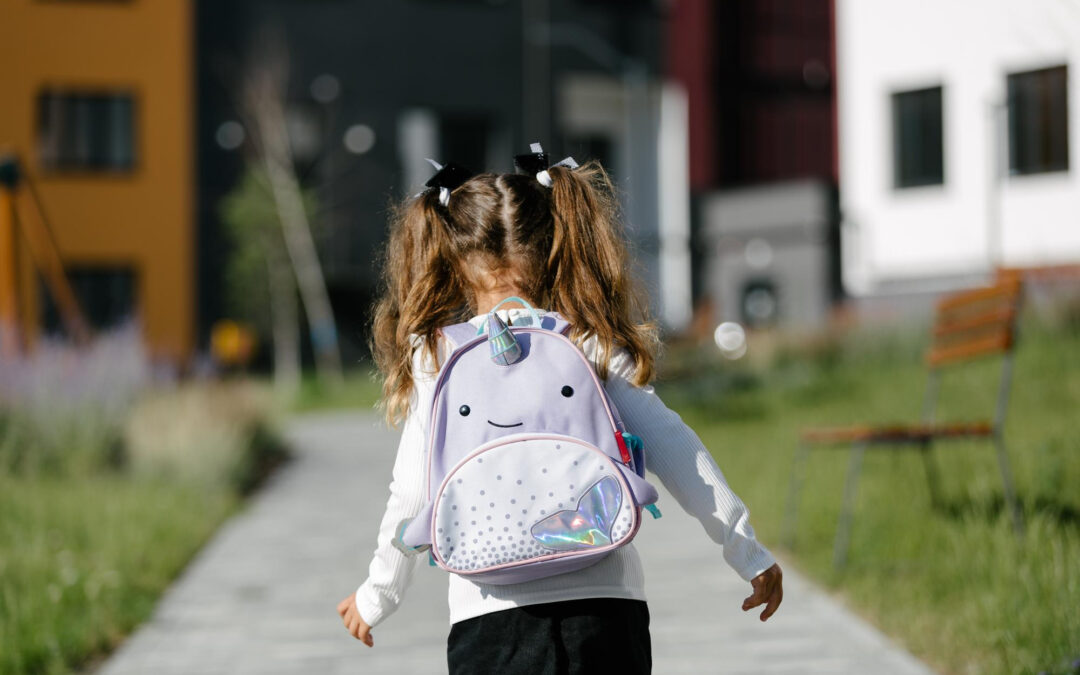
You’re standing in front of a wall of backpacks covered in cartoon characters, sized anywhere from “fits in a lunchbox” to “built for a middle schooler,” with zero indication of which one your 3-year-old can actually open, close, and carry without help. Or you’re scrolling a “best preschool backpack” roundup where every single pick is called a top choice, which isn’t actually a choice at all.
Here’s the direct answer: the best preschool backpack for your child isn’t the most popular one — it’s the one sized to their actual torso, with a closure they can manage themselves, light enough to carry comfortably, and roomy enough for exactly what your program requires and nothing more. Fit, closures, and independence matter far more than character licensing or bestseller badges. This guide explains what those criteria actually mean in practice, then compares six real, currently available options against them — with honest drawbacks, who should skip each one, and a lower-cost alternative for every pick.
How We Chose the Best Preschool Backpack Options and What We Checked
Selection criteria. To make this list, a backpack had to be currently available from a real retailer in the U.S., sized appropriately for a child roughly 2 to 5 years old (not a downsized version of an elementary-school pack), and represent a genuinely different priority — durability, character appeal, matching accessory sets, ergonomic design, premium materials, or budget accessibility — rather than six near-identical options.
Review basis. Every listed spec (dimensions, price, materials, closure type, age range) was checked against current brand and retailer listings. We ran a Consumer Product Safety Commission recall search specifically on each of the six products below and found no recalls affecting any of them. The qualitative notes — drawbacks, comfort, and who tends to skip each option — are compiled from verified customer reviews on brand and retailer sites and consistent patterns across multiple independent listings, not from a ToddlerPreschool.com staffer’s own hands-on test of this specific batch of backpacks. We’re saying that directly because implying hands-on testing that didn’t happen is exactly the kind of unearned “trust us” claim this guide is trying to help you see past. Treat the brand’s own current product page as the final word on live specs and pricing, since both drift over time.
What Actually Matters in the Best Preschool Backpack: Size, Fit, Closures, and Independence
Sizing: What’s Actually Right for a Preschooler
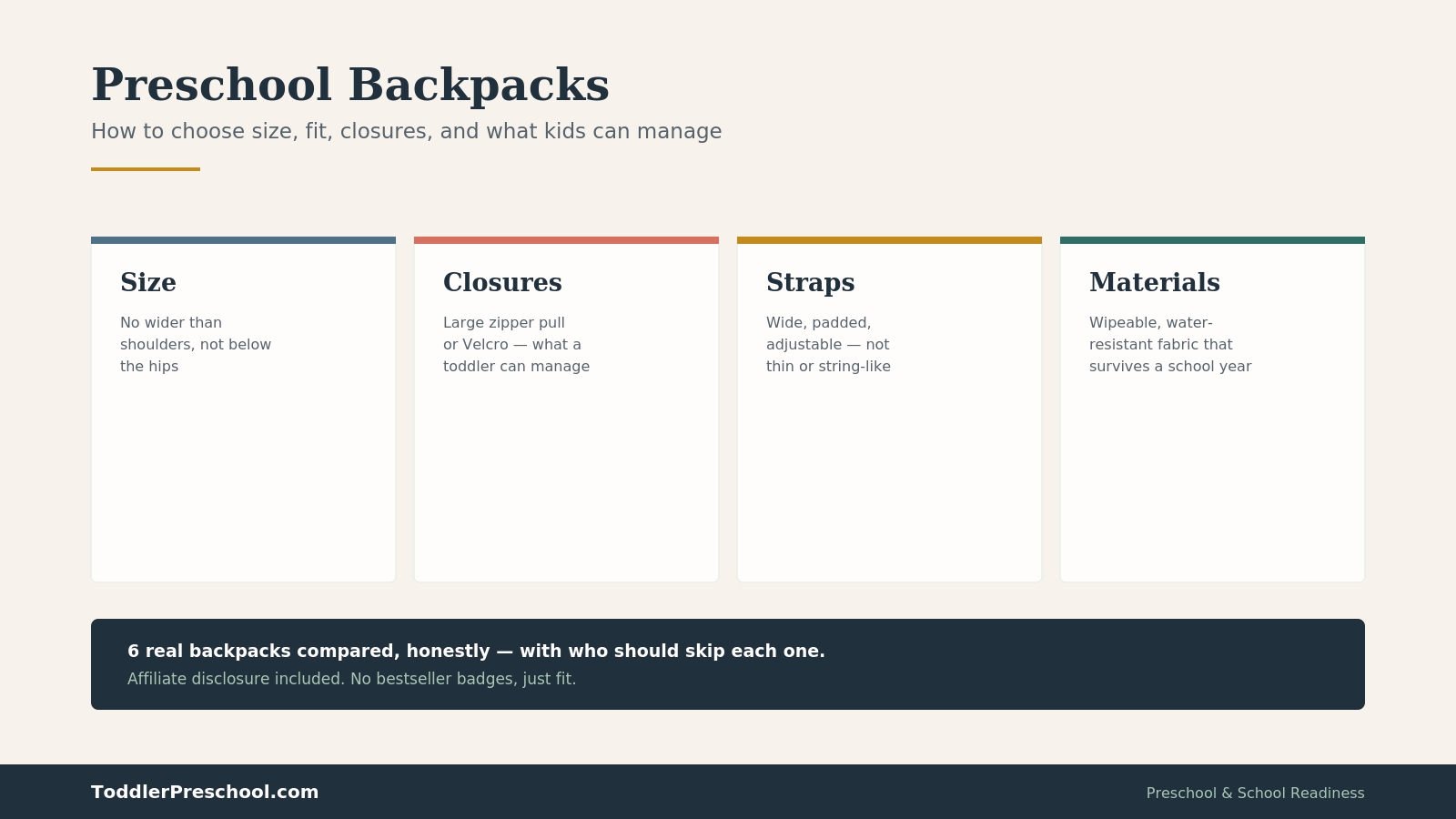
A best preschool backpack pick should, above all, be sized correctly: no wider than your child’s shoulders and shouldn’t extend below their lower back when worn — as a rough visual check, the bottom of the pack shouldn’t hang past your child’s hips. Many preschool-specific backpacks run somewhere in the 10 to 14 inch height range, noticeably smaller than the 16-to-17-inch packs designed for elementary-age kids. A backpack that’s technically “for kids” but sized for a 7-year-old will hang low, throw off a small child’s balance, and often can’t be adjusted short enough to fit properly, however appealing the character on the front is.
Weight: How Much Should Actually Go In It
Pediatric guidance on backpack weight (commonly cited as 10 to 15 percent of a child’s body weight, with some sources recommending 5 to 10 percent for younger or smaller children) is mostly written with school-age kids and heavy textbooks in mind — a preschooler’s backpack load is typically much lighter by comparison: a light jacket, a small blanket or comfort item, maybe a lunch box, rather than books. Still, the same principle scales down: the packed bag shouldn’t feel heavy relative to your specific child, and an empty bag that’s already heavy before anything goes in it is working against you from the start. Wide, padded straps and a padded back panel matter more at this age for comfort than for weight management specifically, since preschool loads are rarely heavy enough to cause the back problems associated with older kids’ overloaded packs.
Closures Kids Can Manage by Age
This is the single most overlooked sizing factor, and it’s directly tied to the self-help and independence skills covered throughout our readiness content: a backpack your child can’t open or close themselves undermines the classroom independence a good preschool program is actively building.
- Large zipper pulls are manageable for many 3-year-olds with practice and are the most common closure on preschool-specific backpacks; a pull with a fabric loop or larger tab is easier to grip than a small metal zipper tab alone.
- Velcro is often the easiest true first closure for a young or newly independent 2- to 3-year-old, requiring less fine motor precision than a zipper, though it wears out faster with heavy daily use and can lose its grip over a school year.
- Buckles and clasps (common on sternum straps for fit, less common as a main closure) generally require more fine motor coordination and hand strength than most 3-year-olds have independently — expect to help with these regardless of the bag you choose.
- Drawstring closures are rare on preschool bags specifically but, when present, are usually too fiddly for independent use at this age and are better suited to older kids.
A bag with a single, large, easy-grip zipper on the main compartment is a reasonable default for most preschoolers; save more complex multi-compartment, multi-closure designs for when your child is a bit older and more coordinated.
Straps, Padding, and Comfort
Look for wide (not thin, string-like) adjustable straps with some padding, and a padded back panel if your child will be wearing the bag with real contents rather than just carrying it empty into the classroom cubby. Adjustability matters more than initial fit, since a strap that starts a little long and can be tightened as needed outlasts a bag with fixed, non-adjustable straps by a full size or more.
Materials and Durability
Wipeable, water-resistant fabric (polyester, nylon, or a coated canvas) handles daily spills, playground dirt, and the occasional forgotten snack far better than canvas or cotton alone. A backpack that can be spot-cleaned or wiped down, rather than requiring a full machine wash, tends to hold up better and stay usable through an entire school year.
What Needs to Fit Inside
Before choosing the best preschool backpack for your family, check your specific program’s actual requirements rather than guessing — some ask for a full change of clothes, a lunch box, and a rest-time item all in one bag; others need only a small lunch bag and nothing else. A bag that’s slightly too small for your program’s actual list creates a daily packing headache; a bag that’s dramatically bigger than needed becomes hard for your child to manage independently. If your program requires a nap mat, most preschool-sized backpacks won’t fit one inside — a nap mat is typically carried separately, which is worth knowing before you assume one bag needs to do everything.
Teaching Independent Use, Once You’ve Picked One
The right bag only delivers on the independence goal if your child gets a few low-pressure practice runs before the first real morning. A few minutes at home — putting it on and taking it off, opening and closing the actual closure a few times, finding and using each pocket once — does more for real classroom independence than buying a supposedly “easier” bag and assuming the skill transfers automatically. If a zipper is still a struggle after a week or two of casual practice, it’s completely reasonable to add a fabric loop or small carabiner to the existing zipper pull as a low-cost fix, rather than replacing the whole bag.
Quick-Pick Summary: The Best Preschool Backpack Options
| Backpack | Best For | Age Range | Closure | Approx. Price |
|---|---|---|---|---|
| Fjällräven Kånken Mini | Long-term durability, grows with your child | 3–7 (fits into adulthood) | Large zipper | $70–85 |
| Skip Hop Zoo Little Kid Backpack | Classic toddler-friendly character appeal | 3+ (fits 43–49”) | Zipper | $30–45 |
| Wildkin 12-Inch Backpack | Matching sets with lunch bags and nap mats | 3+ | Zipper | $30 |
| Bixbee Backpack, Small | Ergonomic, waist-level weight distribution | 3–5 (small size) | Zipper | $28–40 |
| State Bags Kane Kids Mini | Premium style, travel-friendly extras | 2–4 | Zipper | $78–105 |
| Zoocchini Backpack | Character-shaped design for animal-loving kids | 3+ | Zipper | $25–30 |
The Best Preschool Backpack Options, Compared
1. Fjällräven Kånken Mini
A scaled-down version of the famous Swedish Kånken backpack, originally designed to help prevent back problems in Swedish schoolchildren, now a genuine multi-generational favorite that many families use well past preschool.
| Detail | Notes |
|---|---|
| Best for | Families wanting one durable bag that plausibly lasts from preschool through early elementary, not a “toddler phase” purchase |
| Skip if | You want the absolute lowest price point, or your child needs a closure easier than a standard zipper |
| Age & fit | No official age range; the Mini’s smaller scale suits roughly ages 3–7; adjustable straps fit a wide range of torso sizes |
| Closure | Single large zipper on the main compartment; front zip pocket |
| Materials | Vinylon F fabric — lightweight, water-resistant, and notably durable against dirt and general wear |
| Drawback | At roughly 7 liters and about 11.4 x 7.9 x 5.1 inches, it’s genuinely compact — a full change of clothes plus a lunch box is a tight fit, and there’s no dedicated insulated pocket for food |
| Sensitivity notes | No character branding, which appeals to families who prefer a neutral design a child won’t outgrow stylistically as fast as a licensed-character bag |
| Review basis | Long, well-documented product history since 1978; consistently referenced by parenting and outdoor gear outlets as a durable, multi-year option |
| Library or budget alternative | Not applicable to backpacks in the traditional library sense — for budget, see the Zoocchini or Skip Hop options below, which cost roughly half as much |
2. Skip Hop Zoo Little Kid Backpack
An extremely well-established toddler and preschool backpack line, instantly recognizable by its animal-character designs and specifically sized for the “little kid” range rather than a scaled-down adult pack.
| Detail | Notes |
|---|---|
| Best for | A first backpack for a child who’s excited about a specific animal character, and families who want a widely available, easy-to-replace option |
| Skip if | You want a neutral, non-character design, or your child is on the larger end of preschool age and will outgrow the sizing quickly |
| Age & fit | Listed for age 3+, fitting children roughly 43 to 49 inches tall; runs on the smaller side even within that range |
| Closure | Zipper main compartment with an easy-access front zip pocket |
| Materials | Polyester with PVC backing; spot clean or hand-wash |
| Drawback | The PVC backing, while durable and wipeable, is less breathable than some alternatives, and the insulated front pouch is snack-sized, not full-lunch-sized |
| Sensitivity notes | Wide range of animal-character options generally avoids any specific licensed-media character, which sidesteps typical copyright/marketing-tie-in concerns some families prefer to avoid |
| Review basis | Extremely high review volume on major retailer sites (consistently rated around 4.9 out of 5 across thousands of reviews for various colorways), a strong practical proxy for real-world satisfaction at scale |
| Library or budget alternative | Frequently discounted well below list price at major retailers; watching for a sale is a reasonable way to get this specific bag for close to budget-tier pricing |
3. Wildkin 12-Inch Backpack
A Nashville-based brand built specifically around coordinated sets — this backpack is designed to match Wildkin’s nap mats, lunch bags, and other preschool gear, which is a genuine practical convenience for families outfitting a child for a new program all at once.
| Detail | Notes |
|---|---|
| Best for | Families who also need a nap mat or lunch bag and want a matching, coordinated set rather than mixing brands |
| Skip if | You don’t care about matching accessories and want the absolute smallest, lightest option available |
| Age & fit | Suggested age 3 and up; dimensions approximately 12.5 x 10.5 x 10 inches |
| Closure | Zipper main and front compartments |
| Materials | Polyester; lead-safe, BPA-free, and phthalate-free per the brand’s own materials disclosure |
| Drawback | At roughly 13 liters, this is one of the larger options on this list for the stated age range — worth measuring against your child’s actual torso rather than assuming “12-inch” means universally small |
| Sensitivity notes | Wide range of pattern options without licensed-character branding, and consistent sizing across the whole matching product line simplifies buying for siblings or replacing a worn-out piece |
| Review basis | Consistently high ratings (around 4.9 out of 5) across multiple colorways on major retailer sites, with an insulated, food-safe front pocket specifically called out in verified reviews |
| Library or budget alternative | At $29.99 list price, this is already one of the more budget-friendly options reviewed here without sacrificing the safety-material disclosures of pricier picks |
4. Bixbee Backpack (Small)
Bixbee’s defining feature is a patented horizontal design meant to carry weight closer to a child’s waist rather than high on the back — a genuinely different ergonomic approach from the vertical designs most other brands on this list use.
| Detail | Notes |
|---|---|
| Best for | Families specifically prioritizing ergonomic weight distribution, or a child who has struggled with a standard vertical backpack feeling top-heavy |
| Skip if | Your program requires fitting a standard two-pocket folder daily — multiple verified reviews note the smallest size doesn’t reliably fit one |
| Age & fit | Offered in small, medium, and large; the small size is generally the right starting point for ages roughly 3–5 |
| Closure | Zipper, with a sternum strap on many styles for a more secure, stable fit |
| Materials | Lightweight, water-resistant fabric; explicitly PVC-free, phthalate-free, lead-free, and BPA-free per the brand |
| Drawback | The horizontal shape, while ergonomically motivated, means less vertical room for taller or bulkier items than a standard vertical pack of similar volume |
| Sensitivity notes | Bixbee donates a backpack with school supplies to a child in need for every purchase, which some families weigh as a meaningful factor alongside the product itself |
| Review basis | Positive coverage across multiple independent parenting roundups specifically citing the ergonomic design; verified retailer reviews are mixed on sizing accuracy for the smallest size specifically |
| Library or budget alternative | Bixbee runs frequent sales bringing the small size well under its $27.99–44.99 list range; if ergonomic design matters most, watching for a sale is worth the wait |
5. State Bags Kane Kids Mini Backpack
A premium, design-forward option from a brand better known for adult travel bags, scaled down specifically for the 2-to-4 age range with genuine travel-friendly extras like a luggage-handle sleeve.
| Detail | Notes |
|---|---|
| Best for | Families who travel frequently with their preschooler and want one bag that works for both daily drop-off and trips |
| Skip if | Budget is a primary concern, or your program requires fitting a standard folder — a verified customer review specifically notes this bag does not reliably fit one |
| Age & fit | Recommended for ages 2–4, labeled for “Nursery School & Pre-K”; dimensions approximately 13.78 x 9.45 x 4.3 inches |
| Closure | Zipper main compartment with a zippered front pocket |
| Materials | Nylon, coated cotton, or polyester depending on the specific print; roughly 45% recycled materials in many colorways |
| Drawback | The zippered front pocket includes a D-ring for hanging keychains or charms — worth checking that anything attached is sized too large to be a choking risk if your child still mouths small objects |
| Sensitivity notes | Significantly higher price point than every other option on this list; the brand donates a percentage of proceeds to families in need, which factors into the price for some buyers |
| Review basis | Verified retailer reviews average strongly positive (roughly 90% five-star across a meaningful review sample), with the folder-fit limitation raised independently by more than one reviewer |
| Library or budget alternative | The Wildkin or Zoocchini options above offer broadly similar functional capacity at roughly a quarter of the price |
6. Zoocchini Backpack
Part of a broader Zoocchini kids’ product line (also known for hooded towels and training pants), these backpacks are shaped and detailed to resemble a specific animal — a shark, a dinosaur, an alicorn — rather than simply printed with one.
| Detail | Notes |
|---|---|
| Best for | A child specifically drawn to one animal in particular, where the shaped, dimensional design (fins, horns, wings) adds real appeal beyond a flat printed character |
| Skip if | You want a more subdued, less overtly “character” design, or need a bag with more than a snack-and-water-bottle capacity |
| Age & fit | Ages 3 and up; compact sizing intended specifically for a small child’s frame |
| Closure | Zipper main compartment |
| Materials | Polyester; front pencil and utility holder, mesh side pockets for snacks and a water bottle |
| Drawback | The dimensional animal details (ears, fins, horns) that make this design appealing are also the first things to show wear with heavy daily use, more so than a flat-printed bag |
| Sensitivity notes | The brand’s broader product line (bath towels, training pants) means some families already have matching items, which some children find motivating for using new gear independently |
| Review basis | Positive independent coverage from retailer blogs and parenting roundups specifically calling out the shaped, dimensional design as a standout feature versus flat-printed competitors |
| Library or budget alternative | Among the lower-cost options reviewed here already; check the brand’s own site directly for current sales versus third-party retail markups |
What to Skip: Common Preschool Backpack-Shopping Pitfalls
Full-size “kid” backpacks marketed loosely to “ages 3 and up.” Some backpacks labeled broadly for “kids” are really sized for elementary-age children and will hang well past a preschooler’s hips. If a listing’s age range spans something like “3 to 10,” assume it’s sized toward the older end and check exact dimensions against your child’s actual torso rather than trusting the age label alone. A genuinely preschool-appropriate bag is usually explicit about it in the sizing details, not just the marketing copy.
Wheeled backpacks. Pediatric guidance generally advises against rolling backpacks for general use — they’re difficult to manage on stairs, curbs, and in snow or rain, which describes most preschool drop-off routines. They also remove the core independence benefit this whole guide is built around, since a child rolling a bag isn’t building the same “put it on, take it off” self-sufficiency a worn backpack does. Save rolling luggage for actual travel, not daily preschool wear.
Backpacks with excessive hanging decorations. Charms, pom-poms, and dangling accessories are fun, but small, detachable decorations are worth a second look for a child who still mouths small objects — see the safety section below for the general sizing guidance to apply. A bag with one or two securely attached, oversized decorations is a very different safety picture than one covered in small dangling charms.
Heavily structured, rigid-frame packs. A stiff, structured backpack designed to hold its shape when empty is harder for a small child to squeeze into a cubby or car seat area and offers no real functional benefit at preschool loads, which are light enough that structure isn’t solving a real problem it would solve for a heavier school-age load.
Multiple competing closures on one bag. A backpack with a zipper, a buckle, a drawstring, and a flap snap all at once looks feature-rich in a product photo but usually means a preschooler can manage none of it independently. One clear, dominant closure a child can actually learn beats several partial ones.
Safety Notes
On CPSC recalls specifically: our recall search covered all six products reviewed above and found none. It’s worth knowing that most CPSC recalls involving the word “backpack” concern a different product entirely — structured frame carriers parents wear to carry an infant or toddler on their back for hiking (brands like Kelty, Osprey, and others have had carrier-specific recalls over the years for harness and strap failures). Those are unrelated to the school backpacks a preschooler wears themselves, which are the subject of this guide.
On small decorations and charms: the U.S. Consumer Product Safety Commission’s general choking-hazard guidance for children under 3 applies here — a rough rule of thumb is that anything small enough to fit through an empty toilet paper tube (about 1.25 inches across) is worth keeping away from a child who still mouths objects. If a backpack comes with a detachable charm or zipper-pull decoration, check its size against that rule before deciding whether to keep it attached for your specific child.
On visibility: a backpack with some reflective element (several options above include reflective tape or a reflective logo) is a reasonable, low-cost safety plus for early-morning or late-afternoon drop-off and pickup, particularly as daylight hours shift with the seasons.
Adapting This to Every Family’s Situation
Disability and developmental variation. For a child with fine motor differences, a Velcro closure or an oversized zipper pull (sometimes added aftermarket with a simple loop of ribbon or paracord) can make independent use realistic sooner than a standard small zipper tab — this is a reasonable, low-cost adaptation worth trying on any bag, not a reason to assume independence isn’t achievable. For a child using mobility equipment, ask your child’s occupational therapist or the program directly about backpack placement and weight distribution specific to that equipment, since general guidance in this article assumes a typically ambulatory child.
Multilingual families. Backpack shopping and sizing don’t vary by language spoken at home; the sizing and closure guidance above applies exactly the same regardless. If a name tag or labeling system is part of your program’s routine, it’s worth confirming labels can be written in your family’s preferred language or include both languages if that helps your child recognize their own belongings faster.
Different family structures. Whoever handles morning packing and drop-off — a parent, grandparent, or another caregiver — benefits from the same sizing and closure guidance; it’s worth involving your child directly in choosing between two or three pre-approved options, regardless of who does the actual shopping, since a bag your child is excited about tends to get used more independently. In households where backpack duty rotates between caregivers, keeping the packing routine (what goes in, in what order) consistent matters more than which specific adult is doing it that day.
Budget. As the comparison above shows, price doesn’t track cleanly with quality or durability here — the $29.99 Wildkin includes the same safety-material disclosures as pricier options, and a budget choice is a completely reasonable, non-compromised decision for this particular purchase. If cost is a significant constraint, a plain, unbranded backpack from a general retailer that simply meets the sizing and closure criteria in this guide will do the actual job just as well as any option reviewed above — the brand name isn’t doing functional work.
Frequently Asked Questions
Does my preschooler actually need a “real” backpack, or does any small bag work? Any small, appropriately sized bag your child can manage independently works — a backpack isn’t inherently superior to a well-fitted small tote or drawstring bag, except that two shoulder straps distribute weight more evenly than a single strap, which matters more as the bag gets heavier.
Should I buy a bigger backpack so my child “grows into it”? Generally no — an oversized bag undermines the independence (getting it on and off, managing the closure, not tripping over it) that a well-fitted bag supports, and preschoolers grow slowly enough that a properly sized bag usually lasts a full school year or more anyway.
My child’s preschool requires a specific bag size for cubbies — does that override everything else in this guide? Yes — a program’s specific size requirement for cubby or storage space is a hard constraint worth checking before you fall in love with any option above; measure your program’s actual cubby dimensions if you’re unsure, rather than guessing.
Is it worth paying more for a backpack with a name-brand character license versus a generic animal design? Not on functional grounds — licensed-character backpacks don’t outperform unlicensed ones on durability or fit, and the practical guidance in this article (size, closure, materials) applies identically either way. The choice mostly comes down to your child’s specific enthusiasm and your own comfort with licensed-character marketing.
How long should a preschool backpack realistically last? For most of the options above, a full school year of regular use is a reasonable expectation, and several (Fjällräven, Wildkin, Bixbee specifically) are built to plausibly last two or more years if your child doesn’t outgrow the sizing first. Zippers and strap stitching are usually the first failure points regardless of brand, so how a bag is used day to day (being dragged, overstuffed, or used as a step stool) often matters as much as which one you bought.
Should I let my child pick their own backpack, or choose based on the criteria in this guide? Both — narrow the field to two or three options that meet the sizing, closure, and durability criteria above, then let your child choose between those finalists based on color or character. A bag your child is excited about tends to get used more willingly and independently, and you’ve already screened out the options that wouldn’t have worked well regardless of preference.
Your One Next Step
Measure your child’s actual torso — shoulder to just above the hip — before you commit to any best preschool backpack pick — and compare that single number against the dimensions of whichever backpack you’re considering before you buy, rather than relying on the age label alone.
Sources consulted: American Academy of Pediatrics and multiple pediatric/orthopedic sources on backpack weight guidance; U.S. Consumer Product Safety Commission — public guidance on choking hazards for children under 3 and backpack-carrier recall history; Office of Head Start — Head Start Early Learning Outcomes Framework, referenced for the self-help and independence framing throughout.