

Maybe a form just asked you to check a box — infant, toddler, or preschooler — and you weren’t sure which one applied to your 13-month-old who took her first steps two weeks ago. Or maybe someone called your very verbal, very opinionated 3-year-old a “toddler” and it didn’t quite fit anymore. Either way, you searched what age is a toddler because you wanted an actual answer, not a vague “every child is different.”
Here’s the direct answer: what age is a toddler comes down to 1 to 3 years old — 12 to 36 months — according to the American Academy of Pediatrics (AAP), with the label generally starting once a child is walking and ending around the third birthday, when “toddler” gives way to “preschooler.” That’s the clean version. The more useful version — the one that actually explains what’s changing during those two years, how to tell ordinary variation from something worth a closer look, and what to do next if you have a concern — is the rest of this guide.
Young children change quickly, and the same routine, the same expectation, or the same worry can look completely different a month from now for reasons that are themselves useful information. This guide is built to be used that way: read the direct answer, then use whichever section actually applies to your situation today, rather than treating the whole thing as required reading before you can act.
The Direct Answer: What Age Is a Toddler?
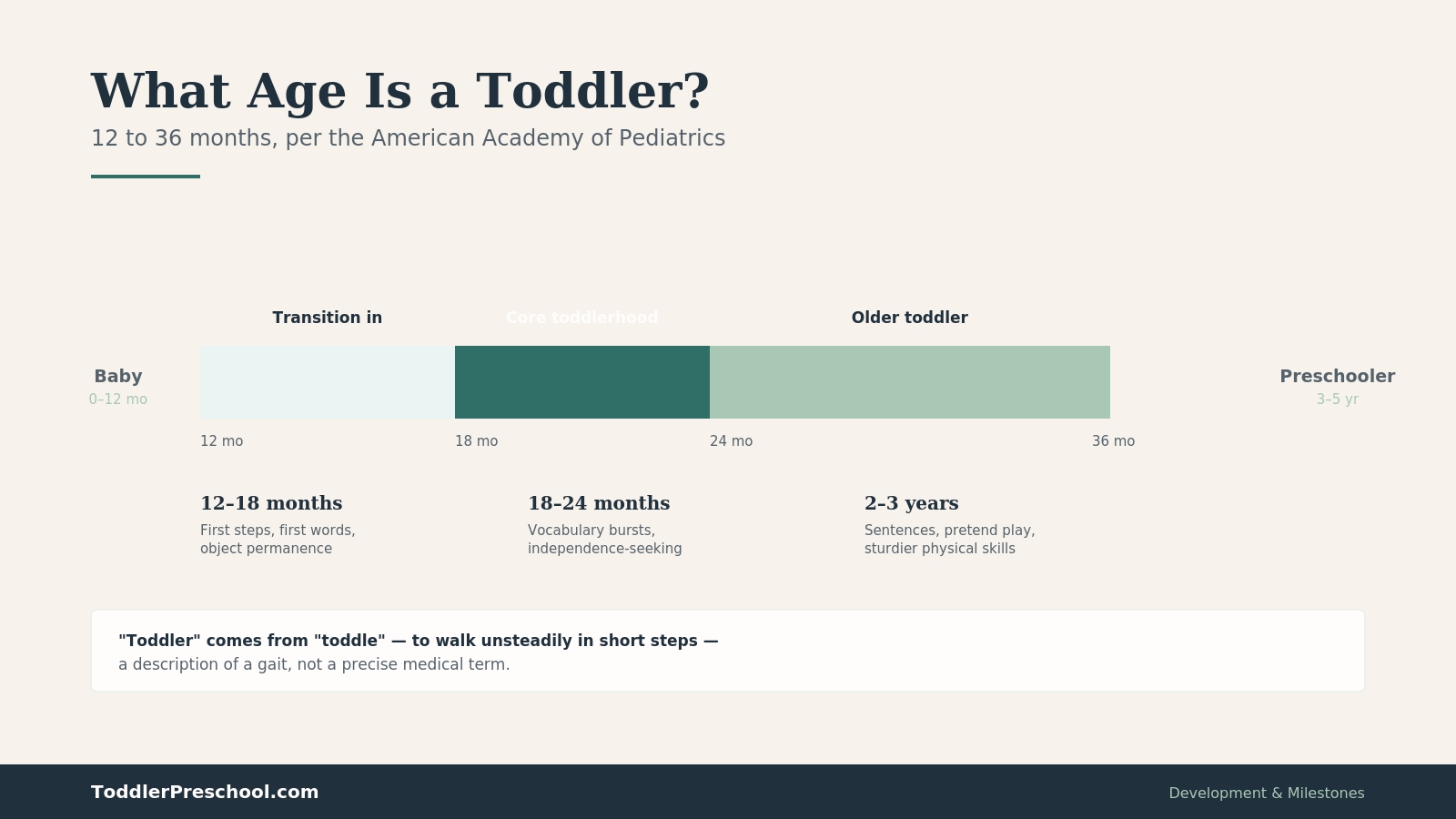
What age is a toddler, in one line: the AAP defines toddlerhood as 12 to 36 months, or roughly ages 1 to 3. Before that, a child is typically called an infant or baby; after their third birthday, most U.S. pediatric and early-childhood resources — including the CDC and AAP — shift the label to “preschooler.”
A few honest caveats are worth stating up front, because the internet tends to flatten this into something more rigid than it really is:
- The starting edge is softer than the ending edge. Some sources, including early-childhood organizations like Zero to Three, describe toddlerhood beginning closer to 18 months rather than a strict 12-month cutoff, largely because the label is tied to walking, and children start walking anywhere from about 9 to 18 months and still fall within typical development.
- The word itself comes from walking, not birthdays. “Toddler” comes from the verb “toddle” — to walk unsteadily in short steps — and has been used this way since the early 1800s. It was never meant as a precise medical term; it’s a description of a gait, applied loosely to an age range.
- The end date is administrative, not biological. Nothing developmentally distinct happens on a third birthday. The shift from “toddler” to “preschooler” mostly reflects how U.S. child care licensing, curriculum standards, and pediatric resources are organized by age band — it’s a useful shorthand, not a switch that flips.
- These labels are for adults, not children. Your child doesn’t know or care whether they’re classified as a toddler or a preschooler this month. The category is a communication tool for parents, doctors, and teachers — useful for finding age-appropriate guidance, not a judgment about where your child “should” be.
Quick Reference: The Toddler Age Range at a Glance
| Question | Answer |
|---|---|
| What age is a toddler, officially? | 12 to 36 months (1 to 3 years), per the American Academy of Pediatrics |
| When does the label typically start? | Often tied to walking onset, commonly cited as 12–18 months; some resources use 18 months as a softer starting point |
| When does it typically end? | Around the third birthday, when U.S. resources generally shift to “preschooler” |
| What comes before “toddler”? | “Infant” or “baby,” roughly birth to 12 months |
| What comes after “toddler”? | “Preschooler,” roughly 3 to 5 years |
| Where does the word come from? | The verb “toddle” — to walk unsteadily in short steps — in use since the early 1800s |
| Is it a medical or diagnostic term? | No — it’s a general age-range label, not a clinical category |
Why This Age Range? What Actually Changes Between 1 and 3
The 12-to-36-month window earns its own category because an enormous amount changes during it — more, proportionally, than almost any other two-year stretch of childhood. Here’s what that actually looks like in a real house on a real Tuesday, broken into rough phases. These phases blend into each other; there’s no hard line where one ends and the next begins.
Toddler Age 12 to 18 Months: The Transition Begins
This is the stretch where “baby” starts to feel like the wrong word, even if it isn’t official yet. Many children take their first independent steps somewhere in this window (though anywhere from about 9 to 17 months is within typical range), and mobility changes everything else almost immediately — reaching the cabinet that used to be out of range, following you room to room, climbing onto furniture. Communication is shifting too: first words tend to cluster here, often alongside gestures like pointing, waving, or bringing you an object to request something.
Everyday example: a 14-month-old who was content to sit and be handed toys a few months ago now pulls up on the couch, cruises along it, and gets genuinely upset when you leave the room — not because anything is wrong, but because object permanence and attachment are both maturing at once, and “you left” now registers as a real event worth protesting.
A few other things families commonly notice in this window: a child copying a simple chore like sweeping or wiping a table, feeding themselves with fingers and starting to attempt a spoon (with far more mess than success at first), and a growing habit of pointing to show you something interesting rather than just to request it — a small but meaningful shift from “give me that” to “look at that with me.”
Toddler Age 18 to 24 Months: The Core Stage
This is often the stretch people picture when they hear “toddler” — mobile, opinionated, and communicating in a mix of words, gestures, and volume. Vocabulary frequently expands quickly during this window for many children, sometimes in a fairly sudden-feeling burst, and two-word combinations (“more milk,” “up please”) commonly appear. Independence-seeking often intensifies here too — wanting to do things “self,” resisting help that was welcome a month earlier, and testing limits more directly.
Everyday example: a 20-month-old who insists on holding the spoon herself, gets frustrated when the food doesn’t cooperate, and has a meltdown when you try to help — not defiance for its own sake, but a genuine collision between wanting independence and not yet having the fine motor skill to fully pull it off.
This is also a common window for temper tantrums to become more frequent and more physical, for a wariness around strangers or unfamiliar situations to resurface even in a child who was previously easygoing, and for simple pretend play to appear — feeding a stuffed animal, “talking” on a toy phone. All three are typical, not a sign that something has changed for the worse.
Toddler Age 2 to 3 Years: Older Toddlerhood
Language usually becomes more complex here — simple sentences, more back-and-forth conversation, and the beginning of using words to name feelings instead of only showing them physically. Pretend play tends to become more elaborate (feeding a stuffed animal, “cooking” at a play kitchen), and gross motor skills like kicking a ball, running with more control, and climbing stairs typically become sturdier. Many families also work on toilet learning somewhere in this window, though the right timing for that varies enormously and isn’t a toddler-status requirement.
Everyday example: a 32-month-old who narrates his own pretend play out loud (“the truck is going fast, now it’s stopping”), negotiates (“one more show, please?”), and can wait — briefly, imperfectly — for a turn on the swing. None of that was available to the same child at 20 months, even though only a year has passed.
Other common shifts in this window: holding something in one hand while manipulating an object with the other (like unscrewing a lid while steadying the jar), playing with more than one toy in a combined way rather than one at a time (putting toy food on a toy plate, rather than handling each separately), and a noticeable jump in physical confidence — climbing structures that felt intimidating six months earlier, or attempting stairs one foot per step instead of two feet per step.
Toddler Age 3: The Shift Toward “Preschooler”
By the third birthday, many children are combining sentences, engaging in more cooperative (rather than purely side-by-side) play, and managing more of their own self-help tasks — eating with utensils, taking off simple clothing, following two-step instructions. This is roughly where U.S. resources start using “preschooler” instead of “toddler,” and where many children move from a toddler classroom into a preschool one if they’re in center-based care. Nothing about your child changes overnight at this point — it’s simply where the label shifts.
Concretely, this is often when a child starts asking real “who,” “what,” “where,” and “why” questions rather than just naming things; when separations at drop-off tend to become noticeably shorter and easier to settle after, even if they’re not gone entirely; and when a child begins joining other children’s play rather than simply playing alongside them without much interaction.
Toddler Age Skills by Domain: A Quick-Reference Table
Development doesn’t move through one skill at a time — a toddler is usually working on movement, language, thinking, and social-emotional skills all at once, at different paces. The table below pulls together commonly cited examples from CDC milestone checklists at three checkpoints inside the toddler range. These are illustrative examples, not a complete or required checklist, and a child can be solidly on track while showing a different mix of these than another child the same age.
| Domain | By 18 Months | By 2 Years (24 Months) | By 3 Years (36 Months) |
|---|---|---|---|
| Social/Emotional | Points to show you something interesting; may cling to caregivers in new situations; plays simple pretend, like feeding a doll | Notices when others are hurt or upset; looks at your face to see how to react in a new situation | Calms down within about 10 minutes after a caregiver leaves, like at a child care drop-off; notices other children and joins their play |
| Language/Communication | Tries to say three or more words besides “mama” or “dada”; follows a one-step direction without gestures | Says at least two words together, like “more milk”; points to at least two named body parts | Talks in back-and-forth conversation with at least two exchanges; asks “who,” “what,” “where,” or “why” questions; says their first name when asked |
| Cognitive | Copies simple chores, like sweeping; plays with toys in a simple way, like pushing a car | Holds something in one hand while using the other; plays with more than one toy at once, like putting toy food on a toy plate | Draws a circle when shown how; avoids touching something hot after being warned |
| Movement/Physical | Walks without holding on to anyone or anything; scribbles; drinks from an open cup; feeds self with fingers and starts trying a spoon | Kicks a ball; walks up a few stairs with or without help; eats with a spoon | Strings large items together, like beads or macaroni; puts on some clothes independently, like loose pants; uses a fork |
A reminder worth repeating here: these are drawn from CDC checklists as general reference points, not a pass/fail exam. A child who’s ahead in language and taking their time with fine motor skills, or the reverse, is describing normal unevenness — not a problem. If you want the complete, official checklist for your child’s specific age, CDC’s free Milestone Tracker app and printable checklists (available at cdc.gov/Milestones) are the most current and complete source, more thorough than any single table can be.

Common Toddler Behaviors That Are Often Mistaken for Problems
Part of what makes “what age is a toddler” worth asking isn’t just curiosity about the label — it’s often an attempt to figure out whether a specific behavior is “just toddler stuff” or something to actually worry about. A few of the most commonly misread behaviors, explained plainly:
Tantrums
Frequent tantrums, especially in the 18-month to 3-year range, are one of the most universal toddler experiences there is, not a sign of a behavior problem or poor parenting. They tend to reflect a very real gap between big feelings and the verbal and emotional regulation skills to manage them — a gap that narrows gradually over the preschool years, not something that resolves through a single technique. Frequency and intensity vary enormously between individual toddlers and don’t track neatly with anything else about how a child is doing overall.
The “No” Phase
A sudden, near-constant “no” — to questions, to offers, even to things the child clearly wants — is a well-documented toddler pattern, often tied to the same push toward independence and control that shows up elsewhere around this age. It typically isn’t personal defiance so much as a toddler testing what happens when they assert themselves, repeatedly, because it’s a new and genuinely interesting thing to be able to do.
Playing Near Other Kids Without Playing “With” Them
Toddlers, especially younger ones, commonly engage in what’s sometimes called parallel play — occupying the same space as another child, each doing their own thing, with minimal direct interaction. This is a typical, expected stage rather than a social skills gap; more interactive, cooperative play tends to develop gradually over the second and third years and beyond, and pushing a toddler to “share” or “play together” before they’re developmentally ready for it usually doesn’t speed up the timeline.
Picky or Inconsistent Eating
A toddler who loved a food last week and refuses it this week, or who eats enthusiastically one meal and barely touches food the next, is showing an extremely common pattern tied to slowing growth rate, increasing food awareness, and general toddler unpredictability — not necessarily a feeding problem. (If eating concerns are more significant — very limited food range, weight loss, gagging, or distress around meals — that’s worth a conversation with your pediatrician, separate from ordinary day-to-day pickiness.)
Sleep Disruptions That Appear Out of Nowhere
A toddler who was sleeping well and suddenly starts resisting bedtime, waking at night, or dropping their nap earlier or later than expected is going through a common pattern, often tied to a developmental leap (new mobility, new language, new independence-seeking) disrupting sleep temporarily rather than a lasting problem. Most toddler sleep disruptions ease within a few weeks with a consistent routine.
Renewed Clinginess or Separation Distress
A toddler who was previously easygoing about separations and suddenly isn’t — crying at drop-off, wanting to be held more, following you room to room — is often showing a normal resurgence tied to a developmental stage (increased awareness of your comings and goings) rather than a step backward. This can appear and fade more than once across the toddler years, not just once.
Repeating Words or Phrases
Toddlers commonly repeat words, phrases, or even whole sentences they’ve heard — from you, from a show, from a sibling — as part of typical language learning. This is a normal part of how young children acquire and practice language, not something to be concerned about on its own at this age.
Insisting on Routines and Sameness
A toddler who wants the same book read the exact same way every night, melts down over a different-colored cup, or insists on a specific order for getting dressed is showing a very common pull toward predictability at an age when so much else feels new and uncontrollable. Sameness and routine genuinely help many toddlers feel secure, and this kind of rigidity typically softens with age rather than needing active correction. It becomes worth a closer look mainly if it’s extreme, paired with significant distress across many parts of daily life, or accompanied by other developmental concerns — not simply because a toddler has strong preferences about cups.
Hitting, Biting, or Other Physical Frustration
Toddlers who hit, bite, push, or throw things when frustrated are demonstrating a genuinely common, if difficult, pattern tied to the same gap mentioned above: big feelings arriving well before the verbal and emotional-regulation tools to handle them appropriately. This is not a reflection of your parenting or a preview of your child’s future character, even though it can feel alarming and embarrassing in the moment, especially in front of other people. A calm, consistent response — naming the feeling, setting a clear limit, redirecting — tends to help more over time than punishment, and this pattern is common enough at this age that most child care providers and pediatricians see it regularly without alarm. Frequent, severe, or escalating physical aggression that isn’t responding at all to a consistent approach over time is worth mentioning to your pediatrician, less as an emergency and more as a useful thing to have on record and get support with.
None of this means every behavior is automatically fine to dismiss — the point isn’t “don’t ever worry,” it’s that these specific patterns, on their own, are common enough at this age that they don’t need to be the reason for concern. If any of them are severe, don’t ease with time, or come with other signs (like a lost skill, described below), that’s a different situation and worth raising with your pediatrician.

Developmental Monitoring vs. Developmental Screening: What’s the Difference
If you’re asking what age is a toddler because you’re also wondering whether your child is “on track,” it helps to understand two terms the CDC uses deliberately differently: developmental monitoring and developmental screening. They’re related, but they’re not the same thing, and knowing the difference changes what you should actually expect from a well-child visit.
What Developmental Monitoring Looks Like Day to Day
Developmental monitoring is the ongoing, informal process of watching how your child plays, learns, speaks, and moves over time, compared to general milestones for their age. According to the CDC, parents, grandparents, and other caregivers can all take part in developmental monitoring — no formal training or tool is required, just a general milestone checklist and your own observation. This happens continuously, not just at doctor visits: noticing that your child started stacking blocks, or that they’ve picked up a new word, or that they’re not yet doing something most children their age are doing.
Monitoring is also part of every well-child visit. Your pediatrician typically asks questions about your child’s development and observes them directly during the appointment, comparing what they see to expected milestones for that age.
What Developmental Screening Actually Involves
Developmental screening is a more formal step. It uses a specific, research-based questionnaire or tool — the Ages and Stages Questionnaire (ASQ) is a commonly used example — administered by a trained professional, usually your child’s doctor. Screening is designed to take a closer, more structured look than monitoring alone provides, and it’s more likely to catch something monitoring alone might miss.
The American Academy of Pediatrics recommends that all children receive developmental screening at specific well-child visits — commonly around 9, 18, and 24 or 30 months — regardless of whether a concern has already come up, plus autism-specific screening typically folded into the 18- and 24-month visits. Children with known risk factors (premature birth, low birth weight, or other risk indicators a pediatrician identifies) may be screened more often.
In practice, a screening usually looks less intimidating than the word suggests: it’s often a short questionnaire (the Ages and Stages Questionnaire, or ASQ, is one widely used example) that a parent fills out about specific everyday skills, sometimes paired with the pediatrician directly observing or gently prompting the child during the visit — stacking a couple of blocks, pointing to a picture, naming an object. It typically takes a matter of minutes, not a separate specialist appointment, and a screening result isn’t a diagnosis either way — it’s a structured way of deciding whether a closer, more comprehensive evaluation is worth pursuing next.
Why Your Child Needs Both, Not Just One
Monitoring and screening aren’t competing options — the CDC frames them as two layers that work together. Monitoring is what happens continuously and catches the everyday picture; screening is a scheduled, more sensitive check that can flag something monitoring alone wouldn’t have caught yet. If monitoring raises a question, screening is often the next concrete step your pediatrician will suggest — not a punishment or an escalation, just a closer look with a better tool.
If your child’s next well-visit doesn’t happen to fall on one of the standard screening ages and you have a concern in the meantime, you don’t have to wait — you can ask for a developmental screening at any visit, or call to ask specifically for one.

How to Track This Without It Becoming a Source of Stress
Knowing what age a toddler is, and what generally changes across that range, is useful information right up until it starts creating more worry than it resolves. A few ways to keep milestone-awareness useful rather than anxiety-inducing:
Use one primary source, not five. CDC’s free Milestone Tracker app or printable checklists are a reasonable single reference point. Checking your child against a parenting influencer’s post, a different country’s milestone list, and a well-meaning relative’s memory of their own kids all in the same week is a recipe for manufactured worry — different sources use different age bands and different thresholds, and comparing across them isn’t actually more informative, just more stressful.
Check in periodically, not constantly. Milestone checklists are designed to be used around specific ages — roughly aligned with well-child visit timing — not as a running daily scoreboard. If you find yourself checking a list multiple times a week “just in case,” that’s a sign to step back, not a sign you’re being appropriately thorough.
Separate “interesting to notice” from “urgent to fix.” Most of what a milestone checklist tells you is simply interesting context about where your child is right now — not a problem requiring an immediate response. Reserve the sense of urgency specifically for the situations described in the next section (a lost skill, a persistent gap, a real concern), rather than applying that level of concern to ordinary variation.
Let your child’s actual demeanor be part of the picture, not just the checklist. A toddler who is curious, connects with you, communicates their needs somehow (even nonverbally), and seems generally content is giving you real information that a checklist alone can’t capture. That doesn’t replace screening when something specific is genuinely on your mind, but it’s a legitimate part of how you (and your pediatrician) should weigh what you’re seeing.
Remember that milestone tracking is a tool for a conversation, not a verdict. The entire point of a checklist, per CDC’s own framing, is to give you and your child’s doctor a shared, concrete starting point for a conversation — not to hand down a pass-or-fail judgment on your own. Bringing an incomplete or “not sure” checklist to a well visit is still useful; it doesn’t need to be perfectly filled out to be worth bringing.

Where the Toddler Age Label Actually Matters in Practice
Beyond the developmental conversation, what age is a toddler also shows up in some very concrete, practical places — and it’s worth knowing where the label carries real weight and where it’s just a loose convenience.
Child Care and Classroom Placement
Most licensed child care centers group children by age band for staffing-ratio and licensing reasons as much as for curriculum reasons — commonly something like an infant room (roughly birth to 12–18 months), a young toddler room (around 12/18–24 months), an older toddler room (2–3 years), and a preschool room (3 and up). Exact cutoffs vary by state licensing rules and by individual program — sometimes by several months in either direction — so “which room will my child be in” is always worth asking the specific program directly rather than assuming from a general age rule.
Product Sizing and Toddler Age Labels
Clothing, car seats, and toys are often labeled by age band (“12–24 months,” “2T–3T,” “ages 3+”) as a rough sizing and safety guide, not a precise developmental match. A toy labeled for a specific minimum age often reflects choking-hazard and small-parts testing standards more than a claim about what your individual child can or should do with it — a toy labeled “3+” isn’t necessarily too advanced for a capable 2-year-old in terms of skill, but the age labeling exists specifically for physical safety reasons and is worth respecting for that reason regardless of your child’s apparent ability level.
Program Eligibility and Everyday Discounts
A handful of common U.S. programs and benefits use specific age cutoffs worth knowing about:
- Airlines typically require a purchased seat once a child turns 2; before that, many airlines allow a discounted or free “lap infant” fare — worth checking directly with your specific airline before booking, since policies vary.
- WIC (Women, Infants, and Children) provides nutrition benefits for children up to their 5th birthday, with food package contents that shift somewhat around the toddler-to-preschooler transition.
- Library story times and museum programs frequently split sessions by age band (often something like “babies,” “walkers” or “toddlers,” and “preschool”). Cutoffs vary widely by branch or institution, so it’s worth checking directly with your local location rather than assuming a national standard.
- Early Intervention (Part C), as covered above, is specifically bounded by the third birthday, after which services shift to the local school district’s Part B system.
None of these practical cutoffs reflect a judgment about your child’s abilities — they’re administrative lines, drawn for consistency across large systems, not individualized assessments of your particular toddler.
How Toddler Age Compares to Infancy and the Preschool Years
Understanding what age is a toddler in relation to the stages around it — infancy and the preschool years — is easier by contrast than in isolation.
| Infant (0–12 Months) | Toddler (1–3 Years) | Preschooler (3–5 Years) | |
|---|---|---|---|
| Primary mobility | Rolling, crawling, pulling to stand | Walking, running, climbing | Running, jumping, pedaling a tricycle |
| Communication | Crying, cooing, babbling, first words near the end | Word combinations, rapid vocabulary growth, simple sentences | Full conversations, storytelling, complex questions |
| Play style | Solitary, sensory-focused (mouthing, reaching, dropping objects) | Simple pretend play; parallel play alongside peers | Cooperative and imaginative pretend play with peers |
| A developmental lens some child-development thinkers use | Trust vs. mistrust — learning the world is safe and needs will be met | Autonomy vs. shame and doubt — testing independence and control | Initiative vs. guilt — taking on tasks and plans of their own |
| Typical daily rhythm | Frequent naps, flexible feeding schedule | Often one nap, a more structured daily routine | One nap or quiet time, closer to a school-day rhythm |
This table is a broad generalization, not a rulebook — a real child showing a mix of traits from adjacent columns is completely normal, especially right around the edges of each range: an almost-1-year-old still crawling everywhere, or an almost-3-year-old still working on two-word phrases.
The framework in that middle row comes from psychologist Erik Erikson’s widely referenced theory of psychosocial development, which is one way child-development thinkers have described what toddlerhood is “for.” Erikson placed roughly ages 1 to 3 at the center of a tension between autonomy and shame or doubt — a child discovering they can act on the world independently, and working out, through a great deal of trial, error, and “no,” what that independence is allowed to look like. It’s one lens among several used in the field, not a single settled truth, but it offers a useful frame for why so much of toddler behavior — the insistence on doing things “self,” the meltdowns when independence collides with a limit — tends to cluster together the way it does during exactly this age range.

What Counts as Normal Variation at Toddler Age
Part of the reason what age is a toddler resists a stricter answer is that the 12-to-36-month range covers an enormous amount of individual difference, and most of that difference is exactly that — difference, not a problem to solve. A few sources of normal variation worth naming directly, since generic “every child is different” reassurance doesn’t actually help you interpret what you’re seeing:
Multilingual households. Children learning more than one language from birth or early toddlerhood often have a smaller vocabulary in each individual language than a monolingual peer, while their total vocabulary across all languages is comparable or larger. This is a well-documented, typical pattern — not a sign of delay — and pediatricians experienced with multilingual families generally look at combined vocabulary across languages, not just English.
Birth order and family context. Younger siblings sometimes talk later because an older sibling anticipates their needs and speaks for them; only children sometimes talk earlier because they get more one-on-one adult conversation. Neither pattern is a red flag on its own.
Prematurity. For a child born significantly premature, pediatricians typically use “corrected age” — age adjusted for how early the child was born — for at least the first two years when thinking about milestones, rather than age counted strictly from the birth date.
Temperament. A cautious, watchful toddler who takes longer to try new physical skills isn’t behind — temperament genuinely shapes how eagerly a child attempts things like climbing or running, independent of ability.
Disability and developmental differences. For a toddler with a diagnosed disability or known developmental difference, “typical” milestone ranges may not be the most useful frame at all — an individualized plan developed with your child’s specialists is a better guide than a general-population checklist, without that meaning the checklist is worthless as a starting conversation point.
Cultural and family variation in what’s practiced. Some skills toddlers eventually show (like using a spoon, or specific self-dressing steps) depend partly on how much a family has actively practiced them, not purely on developmental readiness — a toddler who hasn’t been given many chances to self-feed with utensils yet may simply need more practice opportunities, not more time.
Comparing siblings. Two children in the same family, raised in broadly the same environment, can hit walking, talking, or any other milestone months apart from each other, and both be entirely typical — an older or younger sibling’s timeline isn’t a reliable predictor for another child, even a twin. Birth order, individual temperament, and simple chance all play a role, and “your other kid did this sooner” isn’t useful information for your pediatrician to work with.
Comparing to daycare or playgroup peers. It’s natural to notice that another child in your toddler’s class is already doing something yours isn’t yet, but a classroom or playgroup is a small, informal sample, not a clinical reference group — the range of typical development among children born even a few months apart is wide enough that direct comparisons in a peer group rarely tell you anything a pediatrician’s milestone framework doesn’t already account for.
Twins and multiples. It’s common for one twin to reach a specific milestone before the other, sometimes by a meaningful stretch, without either timeline being cause for concern on its own — providers experienced with multiples generally evaluate each child against general population milestones individually, not against their co-twin.

What to Do If a Skill Is Missing, Lost, or You’re Still Concerned
This is the part that actually matters most if you came here worried, not just curious. Here’s how to think about three different situations, because they call for different responses.
If Your Child Hasn’t Reached a Milestone Yet
A single missed milestone, especially a recent one on a checklist, is common and often resolves on its own with time. The reasonable response is to keep monitoring, mention it at (or before) the next well visit, and ask directly: “is this worth a screening now, or is it reasonable to keep watching?” Your pediatrician can help you tell the difference between “hasn’t gotten there yet” and “worth a closer look.”
It can help to notice a pattern rather than reacting to any single checklist item in isolation: a child who’s missing one item on an 18-month checklist but steadily gaining new skills week to week is telling a different story than a child who’s missing several items across more than one domain, or whose overall pace of new skills has visibly slowed. Both situations are worth mentioning to your pediatrician — but the second is worth mentioning sooner rather than at a routinely scheduled visit.
If Your Child Has Lost a Skill They Used to Have
This is the one situation where “wait and see” is not the recommended default, regardless of your child’s age or how minor the lost skill seems. Losing a previously acquired skill — words they used to say, a physical skill they used to do, social behaviors that used to be present — is something the CDC and pediatric guidance consistently treat as worth raising with a doctor promptly, rather than assuming it will resolve on its own. This doesn’t mean panic; it means a phone call and a conversation, sooner rather than at the next scheduled visit.
A practical note: it’s easy to second-guess yourself here (“maybe I’m misremembering,” “maybe it was never really solid”). If you have any specific memory of the skill being present — a video, a story you told a relative, a note in a baby book — that’s worth mentioning even if you’re not fully certain. Pediatricians would rather field a “maybe this is nothing” call about a possible lost skill than have a family wait to be sure.
If You’re Not Sure Whether It’s “Really” a Concern
You don’t need to be certain before you say something. Bringing up a vague sense that something feels off is a completely legitimate reason to ask for a developmental screening — you don’t need to already have a specific diagnosis in mind, and you don’t need your pediatrician to have raised it first. Parents are often the first to notice a pattern precisely because they see their child across many more hours and settings than a 15-minute appointment allows.
How to Actually Start the Conversation
A short, direct script tends to work better than trying to explain everything at once: “I’ve been noticing [specific thing], and I’d like to ask about a developmental screening.” Bringing a written list — even three bullet points on your phone — helps you say what you meant to say even if the visit feels rushed. If you’ve completed a milestone checklist (like the CDC’s free one), bringing it along gives the conversation a concrete starting point instead of a vague impression.
A few questions that tend to move the conversation forward, if you’re not sure what to ask:
- “Is this something to keep watching, or would a screening make sense now?”
- “What would you expect to see change in the next month or two if this is just timing?”
- “If we do a screening and there’s a delay, what happens next, and how fast?”
- “Is there anything about our specific situation — prematurity, a family history, multiple languages at home — that changes how you’d think about this?”
There’s also no rule against asking for a second developmental opinion, requesting an Early Intervention evaluation directly yourself (most states allow parents to self-refer, without needing a doctor’s referral first), or asking your pediatrician to explain their reasoning if their answer doesn’t sit right with you. You know your child’s day-to-day patterns better than a 15-minute visit can capture, and a good pediatrician treats that as useful information, not an inconvenience.
Early Intervention: What It Is and Who It’s For
If a screening or evaluation identifies a delay, Early Intervention — authorized under Part C of the Individuals with Disabilities Education Act (IDEA) — is the system designed to help, available in every U.S. state for children from birth through their third birthday. A few practical facts worth knowing:
- The evaluation itself is free, regardless of income or insurance status, by federal requirement. You do not need a doctor’s referral in most states to request one yourself, though many families start with their pediatrician.
- Eligibility is based on a developmental delay or a diagnosed condition associated with a high likelihood of delay, determined by the evaluation — not by your own certainty going in.
- If eligible, your family works with a team to build an Individualized Family Service Plan (IFSP), and services (speech therapy, physical therapy, and others depending on need) are often provided in your child’s everyday environment — home, child care, or another familiar setting — not only in a clinic.
- At age 3, a child transitions out of Part C; if ongoing support is still needed, services typically continue through the local school district’s special education system under Part B of IDEA, which covers ages 3 through 21.
- You can find your local Early Intervention program through the CDC’s resource list or by asking your pediatrician directly.
- The process from first call to an actual evaluation appointment typically takes a few weeks in most areas, though this varies by state and by how backed up the local program is — asking about expected timing when you first reach out is reasonable and helps you plan.

Adapting This to Every Family’s Situation
None of the guidance above assumes a specific kind of household, and it shouldn’t. A few things worth naming directly:
Multilingual families. Milestone checklists in the U.S. are generally written with English development in mind, but developmental screening tools and Early Intervention services are required to be available in a family’s native language, and providers experienced with multilingual development know to assess combined vocabulary rather than a single language in isolation. If your pediatrician’s office doesn’t have this experience readily available, it’s reasonable to ask directly whether the provider administering a screening has worked with multilingual children before, or to request an interpreter or a bilingual evaluator through your state’s Early Intervention program.
Different family structures. Whoever spends the most everyday time with your toddler — a parent, grandparent, foster parent, or another primary caregiver — is the right person to lead developmental monitoring day to day, and is welcome to be the one who raises a concern with a pediatrician or requests a screening, regardless of legal or biological relationship, in most circumstances (a support person may want to confirm consent requirements with their specific provider or agency). In co-parenting or shared-custody situations, it can help to keep a shared, simple written note of what each household has noticed, since a child sometimes shows different behaviors in different environments, and both pictures are useful information for a pediatrician.
Budget and insurance access. Early Intervention evaluations are free nationwide by federal law, regardless of insurance status. Developmental screenings at a well-child visit are typically covered by both private insurance and Medicaid as a standard part of pediatric preventive care under U.S. law. Cost should not be the reason a concern goes unspoken — ask your pediatrician’s office or local Early Intervention program directly about your specific situation if you’re unsure, and if you don’t currently have a regular pediatrician, community health centers and local health departments can often help connect you to no-cost or low-cost developmental screening resources.
Time and schedule constraints. If getting to well-child visits on the recommended schedule is hard because of work, transportation, or competing caregiving demands, mention that directly to your pediatric office — many have options like extended hours, phone or video check-ins for some concerns, or help connecting you to a local Early Intervention program that can evaluate your child somewhere more accessible than a clinic, including your home or child care setting.
Adoption and foster care. For a child whose early history is partially or fully unknown, or whose documented birth date may not reflect true developmental starting points, “corrected” or flexible thinking about milestones — in partnership with your child’s pediatrician — is often more useful than treating the calendar age as the whole story. It’s also worth knowing that early adversity or multiple placements can affect development in ways that are genuinely different from typical variation, and a pediatrician or Early Intervention evaluator experienced with foster and adoptive families can help interpret what you’re seeing with that context in mind, rather than applying a generic checklist without it.
Disability in the family beyond the child. If you, as a parent or caregiver, have a disability that affects how you observe or interact with your toddler’s development — for example, differences in hearing, vision, or mobility — most pediatric offices can adapt how they communicate milestone information with you (written summaries, alternative formats, longer appointment slots) if you ask directly; this is a reasonable accommodation request, not an imposition.

When Family Members Disagree About Toddler Age Labels
It’s common for grandparents, other relatives, or even co-parents to use age labels differently than current pediatric guidance — calling a walking, talking 2-year-old “still a baby,” or expecting toddler-level independence and impulse control from a 14-month-old who genuinely isn’t there yet. This is rarely about anything more than different generations and family cultures using looser, more informal versions of these words, and it’s usually not worth much energy on its own.
Where it’s worth a gentle conversation is when the label is driving an actual mismatch in expectations — a grandparent expecting a 15-month-old to reliably “listen” and stop touching something on request, for example, when that level of impulse control is developmentally unlikely at that age regardless of how the child is labeled. In that situation, it tends to help to reframe the conversation around the specific behavior rather than the vocabulary: “he’s not being defiant — he genuinely can’t stop and think before touching yet at this age” tends to land better than a debate about whether he “counts” as a toddler.
If a caregiver’s expectations are consistently mismatched with your child’s actual developmental stage in a way that’s affecting how they interact with your child day to day — frustration, punishment for something outside the child’s current ability, or persistent comparison to an older sibling or cousin — that’s worth a direct, kind conversation. Not because the label itself matters, but because the underlying expectation does, and your child benefits from the adults around them having a roughly shared, realistic picture of what to expect.
This kind of disagreement also comes up across cultures and countries: some cultures use different informal age categories entirely, or place more or less emphasis on early independence versus prolonged closeness with caregivers. None of that makes one family’s approach wrong — the toddler label used throughout this guide reflects common U.S. pediatric convention specifically, not a universal or culturally neutral standard.
Frequently Asked Questions
Is a 1-year-old a baby or a toddler? Both labels get used, and that’s fine — a just-turned-1-year-old is often still called a baby colloquially, especially before they’re walking, while the AAP’s technical toddler range does begin at 12 months. There’s no meaningful consequence to which word you use; use whichever feels natural.
Is a 3-year-old still a toddler, or already a preschooler? Right around the third birthday is genuinely a gray zone, and different resources (and different preschool programs) draw the line slightly differently. Most U.S. pediatric and early-childhood guidance shifts to “preschooler” at 3, but you’ll still see “toddler” used informally for children a few months past their third birthday, and that’s not incorrect — it’s just less precise.
My child was born premature — does their “toddler age” start on their due date or their birth date? For most developmental purposes, pediatricians recommend using corrected age (based on the original due date) for at least the first two years for a child born significantly preterm. Ask your child’s pediatrician how they recommend calculating it for your specific situation, since the exact approach can vary by how early the birth was.
Does it matter which exact box — infant, toddler, preschooler — a form asks me to check? Usually not in any way that affects your child directly. These categories mostly exist for administrative purposes — child care classroom placement, curriculum standards, or article and product targeting (including, frankly, this one). If you’re ever unsure which box fits, picking the closest one rarely has real consequences; ask the specific organization if it seems to matter for your situation.
What if my child seems advanced for their age in some areas and behind in others? This is extremely common and isn’t necessarily a sign of anything beyond normal individual variation — development doesn’t move at one uniform pace across every skill area at once. That said, an uneven pattern is exactly the kind of thing worth mentioning at a well-visit, simply so it’s on record and can be watched over time; mentioning it isn’t the same as there being a problem.
Do online “is my toddler on track” quizzes or milestone apps I find outside the CDC replace a real screening? No — they can be a reasonable way to organize your own observations before a visit, but they aren’t validated screening tools, and a result from an unofficial quiz isn’t equivalent to what a trained provider does with a tool like the ASQ. If a non-CDC app or quiz raises a concern, treat it as a prompt to talk to your pediatrician, not as an answer in itself.
Is “toddler” ever used as a clinical or diagnostic term? No — outside of general age-range labeling, “toddler” isn’t a diagnosis or a clinical category. You may see it used descriptively in a medical chart or an Early Intervention report simply to mean “a child in this general age range,” but no test or evaluation determines whether a child specifically “is” or “isn’t” a toddler — that part is just about age.
My child just turned 1 but isn’t walking yet — are they still a “baby,” or already a toddler? Either label is fine to use, and there’s no meaningful consequence either way. Walking age varies widely within typical development (commonly cited as anywhere from about 9 to 17 months), so a not-yet-walking 1-year-old is not behind simply for being on the later end of that range. If walking hasn’t started by around 18 months, that’s a reasonable point to mention to your pediatrician — not because the label matters, but because it’s a milestone worth checking in on at that stage regardless of what you call your child in the meantime.
Your One Next Step
If you came here with a specific worry rather than general curiosity, do one thing today: write down — in a note on your phone is fine — the one or two specific things you’ve noticed, so you have something concrete to say at your child’s next visit instead of a vague feeling. If you came here mostly out of curiosity about what age is a toddler, that’s a completely reasonable reason to read this far too — you now have an actual answer, and one less thing to wonder about on a Tuesday.
Sources consulted: Centers for Disease Control and Prevention — Learn the Signs. Act Early. and Developmental Monitoring and Screening; American Academy of Pediatrics toddler age-range guidance as cited by multiple secondary parenting and medical sources; Individuals with Disabilities Education Act (IDEA) Part C Early Intervention program guidance, as summarized across multiple state and federal program resources.